Color Tree complete: what Ep9 reveals about Blue and Yellow
AI TRANSLATION NOTE
This is the English edition of a deep-dive originally written in German. The translation was AI-assisted and human-reviewed for terminology, lore accuracy, and Rogue-persona tone. All direct quotes from the Cyberdeck Podcast Episode 9 come verbatim from the original English broadcast, not back-translated from German. The original German article is available at cyberpunk-tcg-news.de .
What this episode actually delivers
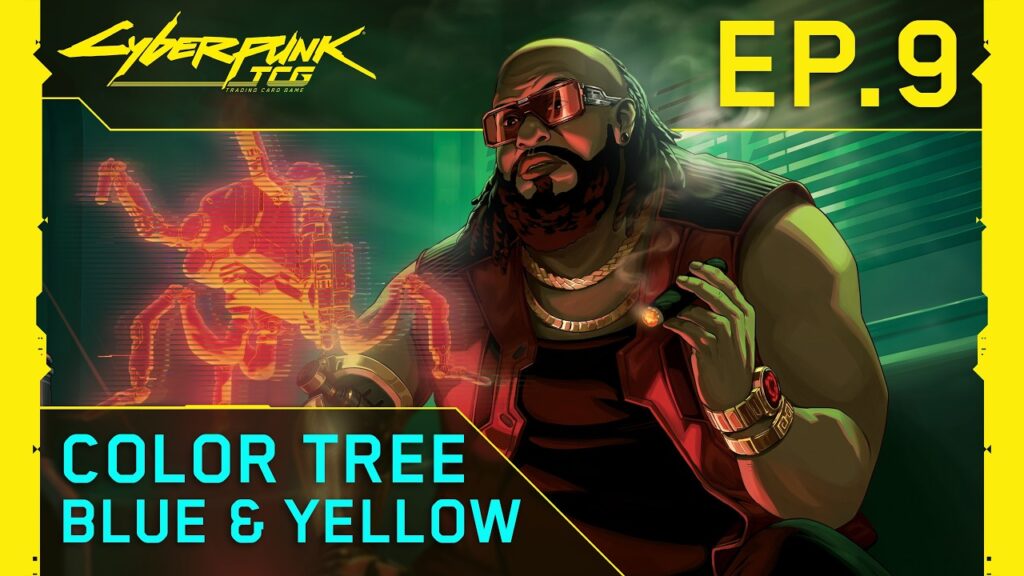
Episode 9 of the Cyberdeck Podcast went live on May 22, 2026, and it closes something that until then was only half a thing. David McDarby (Lead Game Designer at WeirdCo, back for round two after Ep8) sits with Kerry and Burza for 54 minutes and makes it clear what Blue and Yellow actually are, mechanically. Four new cards get revealed: Maman Brigitte, Chrome Reverie, Gilded Matón, Zetatech Faceplate. In parallel, the second part of the official Color Tree blog post drops on cyberpunktcg.com. And Dexter „Dex“ DeShawn gets confirmed as the fourth Mystery Legend: the red fixer, which closes the cycle.
So Ep9 is the first episode where the color pie stops being a marketing story and becomes playable reality. Through Ep8 we had Red and Green as fleshed-out identities, with Blue and Yellow as slogans backed by almost no cards. I wrote exactly that in our predecessor article on the color pie (Ep8): Blue and Yellow were too thin for any solid mechanical reading, and Ep9 needed to fix that. Ep9 delivered. What used to be tendency is now mechanics.
A correction belongs here before it gets buried. In the 991 piece I floated Judy Alvarez as the likely Mystery Legend candidate for Blue. At the time that was a reasonable read based on her braindance-maestro profile. Today I know she’s simply not in the cycle. The fourth fixer slot belongs to Wakako Okada (Update 40 from May 8, 2026), Padre (Update 41) doesn’t sit in the green slot I guessed back then, and the cycle consists of Dex, Wakako, Padre, and Muamar „El Capitán“ Reyes. Which color each of those fixers actually carries is public only for Dex so far. More on that in the cycle section below. Transparency over silence.
If you missed Ep8 or didn’t read the 991 piece, that article builds the foundation for Red and Green: Royce, Sandayu Oda, the Maximize-versus-par axis, the fencing metaphor for Green. This article picks up from there. I won’t repeat what’s already there; I’ll assume the terms are settled and add the second half of the pie.
What Ep9 brings on top (and what makes this worth reading beyond a simple card preview) is that McDarby opens the Tree metaphor as a design principle, explains the four removal axes outright, and openly says that some Alpha Kit cards no longer fit the finished color pie and will be revised. That kind of openness rarely gets communicated in pre-launch TCGs. Three things make this article worth writing: cycle closure, pie completion, design-process honesty.
Method note: I’m working from the episode transcript, the full text of the official blog post, and the card entries in the cyberpunktcg.com database. Where the transcript and the official database disagree (and they do, in several places) I treat the database as canonical. Lore anchors come from the Cyberpunk 2077 wiki and the R. Talsorian Cyberpunk worldbooks. Speculation gets marked, and where I don’t have a hard source, I say so.
Dex closes the fixer cycle
McDarby opens the episode with the news hook. Mystery Legend number four, the fourth and final fixer in the reveal cycle, is Dexter DeShawn. Red. The quartet is complete, and all four fixers now have visibility. At different depths on the card level, sure, but as a reveal list: closed.
For the cycle state, that means concretely: Dex (Red, Ep9 reveal), Wakako Okada (Update 40, posted May 8, 2026), Sebastian „Padre“ Ibarra (Update 41, shortly after), and Muamar „El Capitán“ Reyes (added in a later update as a Mystery Legend bound to the Beta Box, exact date I can’t hard-source because Cloudflare is blocking me from Kickstarter). Color-wise, only Dex is confirmed. WeirdCo hasn’t yet announced which color Wakako, Padre, and El Capitán carry. McDarby in the transcript only says all four Mystery Legends are fixers (verbatim: „All four mystery legends are fixers“) and leaves the color assignment for the next reveal wave.
Picking Dex as the red fixer makes setting-sense. Anyone who played Cyberpunk 2077 knows Dex from the first hours: the man with the limo, the cigar, the calm tone, and the absolute readiness to flip any deal in his favor. He’s the opening fixer for the Konpeki Plaza job, the initiator of the crew built from T-Bug, Jackie Welles, and V, and at the end of the heist arc the first big pivot of the main story. Goro Takemura pulls the trigger on Dex, not V. A beat the game itself almost throws away, because by the time of Dex’s death V is lying out at the Municipal Landfill east of Night City, just past the Medeski Fuel Station.
Character-wise, Dex fits Red, and specifically the Red identity McDarby spelled out in Ep8: physically present without acting physically; maximization through charisma and reach rather than through direct violence; a man who uses the volume of his presence as a tool. The CP2077 database entry on Dex puts it bluntly, in one of the driest descriptions in the whole game: „Dex never shot hoops, jumped roofs, or pulled a trigger … Wait, never pulled a trigger? Yes, that’s right, Dex never popped lead in his entire life. People – that’s what Dex was good at.“ A fixer who never fired a shot is a character whose power comes from network and presence. He lands on Red because he escalates his reach. A quiet escalation, but one aimed at maximum effect.
„Dex is my favorite of the four mystery legends. I have him in most of my red decks. He does exactly what I need, has saved me from the brink of defeat more times than one.“
— David McDarby, Cyberdeck Podcast Ep9
McDarby in the transcript paraphrases the famous Dex life-line „It’s not how you live, it’s how you die“, kin to the philosophical thread the game gives him. The exact form of that line isn’t cleanly verifiable in the CP2077 material; what’s actually on record is a fleshed-out variant from the game itself: „Would you rather live in peace as Mr. Nobody, die ripe, old and smelling slightly of urine? Or go down for all times in a blaze of glory, smelling near like posies, without seeing your thirtieth?“ Both versions say the same thing: style over longevity, presentation over safety. If you carry the quote forward in your own writing, treat it as paraphrased Dex philosophy, not as a verbatim CP2077 quote.
The English voice belongs to Michael-Leon Wooley. If you want to know him from another role: Wooley played Louis the Alligator in Disney’s „The Princess and the Frog“ (2009), a casting choice that in retrospect looks tailored to the warm, deep narrator-voice that makes Dex in the Konpeki sequence so unmistakable. For German listeners, the dub belongs to Tilo Schmitz. More trivia than load-bearing fact for the English audience, but worth noting because the German localization carries Dex’s authority just as well as the original.
If you want to know how to recognize Dex on the card: McDarby describes the artwork as Dex looking at a hologram of the Militech Flathead. The Flathead is the drone he bought from Maelstrom for 10,000 eddies and deployed for the Konpeki heist, the same Flathead that already has a card in the Alpha Kit as MT0D12 Flathead. Direct lore anchor. If you play Dex in a red deck and the Flathead in the same setup, you’re rebuilding the crew-prep stage of the Konpeki heist at the card level. One of the more elegant flavor interlocks the game has shown so far. If you haven’t played Cyberpunk 2077 yet and want to catch up on the lore depth behind Dex’s appearance, the Ultimate Edition has it, Phantom Liberty included, which becomes relevant later.
What the complete cycle demonstrates goes past reveal marketing. Four fixers for four colors means every color pie identity gets embodied in a central CP2077 character who’s simultaneously a lore anchor and a deck-building block. Once the mechanical identities of the three non-red fixers are revealed, players will be able to enter a color through character preference: like Dex, play Red; like Wakako’s mediator profile, play whatever color her card identity inherits; and so on. TCG onboarding through CP2077 character attachment. Affinities filtered out of the first three main-character reveals of the game, used as entry points into deckbuilding logic. A deliberate move from WeirdCo, using the natural audience bridge instead of ignoring it.
Blue before Ep9: what we knew
Going into Ep9, Blue was mostly a slogan promise. V – Corporate Exile was announced as a Blue Legend with five cost, five power, two Blue RAM in the database, plus the subtype cluster „Large Ghost Solo“. Evelyn Parker and Alt Cunningham were named as further Blue Legends in reveal posts: Evelyn as a braindance-doll profile, Alt as the Soulkiller architect at the highest tech tier the setting allows. Placide – Voodoo Sentinel sat in the database as an 8/10/2-RAM card, with an effect that introduced Blue’s bottom-decking tool: „PLAY ATTACK You may discard a Program from your hand. If you do, bottom-deck a rival Unit.“ The idea was recognizable (programs as game material, bottom-decking as a permanent removal variant), but the mechanical depth, the slogan triplet, the identity binding between mechanic and lore: all open.
In the 991 piece I left Blue with four open questions: what’s the slogan equivalent of Red’s „Maximize“? How does Blue relate to Brain Dance as a keyword? What does Ghost mean mechanically on V? How does Blue use Street Cred? Ep9 answers three of four and leaves one for later. The Brain Dance question has at least shifted into a visible direction with Chrome Reverie as a Blue program carrying the Brain Dance keyword: Blue looks like the primary host, with bend appearances in Red and Green as we saw in Ep8. The Ghost subtype question waits for a later episode.
Also already known: Jackie Welles as Pour One Out For Me is a Blue Legend from the Alpha Kit. Her card effect („The first time you play a blue unit or blue gear each turn, you may increase a friendly gig by 2. Then, if it’s at max value, draw a card“) doesn’t, at first glance, fit the Blue identity Ep9 spells out. Max gigs are a maximization trigger and therefore closer to Red than Blue. Not a coincidence; McDarby comes back to this example explicitly later in the episode. More on that in the Alpha Kit section below.
Blue after Ep9: minimize, hack, disable
The official Color Tree blog post from May 22 condenses Blue’s slogan triplet in one line: MINIMIZE, HACK, DISABLE. Three verbs, three axes, one color profile. In the transcript McDarby gives the polar-opposite relationship to Red a formulation that becomes the episode’s central tension:
„If red is going for body, then blue will be going for mind. And if red is going for high, then blue is going for low. Blue’s key axiom is minimize. So where red wants the biggest numbers, the most cred, blue is actually quite happy with being the lowest.“
— David McDarby, Cyberdeck Podcast Ep9
In TCG design that kind of clarity is unusual. MTG has had allied- and enemy-color relationships for 30 years, but no strict „X is the opposite of Y“ binding across all five colors; the relationships are webs more than axes. Cyberpunk TCG, with only four colors, can afford the axis sharpness: Red-Blue is the body-mind axis, Green-Yellow (more on that later) becomes the align-diverge axis. Anyone who wants to play Red-Blue together has to balance two actively contradictory states: high and low numbers at the same time, loud and quiet play in the same deck. Demanding deckbuilding that turns the pie logic against itself. Six structurally possible two-color combinations come out of four colors. McDarby in the transcript says „9 or 8“ at one point, but the math (4 choose 2) gives exactly six pairs. Add the mono-colors and the larger combinations above. A smaller but structurally tighter selection than comparable TCGs.
Mechanical consequence of the Minimize slogan: Blue doesn’t depend on high power, because in the Cyberpunk TCG system every unit with power one through nine steals a gig on attack. A second gig only triggers at power ten. That gives Blue a mechanical floor: even the smallest units progress the win condition every time they can attack, and can focus on other jobs instead of forcing power scaling. „Blue wants to fight on its own terms, which oftentimes is in the net“, McDarby says. If you can shift the battlefield into the netrun, you fight on terms that defang power aggression. Catch-up design in a stealth wrapper.
Programs, the fourth card type alongside Units, Legends, and Gear, are the tool Blue uses to build that stealth wrapper. McDarby describes them as a catch-all category for events, actions, and one-shot effects that don’t fit the other three types. The old TCG adage „units and removal“ applies here: programs are Blue’s preferred tool for removal, disruption, and tempo play. If you understand the Maman Brigitte card, you understand why.
Maman Brigitte – Spirit of Death
Type: Unit
Tags: Mystic · Netrunner · Voodoo Boys
Cost: 5
Power: 3
RAM: 4 (double blue, requires two blue Legends in setup)
Keywords: PLAY
Rules: „PLAY You may discard 2 Programs. If you do, bottom-deck a rival unequipped Unit.“
Set/Number: Spoiler Set · 118
Illustration: TOPDOG Entertainment
Maman Brigitte is the defining Blue card of this episode. Three investments stack on top of each other: five eddies of card cost, the double-blue RAM setup of two blue Legends, and the effect cost of two discarded programs, meaning two cards that could have been sold instead, now hitting the trash. In return the player gets a permanent removal that bottom-decks instead of defeating. Defeated triggers get bypassed; McDarby names Caliber as an example, a card with a Defeated ability that becomes useless against bottom-deck removal. Against the right decks, Maman is the hardest possible answer.
Bottom-decking is a rare mechanic in TCG design with a clear identity. „Exiled“ would be too hard, it blocks any recursion. „Defeated“ is too soft, the trash stays reachable through several cards. Bottom-decked means gone, but theoretically recoverable after 25 or more turns. McDarby nails it: „We don’t shuffle in the game. So there’s a long time to get that unit back.“ In MTG, the bottom-deck mechanic exists in trace elements (Mishra’s Bauble, cascade-whiff effects), but it has no dedicated color home. In Cyberpunk TCG it’s Blue’s removal axis. Permanence without finality.
What makes Maman special compared to her smaller sister Placide is worth a careful read. Placide costs eight eddies, has ten power, two RAM, and only needs one discarded program; her effect triggers on PLAY and ATTACK, and the target doesn’t have to be unequipped. Placide is the brutal answer that hits anything she attacks. Maman is the elegant answer that only hits unequipped, but in exchange she lands on turn five and delivers a more permanent form of removal. Equipped targets are safe: gear up a unit with Mantis Blades or a faceplate and you neutralize Maman as a threat. Counter-play is built in. Risk-reward design at a high level, no „just-do-it“ removal.
The lore layer Maman sits on is deep and cleanly sourced in the CP2077 universe. Maman Brigitte is the leader of the Voodoo Boys, the Netrunner gang from Pacifica, specifically from the Coastview sub-district. Their headquarters sits in Batty’s Hotel, a rundown ruin that was once a tourist resort and now serves as a hidden-city-within-a-district hub for the Haitian diaspora and the netrunner culture tied to it. In Phantom Liberty, the Voodoo Boys get a second outpost in the Eventide Resort & Spa in Dogtown. Brigitte’s position in the gang is hierarchically clear: she leads, Placide is her lieutenant. If you play V on the Streetkid or Nomad lifepath, you meet her through the main quest „I Walk the Line“ and the follow-up „Transmission“. V meets Placide first, who hands out the mall job, and then Brigitte, who takes over the real briefing after the NetWatch contract is done.
The card’s subtitle „Spirit of Death“ picks up the Vodou lore anchor directly. In Haitian Vodou tradition, Maman Brigitte is the death spirit, the bridge figure between the living and the world beyond, often associated with cemeteries and transition rites. The CP2077 Voodoo Boys choosing this name for their leader fits the setting: religious symbolism fused with high-tech netrunner practice, because the gang understands its technological intervention as spiritual practice. The same logic shapes the Voodoo Boys‘ linguistic layer in the game: they speak Haitian Creole and French in dialogue, a deliberate CDPR design choice to make the faction’s cultural distinctiveness audible as well as visible.
The English voice of Maman Brigitte belongs to Victoire Charles, a casting choice that gives the character a calm, almost meditative authority in the game, in sharp contrast to Placide’s frontline energy. Anyone who meets the character in-game for the first time understands without further explanation why she leads the gang and not him.
That hierarchy gets mirrored elegantly at the card level. Placide is the bigger, louder, more direct card (8/10/2-RAM, any rival unit as target, PLAY and ATTACK as triggers). Maman is the smaller, more precise, more demanding card (5/3/4-RAM, only unequipped as target, only PLAY as trigger). Run both in a deck and you have two tools with different cost profiles and different trigger logic. Run only one and you’re choosing between tempo and efficiency: Placide comes down early and hits everything, Maman comes down mid-late and hits permanently. The two most important Voodoo Boys cards share a mechanic (program discard for bottom-deck) but have different cost-effect profiles that work together in a deck instead of replacing each other.
Chrome Reverie
Type: Program
Tags/Keywords: Braindance
Cost: 3
RAM: 1 (single blue, splashable)
Rules: „A rival Unit can’t attack until your next turn. If you control a min Gig, you may Call a Legend for free. (You can only Call a Legend once per turn.)“
Set/Number: Spoiler Set · 131
Illustration: ADIA
Chrome Reverie does what Maman as a heavy investment card can’t: it’s a tempo breaker with an identity-conditional reward. Three eddies, one Blue RAM, sellable, Braindance keyword. A card that slots into practically any deck with a handful of blue cards. Splashable in the classic TCG sense.
The effect on the surface is a Fog variant: a rival unit can’t attack until your next turn. Tempo negation, classic, well understood. The moment you take a Sandayu Oda attack threat carrying eleven eddies of invested power out of game tempo for three eddies, you’ve probably made the better trade. But Reverie goes further: if you control a min gig (a die showing value one) you also get the option to call a Legend for free. Material upgrade on top, and the condition triggers exactly when the player is already living the Blue identity.
McDarby in the transcript explicitly calls this a mini-devotion mechanic in a single card. If your dice are at minimum, you get rewarded for minimum play. If they aren’t, you still get the tempo effect; the floor of the card is usable, the ceiling rises with identity investment. Affinity for Artifacts, Devotion, or Heroic mechanics from MTG run on the same principle: cards that don’t scale universally but require your own identity investment. McDarby condenses that principle into a single spell.
What also pushes Chrome Reverie up: the Braindance keyword. V – Streetkid is a Legend with a GO SOLO DEFEATED trigger that can pull exactly one Braindance card back from the trash to hand. Put Reverie in a V-Streetkid deck and you have a three-eddie card with single-card recursion potential. A tempo card that returns to the deck as a material engine in the late game when the strategy calls for it. Value with reuse, the design equivalent of „sometimes less really can be more“, as the official blog post phrases it.
One last observation on the card because it shows the game’s stylistic instinct well: per the transcript description, the artwork shows a man in a green suit in a green bathroom sitting in a green bathtub smoking a cigar. The braindance experience tints the picture blue, a visual rendering of the line „be the blue, live the blue life“ that McDarby half-jokingly delivers. Whoever wears the braindance sees the world in a different color layer. In the game it’s a blue program, in the lore image it’s the subjective impression of a manipulated perception. Lore-mechanic binding at the aesthetic level, not just at the effect level.
Yellow before Ep9: what we knew
Yellow was, going into Ep9, the least sketched-out color in the whole pie. Hanako Arasaka was named as a Yellow Legend, with a mechanical hint toward „exact die values“. McDarby had dropped a half-sentence in Ep8 („maybe have yellow like Hanako and then she’s more technical adept“), and in the 991 piece I was cautious: Tech Adept as a provisional slogan, exact values as a likely mechanical anchor, Hanako as the frontwoman of a new Arasaka generation that distinguishes itself from the Old-Guard Green line (Saburo, Goro, Sandayu). Concrete cards? None that carried a real mechanical test.
In the 991 piece I speculatively floated Adam Smasher as a possible Yellow avatar: the unpronounceable cyberware personification, the most iconic „tech as identity“ figure in the setting. That speculation I have to walk back after Ep9. Yellow’s identity doesn’t run through pure cyberware maximization, it runs through Diverge plus Gear repurposing, a subtler mechanic than the pure Smasher archetype. Adam Smasher as a Yellow card is still conceivable (no reading is ruled out), but he isn’t the defining Yellow profile. Matón and Faceplate are.
The open question before Ep9 was: if Red is maximize and Green is align and Blue is minimize, what’s left for Yellow? What distinguishes Yellow from being a „tech variant“ of one of the other three colors? Ep9 answers the question with two verbs that didn’t appear in the 991 piece: Diverge and Repurpose. The answer turns Yellow into a standalone pillar, not a derivative color.
Yellow after Ep9: diverge, equip, repurpose
The official blog post pulls the slogan triplet into one line: DIVERGE, EQUIP, REPURPOSE. The opening sentence of the Yellow section is unusually precise: „Standing in stark contrast to Green, Yellow is all about Divergence. It makes small, precise up and down adjustments to its Gig values to ensure each is unique, and that its Street Cred is as different as possible from its rival’s.“ McDarby in the transcript says it almost verbatim: „Where green wanted to align the numbers, yellow the opposite wants to diverge the numbers.“
Diverge is the second polar-opposite axis of the pie. Where Green wants matched values and value pairs (Sandayu Oda, Goro Takemura, Peace Offering: all built around alignment), Yellow wants targeted difference. Every gig should show a different number, the street cred should land as far as possible from the rival’s. What only shows up after sustained engagement: that difference is a mechanical translation of the Cyberpunk core idea that a cyborg isn’t a unified machine, it’s a patchwork of five to ten components from different manufacturers. Every cyberware implant from a different company, every augment set from a different technological generation. A human who functions out of incompatible parts. Yellow embodies that as a game mechanic.
„Cyberpunk is all about body modification … how much cyberware can you fit into your body before you go cyber psycho and stuff like that. So actually having something that a color is attached to that actually plays with this — which is one of the biggest core things in cyberpunk — is just really cool.“
— Burza, Cyberdeck Podcast Ep9
What Yellow also has, and no other color carries at this depth, is Gear specialization. Every color is allowed to play Gear, but only Yellow has mechanics that actively use, sacrifice, and redeploy Gear. Equip is Yellow’s native mode. Sacrifice and scavenging are its sub-themes: sacrificing Gear to achieve something else, repurposing sacrificed resources for new functions. MTG’s artifact decks (Affinity, Modular, Etherium) never had artifacts as their own color; they were always parasitic on the main colors, Blue for card draw, Red for damage, White for tap effects. Cyberpunk TCG makes an entire color into the „artifact color“, and it’s Yellow. That creates its own deckbuilding ecosystem, not replicable in any other color.
Gilded Matón
Type: Unit
Tags: Ganger · Valentino
Cost: 4
Power: 3
RAM: 2 (yellow, splashable)
Keywords: PLAY
Rules: „PLAY You may defeat a friendly Gear. If you do, defeat a rival Unit with cost 3 or less.“
Set/Number: Spoiler Set · 045
Illustration: Josan Gonzalez (Deathburger)
Gilded Matón is maybe the most elegant reveal in the whole episode, because it introduces a removal axis that was missing until now: cost-based removal. Sacrifice one of your own Gear cards and you defeat a rival unit with cost three or less, independent of its power. A 3/10 unit (three eddies cost, ten power) would be effectively immune to every other removal tool in the game; against Matón it dies. A rare and powerful mechanic in TCG design, because it ignores the primary defensive stat (power) entirely and turns the secondary stat (cost) into an attack vector.
MTG has cost-based removal in homeopathic doses: the old „destroy creature with converted mana cost X or less“ cards exist but they’re niche tools. Doom Blade is color-based, Reckoner Bankbuster is counter-based, cost-based removal lines were historically restrained at WotC. Pokémon doesn’t have the concept, because the system doesn’t have a direct cost equivalent. Cyberpunk TCG turns cost into an exploitable weakness, because cost is already established in the game as a second mechanical layer (alongside power). An existing stat structure becomes a second attack surface. Design economy: create new mechanics from existing values instead of introducing new values.
The synergy with Dum Dum – Maelstrom Triggerman, the Maelstrom Legend with „CALL You may defeat a friendly Gear. If you do, draw 4 cards“, shows the Yellow sub-theme „sacrifice“ in full breadth. Control Dum Dum as a Legend, play Matón as a Unit, and you can sacrifice one of your Gear cards every turn to either draw four cards or defeat a rival unit, depending on which effect trigger you need at the moment. Combination potential enabled by the color pie identity, not by random mechanical overlap. Build Yellow and you build around Gear; build around Gear and you unlock these synergies.
The card’s lore layer pulls the Valentinos in Heywood into focus. The Valentinos are the largest gang in Night City’s southern district, around 6,000 members at game time, with primary activity in The Glen, Vista del Rey, and Wellsprings. Their cultural identity is Chicano-Mexican, their patrons are Santa Muerte (the Holy Death) and Jesús Malverde (the Robin-Hood-like folk saint). The in-game database emphasizes „honor, justice, and brotherhood“, a code of honor that lifts gang loyalty into a quasi-religious structure. Lowrider culture, gold-plated guns, religious tattoos, Mexican-Catholic tradition as aesthetic foundation.
„Matón“ is Spanish for thug or killer. The card has no direct one-to-one character anchor in the CP2077 wiki; Matón is more a card-typical profile of the Valentino streetscene than a specific NPC portrait. The subtitle „Gilded“ and the gold-plated-gun stylistic element of the Valentinos (Jackie Welles in the game carries the iconic gold plating on both his sidearms, „Liberty“ and a second pistol counterpart, that became his signature) line up directly. Sebastian „Padre“ Ibarra, the third fixer in the Mystery Cycle, is an ex-Valentino priest from the Glen; he’s the fixer anchor through which the Valentinos become directly visible in the TCG setup. On the Streetkid lifepath, Padre is the first fixer contact in the entire game. So if you play Matón, you’re playing in a lore cluster whose roots run deep into southern Night City.
Zetatech Faceplate
Type: Gear
Tags: Cyberware · Zetatech
Cost: 2
Power: 2
RAM: 2 (yellow, splashable)
Rules: „(Equip to a friendly Unit or face-up Legend.) When this Unit or Legend is spent, adjust a Gig by up to 1. Then, if you control 3 or more Gigs with different values, draw 1.“
Set/Number: Spoiler Set · 064
Illustration: ADIA
Zetatech Faceplate is the more important mechanical novelty in Yellow this episode, even if Matón is the more spectacular card. Faceplate is the first card to actively exploit equip-on-Legend, a mechanic category that was formally allowed in the Alpha Kit but hardly interesting. Burza in the transcript points to it explicitly: „Remember the reminder text does say you can also equip to a friendly face up legend. And this next card greatly benefits from being equipped to a friendly face up legend.“ That’s the pitch for the relevance of the mechanic, not for the card itself.
What the card does mechanically: two eddies of investment, equip to Unit or face-up Legend, trigger every time the wearer is spent, meaning when it’s used for a game action. A gig adjustment by up to one (so zero or one, flexible depending on the situation), and a card draw if three or more gigs with different values are under your control. The color’s Diverge mechanic distilled into a single effect: holding three different die values is the condition; Faceplate is the tool that actively creates that condition; and the card-draw reward motivates you to maintain it.
A technical note belongs here on the database state, because one detail in the transcript sounds different from the final card. McDarby in the podcast says Faceplate also gives „+2 Power“ to the unit, which in the transcript state sounds like a third effect chunk next to gig adjust and card draw. The official card database doesn’t show that +2 power effect. What gets described in the podcast as the third strongest piece isn’t in the final database. Probably pre-print state versus revised final version. McDarby himself says in the transcript „I’ve heard people say this is the best card in the set“, which suggests the card was perceived as too strong in playtesting and got de-powered for the final database. What you see in the finished set is the database version, not the transcript version. I’m using the final database wording for this article.
More than a bibliographic footnote: a rare public glimpse at the design process. A card described in the podcast as „maybe the best card in the set“ comes in weaker in the final version. WeirdCo doesn’t actively document this (there are no patch notes for cards that haven’t been printed yet), but anyone who lays the transcript next to the database can reconstruct the iteration step in real-time material. Rare in pre-launch TCGs.
The card’s lore layer picks up Zetatech as a megacorp, a frequently misunderstood point in the Cyberpunk setting. Zetatech is an independent megacorp headquartered in Cupertino, NorCal. Silicon Valley roots, not an Arasaka subsidiary and absolutely not a corporate puppet. In the First Corporate War, Zetatech fought alongside Orbital Air against EBM, independent alliances, its own agenda. By 2079, the Phantom Liberty timeframe, Zetatech dominated over 80 percent of the North American market for wetware and cyberware components: the Sandevistan Mk. 1 through 3 are Zetatech products, Berserk Mk. 4 and 5 likewise, as well as the Sigma K.54 cyberarm. Trauma Team flies the Zetatech Atlus, MaxTac and Kang Tao use the Zetatech Surveyor. Slogan: „Think ahead.“ 12,000 employees worldwide. A megacorp that produces, in the background, the infrastructure other megacorps work with.
The Faceplate as a card concept picks up the spy-genre thread from Phantom Liberty, the DLC expansion to Cyberpunk 2077, where V works as a spy asset for the NUSA president and navigates Dogtown with Songbird and Solomon Reed. Phantom Liberty has chameleon-spy as a central trope: physical and digital identity change as tools, camouflage as survival tactic, faked identities as disposable resources. Whether „Face Plate“ exists as a specific in-game item in CP2077 isn’t cleanly verifiable in the wiki as a Zetatech product; it’s likely a spy-genre lift by the TCG card without a direct one-to-one CP2077 item counterpart. If you haven’t played Phantom Liberty and want to catch up on the spy setting the card draws on, the expansion is available as a standalone DLC. It carries a noticeably different atmosphere from the base game.
Burza in the transcript mentions a Discord channel called „Phantom Liberty waiting room“ where hundreds of comments had been asking for exactly these kinds of cards. A transcript statement, not an external citation; the channel is Discord-internal and can’t be verified from the outside. But it fits the design calculus: Phantom-Liberty-affine players get with Faceplate the first card pulled directly from the spy-genre setting. A signal to the community that the DLC atmosphere shows up in TCG material too, not just the main game.
Strategically, Faceplate matters to competitive players for several reasons. Legends sit in the Legend zone and can’t be killed by normal means – equipped Faceplate on a face-up Legend is largely safe from classic Gear removal. The gig-adjust mechanic is worded „just a Gig“, with no specification of own or rival gigs; the player can adjust any die on the board by one. Powerful in combination with cards like Chrome Reverie that need a min gig: bump a rival’s min gig up to two and you break their condition. On top of that, it’s a long-term engine contribution, not a one-shot effect. As long as the wearer isn’t destroyed, every spend trigger fires an effect. Across several turns that adds up to real material advantage.
Four removal axes, four design signatures
With Ep9, the four removal axes of the color pie are fully visible, and that might be the most important systemic insight of the episode. Removal, taking rival units off the board, is the mechanic that lets color pie identities differentiate themselves most visibly in TCG design. If every color has removal but each does it a different way, the pie isn’t just marketing, it’s playable reality. Cyberpunk TCG now has that.
The four axes, as they read from the card reveals so far:
Red operates on the power axis. Royce as the example: build enough street cred and you defeat a rival unit with power below a certain threshold. The direct maximization answer: I get stronger and bigger, and everything below disappears. Confrontational, escalating, visible. Play Red and you see the removal coming, because it’s carried by your own Maximize play.
Green works the spend axis instead. Sandayu Oda: per value pair, meaning per two matched die values, a rival unit can be spent as a resource. Not destroyed. Spent. The opponent becomes a variable in your own math. Corporate Surveillance does the same on a smaller scale, with a cost-three limit. The removal logic here is precise and conditional: not „everything under X dies“, but „if my dice line up, I can remove with purpose“. Fencer’s perspective: redirect an attack instead of parrying it.
Blue lives on the bottom-deck axis. Maman Brigitte and Placide: programs get discarded, rival units land at the bottom of the deck, the removal is permanent but theoretically recoverable after 25 or more turns. Defeated triggers get bypassed. The removal logic here is strategic and creeping: the quietest and longest-lasting removal, not the biggest or fastest. Play Blue and you neutralize threats without them coming back, and without the board noticing.
Yellow goes through the cost axis. Gilded Matón: sacrifice one of your own Gear cards, defeat a rival unit with cost three or less, independent of power. The logic is resource-based, a purposeful sacrifice that takes something else off the board. Repurposing as removal. A 3/10 unit falls, a 4/2 unit doesn’t. Power irrelevant, cost decisive.
Four removal axes, four distinct play signatures. Here lies the mechanical justification of the color pie claim. A color without its own removal vocabulary is, in TCG design, a color with a hole. MTG players know this from the long years where Green had no real removal and had to lean on Trample sizes, or the equally long years where Red had no card draw and had to lean on Impulse-draw mechanics. Watch 30 years of TCG design and you learn: colors without removal are frustrating colors.
WeirdCo learned that lesson and made the teaching explicit: „every color can do everything, but stylistically different“ is the 2026 best practice, not the exception. Play Red-Yellow and you have two removal axes in your deck (power-based plus cost-based), which don’t replace each other but complement each other: a 3/10 unit that Royce can’t hit because of too much power gets hit by Matón because of low cost. Inverse robustness between the colors. Design quality.
For the competitive meta, that means: mono-color decks will be vulnerable to certain cards their removal axis is structurally weak against. Mono-Red is defenseless against high-power-low-cost threats (a 10-power-1-cost card doesn’t exist, but the principle will show up in real configurations). Mono-Yellow is defenseless against high-cost threats (5+ cost is out of range for Matón). Multi-color decks open the removal bandwidth and gain flexibility, at the cost of identity consistency. A classic TCG tension, staged cleanly here.
What this lineup also shows: the four axes aren’t randomly chosen. Power, Spend, Bottom-Deck, Cost: those are the four main mechanical dimensions the game already offers as game material (power values, die pairs, deck position, cost values). WeirdCo reaches into the existing mechanic structure and makes each of these dimensions the removal home of one color. Design economy: few new concepts, lots of depth in existing concepts. McDarby’s WotC experience shows through here. It’s how a designer thinks after years on MTG sets where every new mechanic has to be weighed against the risk of complicating the existing system.
The Tree as design philosophy
At the point where McDarby makes the removal axes explicit, he also opens the Tree metaphor as a design principle. In the transcript the decisive sentence drops around minute 28:
„Every color in the Cyberpunk training card game has the basic necessities. It’s got removal, it’s got card draw, has interaction, it’s got big units, small. They can do everything. … While every color has removal, they all go about it in their own way.“
— David McDarby, Cyberdeck Podcast Ep9
That’s the trunk-branches split of the color pie. The trunk is what every color has to be able to do to be playable: removal, card draw, interaction, big units, small units, fun safety. The branches are the color-specific executions of those same basic functions. Every color gets removal, card draw, interaction. What differs is the handwriting. Trunk gives playability, branches give identity.
A deliberate break from MTG tradition. Magic historically ran the inverse model: certain colors didn’t have certain mechanics, and that absence was an identity anchor. Green had no good removal for years (the early-years design doctrine: Green should compete via size, not via destruction), Red had no card draw for years (doctrine: Red should compete via tempo, not via card advantage), Blue had no big creatures for years (doctrine: Blue should compete via information, not via size). These absence identities carried Magic for 30 years, but they also generated frustration: players who wanted to play Green without splashing had no tool against certain threats.
WeirdCo learned from that history and inverts the logic. Every color can do everything, but every color does everything its own way. That reduces frustration in multiplayer environments – every color has an answer to every threat, only the form of the answer varies. It simultaneously raises the strategic depth, because every color has a recognizable removal signature, card-draw signature, and interaction signature. Reading the opponent through their answers means playing strategically deeper.
This is post-MTG design, very deliberately so. The lesson from 30 years of TCG history: absence identities are characterful but user-hostile. Completeness identities with style differentiation are user-friendly but harder to keep characterful. Cyberpunk TCG attempts the second path, with the added risk that the stylistic differentiation actually has to hold on the card level. It holds so far; the four removal axes are the first hard piece of evidence. If the next sets maintain the standard, that’s a new bar for TCG pie design.
What’s rhetorically smart about the Tree metaphor: it suggests growth. A tree has a trunk that doesn’t change and branches that grow, split, and sprout new shoots. The pie isn’t frozen. It’s a growth structure that can develop new branches with new sets without the trunk needing to change. Design humility, comparable to Rosewater’s statements about the MTG color pie as „a set of tendencies“, not „a set of laws“. McDarby positions the pie as a starting point, not an endpoint. That posture was already palpable in the 991 predecessor; here it gets made explicit and built into the system.
If you want to dig into the Cyberpunk lore depth behind this design structure, the Cyberpunk RED Worldbook from R. Talsorian holds the written setting material the faction identities and fixer structures are built on. The trunk behind the branches, so to speak. The gang hierarchies (Maelstrom, Voodoo Boys, Valentinos, 6th Street), the megacorp structures (Arasaka, Militech, Zetatech, Kang Tao), the fixer economy of the districts: all of it has its in-fiction history in the worldbook, which WeirdCo re-activates at the card level. Not a mandatory purchase for the TCG, but a depth-reading tool for anyone who wants to understand the characters behind the mechanics.
The alpha-kit honesty moment
The maybe most unusual statement in the entire episode falls almost in passing, in the transition between Blue analysis and Yellow analysis. McDarby comes to Jackie Welles as Pour One Out For Me, the Blue Legend from the Alpha Kit. Her effect rewards max-gig play. That doesn’t fit the Blue identity he just spelled out. Blue wants min gigs, not max gigs. The card is mechanically contrary to the slogan her color carries.
McDarby’s answer: „Some of the cards I can say now from the alpha kit will definitely be changed when you see them from the full release.“ The Jackie card gets revised. In the final version she’s supposed to reward min gigs instead of max gigs. Concrete wording of the final version: not public yet. But the statement that a pre-release card is being changed is clear and unambiguous.
The official blog post from May 22 underlines this on a broader level:
„If you’re wondering why some of the cards there don’t perfectly align with the characteristics we’ve outlined here, it’s because they played an important role in helping us define exactly what we want the first expression of each color to look and feel like.“
— WeirdCo Color Tree Part 2 Blog
A marketing statement that almost never gets communicated openly in pre-launch TCGs. Companies usually let their pre-release cards stand as final to project trust and not unsettle backers. Anyone who paid into a Kickstarter and holds an Alpha Kit in hand is supposed to believe the cards they see are exactly the cards that will ship. WeirdCo says openly: no, the Alpha Kit was a sandbox, the pie evolved based on test-play, some cards no longer fit, they’re being rewritten.
That carries risk. Backers who found their favorite strategies in the Alpha Kit might feel left sitting on outdated data. Anyone who played and liked Jackie-Pour-One-Out-For-Me as a max-gig strategy won’t find it that way in the final version. Real frustration potential, and WeirdCo knows it.
What still makes the open communication the right call: credibility through transparency about change is in 2026 a more attractive branding anchor than credibility through immutability. Compare to MTG’s „Reserved List“ (cards that will never be reprinted, to guarantee collector value) or Pokémon’s „no changes to printed cards“ policy: both are credibility anchors through the promise to never change. WeirdCo’s approach inverts that: credibility through the promise to change when the game gets better for it. Risky, but for the 2026 TCG buyer probably attractive: the community wants proof that the designers know what they’re doing, not proof that they never change their minds.
I think that’s the more important pre-launch statement than any single card reveal. When a designer publicly admits iteration was part of the process and will continue to be, he signals design maturity. Anyone who’s never rewritten a design document has never seriously designed. McDarby said it out loud. For the community WeirdCo wants to build, that’s a more important signal than a perfectly polished „all our cards are final“ PR statement.
Personal take: I find that honesty refreshing, exactly because it’s uncomfortable. Anyone holding an Alpha Kit backer reward who reads that one of their cards is getting rewritten will get briefly annoyed. But anyone planning to play the game long-term profits from the decision, because the final pie is more consistent. Consistency beats collector value over the long timeline. WeirdCo makes the right design decision here and communicates it publicly. Both deserve respect.
What’s next
Ep9 closes two important arcs (the Color Tree and the fixer cycle) and opens three new teasers. McDarby announces Ep10 as the episode for revised game rules. What exactly that means he leaves open. Probably this episode will introduce the mechanics that have been retuned since the Alpha Kit; the Faceplate pre-print-versus-final discrepancy suggests more than just the Jackie card got revised, and Ep10 could be the collected update for those iterations. Anyone attached to the Alpha Kit will need to listen carefully.
Live demos come right after. WeirdCo is at the UK Games Expo from May 29 to 31, 2026 in Birmingham, at the NEC and the adjoining Hilton Metropole. The 20th anniversary edition of the UK Games Expo, one of Europe’s largest tabletop conventions. The demos there will run the revised rules, played with Alpha Kit decks, the first public opportunity to handle the reworked system. Players in Europe looking for a first table experience with the Cyberpunk TCG have the most direct chance here before the actual release. For German players in particular, this is the closest live convention with WeirdCo presence; the next chance after Birmingham would be the US again.
Anime Expo runs July 2 through 5, 2026 at the LA Convention Center, the Fourth-of-July weekend. Burza confirms his presence in the transcript („Burza confirmed attending“), Kerry promises challenge matches, the first mention of competitive demo formats that go beyond pure learning tables. Anyone wanting to test what the game feels like against a WeirdCo employee gets the chance in Los Angeles. Burza’s attendance is sourced exclusively from the transcript; external verification is pending.
In the background, production is heading toward „Set 1: Welcome to Night City“, the first regular set that will play out the color pie in full breadth. Currently unlocked cards in the official database: 56, as of May 24, 2026, spread across Spoiler Set, Alpha Kit, and promo sets. The full Set 1 will be significantly larger. McDarby describes the current play state as „in the best state ever“. Coming from a designer with eight years of MTG experience, I read that less as empty PR and more as deliberate expectation calibration.
What the Kickstarter success shows as background numbers: 50,773 backers pledged a total of 28,353,088 USD as of May 22, 2026 (before the Wakako update tally). The initial goal of 100,000 dollars was hit in five minutes. The campaign ran until April 17, 2026. One of the largest TCG Kickstarter campaigns in recent memory, building the financial base for a game laid out across multiple sets instead of a quick launch profit. WeirdCo has runway for the iteration McDarby hinted at in Ep9.
For US and international players this means, practically: the game will hit the market through the established distribution channels (with Luminous Cards handling European distribution), the usual TCG retail structure (booster packs, booster boxes, starter decks) will set the entry-level pricing. Anyone wanting to get in now can pick up a direct demo experience with the revised rules through the UK Games Expo without waiting for the Set 1 release. Anyone waiting for release now has, with Ep9, the mechanical foundation in hand to correctly read the card reveals of the coming months.
One last thought on the state of the pie after Ep9: we now have four colors with spelled-out identities, four fixer cards as cycle evidence (three of which still lack officially confirmed colors, but all four visible as Mystery Legends), four removal axes as a systemic litmus test, and a design team that publicly communicates iteration as part of the process. More substance than most new TCGs can show after three sets. WeirdCo shows it before Set 1. Whether the final cards deliver on what the pie promises will only show at release. But the promise is at a level that deserves to be taken seriously.
Kerry said almost in passing in Ep8 that a card should feel like its character. After Ep9, this question can be asked for all four colors. Does Maman Brigitte feel like Maman Brigitte? Does Gilded Matón feel like a Valentino thug with a gold-plated pistol? Does Dex feel like the man with the limo and the cigar? Based on the reveals so far, I lean toward yes. Set 1 will be the test.
Sources
- Cyberdeck Podcast Episode 9 with David McDarby (YouTube)
- Developer Insights: The Color Tree Part 2 (Blue and Yellow), cyberpunktcg.com
- Maman Brigitte, card database cyberpunktcg.com
- Chrome Reverie, card database cyberpunktcg.com
- Gilded Matón, card database cyberpunktcg.com
- Zetatech Faceplate, card database cyberpunktcg.com
- Placide – Voodoo Sentinel, card database cyberpunktcg.com
- Dum Dum – Maelstrom Triggerman, card database cyberpunktcg.com
- V – Streetkid, card database cyberpunktcg.com
- Four colors, four souls: the Color Pie of the Cyberpunk TCG (English edition of Ep8 predecessor), cyberpunk-tcg-news.de
- Brigitte, Cyberpunk Wiki (Fandom)
- Voodoo Boys, Cyberpunk Wiki (Fandom)
- Dexter DeShawn, Cyberpunk Wiki (Fandom)
- Valentinos, Cyberpunk Wiki (Fandom)
- Sebastian Ibarra (Padre), Cyberpunk Wiki (Fandom)
- Zetatech, Cyberpunk Wiki (Fandom)
- I Walk the Line (Quest), Cyberpunk Wiki (Fandom)
- David McDarby, MTG Wiki (Fandom)
- Cyberpunk TCG Kickstarter, main campaign
- UK Games Expo 2026 (May 29-31, Birmingham NEC)
- Anime Expo 2026 (July 2-5, Los Angeles Convention Center)
Passende Produkte bei Amazon*
Cyberpunk 2077 | Netrunner Kartenspiel | TCG Würfel-Set | Cyberpunk Tabletop RPG
*Affiliate-Links: Bei einem Kauf erhalten wir eine kleine Provision, für dich ändert sich nichts am Preis.

// KOMMENTARE (0)