YYR Deck Guide: Yellow, Yellow, Red Takes the Crown

AI TRANSLATION NOTE
This is the English edition of a deep-dive originally written in German. The translation was AI-assisted from the German original. All direct quotes from the Side Gig podcast (episode 1 on yellow-yellow-red) come verbatim from the original English broadcast, not back-translated from German. The German original is available at cyberpunk-tcg-news.de.
For two weeks now everyone has been talking about yellow-yellow-red. Before that it was BBG. This is the first real shift at the top of a very young meta, and it comes with a deck that plays nothing like the aggro label suggests. We went through the lists, the card texts and the math behind the win-rate numbers people are quoting. What follows is how YYR actually works, why BBG feels the pressure, and where the deck still breaks.
The short version (as of October 20, 2026)
YYR means two yellow Legends and one red. The yellow half brings ramp, gear tempo and gig manipulation; the red half brings the finisher. It plays as a gear-heavy midrange deck: 18 of the 40 cards in the reference list are gear, close to one in two. Instead of flooding the board with cheap units, it builds individual bodies past ten power that steal two gigs per attack.
Online play data in the podcast showed roughly 60 percent win rate for the Viktor version. That is a one-week number from an unsolved format, not a tournament result. Official constructed events only start after retail launch, and the first major event is still ahead. Anyone who treats this deck as a free win will get corrected in Chicago or Warsaw.
BBG is no longer the benchmark
BBG was the deck everyone built against for weeks. Blue-blue-green takes early gigs, keeps the board small and bottoms units instead of defeating them. You do not lose to damage against it; you lose to a board that never gets to attack.
Yellow-yellow-red flips that plan. The yellow half can put Adrenaline Converter on a unit and attack with it the turn it enters, which punishes an opponent who takes an early gig and then turtles. Add eight-power units that reach ten or more with gear, plus a finisher that removes a rival unit on entry, and you have three separate answers to three separate BBG patterns.
The Side Gig podcast put it plainly in its first episode: this deck is why BBG just got knocked off its pedestal, but it is not a hard counter. Jordan, Jeff and Alex all play it and all say the same thing. Alex lost his first online match against BBG with the list even though he rates the matchup well. That sentence is worth more than any percentage, because it shows the gap between theory and table.
YYR currently has the most correct answers, and it still has holes. If you want the other side of the matchup, our BBG guide covers the removal map, and the RRY guide covers the other double-red shell.
The list: 18 of 40 cards are gear
Our reference is a public builder list. It runs River Ward, Viktor Vektor and Adam Smasher, the exact trio the podcast names, and it contains the cards discussed there: Sketchy Ripper, Secondhand Bombus, Johnny Silverhand, Adrenaline Converter, Zetatech Faceplate and Live with the Aftermath.
| Qty | Card | Type | Color | Cost | Power |
|---|---|---|---|---|---|
| 1 | Viktor Vektor: Sit Down and Relax | Legend | Yellow | – | – |
| 1 | River Ward: Detective on the Hunt | Legend | Yellow | – | – |
| 1 | Adam Smasher: Ender of Legends | Legend | Red | 9 | 9 |
| 2 | Secondhand Bombus | Unit | Yellow | 2 | 0 |
| 3 | Sketchy Ripper | Unit | Yellow | 2 | 0 |
| 2 | Dexter DeShawn: One Last Chance | Unit | Yellow | 3 | 4 |
| 3 | 6th Street Recruits | Unit | Red | 4 | 6 |
| 3 | Rockn‘ Rockerboy | Unit | Yellow | 5 | 8 |
| 3 | Johnny Silverhand: Never Stop Fighting | Unit | Red | 6 | 8 |
| 3 | Mandibular Upgrade | Gear | Yellow | 1 | 0 |
| 3 | Mantis Blades | Gear | Red | 1 | +2 |
| 3 | Adrenaline Converter | Gear | Yellow | 2 | +3 |
| 2 | Arasaka Emergency Radioport | Gear | Red | 2 | +2 |
| 3 | Satori: Sword of Saburo | Gear | Red | 2 | +2 |
| 3 | Zetatech Faceplate | Gear | Yellow | 2 | +2 |
| 1 | Gorilla Arms | Gear | Yellow | 4 | +3 |
| 3 | Live with the Aftermath | Program | Yellow | 3 | – |
| 3 | Bootleg Black Sapphire Show | Program | Yellow | 5 | – |
The curve across the 40 cards breaks down like this:
| Cost | Cards | Which |
|---|---|---|
| 1 | 6 | Mandibular Upgrade, Mantis Blades |
| 2 | 16 | Bombus, Sketchy Ripper, Adrenaline Converter, Radioport, Satori, Faceplate |
| 3 | 5 | Dexter, Live with the Aftermath |
| 4 | 4 | 6th Street Recruits, Gorilla Arms |
| 5 | 6 | Rockn‘ Rockerboy, Bootleg Black Sapphire Show |
| 6 | 3 | Johnny Silverhand |
Sixteen of the 40 cards cost two. Viktor searches gear costing two or less, and River Ward plays gear costing two or less for free.
Two slots are a matter of taste. The reference list runs two Dexter DeShawn; the podcast mentions Meredith Stout as an alternative. Both cost three or four eddies and do different jobs. Dexter brings four power and gig manipulation, Meredith blocks and punishes gig manipulation.
Three Legends, three jobs
The Legends sit face down and shuffled in the Legends area. You do not know which one comes before your first call, and you cannot plan the order.*1 The deck has to work with every sequence. With these three it does, because each is useful on its own even when it is not the one you wanted.
Viktor is the engine
Viktor is a yellow Ripperdoc Legend with two RAM and no body of his own. His call looks at the top five cards of your deck and takes up to two gears costing two or less. The rest go to the bottom at random.*2
Sounds like a small card trick. It explains the entire list. Seventeen of the 40 cards are gears costing two or less. The chance Viktor whiffs on five cards is 5.1 percent. On average you take 1.7 cards, and because you get to choose two, the selection is usually better than the average. You look for the gear the game needs right now: Adrenaline Converter against an opponent ahead on gigs, Zetatech Faceplate against an opponent on pairs, Mandibular Upgrade when you have to block.
The podcast calls Viktor the card-draw engine of the deck and ranks him clearly above Muamar Reyes, El Capitán. The argument is a calculation, and we checked it.
Viktor versus El Capitán: the math
El Capitán is the yellow Fixer Legend and the alternative to Viktor. His call lets you choose: a friendly unit cannot be defeated in a fight this turn, or you draw a card. As a spend effect he adjusts a gig by one. At first glance that looks like more than Viktor’s search.
The podcast ran hypergeometric numbers for Viktor. At 12 hits in the deck the expected value is 1.5 cards, at 15 hits 1.875. The whiff chance, meaning no gear costing two or less among the top five, sits at 14.9 percent at 12 hits and 8.1 percent at 15. Our reference list has 17 hits. That drops the whiff chance to 5.1 percent, the expected value to 2.125, and because you can only take two, you average 1.67 cards.
| Hits in deck | Whiff chance | Expected hits in top 5 | Taken (max. 2) |
|---|---|---|---|
| 12 | 14.9 % | 1.50 | 1.33 |
| 15 | 8.1 % | 1.88 | 1.55 |
| 17 | 5.1 % | 2.12 | 1.67 |
These are our own hypergeometric calculations over 40 cards and five draws. The definition of a hit comes from the podcast: gear costing two or less. The podcast itself names only the expected values 1.5 and 1.875; the whiff percentages are our math.
El Capitán still has his place. Saving a unit is strong, and the gig fix is not worthless against BBG. Neither reaches what Viktor delivers on the call: card selection. The difference between drawing one card and looking at two gears out of five is the difference between luck and a plan.
River Ward is the defender
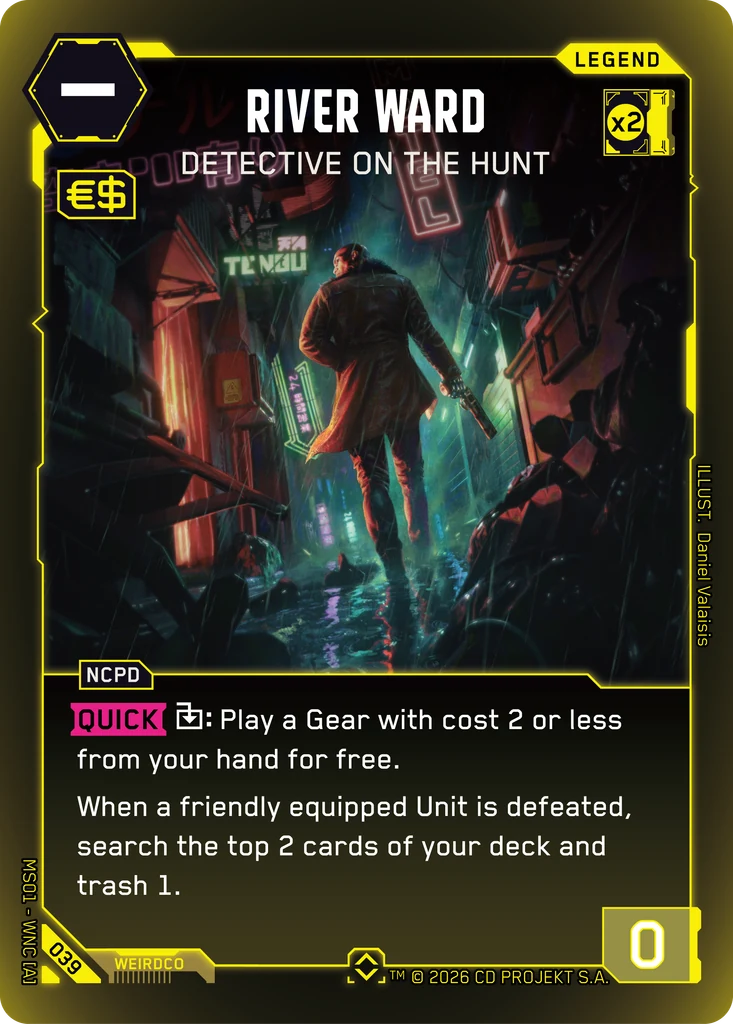
River Ward is the second yellow Legend and the reason the deck stays dangerous on the opponent’s turn. Her quick effect lets you play a gear costing two or less from your hand for free, at any point where you could play a quick ability.*3
You keep River Ward untapped and a gear in hand; the effect itself costs no eddies. Your opponent has to assume that three power appear out of nowhere, that a unit suddenly becomes a blocker, or that an attack no longer wins. The podcast calls this information warfare, and that is accurate. River Ward forces the opponent to play around a card they cannot see.
Then there is the second half: when an equipped friendly unit is defeated, you look at the top two cards of your deck and trash one. Call it selection rather than card advantage. You decide what goes to the trash, and this deck wants specific cards there.
The most common mistake with River Ward is treating her as a gear discount only. The quick trick is usually worth more on the opponent’s turn than on your own, because it turns an attack instead of speeding up your own.
Adam Smasher is the finisher
Smasher costs nine eddies and enters as a ready unit when you play him with Go Solo. His play effect defeats a rival unit. Then he attacks with nine power, more with gear.*4
In the podcast Jeff says he flips Smasher early in this deck, which is unusual in other Smasher decks. The reason is Zetatech Faceplate. A Faceplate on a face-up Legend in the Legends area is out of reach for most removal, because removal targets units. In the podcast it says only Detonate can answer it; in fact Heywood Ripperdoc can also defeat a gear on a Legend. Detonate costs the opponent a card while you have already drawn.*5
With a Faceplate on Smasher you draw a card every turn you spend him to pay, as soon as you control three different gig values. With two Faceplates it is two cards. That is the deck’s second engine, and it runs before Smasher ever hits the field.
The engine runs on gear
In this deck gear is the curve. Reading gear as “equipment for later” means playing the list wrong.

Adrenaline Converter
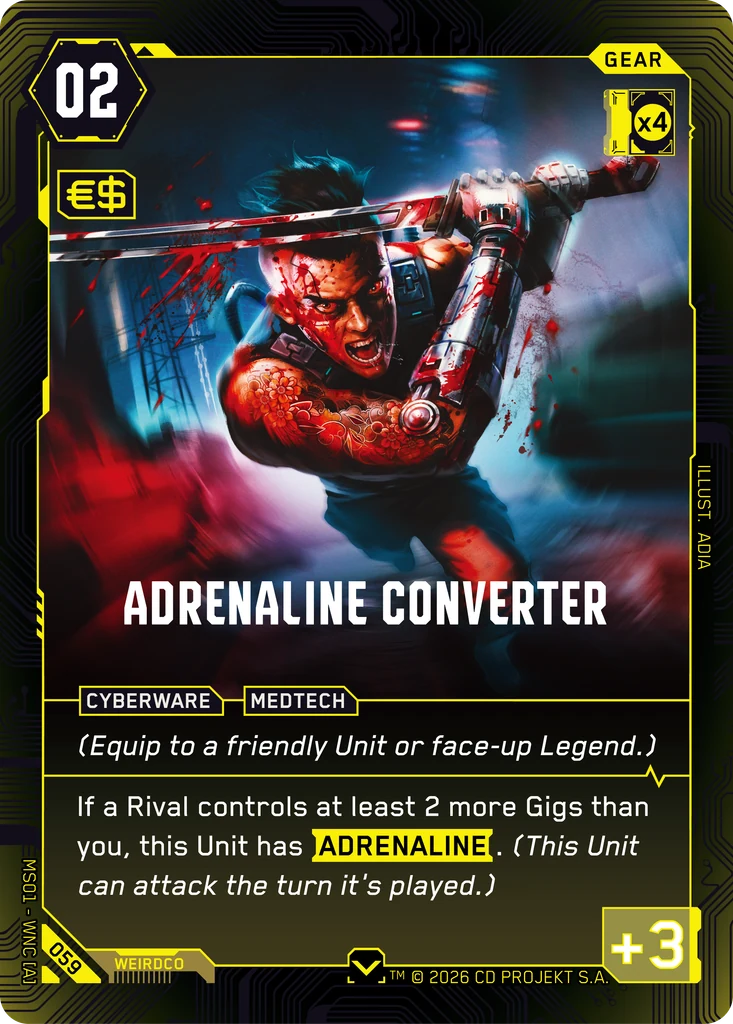
Costs two, gives three power. If the rival controls at least two more gigs than you, the unit also has Adrenaline and can attack the turn it enters.*6
That is the card BBG hates most. BBG takes early gigs and relies on your units needing a turn before they can attack. The Converter removes that turn. An eight-power unit becomes eleven with the Converter and steals two gigs instead of one. The podcast calls it the best gear in the deck; Jeff puts Zetatech close behind.
Zetatech Faceplate
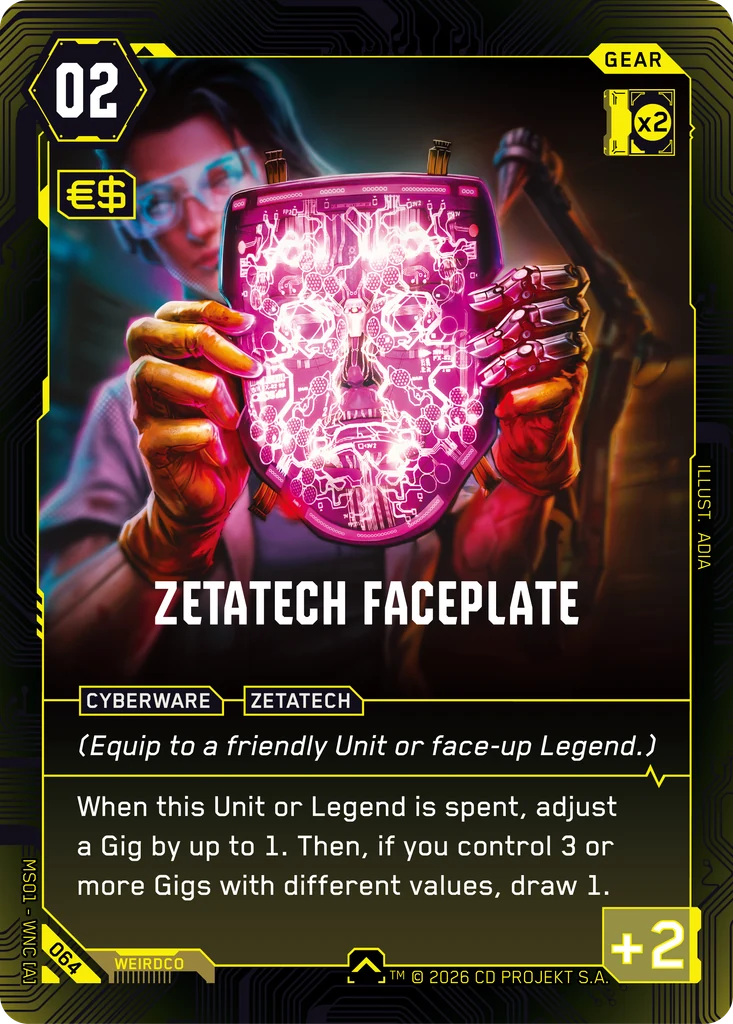
Costs two, gives two power. When the unit or Legend is spent, adjust a gig by one. If you then control three gigs with different values, draw a card.*7
Faceplate is the answer to BBG pairs. BBG wins through matching gig values, and a single point of adjustment can break a pair. It is also the deck’s most reliable draw, because you can put it on a Legend you spend every turn anyway.
Sketchy Ripper and Secondhand Bombus
Both cost two and have zero power. Sketchy Ripper searches the top three cards for a gear on attack and takes it. Bombus is a blocker.*8
Zero power means they do not steal gigs, which is exactly why they work early. Bombus is already a blocker without Mandibular Upgrade; Mandibular on him is redundant.
Mandibular Upgrade and Gorilla Arms
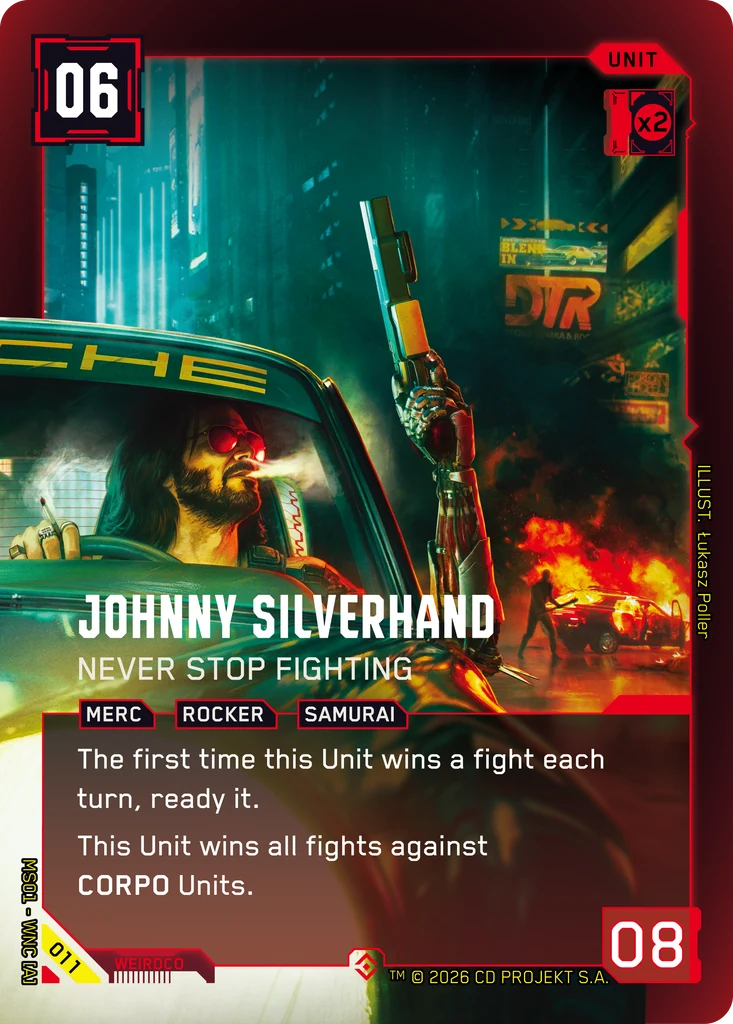
Mandibular costs one and grants blocker. On Johnny Silverhand that is stronger than it looks: Johnny readies the first time he wins a fight each turn, so a blocker Johnny can block, win, and stand ready again.*9
Gorilla Arms costs four and gives three power. The first time the unit steals one or more gigs in a turn, it also steals a rival gig with a value you do not already control. On a seven-power Legend that is ten power and three gigs in one attack. In the normal YYR list Gorilla Arms is a single slot; in the double-go-solo build it becomes a core card.
Six eddies, one attack, two gigs
The strongest line in the deck is also the cheapest. You need Johnny Silverhand in hand, Adrenaline Converter in hand, River Ward face up and six eddies.
You play Johnny for six. Then you spend River Ward and put the Converter on Johnny for free, because River Ward’s quick effect allows exactly that; the effect costs no extra eddies, only the Legend. Johnny now has eleven power. The opponent is at least two gigs ahead, so Johnny has Adrenaline and can attack immediately. An eleven-power attack steals two gigs, not one.*10
Six eddies, one body, two gigs. The podcast calls it one of the biggest tempo swings in the game right now.
The opponent has to be two gigs ahead (otherwise Adrenaline is missing and Johnny cannot attack), River Ward has to be face up, and the Converter has to be in your hand, not in the deck. That is why Viktor’s search matters: he fetches the Converter before you need it.
Live with the Aftermath punishes the wrong answer
There are two obvious answers to YYR, and both walk into a trap. Play only big units to dodge small removal, and Live with the Aftermath gets you. Play many small units to collect gigs, and you switch on the Johnny-plus-Converter line. The podcast describes exactly this dilemma, and it is why the list is hard to play against.
Live with the Aftermath costs three and makes each player defeat one of their units.*11 In a deck with equipped units that is often an advantage, not a cost. You choose the unit you want to lose, and River Ward looks at the top two cards afterwards because the unit was equipped. If Johnny blocks with Mandibular and wins the fight, he readies and can attack again next turn.
The card is a reset you control rather than removal in the classic sense, and it punishes opponents who rely on a single big body.
Ramp that also draws
Bootleg Black Sapphire Show costs five, which means it is playable on your second turn if you sell normally. You sell the top card of your deck and draw two if you control one gig with an even value and one with an odd value.*12
The podcast calls it BS and pretty insane, because it draws and ramps at the same time. A card that makes an eddie and draws two is strong in any card game. Here the extra eddie funds another call or another gear, and the two cards are often exactly the gear Viktor would otherwise search for.
The catch is the price. Five eddies is a lot for a turn in which you put no unit on the field. Against aggro that is a tempo loss; against control it is strong. Slam it in every matchup and fast decks will eat you.
What the 60.3 percent really says
The podcast shows a table from online play. It covers the top ten decks of the last seven days, excluding private games. For the Viktor version of yellow-yellow-red it shows a 60 percent win rate, for BBG with Alt about 52 percent. Jordan says in the same breath that the 60.3 will be significantly lower by Chicago.
That is the most honest read of these numbers. A weekly value from online play measures who is playing the new deck and who has not figured out how to beat it yet. It does not measure how good the deck is once everyone knows it. That process is happening right now: BBG adapts, other decks build specifically against YYR, and the win rate will settle.
Add the data situation for the whole format. There are no official constructed tournaments yet; the first major event is still ahead. Public builder lists are not a tournament archive; they show what is being played, not what wins. Reading 60 percent as “best deck” reads too much into it.
What the number is good for: it shows a direction. YYR is an archetype being played online and performing above average, more than a brew from a podcast. That is more than most lists in this format can claim.
Matchups: BBG, the mirror, RRG
Against BBG
Adrenaline Converter punishes early gig steals, and Johnny delivers an attack that takes two gigs without warning. The podcast says: not a hard counter, a fair matchup. Alex lost his first match against it. Believe the deck wins by itself and a good BBG pilot will beat you.
BBG bottoms whole units. Gear on a unit does not protect against that; gear on a Legend is out of reach for unit removal. Our BBG guide has the full removal map.
Against the mirror
YYR versus YYR is a tempo race decided by gear. The podcast calls the El Capitán version a practical mirror at around 50 percent. Whoever assembles Johnny with the Converter has the strongest single turn; whoever equips Smasher with an early Faceplate draws more cards over the game.
In the mirror, Live with the Aftermath is the first card we move to the sideboard, because the reset is open to both players.
Against red-red-green
RRG is one of the hardest matchups for BBG, with a win rate under 34 percent in the podcast table. The podcast names Bonnie and Clyde as a card that kills Voodoo Boy and Lizzy Wizzy at the same time.
Double Go Solo: Rogue plus River Ward
The podcast closes with a second list that also runs yellow-yellow but wins differently: Rogue Amendiares and River Ward as Legends, plus a red Legend with Go Solo, usually V or Royce. The name Double Go Solo comes from Rogue and the red Legend going into the field themselves; River Ward stays in the Legends area.
Rogue is the only yellow Legend with Go Solo. Her effect: when a friendly Legend steals a gig, you draw a card if the value is even; if it is odd, a rival discards a card. The gig value decides which mode you get.*13
In this build Gorilla Arms gets better, because a seven-power Legend with Gorilla Arms reaches ten power and steals three gigs in one attack. Adrenaline Converter gets worse, because the go-solo Legend can attack the turn it enters anyway.
The price is the d-ramp. Every Legend you put into the field is gone as a payment source afterwards. You trade long-term economy for short-term tempo. Add rival Riot Shields, which make Go Solo cost two more eddies, and Live with the Aftermath, which is especially painful against two Legends that went solo.*14
Seven sideboard cards, our proposal
Tournament rules require a sideboard of exactly seven cards, and Legends cannot be swapped. None of the public YYR lists has a complete seven-card sideboard; the reference list runs six. Our proposal uses cards legal in this color space, meaning red with RAM two and yellow with RAM four.
| Qty | Card | For | Why |
|---|---|---|---|
| 2 | Meredith Stout: Stone Cold Corpo | Early aggro | Five power for four eddies, blocker, plus two power against Legends. Adds a card from the trash when the rival adjusts your gigs. |
| 2 | Detonate | Gear decks, mirror | Quick and one eddie. Kills Faceplate on a Legend or Satori (power 2); Adrenaline Converter has power 3 and is not a target. |
| 2 | Safety Override | Aggro, mirror | Quick. The next lost fight defeats the opposing unit of that fight. The card against a Smasher attack. |
| 1 | MaxTac Suppression Team | BBG, aggro | Costs five, power seven. Rival units cannot attack the turn they are played. |
What comes out depends on the matchup. Against BBG the single Gorilla Arms and the third Bootleg Black Sapphire Show come out, because tempo matters more than ramp there. In the mirror, Live with the Aftermath is the first cut. Against fast decks the ramp goes.
Just under 48 euros, with one big caveat
Using Cardmarket trends and the cheapest printing per card, the reference list comes to 47.75 euros. The number is skewed for a reason that has nothing to do with the deck.
42.62 euros of that sits on two cards: two Dexter DeShawn at 17.30 euros and three Johnny Silverhand at 25.32 euros. For Johnny, Cardmarket currently lists only a foil trend; Dexter has a regular trend of 8.65 euros. The 8.44 euros for Johnny is what a few foil copies are asking, while the Dexter price rests on regular beta printings.
The rest is cheap. Adrenaline Converter, Zetatech Faceplate and Live with the Aftermath sit in the cents range, Viktor Vektor at 1.79 euros, River Ward at 0.37 and Smasher at 0.33. Those are beta foil values. Retail singles do not exist yet, because retail launch is in early November.
Without Johnny and Dexter the rest costs about five euros (Cardmarket trend, October 14, 2026).
Five mistakes this deck punishes
Searching for the Converter too late. Viktor is not a late-game value spell. A call in the first two turns raises the chance that the gear is already there when the opponent is ahead on gigs.
Using River Ward only on your own turn. The quick effect is stronger on defense. An open River Ward with a gear in hand is a threat that prevents attacks before they happen.
Playing Smasher without a Faceplate. When Smasher is face up, the Faceplate belongs on him before Go Solo. On a Legend it draws cards before he hits the field.
Playing ramp against aggro. Bootleg Black Sapphire Show is strong against control and suicide against tempo. Spend five eddies on ramp in turn two and you have no answer to an attack in turn three.
Leaving gear on units that die. River Ward’s trigger rewards equipped units, but gear on a unit that is about to be removed is wasted. Gear on a unit that is about to be removed is wasted; Faceplate on a Legend is out of reach for unit removal.
The rules behind the asterisks
1 The three Legends are placed face down and shuffled. A call costs one eddie, flips one of them and triggers its call effect. One call per turn.
2 Viktor Vektor: “Search the top 5 cards of your deck. Reveal up to 2 Gears with cost 2 or less and add them to your hand. Bottom-deck the rest in a random order.”
3 River Ward: “{Quick} {Spend} Play a Gear with cost 2 or less from your hand for free. / When a friendly equipped Unit is defeated, search the top 2 cards of your deck and trash 1.”
4 Go Solo puts the Legend into the field as a ready unit for its cost, it can attack that turn, and it is removed from the game when it leaves the field. Smasher’s play effect triggers.
5 Gear can be equipped to face-up Legends in the Legends area. When the Legend moves to the field, the gear moves with it.
6 Adrenaline Converter: “If a Rival controls at least 2 more Gigs than you, this Unit has {Adrenaline}. (This Unit can attack the turn it’s played.)”
7 Zetatech Faceplate: “When this Unit or Legend is spent, adjust a Gig by up to 1. Then, if you control 3 or more Gigs with different values, draw 1.”
8 Sketchy Ripper: “{Attack} Search the top 3 cards of your deck. Reveal a Gear and add it to your hand. Bottom-deck the rest.” Bombus has blocker. Units with zero power do not steal gigs.
9 Mandibular Upgrade grants blocker. Johnny Silverhand: “The first time this Unit wins a fight each turn, ready it.”
10 Steal formula: power 1 to 9 steals one gig, power 10 to 19 steals two. Eleven power therefore steals two.
11 Live with the Aftermath: “Each player defeats one of their Units.”
12 Bootleg Black Sapphire Show: “Sell the top card of your deck. If you control a Gig with an even value and a Gig with an odd value, draw 2.”
13 Rogue Amendiares: when a friendly Legend steals a gig, draw a card if the value is even; if it is odd, a rival discards a card.
14 Riot Shield: “Rivals must pay +2 €$ to use {Go Solo}.”
Where the numbers come from
The card texts come from the official netdeck.gg card API. The deck list is a public builder list with River Ward, Viktor Vektor and Adam Smasher: 40 cards plus three Legends and a six-card sideboard. The matchup and meta claims come from the first episode of the Side Gig podcast from October 2026, in which Jordan, Jeff and Alex discuss the deck. The win-rate table is shown there as a screenshot from online play, not as an official statistic. Prices are Cardmarket trend values from October 14, 2026. Our own calculations are marked as such.
Sources: youtube.com, api.netdeck.gg, builder list fcf5872c and Cardmarket.
- Side Gig podcast on yellow-yellow-red: youtube.com/watch?v=1-pt-vwnEEs
- Cards and Comprehensive Rules: api.netdeck.gg
- Deck list in the builder: cyberpunktcg.com/decks/fcf5872c
- BBG guide in this series: Blue, Blue, Green
- RRY guide in this series: Red, Red, Yellow
- Gear guide in this series: Gear and power thresholds
- Cardmarket price guide, as of October 14, 2026
Source: our own analysis of the podcast transcript, the card API and public builder lists, as of October 20, 2026. There are no tournament results for this deck yet.

// KOMMENTARE (0)