Cyberdeck Ep19: Eleven Cards and a Blue Streak
AI TRANSLATION NOTE
This is the English edition of a deep-dive originally written in German. The translation was AI-assisted and human-reviewed for terminology, card-database accuracy, and Rogue-persona tone. All direct quotes from Cyberdeck Episode 19 come verbatim from the original English broadcast — not back-translated from German. The original German article is available at cyberpunk-tcg-news.de.
Gen Con is running right now in Indianapolis, and apparently nobody told Kawa and Paweł Burza that a trade show is allowed to leave you speechless for five seconds every once in a while. Episode 19 of the Cyberdeck podcast sounds like the two of them just watched total strangers walk up to their table, pick up a card, and start grinning. You can hear that energy in every single minute of the recording.
Eleven cards get airtime this episode. Four of them are official, backed by a blog post, press art, and rules text straight from cyberpunktcg.com, because WeirdCo had weeks to prep them for Gen Con. Seven more come up almost as an aside, mid-conversation, without the same editorial polish, like eavesdropping on two industry insiders casually roasting their own product at the next table over. That exact ratio, four fully polished, seven pulled out of thin air, turns out to be the reason the informal cards are where most of the name and number slip-ups show up (more on that in the Name Chaos section further down). Wherever you see „per the blog post,“ the source is checked and official. Wherever you see „per the transcript“ or „per the hosts,“ it’s the spoken word of two people improvising live. Somewhere in between sits the sentence every Kickstarter backer has been waiting months for: fulfillment start is getting close, pinned down to September 1, 2026, with both hosts independently saying everything’s on schedule.
Work through all eleven cards in order and a pattern emerges that neither host ever names out loud, but that quietly drives the whole episode: this is a strikingly blue episode. Exactly how blue only becomes clear once you’ve gone through every card. First, though, the solid stuff: the four cards with press coverage, real art, real rules text. That’s where I’ll start, exactly where WeirdCo itself was loudest.
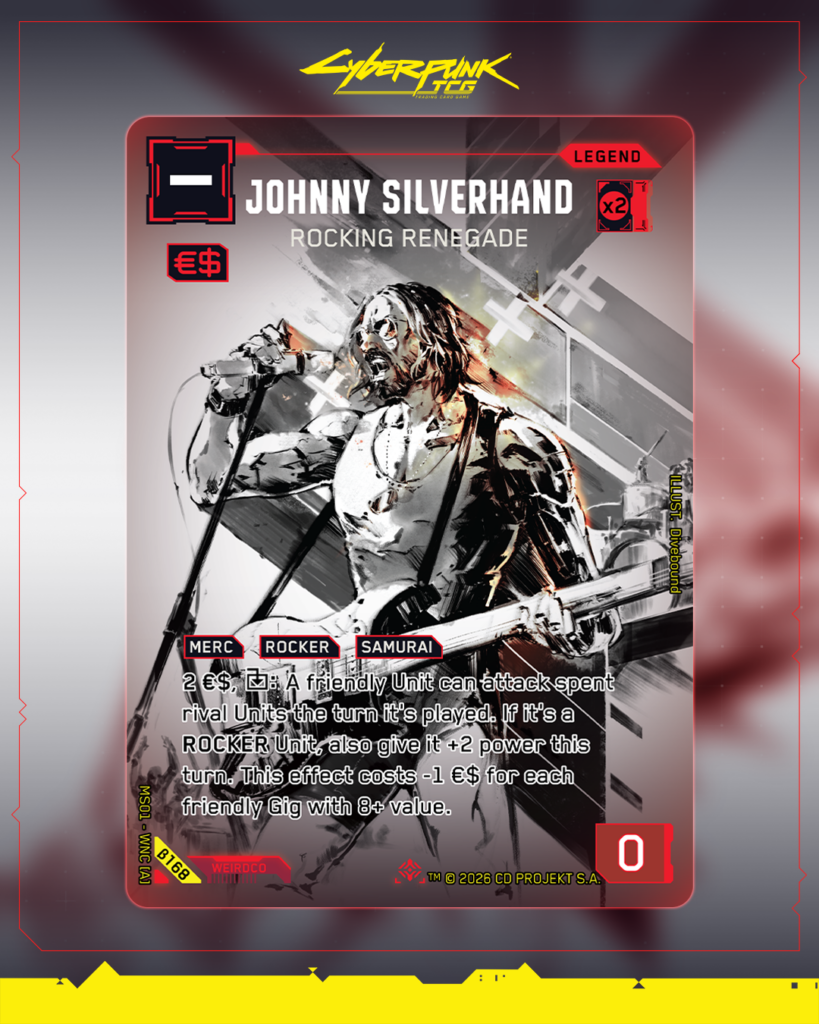
Johnny Silverhand: Rocking Renegade — The Chase Card of the Whole Set?
When a host starts beaming over a Secret-rarity card, it’s worth paying attention. That’s exactly what happens with Johnny Silverhand. Red, Legend, and according to Kawa, possibly the card the whole set’s chase ends up being about.
Johnny Silverhand: Rocking Renegade
Type: Legend · Color: Red · Tags: Merc/Rocker/Samurai · Rarity: Secret (Retail #003, + Beta Secret β003, + Iconic Secret β168) · RAM: 2 · Artist: Daniel Valaisis
Effect (DB wording): „2 €$, {Spend} A friendly Unit can attack spent rival Units the turn it’s played. If it’s a ROCKER Unit, also give it +2 power this turn. This effect costs -1 €$ for each friendly Gig with 8+ value.“
Mechanically, that’s a pretty rude proposition. For 2 €$, a friendly Unit gets to attack rival Units that are already spent, meaning Units that shouldn’t have to worry about defense right now, because they already burned their action for the turn. Normally „spent“ is the state where you’re supposed to feel at least a little safe as the defender. Johnny Silverhand takes that safety away, and if the attacking Unit also carries the Rocker tag, it gets +2 power on top for the trouble. The real hook sits in the last sentence: the more friendly Gigs worth 8 or higher you’ve got on the table, the cheaper the whole move gets. Stack enough big-value Gigs and the surprise attack eventually costs nothing at all. This is a card that rewards a board you’ve already built, and then lets you kick again right when your opponent thinks they’re safe.
Kawa doesn’t hold back on the ranking:
„I think this might be the entire like the chase card of the set. This is a secret uh iconic rare as you can see by Divebound. Absolutely sensational.“
Burza jumps in almost in the same breath, though not about the mechanics. About the art itself:
„You have to see this card … how beautiful it is … the etching … this card visually when it’s printed it just pops.“
The etching comment isn’t a throwaway line. Iconic printings in Cyberpunk TCG often get a foil-stamped texture that barely reads on camera and only really lands once you’re holding the card at a table, exactly the effect collectors have been talking about since the beta. If you’re as into the visual side of the game as the mechanics, the Cyberpunk 2077 art book collection has plenty of reference material for how Night City and its icons look in concept art before they ever land on a card. Not TCG merch in the strict sense, but if „the etching“ already gets you a little misty-eyed, you’ll find something there.
Worth a second look, mechanically, is the Rocker bonus. The set clearly works with sub-types like Rocker, Netrunner, Merc, Techie, classifications spread across colors that enable deckbuilding synergies without tying you to a single color. Johnny Silverhand himself carries Merc, Rocker, and Samurai at once, and his ability specifically rewards Rocker Units in your own deck on top of everything else. If you’re already building around Kerry Eurodyne or other Rocker cards, this gives you a Legend that doesn’t just support the strategy, it sharpens it. For red as a color, that’s about as direct a statement as it gets: aggression first, and if it backfires, at least it was a loud exit.
One more word on rarity, because it shows how much effort went into this card. Secret is already the top regular rarity tier in the set, but Johnny Silverhand also gets an Iconic Secret version (β168), printed by Divebound Studio, not just a rare card, but a rare card with an even rarer special version stacked on top. Kawa’s „chase card“ label isn’t pure marketing spin in that light, it’s a fairly precise description of what collectors are going to do with this one: open, open, open, until the gold version finally shows up in your own booster.
The Relic: Experimental Biochip — The Gear Half the Community Got Wrong
With the second official card, the hosts spend their first breath correcting a misunderstanding that had apparently already taken hold. The Relic: Experimental Biochip is a yellow Gear, and per the hosts, a chunk of the community had the wrong idea about how it actually works before the episode even aired.
The Relic: Experimental Biochip
Type: Gear · Color: Yellow · Tags: Arasaka/Cyberware · Rarity: Epic (Retail #063, + Beta Epic β063) · Cost: 5 · Power: 3 · RAM: 4 · Artist: Dardo Studios
Effect (DB wording): „{Defeated} Play another Unit with cost 9 or less from your trash for free. Then, bottom-deck this Unit.“
The catch sits right in the trigger word up front: {Defeated}. Gear cards in Cyberpunk TCG get equipped to a Unit, and per the rulebook, lower-text on a Gear with a trigger word like that gets inherited by the Unit it’s attached to. It doesn’t fire off the Gear itself. Sounds like a fine point for rules nerds, but per the hosts, it’s exactly where plenty of players got it wrong. If you thought you could just „pop“ the Relic Biochip yourself to grab the effect, you read the card wrong:
„if some people are thinking, ‚Oh, I can play the relic with Dum Dum, pop the relic, and then I get the ability.‘ It’s not the relic being defeated that triggers the ability.“
In other words: it’s not the Gear itself getting destroyed that fires the effect. It’s the Unit wearing the Gear. Only once that Unit gets defeated in combat, or otherwise, does the {Defeated} text go off, and then you get to play another Unit with cost 9 or less for free out of your own trash, right before the card itself heads back to the bottom of your deck. Cost 9 isn’t a random number in the current set. There’s exactly one Unit that hits that ceiling so far: Adam Smasher — Metal Over Meat, cost 9, power 15. And the payoff runs even bigger than the raw stats suggest: per the card database, Smasher carries a {Play} text that simply defeats every other Unit on the field the moment he’s played, a full board wipe, triggered for free the instant he lands. Whoever has a card that pulls that monster out of the trash for free isn’t just getting a big body back, they’re potentially getting a second board wipe in the same match. How you actually get Smasher into the trash before you ever need the Relic Biochip is covered in the combo section further down.
That this discussion happens at all says something on its own: a card game that hasn’t even fully shipped yet already has enough players reading rules text closely enough to argue about interpretation.
As an example of the misread, the hosts mention „Dum Dum“ in passing as the carrier card, an already-revealed Maelstrom Unit that the community apparently likes to equip with the Relic Biochip. The transcript doesn’t give concrete stats for Dum Dum at this point, so I’ll leave it at the name only: anyone who wants to look the card up can find it in the card database. What matters more than the stats anyway is the underlying principle, that Gear cards in Cyberpunk TCG all work on this same rule, equipped to a Unit whose fate they share the moment they enter play. Once you’ve got that down, you’ll read every future Gear reveal correctly on the first pass.
Pacifica Netrunner — The Quiet Answer to Adam Smasher
Card number three out of the official block looks almost forgettable at first glance. Common rarity, cost 4, power 1. Not a statline you brag about. Which is exactly what makes it interesting.
Pacifica Netrunner
Type: Unit · Color: Green · Tags: Netrunner · Rarity: Common (Retail #084, + Beta Common β084) · Cost: 4 · Power: 1 · RAM: 2 · Artist: ADIA
Effect (DB wording): „{Play} If your ☆ (Street Cred) is an even number, a rival Unit can’t ready until your next turn.“
Street Cred lands on an even number, and a rival Unit stays frozen for a full turn. No attack, no blocking, nothing. The condition sounds like a coin flip at first, but in actual deckbuilding it isn’t much of one: Street Cred can be steered through your own Gig setup, which turns the „even number“ condition into more of a rule than a roll of the dice for a well-built green deck. And the comparison the hosts reach for makes it immediately clear what the card is built to answer:
„Once Adam Smasher swings … you’re frozen for a turn.“
Adam Smasher is the name you don’t drop casually in the current metagame right now. A 15-power, cost-9 monster that gets through once and has basically decided the game already. Pacifica Netrunner is one of the few answers that doesn’t need a second fight. Smasher gets to land his hit once, but after that he just stands there. The card triggers at the exact moment an attacking Unit goes spent, and locks it in that state instead of letting it ready back up on your opponent’s next turn. So the first hit still lands, but the second one never comes, as long as Pacifica Netrunner is on the field in time. The hosts draw a parallel in the same breath to Chrome Reverie, another blue program with a similar stalling effect, which shows that „freeze the opponent for a turn“ is apparently a recurring tool in the design toolbox, just spread across two different colors. We’ll come back to this pattern further down, because Pacifica Netrunner isn’t the only card in this episode that reads as a direct counter to Adam Smasher.
What makes this one of the more underrated reveals of the episode, to me, is exactly the Common rarity. Rare or Epic gets to be elaborate, that’s expected. But a plain Common that holds up as one of the earliest reliable answers to the strongest threat in the current metagame is precisely the kind of card a healthy card game needs. Not every counter should have to be expensive, or only players with the fattest binder get a shot against Adam Smasher. Cost 4, Common, anyone can afford it. That’s good, accessible design.
Pyramid Song — A Radiohead Lyric and a Typo in the Card’s Own Database
And then the fourth card in the official block, the one that made me stop and reread twice during fact-checking. Pyramid Song is a blue Braindance program, named after the Radiohead song of the same title. And per the hosts, not a random pick. Judy Álvarez has a tattoo in the Cyberpunk 2077 video game reading „nothing to doubt,“ and that exact line shows up again later in this episode as the title of a second Judy card. Two card names, one lyric, one character. That’s the kind of attention to detail you want from an adaptation TCG when it’s done right.
Pyramid Song
Type: Program · Color: Blue · Tags: Braindance · Rarity: Rare (Retail #135, + Beta Rare β135) · Cost: 3 · RAM: 3 · Artist: Elizaveta Kazakova
Effect (printed card wording): „Choose one effect. If a friendly d4 is a min Gig, choose both instead. Give a rival Unit -4 power this turn. // Bottom-deck a rival Unit with power 0.“
Now for the part that earns its own footnote. On the card database page for Pyramid Song, two numbers sit right next to each other that don’t agree. The separate rules-text field states „-5 power.“ The actual printed card art right beside it on the same page shows „-4 power,“ and the official Gen Con blog post says four as well: „If you control a d4 with a value of 1, this powerful Braindance can reduce a rival unit’s power by 4 and bottom-deck a Rival unit with power 0.“ Two out of three sources agree on minus four; only the metadata field on the DB page comes in at minus five. That reads like a simple data-entry slip in the website’s structured metadata, not an actual balance change. And at the table, what’s printed on the card is what counts anyway, not a text field buried on a website somewhere. For this article, I’m going with the value from the card art and the blog post: minus four power. The slip is amusing regardless. Even the card’s own database apparently fat-fingers its own card once in a while.
Mechanically, Pyramid Song is a choice effect: it either weakens a rival Unit by 4 power for the turn, or sends a Unit with 0 power back to the bottom of the deck. And if a friendly d4 happens to be showing a min Gig (meaning the lowest value among your Gigs), you get to pick both at once. That exact combination of weakening and clearing off is a building block for a combo the hosts openly walk through in the episode: play Floor It first, another blue power-minus program that per the card database drops a rival Unit’s power by 1, then follow up with Pyramid Song to, say, whittle down a Meredith Stout, a well-known 4-cost blocker in the metagame, to exactly 0 power, then finish her off with Pyramid Song’s second effect. Minus one from Floor It plus minus four from Pyramid Song comes out to minus five total, against a blocker sitting around five power, the math lines up almost exactly.
„If you’ve got four eddies, you can do a floor it and then you can do a pyramid song“ — that’s how the hosts put it themselves, even if it doesn’t quite stand alone as a clean pull-quote since the line sits mid-explanation in the conversation.
And then there’s the hint I’m deliberately treating as exactly that, an anecdote, not a fact. Kawa lets it slip during the conversation that Pyramid Song has a balance history behind it:
„There are some stories about how good this card used to be. So, it just shows you there’s a lot of iteration.“
No numbers, no timeframe, no details. Deliberately vague, as Kawa himself signals in the moment without giving too much away. I’m taking that for what it is: a small behind-the-scenes glimpse showing that cards apparently go through repeated playtesting before they end up looking like they do now. There’s nothing more solid behind it right now, and anyone building a „Pyramid Song used to be broken“ story out of that is reading further into it than what was actually said.
That leaves the rarity context: Rare, not Epic or Secret, and still a card with two combinable effects and its own little balance legend running in the background. Compared to Johnny Silverhand above, sitting at the very top of the rarity hierarchy as a Secret, Pyramid Song shows that strong, game-swinging effects in Cyberpunk TCG aren’t necessarily locked to the highest rarity tier. For deckbuilding, that means: anyone betting on a Braindance-program package doesn’t need to hope for the priciest pulls to stay competitive.
Judy Álvarez, Twice Over: One Card Confirms a Misread, the Other Clears It Up
From here we leave the official blog post behind and move into the more informal part of the episode, the cards that only come up in conversation, without their own press text. Fittingly, the character who defines this episode more than anyone else kicks it off: Judy Álvarez. Twice.
Judy Álvarez: Braindance Maestro
Type: Legend · Color: Blue · Tags: Ganger/Mox/Techie · Rarity: Epic (Retail #108, + Beta Epic β108, + Beta Iconic Legend β157) · RAM: 2 · Artist: Gautier Viller
Effect (DB wording): „When you play a BRAINDANCE Program, give a friendly Unit +1 power this turn. {Spend} Trash the top card of your deck. If it’s a Program, you may add it to your hand.“
Braindance Maestro is, strictly speaking, not a new reveal in this episode. More a recap of a reveal that already ran a week earlier. The hosts take it apart again anyway, and that’s exactly where the line drops that ends up holding this whole episode together, without ever being meant as a summary:
„Blue is home for these players. So, players who like to kind of do uh things differently.“
Blue as a home for players who want to do things differently than everyone else. That reads less like dry color-pie flavor text out of a rulebook and more like an identity statement, straight from one of the two people helping build this game. And once you look at how many blue cards show up in this single episode alone, the line almost reads as an explanation for why the whole episode looks the way it does. Braindance Maestro itself is a clean example: every time you play a Braindance program, a friendly Unit gets +1 power for the turn, and the spend ability lets you trash the top card of your own deck to fetch it straight into your hand if it turns out to be a program. A Legend that feeds its own Braindance deck both power and card supply. No flavor text exists for it yet, and no permanent press image either, just a DB card render that would need a fresh pull at actual publish time if one’s needed.
Now for the second Judy, who gives us a lot more to chew on.
Judy Álvarez: Nothing to Doubt
Type: Unit · Color: Blue · Tags: Ganger/Mox/Techie · Rarity: Secret (Retail #116, + Beta #β116, + Beta Iconic #β171 by Divebound Studio) · Cost: 6 · Power: 6 · RAM: 5 · Artist: Ilya Kushinov
Effect (DB wording): „1 €$, {Spend} Reveal the top card of your deck. You may play it for free. Otherwise, add it to your hand.“
Here I need to step out of straight reporting for a second and correct something that had already been making the rounds beforehand as a „mono-blue Legend.“ Wrong. Nothing to Doubt is, per the official card database, a Unit, not a Legend. The hosts say as much themselves, almost as an aside: „the only other mono unit we’ve seen in the game so far has been out of Smasher“ — meaning Adam Smasher — Metal Over Meat, cost 9, power 15, RAM 6, also a Unit, not a Legend. Two mono-color powerhouses in the card pool revealed so far, and both of them Units. With a sample size of two, that’s obviously nowhere near a law of nature I’d sell here as a confirmed design rule, but it’s an observation worth keeping in the back of your mind regardless, in case WeirdCo keeps pulling this thread.
The card itself is ridiculously efficient once it’s running: for 1 €$, you get to reveal the top card of your own deck and either play it for free or add it to your hand. Card advantage and a potential tempo swing in one move, over and over, as long as you’ve got the €$ to keep paying for it. The catch sits in the RAM requirement: covering five blue RAM means, per the hosts, that you effectively need three blue Legends in your own deck to reliably cast Nothing to Doubt at all, „you have to play three blue legends if you want to play this Judy.“ Important note here: that’s a derivation from the general RAM system, not a clause printed on the card itself. Anyone planning a mono-blue deck committed enough to hit that number gets a payoff with Nothing to Doubt that feels like an engine that never stalls out. Kawa himself sounds convinced of the balance: „I also honestly I think this card is extremely well balanced in my opinion.“
If you’re toying with the idea of actually building a RAM-hungry mono-color deck like that, it’s worth thinking practically too: Secret-rarity cards like this one are rare enough that you don’t want to run them naked across your own playmat. A pack of decent standard 66x91mm card sleeves runs a few bucks and saves you the headache later when a Secret card has dog-eared corners after its third tournament. Sounds trivial until you actually love the card in question.
One more quick note on the artist mix-up before we get into the full name rundown further down: an automated summary of a supposed X post claimed Nothing to Doubt carried „Epic Rare art by Gautier Viller and Iconic Rare art by Pandart Studio.“ Not true. Per the directly-queried database, the rarity is Secret, the artist is Ilya Kushinov, and the Iconic printing comes from Divebound Studio. Gautier Viller really is an artist here, just for Braindance Maestro, the first Judy card above. Pandart Studio, meanwhile, is credited as the Iconic artist too, just for an entirely different card we’ll get to later. Two cards an AI search summary apparently scrambled together without blinking.
Set the two Judys side by side and you get a picture that says more about deckbuilding than either card alone. Braindance Maestro runs quietly in the background, a Legend that passively hands out power and passively restocks your hand as long as you’re playing Braindance programs, no extra effort required on your part. Nothing to Doubt demands active engagement instead, turn after turn, for a single €$ of value generated, but in exchange for a deck that’s already fully committed to blue before it even gets there. Neither card alone hands you a deck recipe, but together they give a pretty good sense of why blue shows up so often in this episode.
Trust No One and the Color Cycle That Closes Out With This Episode
From the Judy cards we move straight into a fairly unassuming Common that still delivers a nice little building block: Trust No One, another blue Braindance program.
Trust No One
Type: Program · Color: Blue · Tags: Braindance · Rarity: Common (Retail #139, + Beta #β139) · Cost: 1 · RAM: 1 · Artist: Jesús Hervás
Effect (DB wording): „Decrease a Gig by up to 3. Then, if you control a min Gig, draw 1.“
For a single €$, you knock a Gig down by up to three points, and if you control a min Gig afterward, the lowest-value Gig on the field, you draw a card. Cheap, efficient, and per the hosts, the last piece of a color cycle they informally call „Gig-Trip,“ not an official card type, just a term from their own conversation. The cycle runs four cost-1 programs sharing the same Braindance/Gig-manipulation theme, one per color: Industrial Assembly in red, Peace Offering in green, Afterparty at Lizzie’s in yellow, and Trust No One in blue. Four cards, one shared design principle, spread across the whole color palette, which for a set this young is a fairly clean sign that somebody worked from a plan here instead of throwing cards together on gut feel.
This whole Braindance mechanic ties directly, by the way, into the d4 dice that represent Gigs in Cyberpunk TCG — Pyramid Song above uses the exact same phrasing, „friendly d4 is a min Gig.“ If you’re regularly at pre-release events or launch-night tournaments and keep running into a missing or mislabeled die in the play set, a spare set of four-sided dice makes life easier, especially if you’re playing Braindance- or Gig-heavy decks often and need clear values at the table.
What sells me further on the Gig-Trip cycle is the shared cost point. All four cards cost exactly 1 €$, which makes them among the earliest playable actions in practically any deck, whatever color you’re actually running. Rarity-wise, three of the four cards are Common, with Industrial Assembly sitting one tier above as Uncommon, the cards themselves still all cost the same single €$. A set that offers a clean four-color cycle at this low a price point is thinking in draft and sealed structures, not just constructed decks with a pre-planned card list. For newcomers finding their way into this game out of a booster or starter deck, cards exactly like this are where you first learn what your own color feels like, long before you’re holding the big rare bomb in your hand.
Free Attacks In, Free Attacks Out: Johnny, Jackie, and the MaxTac Counter
Now it gets interesting for anyone who cares less about individual cards and more about how the metagame regulates itself in real time. Because in this exact episode, WeirdCo shows off both halves at once: a new way to play, attacking the turn a card enters play, and, in the same sitting, its direct answer.
Johnny Silverhand, covered above already, explicitly lets a Unit attack „spent rival Units the turn it’s played.“ Jackie Welles — Mama’s Favorite, which we’ll get into in the next section, also allows an attack „this turn“ per its rules text through its Go Solo ability, right after it enters play. Anyone assuming a freshly-played Unit needs a turn to catch its breath first gets corrected by both cards, red and green, two completely different colors, landing on the same idea independently of each other.
And then, practically in the same conversation, comes the card that walks all of it right back.
MaxTac Suppression Team
Type: Unit · Color: Yellow · Tags: NCPD · Rarity: Common (Retail #050, + Beta #β050) · Cost: 5 · Power: 7 · RAM: 1 · Artist: ADIA
Effect (DB wording): „Rival Units can’t attack the turn they’re played.“
One sentence, and it hits three different strategies at once. The hosts spell it out themselves in the episode: MaxTac Suppression Team shuts down what they call „Adrenaline“ attacks in conversation (per their own description, a mechanic that allows immediate attacks under certain conditions, though not an officially defined rules term in the published rulebook), it shuts down the Johnny Silverhand Legend ability above, and it shuts down Go Solo attacks like Jackie Welles’s. And MaxTac Suppression Team is nowhere close to just a rules text on legs. Seven power for five cost is a perfectly solid statline on its own, one you could drop as a body without the ability and be happy. The NCPD affiliation fits the theme too, honestly, a special unit whose entire job is making sure nobody gets to move the moment they show up.
What makes this moment in the episode stand out is the timing. WeirdCo isn’t showing an escalation across several sets and then the answer somewhere down the line. They reveal both in the same podcast sitting. Anyone paying attention gets a live look at designers introducing an aggressive new play pattern while simultaneously making sure it doesn’t tip the whole metagame over. And the thread runs one step further: we already saw Pacifica Netrunner above as the quiet answer to Adam Smasher, freezing an attacker solid for a turn. MaxTac Suppression Team plays a similar role, just specifically against the enter-the-field attack rather than the regular attack. WeirdCo is clearly patching against threats that have already settled into the metagame, namely Adam Smasher and instant-attack strategies in general. Important context so this doesn’t set the wrong expectation: both cards target the attack, not Smasher’s {Play} text from earlier, the board wipe on entry. They don’t help against the wipe itself, that fires the moment Smasher hits the field, whether or not he ever gets around to attacking after. Pacifica Netrunner and MaxTac Suppression Team answer the second act, the moment an already-survived Smasher tries to strike again. Still one of the most directly relevant connections in this entire episode’s material for backers who already have a working deck.
Practically, for deckbuilding, that means: if you’re currently building around instant attacks, whether through Johnny Silverhand or Go Solo Legends like Jackie Welles, MaxTac Suppression Team belongs on your sideboard watchlist at minimum. And flip it around — if you like leaning on stall and control cards like MaxTac or Pacifica Netrunner yourself, you now know exactly which two aggressive strategies they answer most directly. That’s how you end up with what people call a „solved“ metagame at the table, not because one card is objectively the strongest, but because every aggressive line has a reachable answer that doesn’t have to be a rare chase pull.
Maelstrom Zealots, Alt Cunningham, and Jackie Welles: Three Statlines With Fine Print
Three cards remain that look like plain statline filler at first glance, and on a second look, all three earn their own little chapter.
Maelstrom Zealots
Type: Unit · Color: Green · Tags: Ganger/Maelstrom · Rarity: Common (Retail #079, + Beta #β079) · Cost: 4 · Power: 0 · RAM: 1 · Artist: Michał Dziekan
Effect (DB wording): „When this Unit loses a fight, defeat the opposing rival Unit. (Units with power 0 don’t steal Gigs.)“
Zero power on a cost-4 Unit reads like a misprint at first. It isn’t. Maelstrom Zealots is built as a sacrifice stone: lose a fight with it, and at 0 power, it loses practically every fight it gets into, and the opposing Unit goes down too. A Unit that deliberately throws itself on every blade just to take the opponent down with it. The parenthetical in the DB, noting that 0-power Units don’t steal Gigs, is pure reminder text with no extra effect attached, but important enough that it earned its own callout in the database, apparently because the combination of 0 power and aggressive play would otherwise cause confusion. The card’s name came through in the transcript as singular, „Maelstrom Zealot“ — the database lists it correctly in the plural, „Maelstrom Zealots.“ Sounds like nitpicking, but if you’re searching for the card online, knowing the right name matters.
Alt Cunningham — Mother of Daemons
Type: Unit · Color: Yellow · Tags: Merc/Netrunner · Rarity: Rare (Retail #042, + Beta #β042, + Beta Iconic β161 by Dardo Studios) · Cost: 7 · Power: 8 · RAM: 3 · Artist: Mooncolony
Effect (DB wording): „When a friendly equipped Unit or Legend is spent, draw 1. When a rival Unit would steal a Gig, you may discard 1 with cost equal to that Gig’s value. If you do, the Gig isn’t stolen.“
The podcast openly debates which color would actually suit this card best: green for its closeness to Peace Offering and Gig manipulation, red for cheap gear like Mad Blades, blue for the general Gig-manipulation themes Alt Cunningham brings as a character. The card itself is, per the database, unambiguously yellow, and the hosts recommend in the same breath building it around the cheapest yellow gear you can find, a perfectly normal cross-color deckbuilding conversation happening around a card whose actual color is already locked in. Mechanically, Alt Cunningham rewards two different play styles at once: card advantage whenever a friendly equipped Unit or Legend goes spent, and a kind of Gig insurance, where you can discard a card with matching cost to stop a rival Gig theft cold. A netrunner who watches both her own board and her own Gigs.
Worth clarifying, since the name trips people up easily in the community: this card is not the same as the already-existing „Alt Cunningham — Soulkiller Architect,“ a blue Netrunner Legend with a completely different focus on program cost and trash recursion. Two different Alt Cunningham cards, then, and per Kawa, a third one is on the way, teased but not yet shown: „there is the alt based legend that they’ve seen in blue. So there is a cool iconic art for that card which I don’t believe has been revealed yet. … That’s the one I’m talking about very very soon.“ No card data, no date, just the announcement that more is coming. I’m treating that accordingly as a teaser, not a confirmed fact.
Jackie Welles — Mama’s Favorite
Type: Legend · Color: Green · Tags: Merc · Rarity: Rare (Retail #073, + Beta #β073, + Beta Iconic β152 by Pandart Studio, + Pre-Release Beta #007) · Cost: 6 · Power: 8 · RAM: 2 · Artist: Daniel Valaisis
Effect (DB wording): „{Go Solo} (Pay this Legend’s cost to play it as a ready Unit. It can attack this turn. If it leaves the field, remove it from the game.) If a friendly Unit would be defeated, you may spend 1 €$ to defeat this Legend instead. (Remove it from the game.)“
The name first, since it came through wrong in the transcript and got carried over that way into the original briefing: not „Jackie Wells,“ but correctly „Jackie Welles“ — that’s how the database lists it, and that’s how the character’s name has always been spelled across the Cyberpunk universe. The card itself has two abilities that look connected at a glance but, per the hosts, function independently. Go Solo lets you bring Jackie straight onto the field as a ready Unit, complete with an instant attack the same turn. But if she ever leaves the field afterward, she’s completely removed from the game, no retreat to the trash. The second ability, paying 1 €$ to let Jackie get defeated instead of another Unit, could easily read as requiring the Go Solo entry beforehand. It doesn’t:
„This does not have to have gone solo in order to use this ability … as long as it’s even in your legend zone.“
In plain terms: even if Jackie sits quietly in the Legend zone and never goes onto the field as a Unit at all, she can still function as a shield for the rest of your board. Pay a dollar, save another Unit, take Jackie out of the game instead. A Legend that delivers value two completely different ways depending on how you use her. And on the art, Burza has his own read that shows how much thought goes into the visual direction of this set:
„This art really really like stands out to me … it’s a very romantic um look at Jackie … kind of seeing kind of like the sun rising in Night City.“
The Relic Biochip Combo: How to Pull Adam Smasher Out of the Trash for Free
We already covered the Relic Biochip and its {Defeated} text above — now comes the combo the hosts describe as one of the most satisfying interactions of the whole episode.
The plan runs like this: Secondhand Bombus — a blocker who, per the hosts, can attack any time — wears the Relic Biochip as equipment. If Bombus goes down in combat, the {Defeated} text on the Relic Biochip, inherited from Bombus as the equipped Unit, fires, and you get to play another Unit with cost 9 or less for free out of your own trash. Target number one for that slot is, naturally, Adam Smasher — Metal Over Meat, the most expensive and strongest Unit known in the set so far. The problem: for the trick to work, Smasher has to already be sitting in the trash. No sane player just throws away a cost-9 bomb voluntarily, which is where a third card comes in, River Ward — Detective on the Hunt. Per the card database, River Ward itself plays cheap gear for free straight out of hand, and on top of that supplies the missing piece for this combo: „When a friendly equipped Unit is defeated, search the top 2 cards of your deck and trash 1.“ Not a guaranteed grab of a specific card, just a look at the top two with the choice to trash one. If you want Smasher there, he needs to be sitting in the top two, not buried somewhere deeper in the deck.
Put together, that’s a three-step chain running across at least two separate reveal waves: River Ward creates the opportunity to send Smasher to the trash, Secondhand Bombus with the Relic Biochip equipped goes down in combat, and the inherited {Defeated} text pulls Smasher back onto the field for free, setting off his own {Play} text again in the process, the full board wipe. Kawa describes the moment it actually comes together with real enthusiasm: „it feels really good to pull it off.“ No surprise, given the payoff: clearing the opponent’s entire board a second time, bankrolled by a Common Gear for a handful of €$. This whole interaction across three separate cards is a sign the set isn’t just leaning on strong single cards, it’s increasingly building real build-around depth, combos that only work once you’re thinking across multiple reveals from different weeks at the same time. For anyone confusing Adam Smasher — Metal Over Meat with another, similarly nine-cost Adam Smasher printing: there’s a second card, Adam Smasher — Ender of Legends, a Legend rather than a Unit, with power 9 and RAM 2. Two completely different cards sharing a name, for this combo, only the Unit version counts.
What this chain also means in practice: you’re not building a deck that’s just generically good here, you’re building one that depends on three specific cards landing in the right order to hit its ceiling. River Ward has to be on the field, an equipped Unit has to go down to send Smasher to the trash on purpose, and only then does the Relic Biochip on Secondhand Bombus become worthwhile as a target card for this specific combo scenario. It obviously still works without the whole chain, just without the big payoff. That’s a classic build-around risk: without all three pieces, the card stays solid but not spectacular. With all three together, you’re getting a cost-9 monster for the equip cost of a Common Gear. Anyone chasing consistency should plan for more than just River Ward alone as a way to get cards into their own trash on purpose.
Name Chaos: Who’s Actually Being Talked About Here
This episode handed me more name errors during fact-checking than any other episode so far. No shade at the hosts — when two people are talking live about cards they just memorized themselves, that’s completely normal. But if you’re searching the database yourself, you should know the correct names, or you won’t find the card:
- „Jackie Wells“ in the transcript → the character is correctly named Jackie Welles
- „Alt Cunningham, Mother of Demons“ → correctly Alt Cunningham — Mother of Daemons („ae,“ not just „e“)
- „Maelstrom Zealot“ singular → the card’s actual name is plural, Maelstrom Zealots
- „After Party at Lizzy’s,“ as spoken → officially Afterparty at Lizzie’s, one word, „Lizzie“ instead of „Lizzy“
Then there’s the swapped artist credit on Judy: Nothing to Doubt, which we already touched on above: an automated search summary credited it to Gautier Viller and Pandart Studio — in reality, Gautier Viller is responsible for Braindance Maestro, and Pandart Studio for the Iconic version of Jackie Welles. The card itself, per the database, carries art by Ilya Kushinov, with a Divebound Studio Iconic printing. Taken together, a pattern runs through the whole episode: ASR mishearings on one side, AI-generated summaries blending facts from different cards into one new, wrong truth on the other. Even the marketing department itself fat-fingers its own card once in a while, see Pyramid Song above. For names, values, and artists, the card database remains the most reliable source, more reliable than the spoken word, and certainly more reliable than an automated summary of it.
Judy, Alt, and Adam Smasher: Faces You Keep Running Into
A pattern runs through this episode almost in passing that neither host ever calls out by name: recurring characters apparently get multiple card versions. Judy Álvarez already has two in this episode alone, Braindance Maestro and Nothing to Doubt. Alt Cunningham lands at two confirmed cards as well with Mother of Daemons from this episode and the older Soulkiller Architect, plus the teased third blue Legend still to come. And Adam Smasher, who shows up twice as a reference card in this very episode, has two versions of his own in circulation between Metal Over Meat and Ender of Legends.
Three characters observed, each with multiple representation. That’s a recognizable pattern, but numerically still a very small one. I don’t want to make the mistake of turning three examples into a confirmed WeirdCo design strategy. Maybe it’s simply what happens when a licensed TCG draws from a video game with a manageable roster of iconic characters, and those characters inevitably show up more often than generic extras do. Or maybe there’s deliberate design behind it, aimed at keeping fan favorites like Judy or Jackie playable across multiple roles in a deck. Both are plausible with the current data, neither is proven. I’m keeping it in the back of my mind and watching whether the pattern thickens in coming episodes.
For backers eyeing future stretch goals or promo waves, it’s still a pattern worth watching, even if I’m not turning it into a prediction. If a young licensed TCG keeps reinterpreting its most recognizable faces instead of letting them rest after one card, that at least suggests fan attachment to specific characters is a factor in the design process. Whether that becomes a fixed rule or just the natural consequence of a limited character pool will show itself at the earliest once more waves of the set come out.
September 1 Gets Closer: Fulfillment, Showcase, and What’s Next
The part a lot of people are actually here for comes now: where does the Kickstarter actually stand? Both hosts address it independently, and both say essentially the same thing. On fulfillment kicking off:
„1st of September is where fulfillment is really going to start getting going.“
And on the current state of prep, with a hedge I’m deliberately leaving exactly as said, a snapshot, not a guarantee:
„At the moment, it’s all on track. So, feeling good.“
„At the moment“ isn’t a random sentence filler here. It’s precisely the phrasing you use to report a good status without pinning yourself down for the future. A fulfillment process can still stumble in plenty of places in the weeks leading up to the deadline, and both hosts probably know that better than any backer does. I’d treat it as a status report at the moment of recording, not a locked-in promise.
Still, and it’s fair to weigh this, „on track“ a few weeks before fulfillment starts means something different than „on track“ said half a year out. The closer the deadline gets, the more concrete a statement like that becomes, simply because there’s less time left for something to fundamentally go wrong. About four weeks out from September 1, „everything’s on schedule“ carries more weight than the same line would have back in spring. Something could still throw a wrench in it, but as a signal, I’d take it seriously.
For the weeks before that, WeirdCo also teases more details on a digital convention or gameplay showcase, penciled in for „early to mid August,“ with a Rebecca promo card tied to it. In parallel, per the hosts, prep is already underway on starter and theme decks, with „Steve, our marketing copywriter“ contributing to the writing. Both remain announcements without a hard date or delivery timeline for now. Anyone curious about which cards get revealed through the community in the meantime can find the full August 3-28 calendar in our separate article on that. Here it’s enough to point out that it exists, without retyping the whole schedule.
One last small aside to close out this section, because it shows just how close community and dev team have become with this game by now: the podcast shows off a Hanako Arasaka card that, per the hosts, got signed by Alpha Takahashi at Anime Expo — the voice actor who plays Hanako in the video game. A small anecdote with no mechanical weight, but the kind of detail that tells you the people working on this are still fans themselves.
What Episode 19 Actually Shows
Eleven cards, four of them with press coverage, seven tossed into the conversation almost casually, and laying them all out side by side at the end reveals a picture the hosts themselves never spelled out. Four blue cards, three green, three yellow, a single red. Strictly limited to these exact eleven cards from this one episode, mind you, with 104 cards in the full database by now, that’s not enough to say anything about the color balance of the complete set, and I’m not claiming it does. But for this one episode: blue is the secret main color. Three of the four blue cards additionally revolve around the same subsystem, Braindance programs and Gig manipulation through the d4, and two of them, per the hosts, can even be played back to back. Barely reads like coincidence, more like a deliberately chosen running order for a podcast episode that wants to celebrate a color without announcing it loudly.
And there’s a second, smaller pattern worth noticing almost as an aside, once you line up the three yellow cards from this episode: Relic Biochip is a Gear, Alt Cunningham rewards playing equipped Units while also protecting your own Gigs, MaxTac Suppression Team controls your opponent’s tempo. Equipment and control run as a thread through all three. Just like the blue observation, this is strictly a statement about these eleven cards from this one episode, not a full survey of yellow’s overall color identity in the set. But it shows that color coherence here apparently isn’t limited to blue, it runs through multiple colors at once once you look closely enough.
What actually grabbed me about this episode, though, isn’t really the color spread in the first place. It’s how many of the discussed cards reference each other without the hosts having to force it. Johnny Silverhand enables an instant attack, MaxTac Suppression Team shuts it back down. Pacifica Netrunner freezes Adam Smasher for a turn, Relic Biochip pulls him right back out of the trash for free. Two Judys sharing the same lyric. A set that’s only been publicly showing cards for a few months already has enough internal cross-references that you keep drawing connections back to earlier episodes while listening. For a game that’s actually supposed to land in backers‘ hands come September, that’s a good sign. This isn’t just card-by-card design, it’s a set that holds together as a whole.
Burza sums up the mood best at the end of the episode, and I’m deliberately giving him the last word here:
„Feels good to be a fan of the Cyberpunk trading card game right now because we’re actually showcasing uh the game talking about early strategy.“
I can sign off on that. Anyone who’s been in this since the first beta card, like I have, can feel the shift happening right now — from „hopefully this turns into something“ to „okay, this actually works as a game, not just as merchandise.“ And September 1 is only a few weeks away now.
Sources & Further Reading:
„More Insane Card Reveals | Cyberdeck Podcast Episode 19“ — official Cyberpunk TCG YouTube channel
Cyberpunk TCG at Gen Con 2026: All of our Exclusive Card Reveals — official blog post with the four Gen Con reveals
Judy Álvarez: Braindance Maestro — card database
Judy Álvarez: Nothing to Doubt — card database
Trust No One — card database
Maelstrom Zealots — card database
Alt Cunningham — Mother of Daemons — card database
MaxTac Suppression Team — card database
Jackie Welles — Mama’s Favorite — card database
Welcome to Night City Community Card Reveal Schedule — official blog post (context, separate article)

// KOMMENTAR (1)
[…] August 1, 2026 > LANG.status() → current: 🇩🇪 DE $ This article is also available in 🇬🇧 EN → read English version […]