This is the English edition of a deep-dive originally written in German. The analysis, opinions, and editorial voice are ours — the translation was produced with AI assistance and reviewed by a human editor. If you spot an inaccuracy or an awkward phrasing, let us know via the site contact page. The original German version is linked at the top of every article.
- Part A — The mechanic from the ground up
- The six dice — and why they aren’t really dice
- Streetcred — the resource you never actually spend
- The big comparison — what other TCGs actually do
- Why mass beats class — and it’s on purpose
- The cards that show the system at work
- Part B — Five decision points and the interaction map
- From deckbuilding to the last die — five moments that decide the game
- The interaction points — what the system can do, and where it’s napping
- The 33-percent swing — how snowball works in CTCG
- What the game has, what’s missing, and what’s thinkable
- Why the alpha reviews are simultaneously right and painting the wrong picture
- Part C — Verdict and what WeirdCo needs to deliver
- Complex or just complicated?
- The Hearthstone warning
- What WeirdCo has to deliver now
- 7/10 as a framework, 4/10 as an experience
- What the full release can change
- Quick Hacks — the missing interaction layer
- Deepest mechanic in the TCG scene?
Every TCG has a win condition. You bring your opponent to zero life. You take six Prize Cards. You cross the finish line. For thirty years it has worked like that — one axis, one counter, one winner. Clean. Efficient. Boring.
WeirdCo had a different idea.
The Cyberpunk Trading Card Game isn’t won by scrubbing a counter down to zero. You win by placing six dice into your own Gig Area — but at the same time you have to pay attention to the pips on those dice, because they generate a second resource called Streetcred, and that Streetcred unlocks card effects, and your opponent can steal a die from you, which punishes you twice over, and if both players stagnate for too long, an Overtime rule forces an attack. Three axes running in parallel. No other TCG on the market does this.
Ever since the Alpha Kit landed in the first backers‘ hands last year, the community has been arguing about whether the system is really as deep as it looks on paper — or whether it’s ultimately more complicated than necessary without actually creating real decision depth. I pulled the mechanic apart, lined it up against game design theory, and analyzed the cards that are available. The result isn’t as clear-cut as the enthusiasts claim — but it’s not as sobering as the skeptics insist either.
This deep dive runs in three parts. Part A explains the system from the ground up and compares it with the rest of the industry. Part B analyzes potential and risks — the snowball problem, missing catch-up mechanics, what the Alpha decks obscure. Part C settles the account: where CTCG actually stands, and what WeirdCo has to deliver for the framework to hold up.
PART A — THE MECHANIC
The six dice — and why they aren’t really dice
Technically they are dice. But anyone who dismisses the Gig Dice system as „you just roll stuff“ hasn’t understood the design.
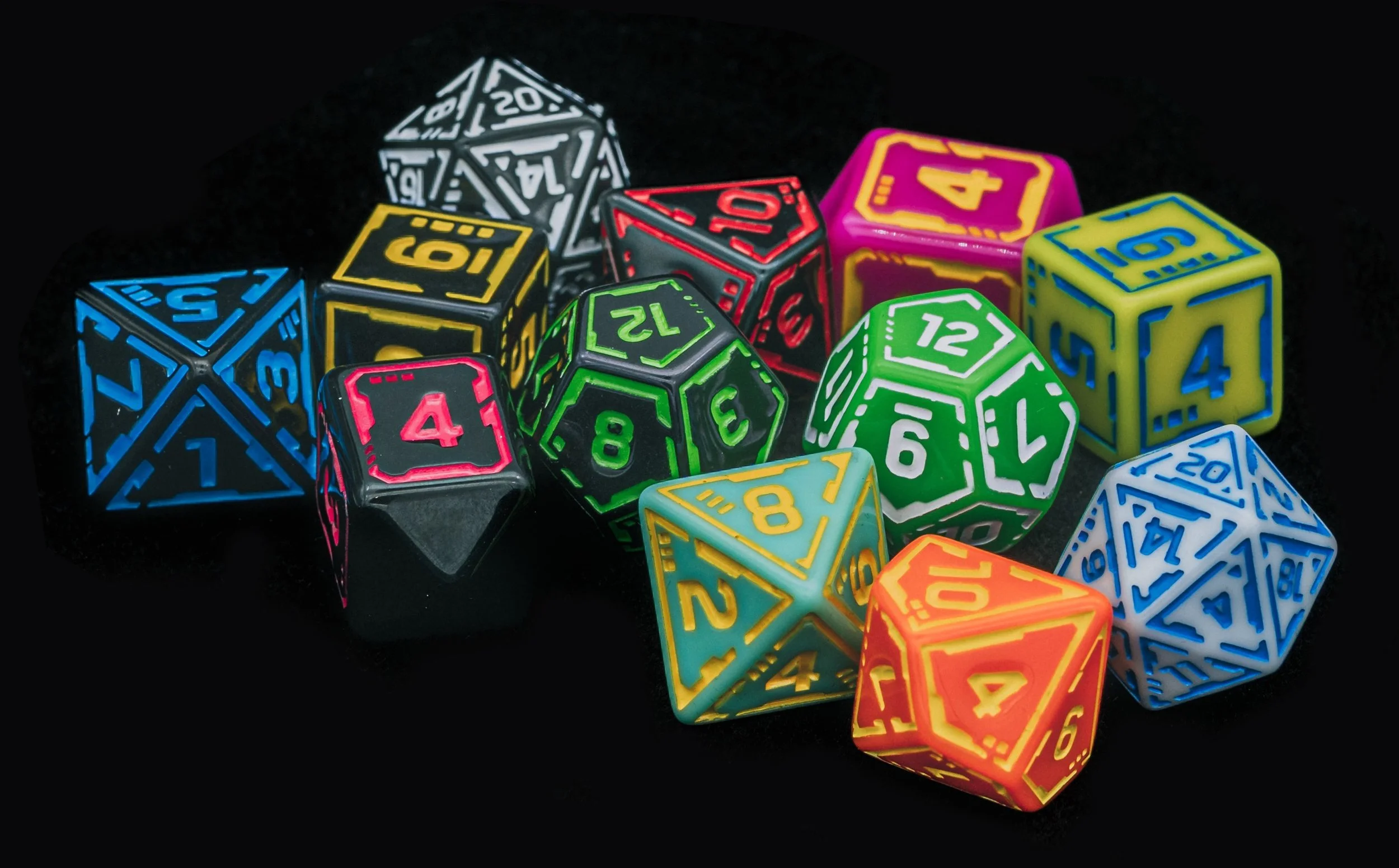
At the start of the game, six polyhedral dice sit ready: d4, d6, d8, d10, d12, and d20. These are the Gig Dice. They aren’t on the table — they’re waiting. Every single one has to be earned through attacks, through card effects, through actions that explicitly let you „take a die.“ When you place a die into your Gig Area, you’ve finished a Gig. Six finished Gigs and you win. (Seven would be an instant win — more on that later.)
So far, so simple. The twist lives in the sequence and in what the dice produce.
When a player takes a Gig Die, it gets rolled. The result counts as Streetcred — a running total of every pip in the Gig Area. A d4 delivers a maximum of 4 Streetcred, a d20 a maximum of 20. But — and this is the catch — the d20 is only allowed as the sixth and final die. It’s reserved for the sprint at the end, not the opening.
The other five dice can be taken in any order. Sounds like a minor detail. It isn’t.
Grab the d12 early and you have a lot of Streetcred fast — but only a few Gigs on the table and a long way from victory. Grab three small dice instead (d4, d6, d8) and you’re three Gigs in, halfway home — but your Streetcred is modest, and any card demanding 12 or more stays locked. Every die choice is simultaneously a resource decision and a progress decision. That makes the system structurally a resource-management problem dressed up as a win condition.
In Magic: The Gathering, mana is the resource system. Every turn you drop a land, which makes mana, which pays for creatures and spells. The win condition — opponent to zero life — is completely separate from that. Mana is a means, never an end. No Magic player wins because they have a lot of mana. They win because they converted the mana they had into the right threats. In CTCG, the resource and the win condition are the same object. The dice are your progress, and the dice are what produces the resource that fuels stronger card effects. Taking a die pushes you toward victory and unlocks options at the same time. That double effect on every single action gives the system an information density per turn that Magic only builds up across several turns.
Streetcred — the resource you never actually spend
Streetcred is a weird one. Anyone coming in from other TCGs instinctively hunts for the moment where you „spend“ it. There is no such moment.
Streetcred is a threshold resource. It accumulates, and when it hits certain values, card effects unlock — automatically, passively, without paying for anything. Armored Minotaur, for example, can destroy an enemy unit if your Streetcred is at 12 or higher. MT0D12 Flathead becomes unblockable at 7+. Cards like these check your Streetcred total the moment they activate and behave accordingly.
Which means: Streetcred isn’t mana you manage, it’s a mirror of your own board state. If you have a lot of dice and rolled high, you have high Streetcred. If you went wide with lots of small dice, you have less Streetcred despite more Gigs. Both have upsides and downsides. Both lead to different deck strategies.
One card stands out here: Yorinobu Arasaka. He is — as far as the current card database shows — the only card that references low Streetcred. He takes a penalty when his owner sits below 20 Streetcred. Sounds strange at first — why punish low Streetcred? — but it’s a proto-rubber-band element: the player who’s behind (fewer dice, less Streetcred) additionally loses efficiency through Yorinobu. Whether WeirdCo wants to expand in that direction is one of the central questions for upcoming sets.
Alongside those, there are modification cards. Jackie Welles as a Legend adds +2 to an existing die in your Gig Area — and if that push lands the die on its maximum value, you draw a card. Industrial Assembly adds +4 to a Gig Die. Those are the only two cards the current research turned up that modify dice values. The scarcity of this mechanic is striking — but more on that in Part B.
The big comparison — what other TCGs actually do
To understand why CTCG’s design approach is unusual, it helps to glance sideways at the competition. Not as a marketing slide, but as a structural analysis.
Magic: The Gathering is won by pushing your opponent from 20 to 0 life. One linear axis. There are exceptions (Commander, specific combo wins like Laboratory Maniac, alternate win conditions), but the basic principle stays one-dimensional. What made Magic the industry yardstick over 30 years is the depth on the path to the win condition. The mana curve is the heart of it: every deck plans which threats hit the table on which turn, and the whole game revolves around tempo advantage and resource efficiency. An aggro deck wants to win on turn 4, before the control deck has found its answers. A midrange deck plans the pivot for turn 5 or 6. That curve defines every deckbuilding decision. The win condition itself — life to zero — is simple; the path there is not. CTCG has a comparable curve inside its die sequence: grab small dice early and you play a different tempo than somebody waiting on the big ones. Only in CTCG that curve is the win condition.
Yu-Gi-Oh runs on the same basic principle: reduce 8000 life points to zero. The complexity lives in the rules and the combo chains, not in the victory condition. And that’s Yu-Gi-Oh’s most infamous trait: a monstrous rules density that, at tournament level, collapses into so-called OTK formats — One Turn Kills, where one player delivers the entire game’s damage through a perfectly choreographed chain of Special Summons, effect triggers, and chain links. The opponent literally just sits there. Anyone watching current competitive Yu-Gi-Oh knows the pattern: whoever draws first and builds their board wins. The game is endlessly complicated in its rules and brutally simple in its outcome. CTCG has the potential to sidestep that problem via its multi-dimensional win condition — but only if the dimensions actually become tactically relevant.
Pokémon TCG deserves a longer look, because it’s probably the closest structural relative to CTCG’s design. Pokémon’s win condition has two axes: you take Prize Cards (through enemy KOs) and the opponent can lose by decking out. The Prize Card mechanic has one crucial property that matters for the CTCG comparison: every KO gives the attacker a Prize Card and simultaneously reduces the opponent’s board presence. That’s double reward for a single action — exactly like CTCG’s steal mechanic, where you gain a Gig and your opponent loses one. Pokémon never truly solved this snowball problem; it mitigated it over decades via Supporter cards, N-effects (hand size normalizes to the Prize differential), and similar mechanics. IP strength additionally covers the problem: Pokémon sells because it’s Pokémon, not because its game balance is flawless. For CTCG that’s an instructive example — IP strength can paper over design weaknesses, but solid game mechanics make the long-term difference between a collecting phenomenon and a competitive game.
Hearthstone deserves its own paragraph, not because it’s mechanically innovative (the opposite is true), but because it demonstrates what accessibility is worth. 30 HP, one axis, done. Your mana goes up by one automatically every turn, you play cards whose costs are printed on the card, you attack the opponent. No tapping, no blocking, no stack. Blizzard put a budget behind it that would have given Magic the spins, and the result is seven million Twitch followers — multiples of what MTG Arena pulls. TCG veterans spent years dismissing Hearthstone as shallow, but the player numbers tell a different story. Simplicity sells, and it doesn’t sell because players are dumb, it sells because the entry barrier is what separates a game you actually try from a game you only look at from the outside.
Altered TCG is the interesting newcomer in this comparison. Instead of life points there’s a race — both players try to cover a set distance first. That’s also linear, but elegant: it eliminates many of the snowball problems classic TCGs suffer from, because progress in Altered can rarely be interrupted directly by the opponent. The two players advance on parallel tracks, and whoever reaches the end first wins. No theft, no direct destruction of progress. That makes Altered the conceptual opposite of CTCG: minimal interaction on the win condition versus maximum interaction.
CTCG stands next to all these games as an outlier. Three axes: quantity (number of dice), quality (pips / Streetcred), time pressure (Overtime). No other game in this list has all three at once. Whether that’s an advantage or a burden depends on whether WeirdCo actually realizes the depth of this architecture in future cards — but the systemic foundation is there.
| TCG | Win Condition | Axes | Snowball Susceptibility |
|---|---|---|---|
| Magic: The Gathering | 20 → 0 life | 1 (linear) | Medium — comeback cards exist |
| Yu-Gi-Oh | 8000 → 0 LP | 1 (linear) | High — OTK meta dominates |
| Pokémon TCG | 6 Prize Cards | 2 (KOs + deck-out) | Very high — KO = double advantage |
| Hearthstone | 30 → 0 HP | 1 (linear) | Medium |
| Altered TCG | Race to the finish | 1 (parallel-linear) | Low — parallel design |
| CTCG | 6 Gigs + Streetcred | 3 (quantity + quality + time pressure) | Open — that’s the central question |
Why mass beats class — and it’s on purpose
Here’s a calculation that explains the design principle in one shot.
Two d4 dice in the Gig Area means: 2 Gigs finished, 8 Streetcred maximum. A single d20 means: 1 Gig finished, 20 Streetcred maximum. On the path to victory (target: 6 Gigs), two d4s are more valuable than one d20 — twice as many Gigs, despite massively less Streetcred potential.
The system rewards breadth over height. Players who collect many dice reach victory faster. Players betting on high individual rolls get strong card effects — but few Gigs.
That isn’t a bug, it’s a deliberate design decision that pulls the game toward aggression and interaction. And it has a crucial consequence for the steal mechanic: stealing an opponent’s die (through an unblocked attack with enough power) punishes them twice. The attacker gains a Gig. The defender loses a Gig. Net swing: two Gigs on a win condition of six. A single successful steal shifts the game by a third.
That makes steal attacks the single strongest tool in the game — and blockers a mandatory defensive commitment. Skip blockers and you bleed dice. Just block and you go nowhere. The fundamental tension between attack and defense emerges organically from the design, with no separate mechanic required to glue it on.
Compare it to Magic: combat there is symmetric — attackers and blockers trade damage, both creatures can die, and the result is often just an exchange of resources. In CTCG a steal is fundamentally asymmetric: what the attacker gains is exactly what the defender loses. No trade, no chipping down, just a direct swing. That turns every combat into a zero-sum play with high stakes. Whether that’s healthy for a long-term metagame is an open question — but as a design decision, it’s consistent, because it actively punishes passive playstyles.
The cards that show the system at work
Four cards from the Alpha Kit illustrate the system better than any abstract explanation.
Armored Minotaur is a bread-and-butter example of Streetcred as an activation condition. At 12+ Streetcred, he can destroy an opposing unit. That’s board control tied directly to your own game progress. The more dice you’ve collected — and the higher the pips — the stronger this card gets. If you play a slow, high-roll plan, Armored Minotaur comes online early. If you play wide, you wait until all those small dice sum up to enough Streetcred.
MT0D12 Flathead shows Streetcred as enabler. At 7+ Streetcred he becomes unblockable. It’s a weak unit that turns dangerous via a minimal Streetcred threshold — and 7 Streetcred is reachable early, even with small dice. In the Alpha environment this is one of the first cards to unlock its full potential. What that says about the calibration of the Alpha thresholds is part of the critique Part B will take apart.
Jackie Welles is the most interesting card when it comes to system depth. He’s a Legend — a card with special conditions to play — and he modifies an existing die by +2. If that push lands the die on its maximum value (so, a d6 landing on a 6 after the +2), you draw a card. That’s resource efficiency on two levels simultaneously: more Streetcred, plus a draw effect as a bonus.
What Jackie does on the table is something the other Alpha cards don’t yet offer: he asks a question. Which die do I modify? The d4, if it’s sitting on 2 or 3, for a realistic shot at the max? The d12, because I desperately need 12 Streetcred for Armored Minotaur, even with a low chance at the bonus? Or the d6 currently on 4 — Jackie pushes it to 6, the bonus triggers, I draw a card and top up my Streetcred at the same time. Those are real decisions with concrete consequences. That’s what good TCG design looks like — cards that don’t play themselves, but ask you to weigh a call.
Yorinobu Arasaka is the weirdest of the four. He’s strong — but he gets worse when your Streetcred sits below 20. That’s a punishment for low progress, not a reward for high. In practice it means: playing Yorinobu commits you to a high-roll path where you either build Streetcred fast or keep him in hand until the right moment. He’s the only card I found that hints WeirdCo has thought about low Streetcred values as a design-relevant variable — and that’s a sign of systemic thinking that reaches beyond the Alpha cards.
Part A, wrap-up
The Gig/Streetcred system is structurally the most ambitious win-condition design a TCG has put on the table in years. Three parallel axes, resource and victory condition in the same object, an organic tension between attack and defense with no bolted-on extra rules — mechanically, it’s cleanly constructed.
At the same time, the Alpha implementation of the system is thin. Two cards with die modification. Streetcred thresholds that trigger fast and automatically. One single proto-rubber-band effect (Yorinobu). The theoretical design space is huge; the current exploitation is modest.
Whether that’s an Alpha problem or a fundamental design flaw — that’s the question Part B answers.
PART B — POTENTIAL AND RISKS
From deckbuilding to the last die — five moments that decide the game
Anyone building a CTCG deck starts, functionally, already in the middle of the game. The first question you have to answer isn’t a question about cards — it’s a question about numbers. Which Streetcred thresholds am I even chasing? If you build around Armored Minotaur, you need 12+ Streetcred. If you bet on MT0D12 Flathead, you’re fine with 7. This deckbuilding moment is decision point one, and it matters more than it looks at first glance, because it quietly dictates the entire later die strategy. In the deck list you already commit to which die combinations you’re aiming for — and with that, how aggressive or defensive you have to play in the early rounds.
Decision point two arrives right after turn one: which die do I take now? The polyhedral sequence doesn’t force you into a fixed order — with one exception: the d20 is always last. Everything before it is open. Early small dice (d4, d6) push the Gig count up fast but barely move Streetcred. Late big dice (d12) unlock thresholds but leave you stuck at low Gig counts for a long time. That sounds like simple weighing — it isn’t, because your opponent is also playing. Reach three Gigs fast and you can be stolen from. Sit on a few big dice and you’re short-term safer but further from victory.
Decision point three is the brutal one: fight or steal? When one of your units attacks unblocked, you always get the choice — destroy the enemy unit, or steal a die. On paper, steal always looks better, because it hurts twice: you gain a Gig, your opponent loses one. In practice the call is often less obvious than it seems.
Picture this: you’re at three Gigs, your opponent is at four. He has an Armored Minotaur with 12+ Streetcred on the board — a card that can destroy one of your units every turn. Your attacker comes through unblocked. Do you steal a die now (3 vs. 3 Gigs, tied), or do you kill the Minotaur (3 vs. 4 Gigs, still behind, but his most dangerous card is gone)? The steal puts you closer to winning. The fight stabilizes your board. The right answer depends on your hand, your remaining blockers, and your deck plan. Exactly these moments make the fight-or-steal decision the central tactical pivot of a match.
Which brings us directly to decision point four. Assigning blockers isn’t a passive decision. Going full defense with every unit keeps you safe from steals — but it also means you don’t move forward. You spend resources on protection and pay in initiative. Every die a blocker protects is simultaneously a die whose pips count for Streetcred thresholds. You’re not just defending your progress, you’re defending your access to card effects.
Decision point five is the timing of effect cards like Industrial Assembly, which adds +4 to a pip. Played early, it might barely open a threshold that makes a particular card activatable. Played late, it can be the final push to victory — or a tactical response to an incoming steal, making a die worth more to you than it’s worth the opponent’s trouble to grab. The timing window on modification cards is narrow and context-dependent. There’s no universal answer.
These five moments run through every match. They’re not isolated — they feed into each other. Miscalculate at point one and you’ll feel it by point two. Get too aggressive at point three and you’ll see it served back at point four. That’s the architecture of a system that can actually work — given enough deep card material to charge those decisions with real consequences.
The interaction points — what the system can do, and where it’s napping
Theoretical decision points are one thing. The question is whether the existing cards actually fill those points with content. To judge that, it helps to look at which interaction axes the system has — and which of them the current Alpha pool already uses:
| Interaction Point | Mechanic | Potential (1–5) | Current Usage | Assessment |
|---|---|---|---|---|
| Streetcred thresholds | Card effects at X+ Streetcred | 5 | 2 — thresholds set too low | Core problem in Alpha |
| Die-pick order | Which die when | 4 | 1 — barely tactically relevant | Design space exists, still empty |
| Gig theft | Steal attacks | 4 | 3 — actively used | Works, but tends toward binary |
| Power scaling | 10+ PWR = steal 2 Gigs | 3 | 2 — few cards use it | Needs more card material |
| Die modification | +X to pips, exact values, max values, matching types | 5 | 2 in Alpha — first spoilers show 4+ new axes | Design space being actively opened up (see update below) |
| Blockers | Prevent steals | 3 | 3 — used, but criticized | PCGamesN: slows the game with no payoff |
| Overtime | Forces endgame on stagnation | 2 | unknown | Safety net, not a feature |
What this table shows: the Streetcred thresholds and the die modification axis had the biggest unused design space in Alpha. That was a problem — but the first card spoilers beyond the Alpha Kit suggest WeirdCo is opening up exactly those.
Update: the Alpha is misleading — the spoilers deliver
If you only know the Alpha decks, you could be forgiven for thinking WeirdCo forgot the most interesting design space in their own system. Two cards modifying pips — that’s it? Not quite.
The first card spoilers paint a different picture. Hanako Arasaka cares about exact die values — not just „high enough,“ but „exactly right.“ Goro Takemura wants to see two matching die types, which opens an entirely new deckbuilding dimension. Kerry Eurodyne rewards a Gig landing on its maximum value with card advantage. And the Brain Dance archetype around Evelyn Parker manipulates Gig values up or down deliberately.
That’s at least four different axes on which dice suddenly become relevant: threshold, exact value, max value, matching type. The Alpha pool was obviously just the surface.
As ^/00gv5 | #1 saka truether put it in the German CTCG Discord: „The system doesn’t have to be complicated and exclusionary just because it allows depth and complexity. Chess is simple, but complex.“ The question isn’t whether the design space exists. It does. The question is whether WeirdCo plays it consistently enough.
The 33-percent swing — how snowball works in CTCG
Every TCG has some form of momentum problem. Who’s ahead has resources. Who has resources gets further ahead. That’s game theory, not a CTCG quirk. But CTCG has one property that makes it structurally more vulnerable than most of its competitors — and it comes directly from the win condition.
When Player A steals a die from Player B, two things happen at the same instant: A has one more Gig, B has one less. That’s a net swing of two Gigs on a six-Gig win condition. One successful steal shifts the game by 33 percent.
Game design theorist Sacher over at StarCityGames once described the snowball effect like this: „The first person to gain a small edge is more likely to parlay that into a larger and more significant advantage.“ In CTCG several factors pile up to favor snowball: steals hurt twice. Streetcred thresholds reward whoever has more dice — five dice hit higher thresholds more easily than three. And whoever hits higher thresholds gets access to stronger card effects. The leader is rewarded on three axes at once.
To make it concrete: picture a game where both players sit at two Gigs. Player A attacks, comes through unblocked, and steals a d8 from Player B. The score is now 3 vs. 1. Player A suddenly has more Streetcred (the stolen die’s pips add to their total), better card effects (more Streetcred = higher thresholds reachable), and more tempo (only three Gigs from the win instead of four). Player B, meanwhile, doesn’t just have one fewer Gig — he has less Streetcred, which means cards like Armored Minotaur stay asleep longer for him. And because B is now behind, he has to play more aggressively, which makes him more vulnerable to further steals. The first steal creates an undertow that makes the second more likely.
Pokémon TCG knows this problem. Prize Cards there have a similar double-punishment structure: a KO gives the attacker a Prize Card and simultaneously reduces the opponent’s board. Pokémon never fully solved it. Some would say Pokémon learned to live with it. The best-selling TCG in the world still runs — snowball alone doesn’t kill a game.
But Pokémon has something CTCG is still missing in Alpha: decades of metagame that organically produced anti-snowball tools. Supporter cards like N, which force both players‘ hand sizes to match their remaining Prize Cards — suddenly the leader has fewer cards than the one behind. Boss’s Orders for targeted removal. Counter Catcher-style mechanics giving the trailing player a shot at flipping tempo. That emerged over 25+ years and hundreds of sets. WeirdCo is in week one.
What still remains is the question of whether the 33-percent swing per steal is too strong for a game built on six Gigs as win condition. On a 20-point win condition, a steal would be a minor setback. On six, it’s structurally significant. That’s not an accusation — it’s a design consequence WeirdCo is aware of and has to work with.
What the game has, what’s missing, and what’s thinkable
The catch-up toolbox in CTCG’s Alpha is suspiciously empty. What’s there: blockers that prevent steals. Yorinobu Arasaka, the only card I could find that explicitly references low Streetcred. And the Overtime rule that kicks in when both players stagnate and nothing moves forward.
The problem with blockers as the primary catch-up tool is one PCGamesN flagged directly: they slow the game down. Players who fall behind wall up every unit on defense, which means they functionally stop playing. That isn’t satisfying and it only solves the problem temporarily. A blocker protects a die for one turn. It doesn’t give the trailing player a resource back, and it doesn’t give them a path forward.
Yorinobu is more interesting. The card references „below 20 Streetcred“ as a condition. That’s approximately rubber-band design — a card that explicitly addresses certain game states instead of ignoring them. But it punishes low Streetcred more than it helps the player recover. Proto-mechanism, not a full solution.
What isn’t there, but has been road-tested in other systems: cards that explicitly get stronger when your opponent has more Gigs. That’s not theoretical wishful thinking. Duel Masters — the TCG Wizards of the Coast developed in parallel to Magic for the Japanese market — perfected exactly those mechanics over the years. Duel Masters has „Shield Trigger“ cards that the defender can activate when their shields are destroyed. The further behind you are, the more triggers you potentially have ready. The result: even a player who’s been dominated for five rounds can flip the game with a well-timed shield trigger. That mechanic kept Duel Masters popular in Japan for decades, because it doesn’t punish aggressive strategies — it gives the trailing player a fair shot at answering them. CTCG has the structural prerequisites for something comparable: cards that get cheaper at low Gig counts, or stronger against high opposing Streetcred. The axes are already in the system. It just needs cards that use them.
What’s also thinkable: die interaction with the opponent beyond theft. Lowering their pips, swapping dice, forcing re-rolls. All of that would massively increase the tactical depth of the die-choice decision. Right now, once taken, a die is effectively frozen — apart from the two modification cards in the pool. That’s a simplification that makes sense in a tutorial product, but is too thin for the full game.
And then there’s the design space almost nobody talks about: conditional steals. Cards that, when you’re behind on Gigs, don’t grab one die but two. Or cards that prevent a steal and simultaneously hand the defender a small bonus — a draw, a Streetcred bump, something. That wouldn’t weaken steals (they need to stay strong, because the game is built on interaction), but it would give the trailing player more options than „block and pray.“
Why the alpha reviews are simultaneously right and painting the wrong picture
The press reactions to CTCG so far have been mostly positive. PCGamesN played the Alpha Kit and described how Streetcred thresholds barely matter in practice — you hit 7+ and even 12+ within a few turns almost automatically. The Magic Rain boiled it down to the core formula: do you have a unit to steal with and a blocker to protect with? Yes, you win. No, you lose.
Both descriptions are precise. Neither captures the full picture.
The Alpha Kit consists of exactly two preconstructed decks: „The Heist“ and „Embracing Power.“ There’s no deckbuilding. No metagame. No way to test the system to its limits, because the system in that environment simply cannot be fully expressed — any more than you can judge Magic from a duel deck or Yu-Gi-Oh from a starter set off a supermarket shelf.
The Streetcred thresholds in Alpha are obviously calibrated for accessibility. A newcomer meeting polyhedral dice and a multi-dimensional win condition for the first time shouldn’t also have to fight to hit their thresholds. The low numbers (7+, 12+) are pedagogical decisions. They tell the newcomer: „Look, you have Streetcred, and cool things happen because of it.“ They say nothing about the depth potential of the system.
What the reviews do land as a legitimate signal: PCGamesN’s blocker critique is accurate and structural. If blockers are simultaneously the only catch-up mechanic and the only defensive tool, then they have a design problem that more cards alone won’t fix — unless future cards give blockers additional functions beyond passive waiting. A blocker that draws a card when it blocks, or modifies a die, would be an elegant solution. A blocker that only blocks stays a problem.
The Outer Haven phrased it in their review as „ideal for TCG veterans“ and warned casual players might be overwhelmed by the „theft swinginess.“ That’s a sharper observation than most Alpha reviews manage, but it scratches the surface. Theft swinginess isn’t an inherent design flaw — it’s a tuning parameter. The question isn’t whether steals are too strong; it’s whether the system gives enough tools to deal with them.
Part B, wrap-up: a system waiting for its cards
CTCG has baked more tactical depth into its interaction points than most TCGs on the market. The five decision points — from deckbuilding through die choice through effect timing — are real and would demand actual strategic work in a fully-fleshed card pool. The base structure holds.
But the current reality is a different beast. The thresholds are too low for tactical die selection. Die modification is nearly absent. Catch-up mechanics are rudimentary. The snowball risk is structurally baked in and currently not sufficiently contained. And the reviews that describe all of this are completely right — they just aren’t describing what the system could be, they’re describing what it is in Alpha state.
CTCG isn’t a badly designed game with the wrong approach. It’s a well-designed system that doesn’t yet have the cards its design deserves. Whether WeirdCo walks that road consistently — higher thresholds, more modification, real rubber-band design — won’t be answered in Alpha. It’ll be answered in the first two or three sets.
PART C — VERDICT
Complex or just complicated?
There’s a distinction the TCG community rarely makes explicit, even though it explains a lot. Complicated means: lots of rules. Complex means: lots of decisions that actually matter. Chess has 16 pieces per side, clear move rules, no randomness — and after millennia, its decision depth still isn’t exhausted. Yu-Gi-Oh has thousands of cards with paragraph-long effect text, rule exceptions on top of rule exceptions, chains and chain links — but at entry level there are barely any real decisions, because the optimal play line is largely determined by board setup, and without background knowledge you simply can’t tell why you just lost.
Where does the Cyberpunk TCG sit in this question? In Alpha state, unfortunately closer to the complicated end — but for different reasons than Yu-Gi-Oh.
In Alpha, CTCG has a considerable rules density: polyhedral dice in a fixed order, Streetcred thresholds, steal attacks, blocker assignment, Legends, Eddies as a resource. That’s not nothing. Only most of it runs automatically. The 7+ and 12+ Streetcred thresholds are hit in a few turns anyway. The steal-or-fight call mostly collapses into „steal if you can.“ Blockers get set because you have to, not because you’re choosing between multiple meaningful options.
That sounds harsh, but it isn’t a foundational critique of the design. The Streetcred system has the architecture for real tactical depth built in. Die-choice timing, weighing early small dice against late high dice, knowing when to fire a die modification effect for maximum effect — all of that exists in theory. In the Alpha card pool, those gears just aren’t meshing yet.
What CTCG needs to shift from complicated into complex isn’t a redesign. It’s enough to introduce higher thresholds. If a card effect only fires at 25+ or 30+ Streetcred, suddenly every single die choice becomes meaningful. Do I take the d8 now for faster Gig progress, or wait on the d12 because I have to trigger the effect on my key card? That’s the depth the system has coiled inside it. It just needs to be unlocked.
The Hearthstone warning
WeirdCo is sitting in a trap they built themselves through their own success.
Cyberpunk 2077 has sold over 30 million copies. That’s the theoretical audience for a Cyberpunk card game — or at least the dream of it. The problem: the overwhelming majority of those 30 million aren’t socialized in TCGs. They know how to drive through Night City and hack Arasaka. They don’t know what a mana curve is, and they won’t start learning if the entry barrier is too steep.
Hearthstone understood this for a long time. 7 million Twitch followers versus Magic: The Gathering Arena’s roughly 1 million — those are numbers that speak a clear language. Hearthstone bet on maximum accessibility: no tap mechanic, no stack rules, a clean mana system that ticks up by one every turn automatically. TCG veterans dismissed Hearthstone as shallow for years. The user numbers never backed that up.
Pokémon found the middle ground and became the best-selling TCG in the world because of it. The core mechanic is simple enough for kids: attach energy to Pokémon, attack, collect Prize Cards. An eight-year-old understands that. But the competitive overhead for tournament players is still substantial — tempo math, deck thinning, prize mapping (planning which Prize Cards you pull and when), engine-building across multiple turns. IP strength plus easy onboarding plus deep endgame — that’s a formula almost no other TCG has replicated.
WeirdCo is trying something similar, but with a specific problem: the Cyberpunk TCG, judging by its design vocabulary, aims at TCG veterans. The rules density in the Alpha Kit, the Streetcred mechanic, the polyhedral dice — all of that signals „we mean business.“ At the same time, the thresholds are calibrated so low that experienced players feel under-challenged while newcomers struggle with the theft swinginess multiple reviews cite as a frustration point. You end up in no man’s land: too many rules for casual players, too few real decisions for TCG sharks.
This doesn’t have to be a permanent problem. Pokémon took years to find its balance. Magic took five years and a near-bankruptcy before it calibrated its business model and game depth. But WeirdCo should be clear about which audience they actually want to target at full release — and then tune the card design accordingly. A game that tries to be for everyone simultaneously ends up being for nobody.
What WeirdCo has to deliver now
Five points that aren’t a wishlist, but structural necessities if the system is going to realize its potential.
First: higher Streetcred thresholds. Cards that only activate at 20, 25, or 30 Streetcred fundamentally change the character of die selection. Suddenly the order you take dice in isn’t incidental. The d12 turns into a tactical target instead of an optional bonus. Deckbuilding decisions sharpen: do I focus on lots of small dice for Gig quantity, or specialize in high dice for threshold effects? That question has to be tangible during play.
Second: cards that reference the opponent’s Streetcred. Yorinobu Arasaka is the only card in the known Alpha pool that uses a „below X“ state — and even that is a downside for its own player, not a weapon against the leading opponent. Rubber-band design is the obvious move here: cards that get stronger or cheaper when the opponent has more Gigs. That would directly address the snowball problem without damaging the steal mechanic.
Third, the game needs more die modification. Right now we have Jackie Welles with +2 on existing dice and Industrial Assembly with +4. Beyond that, nothing. Yet manipulating pips is theoretically the most elegant part of the system — you don’t need new dice, you make the existing ones better. More cards in this design space, possibly in the other direction too (lowering opponent dice, swapping dice, forcing re-rolls), would open a completely new tactical layer.
Fourth: anti-snowball cards, explicitly designed as such. One successful steal shifts the game by 33% of the required win condition. That needs counterweights. Cards that get stronger behind. Effects that get cheaper at low Gig counts. Comeback mechanics exist in almost every mature TCG; CTCG needs them too.
Fifth: the blocker system. PCGamesN named it directly in their Alpha review — blockers slow the game without enriching it. A blocker that only blocks is a passive resource that throttles pace. If blockers started gaining extra effects when they parry a threat — a Streetcred bonus for a successful block, a draw when blocking a steal, maybe even a counter-attack trigger — every attack sequence would instantly get deeper. Then you’d block not because you have no other choice, but because you’re actively setting up a situation. Blocking turns from an emergency measure into a tactical decision.
7/10 as a framework, 4/10 as an experience
The Gig/Streetcred system deserves a split verdict, because it’s two different things at the same time.
As a game design framework, it’s the most ambitious win-condition design a new TCG has put out in years. Combining three parallel axes — quantity, quality, time pressure — into a single mechanical structure is a smart call. No established TCG does it that way. Magic took 30 years to build its mechanical depth; CTCG laid the conceptual foundation from day one. That earns a 7 out of 10 — and the three missing points aren’t a critique of the concept, they’re placeholders for potential that still has to be realized.
As an actual play experience in Alpha state, the score is a 4 out of 10. The mechanics are there, but they don’t mesh. Decisions that could be meaningful aren’t. The game feels predictable after a few rounds — not because it’s badly designed, but because the card pool is too small and the thresholds too low to activate the existing depth. That’s not a fair verdict on a finished product, but it’s the reality of the Alpha Kit.
The $13 million Kickstarter — raised in just nine days — shows the community is willing to buy the potential. The announced five-year roadmap shows WeirdCo wants to take their time. The engine is built. The question is when it gets up to speed.
What the full release can change
TCGs live and die with their card pool. That’s true for Magic, it’s true for Pokémon, and it’s especially true for a game that leans as hard on a single mechanical system as CTCG does.
At full release, the preconstructed Alpha decks get replaced by player-built decks. And that changes everything. Suddenly there are real deckbuilding decisions around Streetcred thresholds. Suddenly a metagame emerges where some strategies prioritize the d12 and others bet on Gig flood. Suddenly die modification cards are either indispensable or situational — and that verdict will shift over months as the meta evolves.
If WeirdCo addresses the five points from this analysis in the first regular expansions, the Streetcred system has the ingredients to become the defining feature of a new TCG in years. If not, it stays an interesting design approach that never reached its peak.
Quick Hacks — the missing interaction layer
A TCG without instant-speed interaction is like Night City without corpo intrigue: technically functional, but missing the tension between turns. The Alpha decks had this problem. Everything played out cleanly in sequence, no reason to watch your opponent during their turn.
Cyberpsychosis changes that. The card carries the „Quick Hack“ subtype and introduces a speed mechanic that lets you play cards during the opponent’s turn. Comparable to Instants in Magic — only here the Cyberpunk flavor lands perfectly. A Quick Hack that temporarily pumps an enemy unit and kills it at end of turn? That isn’t just mechanically interesting, it feels like cyberpsychosis.
If WeirdCo builds out this subtype consistently, it solves two problems at once: the downtime during the opponent’s turn disappears, and the game gets a bluffing layer the Alpha decks completely lacked. Your opponent has two open Eddies and a card in hand? Could be a Quick Hack. Could be nothing. But you have to factor it into your decision.
Deepest mechanic in the TCG scene?
We started with the question of whether the Gig/Streetcred system really holds up to the community hype.
Let me put this personally: over the last twenty years I’ve seen enough TCGs show up with a fat IP attached and offer nothing mechanically new. The Decipher Star Wars TCG, the World of Warcraft TCG, the Final Fantasy TCG — all games with massive fanbases that mechanically took the path of least resistance and essentially reheated existing systems in new clothes. Some survived, most didn’t, and none of them changed the industry.
The Streetcred system is different. The multi-dimensional win condition, a resource system that’s simultaneously the victory condition, the polyhedral die sequence as a tactical decision structure — nobody has built this before. And I say „nobody“ because the design space is so obviously there that you wonder why nobody thought of it ten years ago. The answer is probably: because it’s hard. Balancing three axes at once is exponentially harder than one, and the temptation to play it safe is strong.
What WeirdCo has to prove in the next sets is that they take their own system seriously. That they’re willing to push thresholds higher, build rubber-band effects, and open the blocker system up, even if that means the game gets more demanding for casual newcomers. The Kickstarter backers didn’t pay $13 million for another TCG-lite. They paid for a vision, and that vision has three axes, not one.
My verdict: right now the Cyberpunk TCG is neither the deepest system in the scene nor an overcomplicated rules monster. It’s a system with conceptual depth that’s waiting for its own card material. Structurally yes, practically not yet. I’m ready to buy the full release — not because the Alpha convinced me, but because the foundation is good enough that I want to see what gets built on top.
WeirdCo got a $13 million vote of confidence. That’s more than most indie TCGs earn in their entire lifetime. That money is enough for multiple sets, for organized play, for a digital version. But no budget in the world can replace what has to be delivered now: cards that take the Streetcred system seriously. Cards with 25+ thresholds. Cards that reward the trailing player. Cards that don’t just add to dice but manipulate them, swap them, flip them over.
I’m standing in the front row waiting for it. As a Night City Legend backer I’ve given enough faith-forward cash to have earned the right to see results. And if the first regular sets drop and the Streetcred thresholds are still stuck at 7+ and 12+, then this analysis will have been a pretty accurate warning.
But I don’t think that’s what happens. Anyone who builds a system that serves three axes at once has understood what depth means. Now they just have to prove it.
Matching products on Amazon*
*Affiliate links to Amazon Germany — ships internationally. If you buy through these, we earn a small commission. Price is the same for you.
Sources
- Cyberpunk TCG — Gameplay Guide (official site)
- RipperDeck.gg — Full rules
- WeirdCo Developer Blog — Insights: Gig Dice
- Cyberpunk TCG — Card database
- PCGamesN — Cyberpunk TCG Alpha Kit Review
- The Magic Rain — Cyberpunk TCG First Look
- Temple of Geek — Interview with the Creators
- Wargamer — Kickstarter Interview: Five-Year Roadmap
- StarCityGames — The Snowball Effect: Advantage in Magic (Part 2)
- BoardGameGeek — Rubber Banding and Other Balancing Features
- Altered TCG — How to Play (comparison reference)
- GosuGamers — Cyberpunk TCG raises $13 million in nine days