Four Colors, Four Souls: The Cyberpunk TCG Color Pie Explained
AI Translation Note
This English version was rewritten with AI assistance from the original German article and the English source transcript. McDarby quotes are pulled directly from the original Cyberdeck Podcast Ep8 audio. Human review applied. Read the German original here.
Why Every Serious TCG Needs a Soul
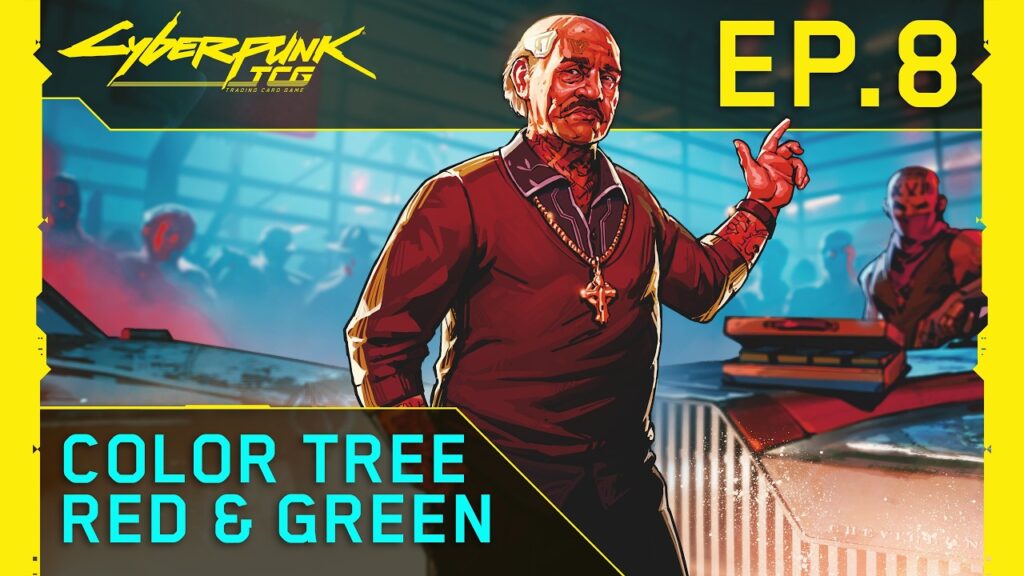
Curry said it almost in passing during Cyberdeck Podcast Episode 8, and it’s the kind of thing you nearly miss on first listen: „Every time I’ve been play testing, I’ve been playing a card, it’s like, man, this really feels like the character from Cyberpunk.“ He meant it as a compliment to WeirdCo’s design team. But hang on. How does that feeling actually happen? Why does a card feel like its character instead of just a number on cardboard? Most new TCGs never seriously ask.
The answer is a color pie. And for the Cyberpunk TCG, one man just talked about it publicly. Someone who knows exactly what he’s building.
David McDarby has been Lead Designer at WeirdCo since February or March 2026. Before that: eight years at Wizards of the Coast, game designer for MTG Arena, card credits on Kamigawa: Neon Dynasty, Outlaws of Thunder Junction, Murders at Karlov Manor, plus MTG × Fallout, a post-apocalyptic genre crossover with clear thematic contact points with the Cyberpunk world. A resume like that doesn’t end up at WeirdCo by accident.
What McDarby laid out in Ep8 goes well beyond „here are four colors.“ He exposed a design philosophy that shows how WeirdCo thinks about the Cyberpunk TCG as a system where every mechanic belongs to the soul of its color instead of floating around in a pile of cool cards. Mark Rosewater systematically documented this approach for Magic: The Gathering starting in 2002, revising it multiple times since, most recently in 2021 with the Mechanical Color Pie Update. McDarby is now doing something comparable for a game that hasn’t even released Set 1. Hubris or genuine design competence? After Ep8, I’m betting on the second one.
The result is a four-color structure: Red, Green, Blue, and Yellow. Deliberately smaller than MTG’s five colors, Lorcana’s six inks, or Flesh and Blood’s roughly a dozen classes depending on how you count. „Limited“ is McDarby’s own word. He says „we’ve limited them to four colors“ and means it actively. Four colors means sharper identities, fewer overlap edge cases, faster onboarding for Cyberpunk 2077 players who’ve never touched a TCG. It also means each color carries more mechanical real estate. With only four slots, nothing can afford to be narrow. Every color holds a disproportionately large piece of the design space.
Before I go through each color, an honest note on the data situation. Blue and Yellow only got brief coverage in Ep8. Episode 9, landing May 22, 2026, is where both colors get their full treatment. So the Blue and Yellow profiles in this article are shorter and more speculative than Red and Green. I’d rather stay precise than pad the word count with material a future episode has to deliver. That’s just bad journalism.
One more note on method: I’m working from what McDarby explicitly said in Ep8, from the card reveals at cyberpunktcg.com, and from CP2077 lore where it makes the mechanics legible. Where the material runs dry, I speculate, and I mark speculation as speculation. There’s enough real substance in this game that none of it needs to be invented.
If you read our earlier deep dive on Zapp’s game design philosophy, you already know the basic frame: WeirdCo designs systems, not individual cards. The color pie is the foundation of that system. Here’s what we know after Ep8.
Red: Crank It Up to 11
The card is called Royce, and the subtitle already tells you everything: „Don’t Call Me Simon.“ Five cost, four power, two red RAM, a removal effect that scales with street cred. When WeirdCo first showed it, experienced TCG players basically had a home game: aggressive body with built-in removal, more dangerous the more momentum your board has already built. Familiar territory, and deliberately so.
McDarby calls it „Maximize.“ Each color in the Cyberpunk TCG is defined, according to him, by a single state, one adjective, one place where that color is happiest. For Red, that’s Maximize. Highest numbers, biggest die values, strongest body on the table, escalating pressure. A reactive aggro color might treat aggression as a tool you deploy when the situation calls for it. Maximize aims higher: be the loudest number when the game ends, and never lift off the gas getting there.
„Each color in the Cyberpunk TCG is defined by one state, one adjective, one place that makes it happy. And Red’s is maximize. Red wants to crank it up to 11, you know, all the way. Get there. Really emphasize the punk in cyber punk.“
— David McDarby, Cyberdeck Podcast Ep8
„The punk in cyberpunk“ is a sharp design decision. MTG Red is the most iconic color in TCG design full stop: Lightning Bolt, Goblin aggro, Haste, Direct Damage. Anyone who’s ever played any TCG recognizes that energy immediately. WeirdCo is using that as an onboarding tool. New players who pick up a Red faction for the first time shouldn’t feel lost, so Red’s learning curve is intentionally shallow, and the other colors can surprise with their actual complexity once players have a foothold.
The existing reveals carry this logic through consistently. Kerry Eurodyne as a legend (4 cost, 3 power) is straightforward pressure, a rocker god who measures success in Night City by volume, not finesse. Carnage at the Coliseum costs six and scales its discount on gig values of 8 or higher: the more tempo you’ve built, the cheaper the next escalation. Classic snowball design. Once Red gets ahead, every subsequent Red play gets incrementally easier, making the deficit exponentially harder to overcome. Armored Minotaur (per the cyberpunktcg.com reveal page) has a removal threshold gated by street cred: enough reputation on the street, and you can wipe a problem with a single motion.
Street cred as a scaling resource is where Red diverges from MTG Red. In MTG, Red typically scales with spells cast (Storm), creature count (swarm synergies), or clock management (Burn that runs out of fuel by turn five). In the Cyberpunk TCG, street cred makes a more direct setting statement: respect on the street translates directly to firepower. Royce scales with street cred because Maelstrom gangers operate by rank. The higher your standing in the hierarchy, the more backup you bring. Here the flavor is shaping the mechanics, and that’s exactly what Curry meant when he said a card feels like its character.
The Maelstrom connection is the strongest flavor anchor for Red in all of Cyberpunk 2077. Maelstrom is the cyberpsychosis-driven gang faction rooted in the Northside Industrial District in northern Watson: raw violence, military borg-corpo aesthetics, maximum body modification as a display of power, no interest in finesse or long-term positioning. Royce as a Maelstrom leader on a Red card writes that association directly into the color identity. 6th Street (patriotic gang-militia in Arroyo, „order through violence“ as their creed, utterly convinced they’re the good guys) and the Animals (fight-sport-obsessed naturalist gang from Pacifica who refuse cyberware and train on pure muscle mass) sit alongside Maelstrom as plausible Red factions. Aggressive, body-focused, direct, always in the moment.
Carnage at the Coliseum carries an Easter egg that hard CP2077 players will catch immediately: the Coliseum references the Animals fight club in Rancho Coronado, Santo Domingo. One of the most atmospheric and most overlooked locations in the game, where violence gets staged as sport and strength becomes performance. A Red card pointing at the place where brutality becomes spectacle, because Red understands violence as a statement rather than just a means to an end. A fine distinction, and it’s sitting right there in the card art.
For CP2077 players, there’s a second image for Red: the Streetkid lifepath. Grew up in Night City’s streets, no corpo backing, no academic hacking education. Just the capacity to take more punishment than the guy across from you and hit back at the right moment. Mechanically that maps to Red, even though McDarby explicitly positioned V as Blue (V Corporate Exile = Corpo lifepath = Blue). My speculative extension: Streetkid V would carry Red, Nomad V might swing between Green’s precision and Red’s directness depending on how they’re played. Deduction from the lifepath system, not a McDarby statement. If WeirdCo actually bakes lifepath differentiation into the pie, that’s the game mirroring CP2077’s character creation system in color identity rather than ignoring it. I’d love that.
One technical point that will matter for competitive play: the Maximize slogan means street cred is a mandatory scaling parameter for Red, no optional bonus resource. Red decks that don’t actively build street cred are playing their own color identity against themselves. The mechanics tell the same story as the flavor: no respect on the street means blunt weapons on the table too. Royce removal at low street cred is strictly worse than Royce removal at high street cred. The card forces you to play the character it depicts.
One place Red visibly diverges from its MTG counterpart: Haste (attacking on the turn a unit enters play) lives in Green in the Cyberpunk TCG. „Attack the turn it’s played“ is Sandayu Oda’s Green ability. Red gets the biggest body and the highest numbers; Green gets first initiative. MTG veterans who instinctively expect Red units to always move first will have to recalibrate. In MTG, Haste belongs to Red because MTG Green has Trample as its initiative tool. In the Cyberpunk TCG, Green has different size mechanics, so Haste migrates one color over.
A note on the card selection: WeirdCo’s Red reveals so far cover three distinct play roles. Legends (Kerry, Royce) as primary threats, scaling spells (Carnage at the Coliseum) as escalation tools, and tactical pivots (Armored Minotaur) as situational options. A complete color toolkit in miniature. You could build a functional Red deck from just these reveals, which suggests WeirdCo is selecting reveal cards systematically along a color’s mechanical range rather than just showing the flashiest stuff.
One more dimension of the Maximize slogan that takes a moment to surface: „Maximize“ describes not just a play style but a risk disposition. A Red deck betting on street cred scaling is investing early in number-building without an immediate concrete return. That’s a belief system. If I escalate long enough, the numbers become large enough that I become unstoppable. Maelstrom’s gang philosophy translated into game mechanics: overcommitment as strategy, escalation as the plan. In MTG terms, all-in aggro with no safety net. Red wins when that works and loses spectacularly when it doesn’t. The color of all-or-nothing.
Cycle position: the fourth Red fixer is still missing. Kerry Eurodyne is documented as a regular Red legend but probably not a Fixer Cycle candidate, since two characters of the same color in the cycle would be design redundancy. Community speculation runs to River Ward (ex-NCPD, hard-nosed operator, direct action without the detours) or Dexter DeShawn (brutal pragmatism, fixer without moral codes, iconic CP2077 character from the opening hour). Both remain speculative until WeirdCo confirms.
Green: Faster Than You’re Ready For
McDarby is a competitive fencer. It comes up in Ep8 briefly, almost as a footnote: „speed is really important for sword fighting. Speed, structure and tactics is basically all you need.“ Miss that line and you don’t fully understand Green. Fencing is the discipline where the faster combatant lands before the stronger one can react, and that’s the design impulse McDarby built into the Green color. A more radical choice than it looks, because it cuts against a deeply conditioned TCG expectation.
TCG players have a hard-wired expectation for Green: the color of the biggest creatures. Llanowar Elves, Cultivate, Craterhoof Behemoth, Worldspine Wurm. Green produces mana, builds enormous units, overruns the opponent through sheer size advantages. Nature, growth, patience, eventual overwhelming force. That expectation is thirty years of MTG deep. McDarby goes the other direction: „Where red is big, powerful, large numbers body, green is basically the opposite. So it’s reflexes, it’s dexterity weapons, it’s being live, accurate, not necessarily sneaky, but more I’m faster than you and I’m more skilled than you.“ Opposite. Not a variation. The opposite.
„Where red is big, powerful, large numbers body, green is basically the opposite. So it’s reflexes, it’s dexterity weapons, it’s being live, accurate, not necessarily sneaky, but more I’m faster than you and I’m more skilled than you.“
— David McDarby, Cyberdeck Podcast Ep8
Speed, tactics, structure: in MTG terms, those are White properties. White coordinates smaller units, plays for tempo control, works with alignment mechanics and formation synergies. The Cyberpunk TCG doesn’t have White. The fifth color is absent, and its mechanics have to go somewhere. Green took the biggest share of them. A systematic choice, because the missing color gets compensated by redistributing its properties across the remaining four colors, and Green gets the largest portion because it fits thematically. Precision, discipline, the tactical mind that beats chaos by thinking faster than chaos can move.
Sandayu Oda – Hanako’s Guardian is the clearest card-level example of this philosophy. Seven cost, eight power, two green RAM, Arasaka Corpo Rare. A body this size would slot into MTG Green without a second thought; „large unit, high cost, end-game threat“ is textbook Green territory. But the effect? Sandayu Oda attacks the turn he’s played. That’s Haste, and it lives in Green. And for each value pair (matching die values in your gig area), Sandayu can spend a rival unit rather than defeat it in combat. The vocabulary matters: Spend, not Defeat.
Spend is Green’s removal vocabulary, and it’s fundamentally different from Red’s Defeat. Defeat means: go into combat, outmatch the opponent mechanically, eliminate them. Direct consumption, combat power invested to eliminate combat power. Spend means: use the opposing unit as a resource. The opponent becomes a variable in your own calculation rather than an obstacle blocking the path. It sounds like a difference in labeling, but it’s a deep design statement. Green doesn’t think of the opponent as a problem to be solved, but as a factor to be leveraged. When Sandayu spends an opposing unit, Red doesn’t just lose a blocker; Green gains position without risking a unit of its own in combat. The fencing perspective: redirect an attack instead of parrying it.
Corporate Surveillance does the same thing at smaller scale: Spend on units of cost three or less. Peace Offering goes deeper into the mechanical territory: one cost, one green RAM, Brain Dance, sets one gig’s value to match another gig’s value. Dice manipulation, Alignment in its purest form. Peace Offering gives you no body, no card advantage, no material. It gives you control over numbers. In MTG that would be a Blue effect, because Blue holds manipulation and information management. In the Cyberpunk TCG it belongs to Green, because „par“ (even street cred, value pairs, aligning numbers) carries the Green identity. The fencer’s color doesn’t want maximum numbers. It wants the right numbers at the right moment.
Green’s street cred relationship is, per McDarby, „par“: the color wants even values, matching pairs, aligned numbers. Direct contrast to Red’s Maximize. While Red always chases the highest number, Green wants the correct number, one that matches another, that creates alignment, that enables the synergy. A philosophical statement about two fighting styles that runs deep in the setting: the maximizer bets everything on one card and hopes the biggest number wins; the tactician brings numbers into alignment to create the decisive moment. Fencing versus boxing. Arasaka versus Maelstrom.
The design iteration story behind this mechanic is the most interesting detail in the entire Ep8 conversation. McDarby openly explained what he originally planned for Green: a mechanic where you’d mirror or match your opponent’s street cred total. „What about matching your rival street credit? That is where my first inclination went. But for that, you have to count up your rival street credit… And then like, okay, well, I’m seven behind. Can I take a two from them? No, that makes me four larger. It’s a lot of math.“ First draft was too complex. McDarby distills away from the rival-match idea toward „par“, even or odd. Easier to check, easier to explain, and by his own stated doctrine („Chess is a lot of depth. It’s actually not that complex“) the better solution: maximum depth at minimum complexity.
Rosewater talks occasionally in his Drive to Work podcast about „killed darlings“: ideas you loved and cut anyway because the playable solution is less romantic. McDarby does it publicly, before launch, for a core mechanic of his color. That sets him apart from most design leads of new TCGs, who sell their colors as finished and intentional regardless of how the internal process actually went. Showing the iteration says something about the design culture at WeirdCo.
For CP2077 players, the flavor anchor for Green sits clearly in the Arasaka world, specifically in the Japanese diaspora layer of the setting. Goro Takemura (card subtitle per cyberpunktcg.com: „Hands Unclean / Vengeful Bodyguard“) is the most precise card portrait of this philosophy: a man with an iron code of honor, lethal precision in combat, and deep distrust of shortcuts and compromises, all while wrestling with the moral weight of his own past. Sandayu Oda as Hanako’s Guardian extends this toward Osaka aesthetics and old Arasaka loyalty, guardians of the old order who believe they’re on the side of justice and enforce it with precision. Saburo Arasaka as „Stubborn Patriarch“ completes the Green triad: the old guard defined by generational planning, discipline, and the slow attrition of anyone who stands against the family.
Green is the old-world Cyberpunk color. Red is Night City’s present: gang brutality, escalation, the moment that burns and passes. Green is deep time. Strategy laid out across generations, codes of honor older than Night City itself, fighters who demonstrate superiority quietly rather than claiming it loudly. The World of Cyberpunk 2077 (the Dark Horse worldbook with its detailed Arasaka background chapters) provides the historical context that makes this Green philosophy fully legible: the Arasaka Corporation’s history reaches back to post-war Japan, and that long memory is visible in the Green cards. The book is worth your time if you want to understand the lore behind the cards. Not required reading, but a genuine depth layer beneath the gameplay.
Peace Offering brings another dimension that’s worth calling out: Brain Dance as a keyword appears on this Green card, and also on Red’s Carnage at the Coliseum. Brain Dance is, from a CP2077 flavor perspective, classically „Blue“ territory (mental manipulation, memory access, netrunner tech). Its appearance on Green and Red cards could be a color pie bend (each color reads the keyword differently, with restrictions) or a universal keyword that runs across all colors, similar to how MTG’s Cycling appears in every color because it makes no color-specific statement. WeirdCo hasn’t officially resolved this. If Blue gets revealed as the primary Brain Dance color in Ep9, the Red and Green appearances will read retroactively as bends. Speculation on solid lore logic.
Cycle position: Padre / Sebastian Ibarra, revealed today (May 15, 2026) as the third Mystery Legend, has a profile that maps naturally to the Green slot from a lore standpoint. Ex-Valentino priest operating out of The Glen in Heywood, „men of the cross,“ a code of honor that transcends gang loyalty, a balancing force within Night City’s power structures. The Alignment theme (bringing values into accord, honoring obligations, moral structure as strength) would be a strong Green anchor. But Padre’s color has not been officially confirmed. Cycle logic gives indirect signals; WeirdCo gives no confirmation. Clearly marked: speculation.
A technical observation for competitive players: Green’s value pair mechanic (two matching die faces) is a synergy prerequisite that’s probabilistically calculable. The odds of hitting a pair with two or more dice depend on die count and face values, and it’s no accident that Peace Offering equalizes exactly those values. Green gives you tools to increase pair probability. A mechanical depth layer that may not register on first play but becomes decisive at tournament level: Green players eventually learn that dice manipulation isn’t a bonus, it’s core infrastructure.
Goro Takemura on „Hands Unclean / Vengeful Bodyguard“ has a value pair requirement for his strongest effects. A design pattern: Arasaka cards demand Alignment because Arasaka philosophy demands order. The mechanics tell the story of the faction without anyone needing to read the lore text. Play Goro and you understand Green. Understand Green and you understand Goro. Color pie working as designed.
One personal take on the design quality: Green is the color where McDarby has invested the most distinctive design thinking. Not the easiest entry point for new players (that’s Red), but the most interesting material for anyone who wants to understand how you build a color pie for a non-MTG game. The fencing metaphor isn’t PR language, it’s a design principle applied consistently at the card level, from the Spend mechanic through the value pair alignment to the Arasaka faction selection. McDarby’s fingerprint, recognizable.
Blue: What We Know (and What We Don’t)
Honest admission upfront: Ep8 only grazed Blue. McDarby briefly described V – Corporate Exile, name-dropped Evelyn Parker and Alt Cunningham, dropped a few mechanic hints, then explicitly said Blue and Yellow get their full treatment in Ep9 on May 22. This profile gives you what exists and names what’s missing.
V – Corporate Exile (stat line per cyberpunktcg.com: five cost, five power, two blue RAM, subtypes „Large Ghost Solo“; McDarby only mentions eight power in the transcript, the remaining values come from the card database) is the clearest Blue anchor so far. McDarby describes her like this: „She’s large ghost solo eight power. She will make you – she’ll let you play blue cards.“ Almost offhand, but the content is clear: V is a color-enabler legend. In MTG terms, a legendary creature that unlocks access to the effects that define her color. High entry cost for high strategic returns suggests classic Blue play feel: builds slower than Red, but controls the late game more thoroughly. Ghost as a subtype hints at evasion or phasing mechanics. Ep9 will have to clarify.
The Corpo lifepath explains Blue’s flavor profile directly. V as a corporate employee before the game’s events operates through knowledge, deception, and networks instead of physical superiority. Information is currency, contacts are infrastructure, the right intel at the right moment is worth more than Royce’s entire Maelstrom gang. The color that wins through information has Corpo V as its figurehead. A clean flavor-mechanic connection.
Evelyn Parker as a Brain Dance archetype legend gives a second Blue anchor. In CP2077, Evelyn Parker was a Doll at Clouds and the mastermind contractor for the Konpeki Plaza heist, embedded deep in Night City’s netrunner underground. Her positioning as a Blue legend confirms the netrunner-hacker connection as the core of Blue’s flavor identity. Alt Cunningham – Soulkiller Architect (per cyberpunktcg.com) extends that toward Arasaka deep-tech and mental manipulation at the highest theoretical level. Soulkiller as a concept (an AI that copies the soul digitally and leaves the body behind) is the most radical tech extremism in the CP2077 setting. Alt as the architect of that technology on a Blue card says something substantial about the color’s philosophy: Blue crosses lines instead of pulling back from them.
Industrial Assembly (color attribution per the Alpha Kit card reveal overview) shows one possible mechanical direction: +4 on a gig die. That points toward active upward manipulation of die values. Not „par“ like Green, not „maximize“ like Red, but precise targeting of a desired value. Consistent with a Blue identity as the manipulative color: operating not through raw force but through precise intervention in structures, whether that structure is a gig die column or a network architecture.
Brain Dance as a keyword already appears on Red and Green cards (Carnage at the Coliseum and Peace Offering). Lore logic would put Blue as the primary BD carrier: Judy as braindance editor, Evelyn as BD-Doll with high-end braindance cyberware, Alt Cunningham as Soulkiller Architect. The setting’s BD cluster, concentrated in Blue. If that’s how it plays out, the Red and Green BD appearances will read retroactively as color pie bends: secondary use of a mechanic that primarily belongs to another color, with restrictions. In MTG, that’s a legitimate and well-documented design tool. McDarby knows it. It would surprise me if the Cyberpunk TCG skips it.
Judy Alvarez is the strongest community candidate for the Blue fixer slot in the Mystery Legend Cycle. „Braindance Maestro“ as a subtitle is a signal that seems hard to place accidentally. In CP2077, Judy is the most technically skilled braindance editor in Night City, based in the Watson district, allied with the Moxes. Her profile: technical expertise, emotional depth, no brutal gang mindset, network operations over frontal assault. If the Cycle slot means solving problems „in the way that color likes to do it the best,“ and Blue solves problems through information and manipulation, Judy is the natural fit. Nothing is confirmed. WeirdCo hasn’t made the color public, and an indication remains an indication.
A quick comparative note for orientation: MTG Blue is the control color above all others (Counterspells, Draw, Bounce, tempo negation, manipulation). Lorcana’s Sapphire (also Blue) is positioned similarly with Wisdom and Knowledge flavor. The Cyberpunk TCG seems to be heading in a related direction, but the mechanical depth isn’t reliably extractable from Ep8.
There’s one aspect of Blue’s flavor positioning that goes beyond the mechanics questions: Blue is the color of the people who understand the system from the inside. If you understand the system, you can manipulate it, hack it, or route around it rather than running headfirst into it. A philosophical position that has to hold at the card level: Blue players should redirect opponent actions rather than block them. The difference between control and disruption. Which side Blue comes down on is something Ep9 has to show.
What Ep9 needs to answer: What is Blue’s mechanical slogan, the equivalent of Red’s „Maximize“ and Green’s „par“? How does Blue relate to Brain Dance as a keyword, primary carrier with restrictions for other colors or equal participant? What does Ghost as a subtype mean mechanically for V? How does Blue use street cred? Manipulatively, meaning most powerful when the opponent has high values? Four open questions after Ep8. Ep9 needs to close them.
Yellow: The Color Ep9 Still Has to Invent
Yellow is the least defined color in the Cyberpunk TCG based on what Ep8 actually provides. McDarby offered one half-sentence hint: „maybe have yellow like Hanako and then she’s more technical adept.“ A slogan fragment, not a developed pie definition. What „technical adept“ means mechanically (which mechanics belong to Yellow, how Yellow uses street cred, what Yellow’s removal vocabulary is, which Cycle fixer Yellow gets) stays open until Ep9. This section covers what’s there.
Hanako Arasaka is the only confirmed Yellow legend so far, and her card profile is thin. WeirdCo has hinted in earlier posts that Hanako cares about exact die values, a mechanical signal that would fit a tech and precision identity. Exact values rather than „maximize“ (Red), „par“ (Green), or „manipulate“ (Blue, speculative): the engineer who builds to specification rather than building the biggest machine or landing the fastest strike. WeirdCo still has to make the mechanic implementation public.
In CP2077, Hanako Arasaka is Saburo’s only daughter, drawn into a power structure after her father’s death, playing either as a victim of corporate logic or a cold-blooded heir using apparent naivety as cover depending on your perspective. In either reading: industrial resources, Arasaka patronage in a new generation, technical expertise within a corporate context. That clearly differentiates her from the Old Guard Green line (Saburo, Goro, Sandayu). Saburo and his generals are Green, all discipline, codes of honor, old structures. Hanako is Yellow: applied power, technological infrastructure, the new generation modernizing old structures rather than preserving them.
Working backward from the other three colors: Red maximizes physical numbers, Green maximizes precision and speed, Blue manipulates information. What’s left for Yellow? The tech axis in the sense of construction, crafting, cyberware engineering, industrial processing. In Night City lore, that would be ripperdocs (Viktor Vector, V’s trusted neighborhood ripperdoc, or Fingers with his ethically questionable methods), cyberware manufacturers (Militech engineers, Kang Tao weapons designers), and fixer types who operate as patron and broker – less streetkid broker, more corporate intermediary who deploys resources rather than contacts.
MTG Yellow doesn’t exist as a color, which makes direct comparison difficult. The closest analogy would be a combination of MTG White (order, structures, smaller coordinated effects, justice through system) and MTG Blue (tech, applied knowledge, artifact synergy). Lorcana’s Amber is positioned around tradition and nurturing – thematically nothing like Cyberpunk’s tech-adept concept. External comparison has limited mileage here; Yellow has to be understood from the Cyberpunk TCG’s own logic.
El Capitán (Muamar Reyes), confirmed as a Mystery Legend, is the most interesting Yellow candidate in the Cycle context. Santo Domingo is CP2077’s energy and industrial district: power plants, Militech facilities, heavy infrastructure, a district that exercises power through resource control rather than gang brutality or corporate networks. A fixer operating in that district solves problems through industrial power and resource calculation, which would support a Yellow identity as the tech and industry color. But that’s Cycle logic, not a confirmed color attribution. Clearly marked: speculation.
Wakako Okada comes up in community discussions for the Yellow slot. The fixer legend from Japantown is thematically interesting: broker, patron, power player who operates through social networks rather than direct combat. Our earlier post discussed Wakako as a Mystery Legend candidate. WeirdCo has established that the Fixer Cycle has exactly four slots, and there’s no confirmation whether Wakako is in the Cycle or gets a standalone hero legend outside it. Be careful about the inference chain here.
An honest assessment of the data situation: this profile has roughly half the grounded material that Red and Green do, because Ep8 barely touched Yellow. That reflects the current state of public information, not a research failure. Yellow simply hasn’t given us enough for substantive mechanical analysis after Ep8. Confirmed: Hanako as Yellow legend, tech-adept as a provisional slogan, exact die values as a mechanical signal, Santo Domingo industrial context as a plausible flavor anchor. Uncertain: everything else. Ep9 on May 22 changes that.
Speculative but worth raising: if Yellow becomes the „exact value“ color, there’s an interesting competitive implication. Hitting exact target values is harder than „maximize“ (Red) or „even/odd“ (Green). Yellow might have a higher skill ceiling than the other colors. Not because the mechanics are more complicated, more because precision requirements demand more from the player. The engineer building to millimeter tolerances has a different learning curve than the maximizer or the tactician. An elegant design concept that would give the four-color system genuine skill differentiation. Clearly marked: speculation.
One more point relevant to all Yellow theorycrafting: the Cycle logic. McDarby said every fixer solves problems „in the way that color likes to do it best.“ If Yellow is the tech color, the Yellow fixer solves problems through resources and industrial power. The Yellow fixer would be the one building the infrastructure that makes other fixers‘ work possible at all. El Capitán, if Santo Domingo energy infrastructure is the flavor anchor, as the man who keeps the power plants running without which Night City goes dark. A form of power that gets consistently underestimated in the CP2077 setting.
Until Ep9, Yellow remains the unknown variable that makes the game a four-color system rather than a triangle of three clearly defined points. Without Yellow, the pie is incomplete. With Yellow, the color axes (Red versus Green, Blue versus Yellow, Punk versus Cyber) form a closed system. That makes Yellow more important, not less, precisely because we know so little. Ep9 has a lot to deliver.
When Colors Collide
Four colors produce six possible pairings. Not all six are equally clear from the current material. I’ll name the axes that are visible and say plainly where I’m speculating. TCG design doesn’t happen in a vacuum: the most interesting design decisions emerge at the borders between colors, and some of those borders are already readable.
The clearest axis: Red versus Green. McDarby opened this himself in a single sentence: „Red is like, you know, let’s go, let’s square up. Green’s like, oh, I’m going to attack you before you’re even ready to defend against me.“ Body versus skill. Raw power versus tactical precision. Defeat versus Spend as removal philosophy. At the deck level, that’s the contrast between an aggro Red player building pressure through escalating numbers and street cred scaling, and a Green player trying to win the initiative fight before Red has built up any momentum. Red gets more dangerous as the game goes longer, snowballing off rising street cred and cheaper escalations. Green wins by landing the first decisive strike before Red is ready to respond. A classic aggro-versus-tempo matchup, clearly structured, tactically rich, already readable in the cards.
In CP2077 terms: Animals boxers versus Arasaka elite soldiers. The Animals bet on pure physical force, refuse cyberware, train on muscle mass and raw strength. Arasaka security forces are precise, disciplined, efficient, and often strike before the opponent understands what’s happening. An aesthetic distinction that runs deeper than „aggro versus control.“ It mirrors one of the fundamental ideological conflicts in the CP2077 universe: purity through strength versus precision through mastery.
The second structural axis, Blue versus Yellow, is barely supported by Ep8 material. I’ll say that plainly. If Blue operates through information and manipulation (netrunner, hacker, BD manipulation, knowledge as power) and Yellow through applied technology (tech crafting, industry, resource calculation), the Blue-Yellow axis would be roughly „theory versus practice“ or „knowledge versus application.“ In CP2077 lore: Corpo V operating through deception and network manipulation versus Hanako Arasaka acting through industrial power and resource control. Knowledge as weapon versus resource as weapon. Ep9 confirms or refutes this.
The third axis, structurally the most interesting one, is the diagonal: Red and Green on the „Punk“ side of the setting versus Blue and Yellow on the „Cyber“ side. Red (gangs, body, direct action, Maelstrom brutality) and Green (Bushido precision, Arasaka loyalists, tactical action from a code of honor) are the physical worlds that operate face-to-face without network abstraction. Blue (netrunner, hacker, Brain Dance, corpo espionage) and Yellow (tech engineering, industrial power, fixer patronage) are the networked worlds that operate through infrastructure and information, their power invisible and yet omnipresent. That mirrors the famous CP2077 slogan: „the punk in cyberpunk“ (Red, McDarby verbatim) and its implicit counterpart, „the cyber in cyberpunk“ (Blue and Yellow, deduced). McDarby didn’t formulate it this way; this is deduction from the card lore anchors and the CP2077 lifepath system. If WeirdCo runs this axis all the way through, the game has an aesthetic depth structure that actually understands the setting rather than just quoting it.
What’s still missing from the two-color picture: do two-color decks exist, and if so, how do they work? The RAM system (each card has color-specific RAM costs) suggests mono-color is the primary deck structure. That would explain why the color identities are kept so sharp: if multi-color play is unavailable (or undesirable), each color has to be broad enough to support a complete strategy on its own. A different design requirement than MTG, where two-color combinations are the heart of competitive play. WeirdCo hasn’t addressed this publicly. Ep9 might.
If mono-color is the primary structure, that has an interesting implication for the Fixer Cycle: each fixer would function not just as a flavor ambassador but as a deck building block that operates exclusively in mono-color decks. That turns the Cycle into a clear entry point. Pick your fixer, pick your color, build the deck around that color’s pie identity. TCG onboarding at exactly the level WeirdCo needs when it’s reaching CP2077 players who may have never opened a TCG booster in their lives.
The Fixer Cycle as Color Pie Proof
In TCG design, a cycle is the most rigorous self-imposed test a design team can set. The concept is simple and demanding: take the same conceptual slot (here: fixer character, Night City district connection, specific problem-solving approach) and run it through all four colors. Each card has to read clearly as belonging to its color’s identity. When a cycle works, the pie stops being a design document and becomes a playable reality that holds at the card level what the concept promised. MTG has used cycles as a pie litmus test since Alpha in 1993. The Cyberpunk TCG runs this test before Set 1. That says a lot about how seriously WeirdCo takes the pie as a foundation.
„These fixers are part of a cycle, one for each color. They all help you solve problems in the way that color likes to do it the best.“
— David McDarby, Cyberdeck Podcast Ep8
Status as of May 15, 2026: four fixers, four colors, four unknowns.
- Judy Alvarez („Braindance Maestro“): revealed as a Mystery Legend. Color not publicly confirmed. Lore profile: braindance editor, Watson district, Moxes ally, emotional depth alongside technical precision. Strongest Blue candidate in the Cycle.
- El Capitán (Muamar Reyes): confirmed as Mystery Legend (reveal post, early May 2026). „Santo Domingo’s hardest fixer.“ Color not publicly confirmed. Santo Domingo is an energy and industrial district, which overlaps with Yellow if Yellow equals tech and industry. Speculation.
- Padre / Sebastian Ibarra: revealed today (May 15, 2026) as the third Mystery Legend. Ex-Valentino priest, operating out of The Glen in Heywood, code of honor, balancing figure in Night City’s power structures. Alignment theme maps naturally to the Green slot. Color not publicly confirmed.
- Fourth Fixer (Red): not yet revealed. If Cycle logic gives us Judy = Blue, El Capitán = Yellow, Padre = Green (all speculative), Red is the remaining slot. Kerry Eurodyne is documented as a regular Red legend, and a second Red character in the Cycle would be design redundancy. Community candidates: River Ward (ex-NCPD, Watson background, hard-nosed broker profile), Dexter DeShawn (brutal pragmatism, iconic fixer from the game’s opening hour). WeirdCo has confirmed nothing.
What the Cycle already shows before all four cards are in: McDarby is systematically working Night City district logic into the pie. Watson (Judy), Heywood (Padre), Santo Domingo (El Capitán) are geographic anchors that carry different cultural energy in CP2077. Watson is netrunner underground and Moxes territory, the city’s creative fringe. Heywood is Valentinos turf and community structure, the street’s code of honor. Santo Domingo is industry and energy, the heavy infrastructure that keeps Night City running. If the fourth fixer gets an equally clear district connection, the Cycle’s design is fully worked out at the lore level: each color with not just a mechanic identity but a place in Night City that belongs to it.
The full evaluation at the card level (do all four fixers actually solve four distinct problems in four distinct ways, mechanically separate and recognizable?) is only possible when all four cards exist. What’s already readable: the design statement is clear. The question is whether the cards hold it.
Padre, Judy, and El Capitán all have their own questlines in Cyberpunk 2077. If you want the fixer lore behind the cards, it’s in the game itself. Cyberpunk 2077 Ultimate Edition includes all DLCs and gives you full access to these fixers‘ character arcs, from Judy’s Moxes story through Padre’s Heywood network to El Capitán’s Santo Domingo territory.
What the Pie Reveals, and What It Still Owes Us
McDarby said something in Ep8 that stands as the most honest design statement in the whole conversation: „We are in set. We’re not even to set one of our card game. We’re going to have a lot of sets. So things will never be more simple than they are right now. So give it time, but we’ll definitely be exploring that in the future.“
Design humility at Rosewater-level. The MTG color pie has been in motion for thirty years; Rosewater published explicit revisions in 2017 and 2021 because the system evolved alongside the game across decades. McDarby opens the same door before launch. The pie isn’t a frozen document, it’s a set of tendencies that will develop with the game. That separates the Cyberpunk TCG from the majority of new TCGs that sell their colors as finished and run into pie breaks two years later because the mechanics were never fully thought through against the color’s identity. McDarby is building the pie with intentional openness. Strength, not convenience.
What this analysis shows, as far as it can go: the pie has genuine strengths. Red is solid and MTG-adjacent, a deliberate onboarding tool for experienced TCG players that works because it gives familiarity instead of needing to surprise. Green is the genuine design highlight of this cycle: a color shift that cleverly compensates for the missing fifth color, systematically incorporates MTG White mechanics, and carries McDarby’s personal design fingerprint throughout. The Fixer Cycle as an early self-imposed stress test shows that the design team treats the pie as a real foundation rather than a marketing term. Substantial marks in the plus column before a single booster has been opened.
But the pie has weaknesses I need to name. Blue and Yellow are too thin after Ep8 for reliable mechanical assessments. The Brain Dance keyword conflict isn’t officially resolved. Two-color interaction is an open question. Padre’s color isn’t confirmed. The fourth Red fixer is completely missing. Those aren’t minor peripheral ambiguities. They’re gaps in two of the four colors. Ep9 on May 22 has to deliver.
What Ep9 specifically needs to answer: What is Blue’s mechanical core? Its slogan equivalent to Red’s „Maximize“ and Green’s „par“? What makes Yellow something other than a weaker Blue variant? How does the Fixer Cycle hold at the card level when all four are on the table? The pie’s systemic strength will be measured against those questions.
McDarby’s WotC experience remains the strongest long-term signal. Eight years of MTG design, experience with genre crossover settings through MTG × Fallout, bend awareness developed through years of pie work. This is not a Kickstarter hobbyist who built a pie on instinct. It’s a designer who has internalized pie thinking and is now applying it consciously to a different setting. An MTG student who isn’t building MTG. The fencing metaphor for Green is the clearest evidence of that: McDarby didn’t map MTG’s Green definition onto Cyberpunk, he mapped fencing onto Cyberpunk and built Green from that. Translation versus design, and McDarby stands on the second side.
One thing that distinguishes this analysis from most TCG design pieces: we’re talking about a game before Set 1. That’s rare. Most color pie analyses happen retrospectively, once you can see how the system performed (or didn’t) across multiple sets. McDarby is talking publicly about his design principles before a single booster pack has been cracked. That gives us something unusual: a baseline we can compare against Set 1 material when it arrives. If the pie holds what Ep8 promised, that’s design competence on record. If it doesn’t (say Red cards start pulling Green effects, or bends appear without flavor logic), we have the promise in writing. That’s what makes this transparency valuable.
McDarby gave a glimpse of the long-term vision in Ep8: „Maybe at some point in five years we have a card that says if you have a two, a 10 and two sevens you win the game… There are infinite ways you can use dice.“ A win condition that distills all four colors‘ dice mechanics into a single effect: Red’s D10 maximum, Green’s value pairs, Blue’s manipulation, Yellow’s exact target values. If that card ever appears, it’s the moment the pie proves it was always conceived as a long-term foundation. WeirdCo’s five-year roadmap has given that vision a frame. Whether the cards deliver on it, the next sets will decide.
Curry’s original observation, that a card feels like its character, is the right measuring stick for this pie. Not „is it technically correct,“ not „is it MTG-compatible.“ The question is: when you play Royce, does Maximize feel like Royce? When you play Sandayu Oda, does speed-and-precision feel like Sandayu? After Ep8, the answer for Red and Green is yes. For Blue and Yellow, we have to ask Ep9.
McDarby is building a pie where that answer is supposed to be yes for all four colors. Not eventually, when Set 5 lands, but already in Set 1. A high bar. The Fixer Cycle is the first public stress test. The card reveals are the second. Ep9 will be the third. After Ep8, two colors have passed. The other two are coming.
Sources
- Cyberdeck Podcast Episode 8 with David McDarby (YouTube)
- cyberpunktcg.com, official card database and reveal page
- Mark Rosewater: Mechanical Color Pie 2021 (magic.wizards.com)
- David McDarby, Portfolio (TCG Credits)
- Cyberpunk TCG Deep Dive: Zapp and the Game Design Philosophy (cyberpunk-tcg-news.de)
- Sebastian Ibarra (Padre), Cyberpunk Wiki
- Maelstrom (Cyberpunk Wiki)
Passende Produkte bei Amazon*
Netrunner Kartenspiel | TCG Würfel-Set | Cyberpunk 2077 | Sammelkarten-Album
*Affiliate-Links: Bei einem Kauf erhalten wir eine kleine Provision – für dich ändert sich nichts am Preis.

// KOMMENTAR (1)
[…] Four colors, four souls: the Color Pie of the Cyberpunk TCG (English edition of Ep8 predecessor) —… […]