Cyberpunk TCG: The Beta Event Kit, In Detail
AI TRANSLATION NOTE
This is the English edition of a deep-dive originally written in German. The translation was AI-assisted and human-reviewed for terminology, card-database accuracy, and Rogue-persona tone. All direct quotes from Cyberdeck Episode 18 come verbatim from the original English broadcast — not back-translated from German. The original German article is available at cyberpunk-tcg-news.de.
Full disclosure before the pitchforks come out, choom: Episode 18 of the Cyberdeck podcast sat unread on my desk for eight days. RSS feed hiccup on our end. Nothing dramatic, but annoying enough that I’m saying it out loud before somebody asks in the comments why we only got to this now. The episode went live on July 24th. Yeah. Anyway, the delay almost worked in our favor, because right as I type this Gen Con is in full swing in Indianapolis, and this is the exact segment that set that show up.
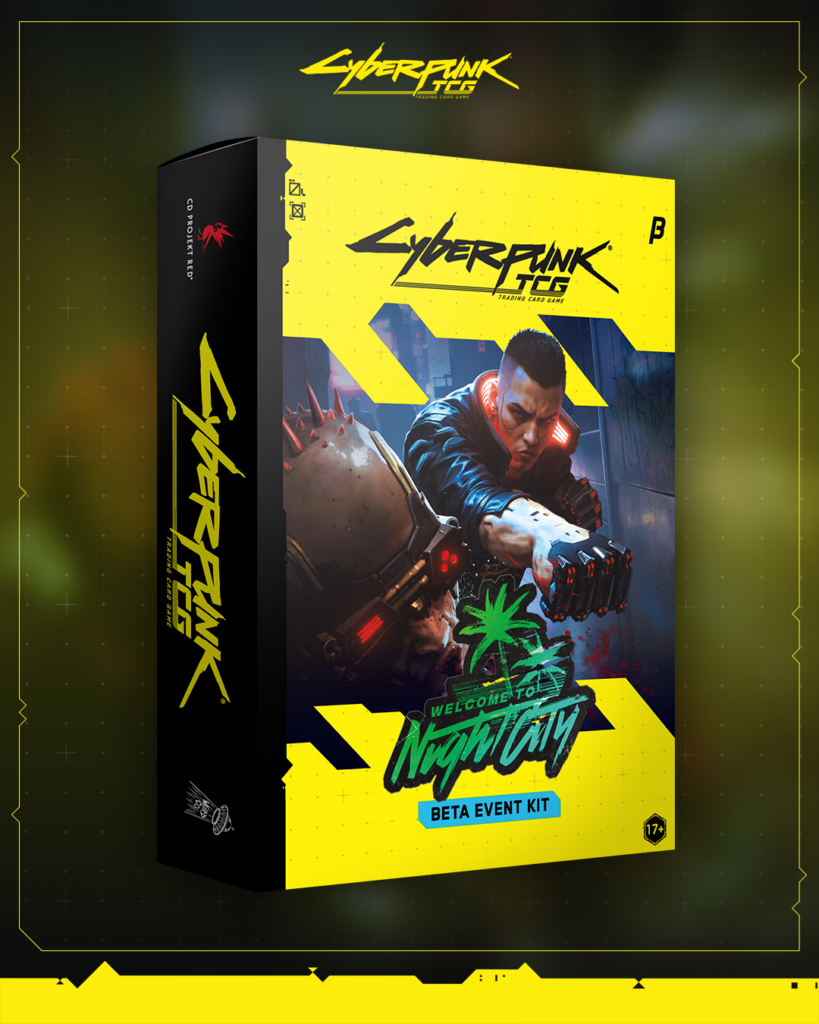
Cree „Kawa“ Gunning from WeirdCo and Paweł Burza from CD Projekt Red have kept the same format for months now: a weekly recap, a handful of cards, some studio small talk. Episode 16 brought card reveals, Episode 17 launched the store locator, and Episode 18 takes a harder turn. This one is about a product you can actually hold. The Beta Event Kit. Six boosters, three Legends, one promo card, a full dice set, all packed into a box heading to more than three thousand registered stores in September. For the first time since the Kickstarter wrapped, the whole „here’s what you get, on this date, at this price“ thing is a real checklist you can tick off instead of a stack of vague roadmap promises.
Burza opens with a story that pretty much sets the mood for everything after it. The first time CDPR got actual printed cards back from the factory, the team started sliding them into a binder. No prototypes. No proxy printouts. Real finished cards, finally. The reaction of a colleague flipping through that binder says it all:
„Oh, man. This is really — this is it, right?“
After more than a year of Kickstarter updates, announcements, demo decks at conventions, and weekly card reveals, the tone here visibly flips from „we’re building a game“ to „we’re shipping a product.“ That alone earns this episode a full writeup, even a week late. And the kit is only half of it. Five new cards bring a new keyword along, a quiet rules overhaul runs underneath everything, and the roadmap now stretches into November. This one runs long, and I’m not apologizing for that.
The Beta Event Kit in Detail: What’s Actually in the Box
This is the real news of the episode, so I won’t bury it. The Beta Event Kit is what local game stores will run their first official Cyberpunk TCG tournaments with starting in September, and the contents are now confirmed down to the last item, both in the official blog post on cyberpunktcg.com and in the podcast itself. Every kit comes with six „Welcome to Night City“ Beta Booster Packs, three additional random Legend cards pulled from a pool of ten, a promo card called „Beta Kit Mantis Blades,“ and the complete set of polyhedral dice: D4, D6, D8, D10, D12, and D20.
On paper that reads like a dry inventory list. Then Cree gets almost emotional about the dice. „Very very very important game piece,“ he calls them. Three „very“s in a single sentence, and from a studio rep who has clearly learned to weigh his words, that’s a statement. You don’t waste three verys on set dressing. And that’s the point: dice in Cyberpunk TCG aren’t decorative. They run straight through the mechanics, from card color assignment down to the Gig-value system that carries real weight in this week’s new cards (more on that below). Grab a Beta Event Kit and you’ve got the entire physical toolkit to sit down at a table and start playing, with no third-party dice order required. That’s not nothing.
Want your own set squared away without waiting on the beta timeline? You don’t have to sit around until fall. A solid polyhedral dice set costs next to nothing at retail and earns its spot in any game bag, especially if you’ve already got tabletop RPG dice or other games with their own sets floating around. Sure, the kit ships with dice for the beta events. A backup set still never hurts, and you’ll feel it the moment you’re running two tables at once.
Sealed Format, Not Backer-Only
The genuinely interesting design call here isn’t in the item list at all, it’s in the format. Beta Events run as sealed tournaments. Nobody needs to bring their own collection. Nobody needs to have been a Kickstarter backer beforehand. You sit down, crack open the kit, build a deck from what’s inside, and play. Cree frames this as a milestone and he’s right, these being the very first in-store Cyberpunk TCG tournaments, period, „our first in-store Cyberpunk TCG tournaments.“ The barrier to entry is as low as it gets: no backer status, no prior knowledge, no existing collection. Just the willingness to show up at a local store on a given weekend.
If you’ve followed the game’s Kickstarter arc, you can feel the center of gravity moving here. For months the entire conversation revolved around backers, pledge tiers, who paid what and gets what when. The Beta Event Kit talks to a store’s entire customer base instead, not just the people who backed a campaign more than a year ago. A studio that eventually wants to live in normal retail logic has to leave crowdfunding logic behind, and the beta events are the first place that shift becomes visible.
Before you get too fired up, keep one thing in mind: store registration for the program closed before May 1st, 2026. If your local shop isn’t registered, there’s no retroactive signup at this point. What you can do is hit up the stores near you that are already registered and ask whether, and when, they’re running a beta event. Easy distinction to miss in all the excitement, which is exactly why I’m spelling it out before anyone marches into their store expecting a yes and walks out confused.
One last detail about the kit grabs me harder than almost anything else, because it’s such a pleasantly unofficial little touch. Every Beta Kit Legend and the Mantis Blades promo carries a special beta symbol underneath the RAM icon in the top right corner, marking its origin from the kit. How exactly that symbol gets finished, Cree wouldn’t confirm on record. He did offer up a guess though. He’s betting on some kind of cold-foil stamp, and he’s quick to flag it as his personal read, not a studio confirmation:
„I won’t — this is not confirmation. I think it’s going to be like a cold foil stamp.“
I’ll take him at his word. For collectors that means the Beta Kit variants of these cards are quietly shaping up to be their own visually distinct print run. What it actually looks like on cardboard, we’ll only know once the first kits get cracked open in the wild. Until then it stays exactly what Cree himself called it: an educated guess, not a fact.
Store Locator and the Gap Between Tool and Reality
Okay, so how do you actually find out which store near you is even part of the program? The Store Locator on cyberpunktcg.com has been live for a few weeks now and lists more than three thousand registered stores worldwide, as of the official blog post from July 17th. For a game that hasn’t had a single regular sale day yet, that number is striking. It tells you how much groundwork got laid in the background while the community was mostly tracking card reveals.
The catch, and this is where the episode gets genuinely interesting from a journalism standpoint, is that Cree brings it up himself instead of burying it. At the time of recording, the locator can’t filter which of those three-thousand-plus stores is specifically hosting a Beta Event versus which one is just running a standard pre-release event. He says it flat out:
„we probably don’t have it set up so that you can check, hey, is this actually doing a beta event or is this just doing a normal pre-release event“
So there’s a real gap between the marketing reveal (look, a kit with contents and a date!) and the tool players would actually need to act on it (find a store that genuinely offers the kit). That’s not a criticism I’m manufacturing here. A locator with three thousand pins on the map and no filter is, functionally, an address list with a lot of noise. You see stores. What those stores are actually running come September? Invisible.
And look, I’m not losing sleep over it. There’s a reason. A store locator that covers the address layer first and adds the event layer later is the usual first rollout stage in the TCG industry, not the exception. Even the established games typically had tournament filtering lag behind the plain retailer list, because you have to know where the product physically sits before you can layer on who’s running tournaments with it. Cyberpunk TCG is sitting in a fairly ordinary starting position for a game fresh out of Kickstarter. The gap just feels more tangible here, because with a project this young nothing is settled yet, and every missing feature stands out immediately. A ten-year-old franchise gets that same gap forgiven by default.
Because of that, the hosts land on a pretty direct call to action for the community, and I’d rather state it plainly than paraphrase around it: contact your local game store, by email or by phone, and let them know you’re interested in Cyberpunk TCG. Per Cree, that exact kind of feedback shapes how much product a store orders and how many beta slots it sets up in the first place. It’s a community-mobilization move that says out loud what plenty of smaller TCGs do quietly. Demand generation gets deliberately pushed onto the player base, because a studio sitting in Poland or California has no way of knowing that a store in your town is currently weighing whether a shelf for a new card game is worth it. If you’ve been putting off that email to your local shop, here’s your excuse. Do it now, not in September, when the slots might already be spoken for.
The Quiet Revolution: How Alpha Became Beta
The genuinely more interesting part of the episode barely gets airtime in the podcast itself. Burza mentions in passing how big the jump from alpha to beta actually was on the gameplay side, comparing the new demo decks directly to the old ones from Anime Expo. That offhand comment is worth more than a footnote, because behind it sits a rules update that went live back in late May, and you’d miss it completely if you’re only tracking card reveals and not reading the blog.
Important context, because I don’t want to credit the wrong source: these detailed rules changes come from a separate blog post dated May 29th, 2026, not from Episode 18 itself. The episode only references them as background and doesn’t reveal anything new on this front. It supplies the context that explains why the hosts keep talking about a „huge transition.“ And that context is worth digging into, because it says more about the game’s maturity than any single card announcement does.
One Less Phase, One More Window
The basic skeleton of a turn changed structurally. In alpha, the first phase of a turn was simply called the Ready Phase. In beta it’s now the Start Phase, and the order of what happens inside it is newly locked in: first tapped Units, Legends, and Eddies get untapped, then you draw a card, then you receive a Gig from the Fixer zone. On its own that’s mostly cosmetic, a cleaner definition of what happens in what order.
The real overhaul comes right after. In alpha, the Play Phase and the Attack Phase were two separate segments of a turn. In beta they’re merged into a single Main Phase. Sounds like minor structural housekeeping, the kind of thing only a rules lawyer gets excited about. It’s a real change to how the game feels though. Instead of a fixed sequence (sell first, then play cards, then attack), you can now sell, call a Legend, play cards, activate abilities, and attack in whatever order you want. Two of those five actions stay deliberately limited. Selling a card for an Eddie and calling a Legend both remain once-per-turn per the rules update, while playing cards, activating abilities, and attacking can all be repeated as many times as you like. That’s a smart compromise between freedom and control. Enough open sequencing for players to get tactical, but two resources stay scarce enough that nobody dumps their entire hand into Eddies in a single turn or fields two Legends back to back. If you’ve played other card games, you know the pattern: total freedom on every action turns the Main Phase into a pure math problem, and whoever goes first automatically stacks the most resources. Those two once-per-turn caps are the glue that keeps the new freedom from becoming an end in itself. You can still attack first, spend the Gig value you just earned on another card, then attack again, instead of being locked into rigid windows. You just can’t sell twice or call the same Legend twice.
Tied directly to that, and arguably the most important new system piece: after an attack is declared, a so-called React Window now opens for the opponent. Inside that window, the defending player can declare a blocker, call a Legend, or play cards and abilities carrying the new QUICK keyword. QUICK itself was already announced in the May blog post, with a note that a follow-up article carrying more detail was supposed to land „next week.“ I couldn’t verbatim confirm the exact wording and URL of that follow-up for this piece. A web search only turns up a plausible summary describing the keyword as effects playable both during your own Main Phase and during the React step, without a solid blog source backing it. I’d rather be too cautious than too confident here. What’s written above is a reasonable reading, not a literal blog quote.
The thread back to the podcast episode still holds up. Burza talks in the episode explicitly about „Quick Cards“ as one of the coolest new pieces introduced to the experience, naming „Floor It“ and „Reboot Optics“ from the Heist demo deck as examples. I didn’t individually check those cards against the database for this piece, so I’ll leave them exactly as they were in the podcast: examples, not data sheets. The connection between Burza’s „Quick Cards“ and the official QUICK keyword from the rules update is a reasonable inference, even though no literal source treats them as a one-to-one label. Cards you can play during the React Window are pretty much exactly what the new keyword sounds like it’s built for.
Anyone who’s played other card games knows the underlying tradeoff. Some games run on strictly separated phases, where every action gets its own window. Others hand players maximum freedom inside a single main phase from the start. Both approaches have their merits. Strict phases make a game easier to read for newcomers, since it’s always clear what’s allowed at any given moment. A merged main phase pushes tactical depth up instead, because the order itself becomes a decision, and whoever sells first might win options they’d otherwise have locked themselves out of. The fact that Cyberpunk TCG makes this jump, from the stricter alpha structure to the looser beta structure, before the game has even hit retail, tells me the designers would rather adjust early than untangle a too-rigid framework after full release. A mistake fixed during the beta phase tends to cost a lot less trust than one that’s already circulating a thousand times over after November 6th.
Two Numbers, One Shared Message
Next to the phase reform, the May update carries two isolated number changes that look like footnotes at first glance and add up to a balancing statement once you put them side by side. The cost of Call a Legend dropped from two to one €$, which makes it cheaper to get your Legend onto the board in the first place. In an early format with a still-limited card pool, that’s likely quite noticeable, especially considering how central Legends are to a lot of the new card effects coming up.
The second change interests me more. The win condition got bumped from six to seven controlled Gig dice. Sounds like a small cosmetic nudge, but per the rules update, that increase specifically prevents the starting player from winning purely by running out the clock. At six Gig dice as the target, certain board states apparently allowed a structural advantage for the first turn, and the seventh mark exists to balance that back out.
What grabs me about this change is how it lines up with one of this week’s new cards, without the hosts ever drawing that connection out loud in the podcast. My own reading here, not a quote, but I think it holds up well enough to state plainly: a higher win-condition threshold stops the starting player’s automatic lead. A card that explicitly rewards being behind (more on that shortly, with Bonnie and Clyde) does on a small scale exactly what the win-condition change does on a large one. Both design decisions push against snowballing, against the idea that whoever gets ahead first automatically stays ahead. That’s a consistent balancing philosophy running from the turn structure all the way down to individual card design in the beta version.
Cree sums up his satisfaction with how these changes turned out pretty clearly on the episode, and it doubles nicely as a bridge into the actual cards:
„I’m really impressed what the game design has come up with and I’m looking forward to everyone being able to explore many different deck archetypes… it’s only going to grow from here as we continue to make future sets.“
Five Cards, One New Vocabulary
Around Episode 18, five cards got newly revealed or thoroughly discussed, all with fully verified values straight from the official card database: Octant, Japantown Jonin, Valentino Street Racer, The Heist, and Bonnie and Clyde. On top of that, the podcast physically shows off three previously revealed rare cards as print samples, plus the Mantis Blades promo, bringing the total to nine concrete cards plus assorted comparison cards mentioned only by name. That’s plenty of material for each of the five new cards to get its own paragraph instead of being burned through in a list.
Octant: The Math of a Discount
Octant is a red Unit with the Drone, Militech, and Zetatech tags. Cost 7, power 8, RAM 4, entirely red per the transcript („four red RAM“), rarity Common, number #015 in the Welcome to Night City set. The rules text looks unremarkable at first. Then the hosts unpack the discount math around it, and it gets dense fast: „Play this Unit for -1 €$ for each friendly Gig with 8+ value, to a minimum of 1 €$.“
In practice: every friendly Gig worth eight or more drops the cost by one €$, down to a floor of one €$. Cree mentions Octant actually got revealed the week before Episode 18. It’s designed as a classic late-game card that can drop well below its regular seven-cost as long as enough high-value Gigs are sitting on the table.
The card only gets interesting in the direct comparison the hosts draw themselves. They put Octant next to the demo-deck statblock Minotaur, which Cree names in the episode at seven power for nine cost, a pure vanilla card with no discount mechanic whatsoever. Minotaur always costs nine. Octant can slide well under that in the right conditions and still bring eight power to the table. That’s a bit of power-creep self-awareness the hosts are openly laying out: a new card is allowed to be stronger than an old statblock as long as it has to clear a condition to unlock that strength. And the number eight as the threshold for a „high-value Gig“ isn’t arbitrary either. It ties the card directly to the dice system Cree emphasized so heavily at the start of the episode. Wrong numbers showing on the table? Octant stays expensive. Right numbers? It turns into a bargain. That kind of conditional discount is what makes a card game interesting, because it forces the player to keep tabs on their Gig lineup before they even decide when to play Octant.
Japantown Jonin and Valentino Street Racer: A Teaching Pair
The next two cards belong together, and that’s not just my reading of them. According to Burza, Japantown Jonin and Valentino Street Racer were deliberately revealed back to back as a combinable pair, meant to explain a new concept together instead of dropping two isolated single cards on the world. It’s a didactic reveal trick, and it shows the marketing team has settled into a bit of a routine when it comes to introducing a new keyword.
Japantown Jonin is a red Unit with the Tyger Claws tag. Cost 2, power 0, RAM 2, rarity Common, number #010. Its effect: „{Play} Give a friendly Unit +2 power this turn. (Units with power 0 don’t steal Gigs.)“ The zero power is the actual hook. A Unit with zero power can’t steal Gigs in this game, which sounds like a useless card at first glance. Then the Play effect turns it into a cheap two-cost card with immediate value anyway: +2 power to a friendly Unit for the turn. And here’s the part the hosts explicitly discuss in the episode: the card can buff itself. Self-targeting on a +2-power Play effect isn’t a given. The fact that Japantown Jonin leaves that option open turns the zero-power Unit into, potentially, a two-power threat for two mana, without spending a second card to make it happen.
Valentino Street Racer is the counterpart. Green Unit with the Valentino and Vehicle tags, cost 3, power 3, RAM 2, also Common, number #091. Its effect: „{Play} Give another friendly Unit with cost 5 or less {Adrenaline} this turn. (A Unit with Adrenaline can attack the turn it’s played.)“ That’s the first time the word Adrenaline drops explicitly in the podcast. It’s a new keyword that basically knocks out the classic „summoning sickness“ concept from other card games: a Unit with Adrenaline is allowed to attack even though it was just played this turn.
Together the two cards make a neat little teaching example. Japantown Jonin shows how you generate value out of zero power. Valentino Street Racer shows how you throw freshly played Units straight into the fight. Both work perfectly fine on their own, but anyone stacking them in the same deck sees immediately what the new keyword is built for: aggressive tempo, where fresh cards don’t have to sit out a turn to matter. For a set that’s clearly also chasing faster, more aggressive archetypes, that’s a clever signal to pack into the very first two cards introducing this keyword to the public at all.
The Heist: Free Gear, If the Numbers Line Up
The Heist is a yellow Program with the Merc tag. Cost 2, RAM 2, no power value since Programs work differently from Units, rarity Uncommon, number #070. And the name isn’t a random reference either. Burza mentions in the podcast that „The Heist“ is V’s opening mission in Cyberpunk 2077, a nice little nod to the source material that’s easy to miss if you only read the card text.
The rules text reads: „Trash 4. Add a Gear from among them to your hand. If that Gear’s cost equals the value of a friendly Gig, you may play it for free instead.“ So four cards, presumably the top four of your own deck, go to the trash, one Gear from among them goes to hand, and if that Gear’s cost exactly matches the value of a friendly Gig, you get to play it for free instead.
On the episode, the hosts walk through this card at length using a combo example involving an expensive Gear called Overwatch. I won’t quote its exact stats here, since that comparison card wasn’t independently checked against the database for this piece. The principle is clear regardless. The Heist is a gear-cheat card that can bring expensive equipment into play essentially for free, as long as the player has lined up their Gig values in advance. Same as with Octant: a strong ability tied to a condition running through the dice system instead of being handed out unconditionally. That pattern shows up a lot in this episode. Strong effects, always with a catch that forces the player to build their Gig board accordingly beforehand.
Bonnie and Clyde: The Card That Rewards Being Behind
The last of the five new reveals, and to me the most interesting one, is Bonnie and Clyde. Red Program with the Braindance tag, cost 3, RAM 3, rarity Uncommon, number #029. The rules text: „Defeat a rival Unit with power 4 or less. You may defeat 2 instead if a Rival controls at least 2 Gigs more than you.“ On the surface that’s a solid but unspectacular removal spell clearing enemy Units with four power or less off the board. The second sentence turns it into something special. If you’re behind by at least two Gigs against your opponent, you get to defeat two Units instead of one.
Cree is visibly hyped about this card in the podcast. Hyped enough that he mentions bringing it directly to the game’s own designers to make his case:
„This is the ideal comeback card in my opinion… I’ve spoken to the game designers. I’ve spoken to David. I’ve spoken to Richard and be like, ‚This card is awesome. Make more cards like these.'“
Easy statement to overreach on, so here’s the caveat. Cree says there’s exactly one card of this „comeback“ type per color, one card that works on this „if you’re behind, you get more“ principle. But that’s only confirmed for red, in the form of Bonnie and Clyde. Whether there really are four such cards, one per color, was pure announcement at the time of recording, not revealed reality. Yellow, blue, and green could still get their counterparts, but until those actually get shown, it stays an expectation, not a fact. I’m phrasing this carefully on purpose, because „there are four comeback cards“ would be a noticeably stronger claim than what the podcast actually supports.
Burza adds a second reading of the same card that seems at least as important to me. For him, Bonnie and Clyde isn’t purely a comeback mechanic. It’s also an anti-blocker card, since it can potentially clear two enemy defenders out of the way at once. Same card text, two completely different jobs on the actual board, depending on whether you’re behind and trying to claw back ground, or you’re simply trying to punch through a wall of defenders your opponent built up. A card that flexes that well is rarely an accident. It shows the design team didn’t write the text for just one use case.
The fact that the designers explicitly built a card rewarding being behind fits the same logic as the win-condition change from six to seven Gig dice: both target the same automatic edge for whoever goes first or builds an early lead. The podcast itself never draws that connection. That’s my own reading of it, but it’s hard to unsee once you notice it.
Three Old Friends, Fresh Off the Press
Alongside the five genuine new reveals, the hosts pull three previously shown Rare and Epic cards out of the drawer. Not as reveals, mind you. As physical print samples with a foiling showcase, „these are not exclusive reveals,“ as it’s put in the episode. Worth a look anyway, since two of the three cards come back up elsewhere in this piece, and the third is simply one of the early community’s most popular cards.
Meredith Stout — Stone Cold Corpo is a Unit from the Corpo/Militech faction, cost 4, power 5, RAM 1, rarity Rare, number #014, illustrated by Daniel Valaisis. Its effect: „{Blocker} This Unit has +2 power while fighting a Legend. When a Rival adjusts or swaps 1 or more friendly Gigs, you may add a card from your trash to your hand.“ A defensive card with a built-in bonus against Legends and a card-advantage kicker whenever the opponent starts fiddling with your Gigs, which makes it a pleasant counter against exactly the kind of Gig manipulation that comes up elsewhere in the game, even though that specific comparison never comes up in this episode.
Royce — Psycho on the Edge you already know, since the same card shows up again further down in the ten-card pool of random Beta Kit Legends. As a Legend from the Ganger/Maelstrom faction, cost 6, power 6, RAM 2, rarity Rare, number #004, illustrated by Michal Ivan, it carries the effect: „{Go Solo} (Pay this Legend’s cost to play it as a ready Unit. It can attack this turn. If it leaves the field, remove it from the game.) During your turn, this Legend has +2 power for each of its equipped Gear.“ Here’s where the episode slips up. The hosts call him „an awesome character from the Voodoo Boys since Cyberpunk 2077,“ and that’s simply wrong, probably a slip between colleagues who have ten things running through their heads at once. Royce, real name Simon Randall, is the leader of the Maelstrom gang in the video game, not a Voodoo Boys character, and the TCG card database consistently lists him as Ganger/Maelstrom too. Mixing up two factions happens even to people who’ve been following the franchise for years. For deckbuilding purposes, though, only one assignment matters: Ganger/Maelstrom.
And finally, Jackie Welles — Ride or Die Choom. Per Cree, „everyone’s favorite card from the original alpha kit.“ A Unit from the Merc/Valentino faction, cost 6, power 8, RAM 2, rarity Epic, number #048, illustrated by Ilya Kuvshinov. Effect: „{Attack} Give this Unit +2 power this turn for each friendly Gig with an even value. {Defeated} Draw 1 for each friendly Gig with an odd value.“ Basically every Gig value on the table turns into some kind of advantage. Even numbers push attack power. Odd numbers hand you card draw the moment the card itself gets defeated. It exists in two official print variants per the database, Retail #048 and Beta #β048, and a separate „alpha kit“ variant isn’t listed as its own entry on the current card page. The card physically shown in the podcast is stated on air to actually be from the original alpha kit, meaning an earlier test phase predating the current database entry, a small piece of game history the hosts just happen to pull out of their own collection and lay on the table. Cree casually admits to running two copies of this card in his own deck, which says quite a bit about the standing of a six-cost Epic that expensive.
The Legend Pool: Ten Faces, Three Random Pulls
Every Beta Event Kit, as mentioned above, contains three additional random Legend cards from a fixed pool of ten. Which three you get is pure luck, but the list of the ten possible cards is already locked in, and it reads like a greatest-hits of the best-known Cyberpunk 2077 characters: Adam Smasher: Ender of Legends and Royce: Psycho on the Edge in red, Dum Dum: Maelstrom Triggerman, River Ward: Detective on the Hunt, and Rogue Amendiares: Preem Solo in yellow, Jackie Welles: Mama’s Favorite and Alt Cunningham: Soulkiller Architect in blue, plus Panam Palmer: Nomad Cavalry, Judy Álvarez: Braindance Maestro, and Goro Takemura: Vengeful Bodyguard in green.
A note on the color assignment, because it cost me some time. Cree runs through the ten Legends in the episode in an order that first reads like a clean two-three-two-three block pattern by color, but independent sources on the individual card pages suggest that right at the blue/green boundary of that list, the printed color doesn’t actually match the plain speaking order. So I’ve corrected the assignment above accordingly: Jackie Welles and Alt Cunningham run as blue here, Panam Palmer, Judy Álvarez, and Goro Takemura as green. And I’m still not fully certain about it either, because that correction rests on inference from card-page search hits, not an explicit color key in the official blog post. If you’re holding one of these cards and the printed color doesn’t match what’s listed here, now you know why.
Interesting bit: of these ten cards, only two were still without a fully public effect text at the time of recording per Cree, Jackie Welles: Mama’s Favorite and Judy Álvarez: Braindance Maestro. Cree says he expects to show their effects before the end of July 2026. Whether that timeline actually held is outside the research window of this article, but it does show how tightly packed the reveal cadence was in the weeks leading up to Gen Con.
Rounding out the full kit contents is the Mantis Blades promo card, its artwork by Ricardo Padierne Silvera, an illustrator who per Burza only recently joined CD Projekt Red as a full-time hire. The base card itself, a Gear/Cyberware item with cost 1, power 2, RAM 1, rarity Common, number 025, carries the terse but atmospheric flavor text „One cut, one kill.“ Burza tells a small, likeable side story in the episode: Ricardo himself is genuinely excited about this card, and Burza wants to bring him a personal copy whenever he gets the chance. No factual reveal there. Just the kind of texture that shows real people stand behind all the blog posts and card databases, geeking out over printed cardboard just like any fan would.
Gen Con 2026: First Time in Indiana, Already Sold Out
This is a side thread in the episode, but it’s the tension holding the whole thing together: WeirdCo and CD Projekt Red are, by their own account in the podcast, at Gen Con for the first time ever, and by extension in Indiana for the first time too. The show itself, per outside research, runs from July 30th to August 2nd, 2026 at the Indiana Convention Center and Lucas Oil Stadium in Indianapolis. That date isn’t from a Cyberpunk TCG source, it’s from a web search, but it’s consistent with the phrasing in the official blog post published the same day as the episode, which talks about „next weekend in Indianapolis.“
A quick note for readers picking this up later. By the time you read this, Gen Con is either currently underway or freshly wrapped, depending on exactly when you land on this article. I’m being transparent about that on purpose, because the episode itself was recorded in full anticipation mode, roughly a week ahead of the show, while this piece gets written after the fact. The countdown feel of the original episode is already history. The facts the hosts discuss still hold.
Demand was sounding intense before the show even started. Per the transcript, the Cyberpunk TCG booth was fully booked for demo slots at the time of recording, with only a limited walk-in allowance for anyone showing up on the fly. Cree puts it this way in the episode:
„fully booked out for demos… which is absolutely crazy“
That’s a subjective read from the hosts at the time of recording, not an externally verified figure, but it’s a strong demand signal for a game that isn’t even on shelves yet. Anyone who wandered up to the booth without an online slot booked was left relying on the walk-in allowance or going home without a demo at all.
One line in the transcript can read as misleading if you’re not careful. Kickstarter backers get the promo card „Rebecca: Having a Moment“ at the booth by showing their backer status, which sounds at first like backer exclusivity. Per the official blog post, though, every player who completes a demo session at the booth gets the card, not just Kickstarter backers. What backers get on top of everyone else is priority for demo slots. Anyone who couldn’t grab an online slot gets reserved demo spots at the booth by showing their backer number. The distinction matters, because it corrects the impression that non-backers walk away empty-handed on the promo card. They only miss out on the slot reservation, not the card itself.
Con-exclusive promo cards are an old but effective trick in the TCG industry, and Cyberpunk TCG deliberately joins a long tradition here. The mechanism behind it is basically always the same: make a card artificially scarce, tie it to physical attendance, and you’ve created a solid reason to actually show up at the booth instead of just following along online. Where WeirdCo does differently from a lot of established examples in the genre is tying the card to a completed demo session rather than a pure purchase. You don’t have to buy the card. You have to learn the game. For a studio still building out its player base, that’s the preem play, because it handles new-customer acquisition and collector incentive in one motion instead of just rewarding people who are already sold.
This bit of the episode gets me a little wistful, truth be told. For a team fresh out of a crowdfunding campaign, a fully booked con booth doesn’t just happen. It’s the product of hard work over months. Whether you were there in person or, like me, tracking it from a distance, that demand signal is real, and it says a fair amount about how much the fanbase has grown well past the online-only community at this point.
The Roadmap: From Kickstarter Box to Store Shelf
The Beta Event Kit is a waypoint, not the destination, and understanding that means looking at the entire chain behind it. That chain has been building for months and isn’t Episode-18 news on its own, but the episode is the point where the middle link finally gets filled in with concrete content.
At the very start sits the Kickstarter fulfillment target. Per the official blog post „Production Diary: Cyberpunk TCG ships to backers starting September 2026,“ backer shipping begins in the first week of September 2026, around September 1st, with a two-week window built in for regional delays.
Right after that, from September 10th to 17th, 2026, the beta events themselves run, exactly the window the Beta Event Kit is built for. On October 30th, 2026, a retail pre-release weekend follows, which unlike the beta events is open to every store, not just the ones pre-registered. And on November 6th, 2026, the full retail launch of „Welcome to Night City“ kicks off. From that date on, weekly „Night City Brawl“ events run as part of the ongoing organized-play program, plus „Night City Showdowns“ once per store per set, competitive tournaments handing out full-art champion promo variants and playmats as prizes for the winners. Full-art promos as tournament prizes are a proven move in the TCG scene for driving both purchases and repeat attendance. If you can only get a rare variant by winning, you keep coming back even after your collecting itch is long satisfied.
That chain makes clear why the Beta Event Kit isn’t a standalone product at all, it’s the link between the Kickstarter delivery and the store shelf. Anyone who plays a beta event in September gets a preview of what hits retail broadly in October and November, in a controlled setting with pre-registered stores. For a studio with zero prior retail experience for this game, that’s a sound, staggered approach that spreads risk across several smaller milestones instead of betting everything on one big release day.
Anyone active in organized play for other card games will recognize the pattern. A controlled beta or pre-release window with a limited participant pool, then an open pre-release weekend for everyone, then the full retail launch with an ongoing weekly program. The advantage of this staggering: print errors, rules ambiguities, or logistics problems surface in a smaller, more manageable setting before they hit the much larger retail wave. A manageable, pre-registered group of beta stores is easier to support than thousands of stores worldwide handling the finished product for the first time on the same day. And should a print error or a confusing rules wording turn up somewhere in September, there’s still enough runway before November 6th to fix it in the ongoing sales materials, without the entire first retail wave being affected by it.
Community Growing: A New Podcast and a Card Pool Number
A handful of smaller community observations from the episode remain, and together they show that a small ecosystem is forming around Cyberpunk TCG, on the official side as much as among fans themselves.
The hosts mention the announcement of a new, game-specific podcast called the „Brain Dance Podcast,“ hosted by „Spessie“ and „Fresh Lobster,“ whose real name, per Burza, is „Peter.“ The duo has already published two video card ratings, according to the episode. Cree notes that ratings without full card-pool context can end up „misjudged,“ a nice little meta-comment showing the hosts actively track and comment on fan content rather than just running their own program in isolation. One caveat belongs here: I couldn’t find an independent external confirmation of this podcast, whether on Spotify, YouTube, or Apple Podcasts, for this research. Very likely real, the hosts speak too specifically about the content and format to be making it up, but at the time of this research it was simply still too small or too new to be indexed anywhere. So it stays a mention here. No link, no channel name, because per the research, neither exists to be found.
A second number I don’t need to hedge quite as hard this time. Cree puts the full Set 1 card pool at 140 cards in the episode, and that lines up with independent set breakdowns that arrive at exactly that number, plus 31 alternate arts for 171 total print variants. A solid sense of scale for where this is all headed long-term. Anyone seriously starting to build a constructed deck, the way Burza says he just did himself for the first time with Cree’s help on decklists, hits the point pretty fast at a pool this size where their own collection needs proper sorting.
Practical side effect of a growing collection: at some point the shoebox on the shelf stops cutting it. Anyone starting to build out a real collection alongside the Beta Kit cards and the coming boosters does themselves a favor with a few packs of standard card sleeves and a decent deck box, especially once the collection grows again noticeably between pre-release and full launch this fall. Sounds trivial, until you drive to a store with loose boosters rattling around in a jacket pocket and find out how fast the first corner of a new card gets a crease.
For the coming weeks the hosts announce a „midweek article“ ahead of Gen Con listing out all the places extra card reveals will happen, plus exclusive reveals in Episode 19 of the podcast. A blog post matching that exact title and date couldn’t be specifically verified for this research, but the official blog does have later, thematically matching posts like „Welcome to Night City Community Card Reveal Schedule“ from July 29th and „Cyberpunk TCG at Gen Con 2026: All of our Exclusive Card Reveals“ from July 31st, both published after Episode 18 and therefore outside this article’s research window, noted here only as a jumping-off point for anyone who wants to keep reading.
What Sticks From Episode 18
If I had to sum up the episode in one line: this is where Cyberpunk TCG visibly tips from promise into something you can actually hold. The Beta Event Kit gives, for the first time, a concrete „here’s what you get, where, on what date“ picture that’s no longer built out of vague roadmap points. And the offhandedly mentioned Alpha-to-Beta rules overhaul shows at the same time that a lot of structural work has happened under the surface of all these marketing reveals since the last big showcase at Anime Expo.
For you as a reader, one thing pays off above all: get active instead of watching from the sidelines. Ask your local game store whether it’s registered for beta events, because new registration hasn’t been possible since May 1st, and the store locator still can’t tell you right now which store specifically is hosting one, so asking directly is the only way. If you’re into deckbuilding, take a closer look at the new Adrenaline keyword and the React Window mechanic, since both point toward where the game’s pace is headed. And keep Bonnie and Clyde on your radar, not just for its power level, but because it’s probably the first visible member of a card family whose other members we haven’t seen yet.
For us this rolls on into Episode 19, already announced, plus the midweek article around Gen Con we’ll be watching for once it drops. Until then, maybe we’ll actually run into each other at some store with a Beta Event Kit on the table. Six boosters, three Legends, one Mantis Blades promo, and a dice set that’s really, really, really important.
Sources
cyberpunktcg.com/blog/beta-event-guide ·
cyberpunktcg.com/blog/store-locator-live ·
cyberpunktcg.com/blog/beta-rule-updates ·
cyberpunktcg.com/blog/production-update-1 ·
cyberpunktcg.com/cards/octant ·
cyberpunktcg.com/cards/japantown-jonin ·
cyberpunktcg.com/cards/valentino-street-racer ·
cyberpunktcg.com/cards/the-heist ·
cyberpunktcg.com/cards/bonnie-and-clyde ·
cyberpunktcg.com/cards/mantis-blades ·
Cyberdeck Podcast, Episode 18 „BETA Event Kit Revealed“ (YouTube, Cyberpunk TCG channel, 07/24/2026)

// KOMMENTAR (1)
[…] August 1, 2026 > LANG.status() → current: 🇩🇪 DE $ This article is also available in 🇬🇧 EN → read English version […]