AI TRANSLATION NOTE
This is the English edition of a deep-dive originally written in German. The translation was AI-assisted and human-reviewed for terminology, lore accuracy, and Rogue-persona tone. All direct quotes from Cyberdeck Podcast Episode 12 come verbatim from the original English broadcast — not back-translated from German. The original German article is available at cyberpunk-tcg-news.de.
The Motorcycle Problem
Paweł Burza has apparently waged a personal design crusade on behalf of a motorcycle. In Episode 12 of the Cyberdeck Podcast, he mentions almost in passing that he personally made sure the most iconic vehicle from Cyberpunk 2077 found its way into the card game. The Yaiba Kusanagi CT-3X — the bike V rides early in the game, a symbol of Night City street life and midnight runs, the machine that appears on roughly a third of all fan-art wallpapers — was not an optional-nice-to-have for Burza. It was mandatory.
On the surface that sounds like a nerd anecdote. And it is. But sit with it a minute and there’s something deeper: a designer personally vouching that a vehicle gets a subtype that signals an entire archetype, clarifying gear-return rules so the card game feels coherent, doing design philosophy that just happens to feel personal.
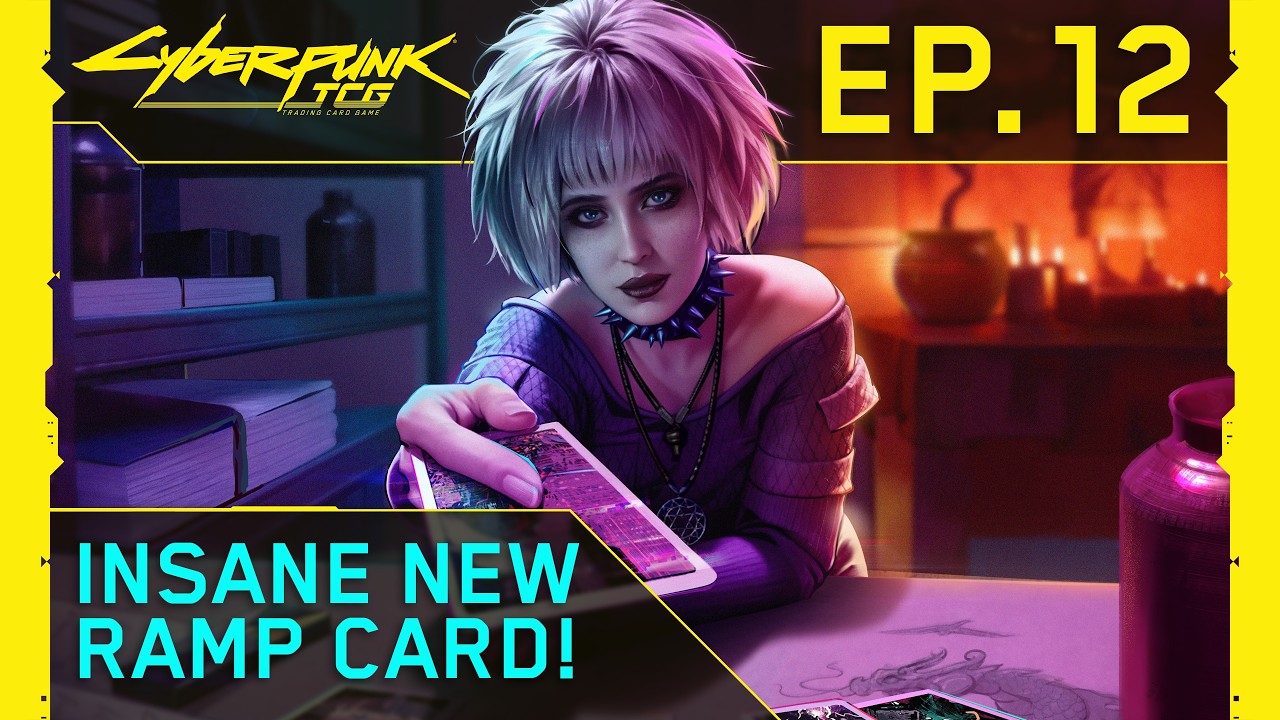
Episode 12 is the most substantial Cyberdeck Podcast episode yet. WeirdCo revealed three new cards, rolled out post-UKGE rule changes, and in the same breath redesigned the entire card frame system. Most of it deserves more than a news headline.
What strikes me most about this episode: everything connects. The rule changes reward slower, more strategic game plans. The new cards provide the tools for exactly those game plans. The UI redesign lowers the entry barrier for new players who still need to learn those game plans. WeirdCo isn’t building a game that accidentally grows in the right direction — this is coordinated design craft on three fronts at once. You sometimes only notice that when you lay three separate announcements side by side and realize they’re all pointing the same way.
So let’s lay them side by side.
The New Rules After UKGE: What Changed and Why Now
Anyone following the Cyberpunk TCG Beta knows WeirdCo doesn’t treat the game as a finished product. Core mechanics have shifted since the first playtesting sessions — sometimes subtly, sometimes fundamentally. In beta that’s a feature, not a bug. The question isn’t „why is something changing?“ — it’s „what does the direction of change tell us?“
After UK Games Expo the team communicated three changes. Each one is manageable on its own. Together they paint a picture of what this game is meant to become.
7 Gigs: Not a Nerf — a Design Statement
The win condition was raised from 6 to 7 Gigs, according to Podcast Episode 12. If your reaction is „one more round, so what“ — you’re underestimating what that means for the game’s structure.
Cyberpunk TCG isn’t a game with a life-point pool you whittle down. The win is binary: you hit 7 Gigs, you win. That means every round is potentially the last — and simultaneously, every round where you can accelerate toward your win condition is a round your opponent skipped. When the threshold is 6 you need six successful Gig wins. At 7 you need seven. That reads like a margin, but it’s structurally similar to the difference between starting at 18 versus 20 life in Magic: The Gathering — seemingly a tick, in practice a design statement about how long the game should last and who benefits from that length.
Longer games mean more time for expensive cards to come online. A Legend with 7 Power and a complex effect is less relevant in a 6-Gig game that might be decided after four or five rounds. In a 7-Gig game that card gets potentially one more turn to matter. That’s not a large number, but in TCG design small numbers multiply over many games.
WeirdCo was explicit about it in the podcast — Clark noted that people at the booth kept asking „what color is aggro in this game?“ and the answer was essentially: none, at least not in the traditional sense. As he put it: „yes, there will be kind of go wide aggressive strategies but it’s not like what you would call traditional aggro.“ The earliest possible win still sits at Turn 5. That’s not an eternity, but it gives Control strategies and expensive Legends room to breathe without letting aggro decks end the game in the first three turns.
What „go wide“ means specifically in Cyberpunk TCG is still not fully clear from the available information. In Magic: The Gathering go-wide means many small units attacking together. In Cyberpunk TCG, where Gigs are the win resource and units don’t directly reduce life totals, go-wide is probably defined differently — possibly as „many units enabling coordinated Gig wins“ rather than „many units dealing health damage.“ Clark’s statement is clear enough regardless: the game has multiple strategy paths, and none of them is the „kill turn 2“ approach.
That’s a deliberate counter-move to what many TCG players know from Magic or Hearthstone — where the race to establish resource leads is often decided in the opening turns. Some players will love that, others will find it too slow. But it’s a decision, not an omission. WeirdCo is building a game that rewards strategic mid-game play, and the Gig change is the first mechanical expression of that.
What it means concretely for deckbuilders: cards with high individual card value get stronger. Every turn the game goes longer is a turn a powerful single card can be used again. Legends, expensive Epics, cards with repeatable bounce effects — all of that grows disproportionately important in a longer game. No coincidence that WeirdCo announces ramp cards and Legend cost reduction simultaneously.
There’s also a community angle that I find quietly encouraging: Clark’s on-the-floor read was that feedback across the board was „super super positive from folks.“ That means the playerbase, currently composed mostly of Kickstarter backers, intuitively understood what WeirdCo was going for. A community of experienced TCG players can react defensively to aggro restrictions — „you’re taking away my fast playstyle.“ That apparently didn’t happen. Either because this community understood the game differently than its predecessors, or because WeirdCo’s communication was clear enough that the reasoning landed. Either is a good sign.
1 Eddie for Legends: More Control, Less RNG
The second change is smaller in number, larger in consequence: Legend-Call now costs 1 Eddie instead of 2, per Podcast Episode 12.
Quick explainer for everyone not yet buried in the rulebook: Legends are special unit cards with their own call mechanism called „Go Solo.“ You pay Eddies to bring them into play — but unlike normal units, there’s an additional flip mechanic when you call a Legend. Goro Takemura — Hands Unclean, for example, costs 5, has 7 Power, 2 RAM, and has Blocker. When you call him via Go Solo, you now pay 1 Eddie instead of 2 for the call itself.
At first glance that saves only one Eddie. But the real impact is subtler. Lower call cost means Legends become worthwhile earlier in the game — the opportunity cost drops. At the same time decks can run more Legends without fear of flooding: the situation where you’re holding too many Legends and don’t have enough Eddies to activate multiple calls in a single turn.
At 2 Eddies per call you were punished for holding too many Legends simultaneously if you didn’t have a plan to activate them all. At 1 Eddie that punishment is less severe. This opens deckbuilding decisions that were too risky before: running more than two Legends, deliberately leaning into Legend synergies, playing Legends early instead of saving them for the decisive moment. Goro Takemura — Hands Unclean with 7 Power and Blocker as an early call is now a legitimate line instead of a desperation move.
Kawa framed it well in the podcast: going from two Eddies to one „means you get to see your legends more often throughout the game, which kind of reduces the feeling of, oh, I flipped a legend. It’s not really the one that I wanted.“ WeirdCo is halving the entry price for the Go Solo mechanism without making the cards themselves cheaper. That’s a classic beta refinement move: lower the barriers to access, leave the power level untouched. Legends become more accessible in deckbuilding, not in power level. Using them smartly still gives you the same edge as before — the road there is just less treacherous.
Long-term for the community: more Legend variety in tournament decks. Less variance-dependent wins where you beat your opponent because they never drew the right Eddie combinations to activate their Legend. More control over your own game plan. For a game in the middle of building its card pool and shaping a competitive scene, that’s a healthy direction.
Open Phases: When the Community Was Already Right
The third change tells you the most about WeirdCo’s design mindset. Open Phases are now officially in the rulebook, and the team admitted in the podcast that players had been intuitively playing this way before the rule even existed.
Kawa described the reaction with audible amusement: „some people came up to me and they said, ‚oh, it’s open phases now. I’ve actually been playing the game like this all along.‘ They just didn’t even like — they were like they just intuitively thought, ‚oh, that’s the way I play the game.'“
What it means mechanically: actions within a phase become more flexible. The full technical description can’t be completely reconstructed from the podcast transcript alone — WeirdCo describes it as more flexible action ordering within a phase, which takes different forms in other TCGs. In Magic: The Gathering players can respond to any action with instant-speed cards. Flesh & Blood has a dedicated Reaction Step. Both work as analogies; neither is a technical equivalent — Cyberpunk TCG has its own language.
The community feedback was „extremely positive.“ When players apply a rule intuitively correctly before it’s been formalized, the design has gotten something fundamentally right — the base mechanic is self-explanatory enough that it doesn’t need explicit writing-down to be understood.
There’s a concept in TCG design discourse called „elegant design“: rules that emerge naturally from the game system rather than being imposed on it. Open Phases sounds like exactly that kind of moment. WeirdCo didn’t invent a new rule — they formalized what the game already was. That’s rare, and when it happens it’s a good sign for the underlying mechanic.
MTG has made similar formalizations across its history, mostly decades after release, after the playerbase had worked out the rules through sheer play experience. WeirdCo is doing it in beta. That’s smarter.
Three Cards, One Pattern
Episode 12 revealed three new cards. On the surface: a motorcycle, a cheap graveyard enabler, and an expensive ramp card from a Braindance archetype. One level down: three pieces of a coherent deckbuilding system WeirdCo has apparently been assembling in the background for a while.
When three cards from the same set get revealed simultaneously and each one serves a different mechanism type — Repeatable Threat, Graveyard Fuel, Ramp Enabler — that’s product design, not a random selection. WeirdCo is communicating what a deck in „Welcome to Night City — Retail“ can do. They’re showing you the painting and the brushes at the same time.
Add Adam Smasher — Metal Over Meat, revealed before this episode but confirmed in Episode 12 as the primary synergy target for the ramp card, and the circle closes: Graveyard Fuel, Ramp, final Finisher. Three layers of a classic combo package design.
Each piece deserves a proper look.
Modded Kusanagi: What the Motorcycle Is Really Saying
Modded Kusanagi
- Type: Unit (Tyger Claws, Vehicle)
- Cost: 6 | Power: 8
- RAM: 2 Blue RAM
- Rarity: Common
- Effect: Adrenaline (This Unit can attack the turn it’s played.) At the end of your turn, return this Unit to its owner’s hand. Gear attached to it returns with it — a general game rule clarified by WeirdCo in the podcast, not specified in the printed card text.
Here’s what Burza said in the podcast: he’s not one hundred percent sure there’s ever been a Vehicle in the game before. If accurate, Modded Kusanagi is the first Vehicle in Cyberpunk TCG history — at least among publicly revealed cards. That it’s specifically the Yaiba Kusanagi CT-3X was Burza’s personal priority. As he put it: „having vehicles portrayed is awesome… I’m not 100% sure if we ever like showed any other vehicles, but I would say this has to be one of the first… I’m a big motorcycle enthusiast. I have been — before I started working in games I actually worked in the motorcycle industry. I used to sell motorcycles. I used to work as a motorcycle mechanic.“
The card costs 6, has 8 Power, carries two blue RAM, and the subtype „Vehicle“ alongside „Tyger Claws.“ The Adrenaline keyword gives it a haste-like effect — it can attack immediately after being played, no waiting for the next turn. And at the end of your turn it automatically returns to your hand.
That sounds weak at first read. A 6-cost card that doesn’t hold the field sounds like a bad deal. There’s a trick in there, though.
Bounce + Gear + Adrenaline: Why This Is Deeper Than It Looks
The interesting rule is the Gear return. When Modded Kusanagi bounces back to your hand at the end of your turn, it takes any attached Gear with it — WeirdCo specifically clarified this in the podcast because it doesn’t appear explicitly in the printed card text. Clark explained it as a game rule: „a game rule that not a lot of people know about just cuz it doesn’t come up very often is gear actually returns to where the unit goes to. So if you attach gear to a unit and then it goes back to your hand, you get to replay that gear later on as well.“
What that means in practice: you have an equipped unit that attacks every turn (Adrenaline), can’t be permanently removed by your opponent (because it’s going back to your hand anyway), and keeps its Gear when it leaves. No permanent field removal, no Silence that sticks — it just comes back next round. That’s a Repeatable Threat that shows up every turn, makes its attack, and disappears.
Think it through: your opponent can’t permanently clear Kusanagi from the board. They can respond to her in the round she’s active. But at end of turn she’s bouncing back to your hand regardless. The only answer is removal during the attack window — and if the Gear stays with the card even when it’s bounced, your opponent can never fully neutralize your investment. They can only buy time.
The pattern echoes „Flicker“ or „Evoke“ effects in Magic: The Gathering — a powerful card enters, does its job, leaves, and the system repeats every turn. A 6-cost card with 8 Power that swings in fresh every turn and retains Gear isn’t a one-shot threat. It’s recurring pressure that asks your opponent the same question every round: do you have an answer this turn? And next turn? And the turn after?
Steve’s read in the podcast cuts right to it: „I really like this that this functions as repeatable removal for spent units on your opponent’s board. You have to think super carefully about what they can leave spent and you never need to worry about this being exposed to an attack back because you could simply replay it next turn.“
The Vehicle subtype also implies more synergies are coming. In TCGs, subtypes are rarely decorative — they’re deployed to build archetype packages. Burza hinted as much: „I can’t wait for more. Wink wink“ — and Clark confirmed it: „There are more motorbikes in this set.“ If that holds, Modded Kusanagi is the first stone of a Vehicle archetype, probably anchored in the Tyger Claws faction, whose Night City lore is all about motorized gangs, Japanese aesthetic, and body-modification fighters. Whether that becomes a full synergy package or stays thematic flavor depends on what else the set contains — about which we still have no complete picture.
The Yaiba Kusanagi CT-3X in Night City
For everyone who’s played Cyberpunk 2077: you know the bike. For everyone else — quick context. The Yaiba Kusanagi CT-3X is an iconic motorcycle from the Cyberpunk universe, one V can ride relatively early in the game. Yaiba is a fictional Japanese manufacturer in the Cyberpunk setting, known for aggressive street machines. „Kusanagi“ is the name of a legendary Japanese blade — the Grass-Cutting Sword, one of the three Imperial Treasures of Japan. A motorcycle named after a mythological sword, built by a corporation that blends Japanese aesthetics and raw power. Fits Night City like a custom-measured jacket.
In the Cyberpunk universe the Kusanagi represents people who come from nothing in Night City and still want to arrive somewhere — fast enough for the escape, iconic enough for the lore. It carries emotional charge WeirdCo didn’t have to earn. They just had to not waste it. In the anime Edgerunners it appears as well — Kiwi, the netrunner in Maine’s crew, rides a Yaiba Kusanagi through the city’s night streets.
Choosing this vehicle as the first Vehicle card makes narrative and mechanical sense: it’s a motorcycle with the necessary street cred, modified („Modded“) just enough to be dangerous. Exactly like the card — 6 cost for 8 Power is solid, and the bounce plus Gear return makes it a Repeatable Threat rather than a one-time alarm bell.
For fans who want the Kusanagi on their shelf outside the card game — Cyberpunk 2077 vehicle models and diecast replicas on Amazon have a solid selection for collectors.
All is Lost: 1 Eddie, 3 Cards, and a Graveyard Promise
All is Lost
- Type: Program (Zetatech)
- Cost: 1 | Power: —
- RAM: 2 Red RAM
- Rarity: Common
- Effect: Trash 3. Add a Unit from among them to your hand.
TCG history has a long tradition of cards that look unremarkable on first read and quietly uncomfortable on second. All is Lost might be one of them.
1 Eddie for Trash-3-plus-tutor. You put the top three cards of your deck into the trash and grab a Unit from among them. That’s effectively a 1-cost draw with graveyard fuel — you lose two cards into the trash, but you’re actively selecting a Unit from three options. No blind shoveling, controlled deck digging at near-zero cost.
Why Cheap Graveyard Enablers Are Structurally Important
In any TCG that uses the graveyard as a resource, the first question isn’t „what can I do with the graveyard?“ — it’s „how fast and cheaply can I fill it?“ When filling it is expensive or action-intensive, the graveyard becomes a situational bonus. When it’s nearly free, it becomes a second hand — a parallel resource source your opponent can’t see coming.
All is Lost costs 1. That’s close to „free“ for an effective payoff. For comparison: Faithless Looting in Magic: The Gathering has a structurally similar mechanic — 1 mana, draw 2, discard 2 — and that card shaped and warped more formats than almost any other in its era. Not because Faithless Looting itself was powerful. Because graveyard cards that interacted with their contents suddenly cost 1 mana through Looting.
All is Lost is arguably more efficient: you’re actively selecting a Unit from the three trashed cards. That’s not a random Looting component; you have three options and take the best one. The graveyard fuel is the side effect, the tutor is the main effect.
Synergies That Grow
WeirdCo flagged the synergy connections in the podcast: Clark mentioned that „you could use this with Alt Cunningham. Another legend you could use this with would be V Street Kid. So V is looking for brain dancers in your trash. This one just only pulls out a unit. So those brain dancers go in your trash. V then takes a look at another three cards and then gets to pick up one of those.“
If you’re sending Brain Dancers into the trash with All is Lost — either deliberately through good deck construction or because they land in your top three — you’re set up for both synergy cards. All is Lost becomes a tutor for your win conditions: you find a Unit, and you load the material for your next turns into the trash at the same time.
That’s a pattern that escalates regularly in TCG card pools. Card A is harmless until Card B exists in the pool that interacts with the graveyard. Card B is harmless until Card C establishes that the graveyard is a resource by design. All is Lost is Card A. Bootleg Black Sapphire Show is partly Card B. What Card C turns out to be, only WeirdCo knows right now.
The safe assessment: All is Lost is a solid 1-Eddie play today. Six months from now, when the card pool has grown, it could be one of the central enablers graveyard decks hang on. I’d be picking up multiple copies right now.
There’s another dimension worth noticing: All is Lost is from the Zetatech faction; Bootleg Black Sapphire Show carries the Braindance subtype. If the graveyard-as-resource ecosystem gets a faction home, it probably won’t be a single corporate faction — it’ll run across the setting. Braindance in Cyberpunk 2077 is mass media consumed by rich and poor alike, produced by corporations like Zetatech and distributed in illegal bootleg versions on Night City’s streets. If WeirdCo spreads the graveyard system’s mechanics across multiple factions, that mirrors the lore: Braindances come from everywhere, and so do their illegal copies.
What Zetatech as a Faction Means
The Zetatech affiliation fits the context. Zetatech is a mid-tier corporation in Night City — not a megacorp like Arasaka or Militech, but not a pure street gang either. They stand for cheap cyberware, mass-market gear, corporate overpricing at the low end. „All is Lost“ as a card you play for 1 Eddie while cheaply shoveling three cards into trash has that Zetatech energy: affordable, efficient, a bit desperate. The naming is also a joke for the initiated — in a deck that’s deliberately sending cards to trash, nothing’s actually lost.
Bootleg Black Sapphire Show: The First Real Ramp Card
Bootleg Black Sapphire Show
- Type: Program (Braindance)
- Cost: 5 | Power: —
- RAM: 4 Yellow RAM
- Rarity: Uncommon
- Effect: Sell the top card of your deck. If you control a Gig with an even value and a Gig with an odd value, draw 2. (Per WeirdCo in the podcast, a sold Unit enters the game ready and immediately able to attack — this is presented as a general rule of the Sell mechanic, not printed on the card text itself.)
This is the most interesting card in the reveal. Possibly the most interesting card in the entire game so far — at least from a deckbuilding theory perspective.
Let me explain what „Sell“ means first, because that’s the core of everything: the top card of your deck goes to trash, and the unit brought into play via Sell enters ready and immediately able to act. Kawa was explicit about this in the podcast — it doesn’t appear as a written READY keyword on the card text, but the team confirmed it as a general Sell-mechanic rule. In practical play that means: the unit you „Sell“ through Bootleg can immediately attack, immediately trigger its Play effect, immediately be effective — no waiting for a standard activation step.
For Adam Smasher — Metal Over Meat, who costs 9, that means concretely: you play Bootleg Black Sapphire Show for 5, sell Adam Smasher off the top of your deck, and per WeirdCo he enters ready. He immediately triggers {Play} Defeat all other Units. That’s an effective 4-cost discount on one of the most expensive and most destructive cards in the set — a board wipe plus a 15-Power monster for 5 Eddies.
What Ramp Means in a Game With a Fixed Turn Count
In Magic: The Gathering, ramp gives you more mana. You can play more expensive cards earlier, which gives you a tempo advantage. That’s valuable, but the tempo advantage is indirect — you get mana, and mana enables options the following turn.
In Cyberpunk TCG the structure is different. The win isn’t a resource you gradually build — it’s a counter. 7 Gigs, done. Every turn where you put your most powerful threats onto the field earlier isn’t a „tempo advantage“ in the abstract sense. It’s a concretely shortened distance to the finish line. Ramp in a fixed-turn game means: I’m bringing my 9-cost card out in round 2 instead of round 4. I gain a round on an opponent who was waiting for Turn 4.
That’s structurally disproportionately powerful — and WeirdCo knows it. Steve was transparent about the calibration in the podcast: „I’m happy that it’s at five, but I also feel that, you know, in a game that has a fixed turn structure, you pretty much have this thing that you really want to be keeping the tempo going.“ And Kawa: „I’m also happy that it’s a five cost. So it’s not one of those things that you know if it was like a two cost or I don’t know like you could like play multiple copies and start really really ramping up very very quickly then you’ll be like okay that’s that’s pretty much your opponent would just say like GG.“
The 5-cost calibration is also a self-confidence statement: if Bootleg Black Sapphire Show were recognized as broken, WeirdCo could have put it at 6 or 7. At 5, the team is saying: we trust the game system enough to build a real ramp card that’s actually useful. That takes guts in a design phase where many studios prefer printing weaker cards and buffing post-release.
The Even/Odd Condition: Deckbuilding as Access
The second calibration tool is the Draw 2 condition. To draw the two cards you need to control both a Gig with an even value and a Gig with an odd value. The card is effectively two-layered: Ramp (the Sell effect) works always. Draw 2 only works if you’ve planned your Gig development accordingly.
How easy the condition is to fulfill depends on how the Gig system functions in your deck — about which there isn’t enough public information to assess precisely yet. It likely requires a dedicated deckbuilding decision, not a lucky draw. That makes Bootleg Black Sapphire Show a „build-around“ card: maximally powerful when you orient your deck around it, still solid when you don’t.
That’s elegant design. The card has two levels: a base that benefits anyone, and a bonus level that rewards informed deckbuilders. Newer players can run the card and get the ramp. Experienced players build around the even/odd condition and extract more from the same card. Exactly that kind of depth — accessible on the first level, rewarding on the second — is what keeps TCGs interesting over time.
Why WeirdCo Always Had This Planned
Adam Smasher — Metal Over Meat was revealed several weeks before this episode. A 9-cost card with 15 Power and a board-wipe effect. On first read: a card for late-game stages or resource-heavy decks. On second read: a card that obviously needs an enabler to be playable in a competitive deck.
When you design a 9-cost card without simultaneously developing a way to make those costs manageable, you’re building a card game with decorative Legendary creatures. WeirdCo knew ramp had to come. The question was when and in what form. Bootleg Black Sapphire Show is the answer. The fact that Clark explicitly names Adam Smasher as the card’s primary synergy target in the same episode is not an oversight — it’s design communication. The team shows you what the puzzle piece looks like and which puzzle it solves.
In Magic: The Gathering the Eldrazi titans (12+ mana) appeared in Rise of the Eldrazi, and players wondered how those costs would ever be manageable. Then cards arrived that made the Tron land system possible, and Emrakul suddenly cost 3 mana on Turn 3. WeirdCo is doing the same thing, but in transparent order: show the finisher first, explain the accelerant, then demonstrate both together. That way players understand the system before they can execute it. It’s didactically smart.
One more note on the naming: „Bootleg Black Sapphire Show.“ In the Cyberpunk universe, Braindance showrooms are high-end entertainment for the wealthy — expensive, exclusive, controlled. A „Bootleg“ version is the opposite: illegally copied, sold on street corners, the experience without a license or safety checks. The card makes a normal game action (working through the top of your deck) into an illegal shortcut — you „sell“ the card instead of playing it normally, saving costs in the process. The word-mechanic and the name fit together in a way that shows someone on the naming team was paying attention.
Adam Smasher — Metal Over Meat: What 9 Cost and 15 Power Are Saying
Adam Smasher — Metal Over Meat
- Type: Unit (Arasaka)
- Cost: 9 | Power: 15
- RAM: 6 RAM
- Rarity: Epic
- Effect: {Play} Defeat all other Units.
Adam Smasher in the Cyberpunk lore is Head of Security for the Arasaka Corporation — historically the personal enforcer of Saburo Arasaka, and by the events of CP2077 serving under Yorinobu Arasaka after Saburo’s death. A full-conversion cyborg, more machine than human. „Metal Over Meat“ is literally his life philosophy. In the game he kills Johnny Silverhand. In the anime Edgerunners he destroys the protagonist David Martinez.
The card mirrors that exactly: {Play} Defeat all other Units. When you bring Adam Smasher into play, he destroys every other Unit on the field. Not „choose a Unit.“ Not „if he survives an attack.“ All of them, immediately, unconditionally. In Magic terms you’d call that „Wrath of God plus a monster“ — a board wipe combined with a 15-Power threat that swings uncontested afterward.
15 Power makes him the strongest Unit in the currently shown card pool — the second highest is Placide — Voodoo Sentinel at 10 Power. 6 RAM and 9 cost mean he’s not cheap to play — except via Bootleg Black Sapphire Show. The synergy is obvious and obviously intentional.
What Smasher means for the meta depends on a question WeirdCo hasn’t answered yet: are there cards that counter him? Graveyard hate would weaken Bootleg Black Sapphire Show. Anti-ramp mechanics would prevent his early deployment. Removal cards that eliminate Units before the Play effect resolves would make him an expensive threat with no teeth. Without that counter-side any power level assessment is preliminary — but the foundation looks like a very strong card.
There’s also an implied rules question in the card design: what happens to Smasher’s own Unit status after his {Play} effect? He is himself a Unit. „Defeat all other Units“ — does „other“ in the rules text mean he survives? That’s the natural reading and almost certainly correct, but without a published rules text you can’t say that with certainty. If the card functions as it sounds, Smasher remains as the only Unit on the field and swings uncontested. That’s an „I win now“ moment, not „I have an advantage.“ Exactly like Adam Smasher in the lore.
Smasher is also the first real test of the Epic design concept. If Epic cards are meant to be so extreme they break their card frame, they should also be mechanically extreme. A board wipe plus 15-Power body justifies the Epic status — and the frame break. You see the card and you know instantly: that’s the heaviest hitter in the deck.
For everyone who values Adam Smasher as a character — Cyberpunk 2077 collectible figures on Amazon cover the full-metal man in several editions. For the man who knows no walls, there’s merch to match.
The New Card Design: Accessibility as Competitive Advantage
Episode 12 didn’t just bring cards and rule changes — WeirdCo simultaneously overhauled the visual card design from the ground up. That sounds like cosmetics. It’s more than that. Card readability directly determines how fast new players get into the game — and therefore how large the potential playerbase grows. A new TCG launching in 2026 isn’t competing only against other new games for attention. It’s competing against Magic: The Gathering with its 30-year head start that still loses newcomers in its keyword jungle.
Convex and Concave: When Card Shape Explains More Than Rules Text
The new design distinguishes between two types of „pills“ — small visual indicators on the card that mark abilities. Timing Trigger pills are convex — they bend outward. They mark automatic effects: PLAY, CALL, ATTACK, DEFEATED. These effects happen whenever the corresponding timing occurs, with no player decision required.
Keyword pills are concave — they bend inward. They mark activatable or passive abilities: Go Solo, Quick, Blocker, Adrenaline. These require either a player decision or are passive abilities the player needs to know and deploy at the right moment.
Steve explained the logic in the podcast: „you can tell a timing trigger by the fact that its pill is convex. It bends outwards. And these point to effects that happen automatically, and the pill tells you exactly when they’re going to happen.“ The concave keywords „just represent abilities that you can use.“
That sounds like a design flourish at first. But think briefly about how other TCGs solve this problem: in Magic: The Gathering everything lives in text. „When this creature enters the battlefield, do X“ versus „T: Do Y“ — the difference between a triggered ability and an activated ability is buried in the phrasing, recognizable only through specific wording. New players learn that over months, with external resources, tutorials, and community help. Pokémon is similarly text-heavy, and rulebook evolution over 25+ years has layered exception upon exception on top. Flesh & Blood did it better than most, but even there you’re still navigating keyword prose lists.
WeirdCo is building the system from scratch and can avoid the structural mistakes of established TCGs by design. Convex means: that happens automatically. Concave means: that’s your decision. Memorable in a second and impossible to forget — because the physical shape of the pill communicates the function, not the text. That substantially reduces cognitive load for newcomers.
Picture yourself at the table for the third time. You look at a card. One pill bends outward — you know it happens automatically when you attack. Another bends inward — you know you have to make a decision there. You didn’t learn that from a rulebook. You read it off the card’s shape. Good UX interfaces have used this physical language for decades: buttons that look pressed inward signal „you can push this“; surfaces that bulge outward signal „something happens here.“ WeirdCo has transferred that basic principle to card design. It seems obvious in hindsight because good designs do that.
Blocker and Quick in Pink: The React Step Reminder
Blocker and Quick are displayed in bright pink. There’s logic to it — these keywords are relevant in the React Step, the moments when your opponent has already declared an action and you can respond.
The pink highlight is an active reminder: when someone attacks and you scan the cards on your field, the pink jumps out at you. You see immediately which of your units can act in that moment. No scrolling through text, no trying to remember whether „Blocker“ was the keyword you meant.
As Steve described it: „you’ve got quick and blocker called out in that really vibrant pink just to remind both players that those are effects which can be activated in the react step of your rival’s turn as well. So, it’s like that kind of small visual association that keeps it front of mind.“
For an experienced player that’s almost redundant — they know from memory what each card can do. For someone on their fifth or twentieth game still in the learning process, the pink is the difference between a good and a missed blocker moment. TCGs aren’t only played by experienced players. Making the game readable for newcomers means having more players.
Steve George, Color Blindness, and What That Says About WeirdCo
Steve George, one of the WeirdCo designers, is partially color blind. The RAM corner indicator system — color-coded corner markers for blue, red, and yellow RAM, in addition to the color of the RAM symbol itself — exists directly because of him. Because he noticed during internal testing that color differences alone aren’t enough when you can’t see all colors equally.
Steve was candid about it in the podcast: „Yeah, that’s correct. I’m really happy that the colors are distinguishable in the sense that I have problems with some shades of yellow, some shades of green. Which they kind of blend into sometimes — one I kind of associate with being green instead and the yellow becomes green and green becomes yellow. So I’m really happy that they’re distinct in the sense that they’re easy to follow.“
That’s a rarely explicit case of lived-experience-driven design. Accessibility features in TCGs usually emerge through external consultation, community feedback post-release, or regulatory pressure. Rarely because someone on the core team is personally affected and brings the consideration in from day one. The result is a system that doesn’t get retrofitted with accessibility patches, but was built barrier-free from the inside out.
Color blindness affects between 5 and 8 percent of the male population according to standard figures. The TCG community skews male (though that’s changing). Statistically, in a tournament group of twenty players, one or two of them can’t reliably distinguish RAM color differences without a secondary indicator. When a card isn’t fully readable for those players, they make mistakes — not through ignorance, but through a design failure. WeirdCo avoided that design failure.
It’s also strategically smart. The TCG community is older and more diverse than its reputation, and accessibility features broaden the target audience without taking anything away from anyone else. A card that’s fully readable for color-blind players is equally readable for everyone else. No compromise, just quality design.
Frame Break for Epics: When Collectibility Becomes Mechanical
Epic cards and above break the frame — the artwork physically exceeds the card rectangle, the border gets blown out. That’s a collectible value signal, but also a practical gameplay information signal.
At the table you know at a glance which card is the most powerful on the field. No asking, no looking up rarity in the corner, no reading text. Epics are literally bigger than their frame. That has a visual language that needs no explanation.
Adam Smasher — Metal Over Meat with frame break: a full-conversion cyborg that is literally more than its original human form, whose card is literally more than its frame. Whether that was deliberately planned or emerged from the design logic — both make sense for a team that clearly knows their IP deeply. WeirdCo could have stumbled into it accidentally and it would still be right.
For anyone who wants to protect their cards — especially Epic cards with frame breaks that sometimes don’t sit perfectly in standard sleeves — there’s a good selection of TCG card sleeves and deck boxes on Amazon in various formats and quality tiers.
UK Games Expo 2026: 500 Slots, All Booked, People From the Continent
WeirdCo was at UK Games Expo 2026 — and the show, by all accounts, was a success that exceeded what you’d reasonably expect from a game still in beta.
For context: UKGE officially recorded 51,196 unique visitors for 2026, a record and roughly 22% more than the previous year — at the event’s 20th anniversary. The roughly 90,000 WeirdCo mentioned in the podcast refers to the footfall — a multiple-count where every entrance through the gate is counted separately, so attendees who come on multiple days appear more than once. The footfall figure per external sources is 87,837. Both numbers are accurate; they measure different things. WeirdCo uses the footfall figure to convey the overall scale of the event — fair, since it describes total presence, not just unique visitors.
At this event WeirdCo had, per their own account in the podcast, 500+ demo slots. All booked. What the team emphasized particularly: visitors came back for second and third demo rounds. Clark described it directly: „even people who came back a second or third time to play the game just to actually just try more. At the end of nearly every demo session, people were saying, you know, you’re leaving us wanting more.“ That’s the best feedback you can get from a demo session — not „good game,“ not „interesting for TCG fans,“ but „give me more of this, now, today.“
The European Market Is Already There
What stands out especially: WeirdCo reports that visitors came specifically for their booth from France, Germany, and the Netherlands — not accidental expo visitors who wandered by, but Europeans from the continent who invested money and travel time for a game that isn’t yet available at retail. Clark was direct about it: „I was seeing, I was hearing and putting names to faces of some of the folks who are, you know, French speaking on the Discord and like coming all the way from France, from Germany — some folks from the Netherlands even came along.“
WeirdCo should be paying close attention to this — and I’d expect they are. A game without a retail date that’s already attracting international fans has strong organic foundations. The Kickstarter community is heavily anchored in the EU. When the game eventually reaches European stores, the groundwork is already laid. No warm-up phase, no „we need to build the US community first“ — Europe is already in.
For comparison: most new TCGs get a mixed reaction at their first convention appearance — some enthusiasts, plenty of curious observers, and a large group who might check it out later. 500 fully booked demo slots at a first public appearance, with return visitors from abroad, is a different category.
The retail launch is confirmed — Clark explicitly reassured non-Kickstarter backers that the game is coming to stores. A date doesn’t exist yet. Anime Expo might change that.
Anime Expo, Judy, and What the Next Months Bring
Anime Expo runs July 2–5, 2026 at the Los Angeles Convention Center. WeirdCo announced „very, very special news“ for the show — those are the actual words from the podcast, with deliberate emphasis on the doubled „very very.“
What exactly that means only WeirdCo knows. But the context isn’t uninteresting: on July 3 there’s a confirmed Edgerunners 2 panel from Netflix and CD Projekt Red, at the Crypto.com Arena in Los Angeles. A Cyberpunk TCG announcement at the same event where the direct IP holder is also present — that could be coordinated. Or it’s coincidence. In TCG marketing contexts such timing is rarely unintentional, but I haven’t seen any official WeirdCo confirmation that their announcement connects to the Netflix/CDPR panel. That’s interpretation of context, not news.
What I’m expecting: either a retail launch date, a larger tournament or league announcement, or a set reveal that goes beyond individual cards. „Very very special news“ doesn’t sound like another demo round. UKGE was for demos. Anime Expo sounds like a different category of announcement — a step that moves the game from „promising beta“ to „concrete product with a purchase date.“
Judy Before Gen Con: What the Reveal Rhythm Is Saying
One detail that falls almost casually in the podcast: a Judy Alvarez reveal is coming before Gen Con. Gen Con traditionally takes place in August. That means the current card reveal rhythm of roughly four cards per week continues through the summer — and Judy is one of the cards WeirdCo treats as special announcements.
Clark’s reveal of his plan came with appropriate uncertainty: „I want to say we’ll see Judy before Gen Con. That’s all I can say. We’ll see Judy before Gen Con.“ And Kawa’s response was instant: „I’m going to hold you to it.“
Judy Alvarez is for many CP2077 players the strongest emotional connection to the game — the Braindance technician, the character who shows Night City as broken and still worth living in more directly than anyone else. As a TCG card she’ll be discussed regardless of her stats, because for part of the community she’s not a neutral card. That’s the kind of emotional capital WeirdCo deploys intelligently — announce the characters with the most pull first, build the mechanics around them afterward.
What I want from Judy as a card: something with Braindance synergies. She’s an in-game Braindance expert — a card that interacts with the Braindance subtype, also found on Bootleg Black Sapphire Show, would be narratively and mechanically coherent. That would be WeirdCo’s opportunity to anchor the graveyard-as-resource ecosystem taking shape through Bootleg and All is Lost with a character anchor. Whether that happens is speculation. But the building blocks are on the table.
Four cards per week sounds like a lot, but by TCG comparison it’s a calm, manageable pace. Established games like Magic or Flesh & Blood reveal full set announcements with 200+ cards at once, generating 48 hours of community analysis before sinking back into the noise. WeirdCo gives each card its own moment, its own community discussion, its own reaction time. That’s marketing calculus, but also design calculus: when each card is revealed individually, each card gets discussed individually, and the team receives more direct feedback than in a full-set dump.
Four reveals per week over several months also means the community understands the set as a whole step by step — rather than having to process a shock dump that leaves most cards with no real attention. If WeirdCo continues to curate the reveals — showing cards so that synergies become visible before the set is complete — that’s also a deckbuilding tutorial in real time. Modded Kusanagi + Bootleg Black Sapphire Show + Adam Smasher in one episode is not coincidence. It’s teaching.
What the Next Months Mean
WeirdCo has built a schedule that communicates clearly: the game is coming. UK Games Expo was the proof of concept for the European market. Anime Expo will be the US launch signal. Gen Con in August is traditionally the most important tabletop convention in North America — if WeirdCo reveals Judy before Gen Con and then shows up at the convention with a more complete card pool, that’s an escalation step relative to the UKGE appearance.
I’m not saying the retail launch hits at Gen Con. I’m saying the timing decisions — UKGE, Anime Expo, Judy before Gen Con — look like a thought-through escalation plan, not a random announcement calendar. That’s the behavior of a team that knows what it’s building and is systematically working toward it.
What Episode 12 Actually Said
Let me circle back to where it started: Paweł Burza’s motorcycle story. He personally made sure the Yaiba Kusanagi CT-3X landed in the set. That’s not a grand design statement on the surface. But what it shows matters more than the card itself: WeirdCo is a team that takes its IP seriously — not as a license onto which you bolt TCG mechanics, but as a universe that informs the mechanics.
7 Gigs instead of 6 is a statement about game philosophy. Bootleg Black Sapphire Show is a statement about deckbuilding depth. The convex/concave distinction is a statement about target audience and accessibility. These aren’t isolated decisions — this is a game that knows what it wants to be and is methodically working toward it.
What impressed me most about Episode 12 isn’t any single card or rule change. It’s the feeling that WeirdCo thinks from the inside out, not from the outside in. Steve George, who built in the color blindness accessibility because he’s personally affected. Paweł Burza, who pushed the motorcycle through because it mattered to him personally. Clark, who explains transparently why Bootleg Black Sapphire Show costs 5 and not 3. That’s a different energy than most TCG releases, which feel like marketing-driven reveals with perfectly engineered cliffhangers.
That doesn’t mean WeirdCo is flawless. The Alpha Kit changes to existing cards are still unclear — if V Street Kid or Alt Cunningham have changed, some of the All is Lost synergy analysis could be moot. No counter-cards for Adam Smasher are known yet, which is an important open question for meta development. And „very very special news“ at Anime Expo could mean anything or nothing.
But the foundations WeirdCo communicated in Episode 12 — rules that reward strategic play; cards that build a coherent deckbuilding ecosystem; design that speaks to newcomers and veterans at the same time — those are the right foundations. Too many TCG launches have started with the wrong priorities: too much aggro, too little deckbuilding depth, too complex an entry-level rulebook. WeirdCo seems to be making none of those mistakes.
Whether the game builds a long-term competitive scene or primarily serves fans of the Cyberpunk universe is still open. Probably both, in different proportions, and that’s fine. Games don’t have to choose between casuals and competitors — they need to make both accessible, with different depths depending on how much you want to invest. The convex/concave system is exactly right for that: newcomers read the shape language intuitively, veterans appreciate the structural precision.
The motorcycle was the beginning. The rest is going to be interesting.
Sources
- Cyberdeck Podcast Episode 12 (YouTube)
- Cyberpunk TCG Card Gallery — cyberpunktcg.com
- UK Games Expo — Official Website
- BoardGameWire — UKGE 2026 Statistics
- Geek Native — UKGE 2026 Coverage
- Anime Expo 2026 — Official Website
- CD PROJEKT RED — Edgerunners 2 at Anime Expo 2026
Passende Produkte bei Amazon*
Cyberpunk 2077 | Cyberpunk Edgerunners | Kartenhüllen | Deckbox | Netrunner Kartenspiel
*Affiliate-Links: Bei einem Kauf erhalten wir eine kleine Provision – für dich ändert sich nichts am Preis.

Said Benadjemia – online als „Kenearos“. Cyberpunk-Fan seit dem ersten Trailer 2012, Night-City-Legend-Backer der Cyberpunk-TCG-Kickstarter-Kampagne 2026. Schreibt hier auf Deutsch alles rund ums Cyberpunk Trading Card Game von WeirdCo und CD Projekt Red – Kickstarter-News, Deep Dives zu Mechanik und Lore, Charakterguides, Strategieartikel.