Cyberdeck Ep20: 107 Cards and a Promise Nobody Made
AI TRANSLATION NOTE
This is the English edition of a deep-dive originally written in German. The translation was AI-assisted and human-reviewed for terminology, lore accuracy, and Rogue-persona tone. All direct quotes from Cyberdeck Podcast Episode 20 and from WeirdCo’s published writing come verbatim from the original English sources, not back-translated from German. The original German article is available at cyberpunk-tcg-news.de.
Episode 20 of the Cyberdeck Podcast dropped August 7 with thirteen new cards on the roster, pushing the reveal count to 107 of 140. Same day, WeirdCo’s blog published „Availability versus Collectibility“, and buried in that piece sits the hardest commitment this game has made so far. Gen Con had been over for five days and nobody at WeirdCo had written a recap. Three events, one date, look unrelated on the surface. Lay them side by side, though, and you’re watching a company quietly pivot what it talks about: less game, more market.
The 107 come from a count of the official card database as of August 7, which works out to 76.4 percent of the set. The number to put next to it is zero. That is how often the word „scalper“ appears in the collectibility article that Cree „Kawa“ Gunning describes on the podcast as the text where WeirdCo explicitly talks about scalpers.
Set 1 is three quarters exposed, and what’s lying there follows a rule you can spot with the naked eye: a bare body with no rules text has exactly twice as much power as it costs, minus two. Sounds like bean counting, and it’s also why both speakers land on the same number six separate times without ever announcing it as a topic. Around that, WeirdCo is assembling a market policy that in some places is harder than anything Magic, Lorcana or Star Wars Unlimited have ever promised, and in other places consists of sentences that commit nobody to anything.
Sitting between those two things is you. Specifically the European buyer, who this fall gets three different on-sale dates, a 32 percent price gap between two German shops for the identical display, and 123 listed stores out of roughly 3,400 worldwide.
107 of 140: the reveal arithmetic
Cree opens the episode with a piece of scheduling that sounds like marketing on first listen and reads like a surrender on second.
„We are about maybe 2 to 3 weeks away from fully finishing card reveal season … The rest of the month of August and then, like I said, by the time the first of September fulfillment stage comes around, all of these cards should be out because people are going to be opening up packs and product.“
Translated: the reveal schedule doesn’t end when WeirdCo has collected enough attention. It ends when the mail arrives. The fulfillment target has been „around September 1, 2026“ since the Production Update of June 19. The moment the first backer cuts open a Beta display, secrecy becomes a purely theoretical concept. In a normal TCG set the publisher decides when the last chase card gets shown. Here the shipping center decides.
That creates a window you rarely get to watch. Retail pre-release lands on October 30, full trade release on November 6. Between the fulfillment start around September 1 and November 6 sit roughly 66 days where the complete set is public knowledge, product is physically circulating, and you still can’t buy any of it in a store. The metagame gets solved on paper, and singles prices form off Beta product alone, before the first retail case is opened. Anyone walking into a European store on November 6 buys into a finished market they never had a chance to help shape.
In a normal TCG set the publisher decides when the last chase card gets shown. Here the shipping center decides.
The distribution tells you no fireworks are coming
That leaves 33 of the 140 booster cards outstanding. Broken down by rarity: 46 of 60 Commons, 25 of 32 Uncommons, 24 of 32 Rares, 9 of 12 Epic Rares, 3 of 4 Secret Rares. In percentages that’s 76.7 / 78.1 / 75.0 / 75.0 / 75.0.
All five rarity tiers sit within a bit over three percentage points of each other. That’s what an evenly distributed sample looks like. Dramaturgy looks different. Classic reveal direction holds the most expensive cards back so the final week detonates. WeirdCo visibly isn’t doing that. Three of the four Secret Rares are already public: Johnny Silverhand — Rocking Renegade as number 003, Sasha Yakovleva — Won’t Let You Down as 109, and Judy Álvarez — Nothing to Doubt as 116. Exactly one Secret Rare is left for the grand finale. Not four.
And what else is left? 14 Commons and 8 Rares, together 22 of the 33 open slots. If you’re hoping for a closing fireworks display, what you’re mostly getting is gap-fillers. That isn’t an accusation. A company that spreads its reveals evenly is saying, implicitly, that the set carries itself on breadth rather than on four poster cards. Just be aware that the exciting part is already behind us.
Cree’s two-to-three-week estimate looks conservative on the arithmetic. Episode 19 showed eleven cards, Episode 20 shows thirteen, so three more episodes would cover the remaining 33. Except the podcast isn’t its own reveal channel: the official episode description says it recaps the reveals „from across social media“ of the past week, which makes it mostly second-run coverage. The community reveals set the tempo. Paweł Sasko and Sebastian Kalemba on August 19, Cree „Kawa“ himself on August 26, the Braindance Podcast on August 28, so that plan ends exactly three weeks after this episode dropped. There is no official end date for reveal season, and August 28 is nowhere declared as the set’s closing bell.
A hypothesis about the card numbers
One more point, and I’m flagging it explicitly as my own derivation, because WeirdCo has said nothing about it. The card numbers appear to be blocked by color. Apply the grid Red 001 to 035, Yellow 036 to 070, Green 071 to 105, Blue 106 to 140, and all 107 revealed cards fit without a single contradiction. Every one of them carries a color and a number in the database, and the blocks separate cleanly: 001 to 035 holds 27 cards, all red; 036 to 070 holds 28, all yellow; 071 to 105 holds 26, all green; 106 to 140 holds 26, all blue.
The most recently shown cards as a sample. Red: Animals Wrecker 007, Johnny 011, Valentino Guerrera 021. Yellow: Rockn‘ Rockerboy 052, The Relic 063, Safety Override 069. Green: Emergency Atlus 077, Pacifica Netrunner 084, Synapse Burnout 102. Blue: Sasha 109, Judy 116, NetWatch Netdriver 129, Pyramid Song 135, Unlikely Bond 140.
4 × 35 = 140 comes out clean. 107 checks, zero counterexamples. What WeirdCo intends by it stays a hypothesis; the data underneath no longer is. One small fuzziness survives: V — StreetKid carries the number 005a, the only card in the set with a letter suffix. Whether a 005b exists is not visible from outside, which makes 4 × 35 a clean approximation rather than a count. Take the grid as a working assumption and eight red, seven yellow, nine green and nine blue cards are still missing. Near-even again, which supports the evenly-distributed-sample reading.
Set 1 in numbers
140 mechanically unique cards in the booster set: 60 Common, 32 Uncommon, 32 Rare, 12 Epic Rare, 4 Secret Rare. On top of that, 31 Iconic Rares per printing, so 171 cards per configuration. Beta and Retail each get their own 31 Iconic artworks, 62 Iconic Rares in total.
A booster holds 12 cards: 7 Common, 3 Uncommon, 2 slots for Rare and above. The Beta display holds 36 packs, the Retail display 24.
Eight is the most important number in the game
Search this episode’s transcript for numbers and one of them lights up like a neon sign. Both speakers come back to the same threshold six times without ever flagging it as a subject. It just keeps happening.
Cree on Johnny: „that eight power threshold is so important because stick one Mantis blades on it and it becomes a 10 and suddenly it’s starting to steal two gigs“
Paweł on Animals Wrecker: „a 10 uh I will remind you steals two uh gigs from the get-go“
Cree on Synapse Burnout: „if you had a seven power card, you could get it to a 10 and then steal two gigs“
Cree on NetWatch Netdriver: „sometimes taking you from the all-important eight power value up to a 10 to steal two extra gigs“
Paweł on a comparison card during the MaxTac discussion: „He’s at eight power. very easy to get him to a 10“
Paweł on Rockn‘ Rockerboy: „eights in the cyberpunk TCG, they’re they’re easy tens“
Behind all of that sits an official rule: a Unit that reaches 10 power steals two Gigs from the opponent instead of one. Eight power is therefore the point at which a card is exactly one piece of gear away from double yield. Seven doesn’t quite get there, nine would be wasted. That’s why nobody in this episode talks about „good statlines“. Everybody talks about eights.
The vanilla curve is actually a straight line
Cree then does something you rarely hear from marketing people: he recites the game’s reference values out loud.
„the best baseline to think about in our game is it’s like two, right? Two is kind of the baseline power. Uh you you could argue two like a two two like jacked in voodoo boy but any of the two cost cards we talked about the philosophy two cost units we usually require them to you have to have another card to to to play in order for them to attack. Then 3/4 is the next vanilla stat line. Then 4/6 with the psycho squad. Uh 6/10 I’ll say with animals record. And moving on we have rocking rocker boy 5/8.“
Four of those reference cards can be looked up in the database, and they check out. Emergency Atlus costs 3 and has 4 power, green, RAM 1, number 077. Psycho Squad costs 4 and has 6 power, blue, RAM 1, number 124. Rockn‘ Rockerboy costs 5 and has 8 power, yellow, RAM 1, number 052. Animals Wrecker costs 6 and has 10 power, red, RAM 3, number 007.
Write those under each other and you get an exact arithmetic progression. Power = 2 × cost − 2. Cost 3 gives 4 power, cost 4 gives 6, cost 5 gives 8, cost 6 gives 10. Across those four points, not one outlier, no rounding, no generosity in either direction.
The two is missing from the sequence, and Cree pulls it out himself in the same breath. You could argue about a 2/2 like Jacked-In Voodoo Boy, he says, but two-cost Units get an extra condition before they’re even allowed to attack. The database backs him up: no rules-text-free two-cost Unit exists in the revealed portion of the set. Corpo Security, number 076, is a 2/2 with Blocker and the line „This Unit can’t attack.“ Jacked-In Voodoo Boy, number 115, is a 2/2 with „This Unit can’t attack unless you played a Program this turn.“ The bare body starts at three.
Now put that straight line next to the two-Gig threshold. Nothing generic about it; the thing was built around the threshold. The five-drop lands on 8 power, one piece of gear short of 10. The six-drop lands on 10, stealing two Gigs from the first turn it attacks. The cost curve isn’t calibrated around „what is fair“, it’s calibrated around „where exactly does the Gig economy tip“. When two speakers discuss eights the way people discuss currency, it’s because the design turned eights into one.
No color owns the bare body
One detail in that four-card sequence only shows up when you lay the colors alongside. The 3/4 is green, the 4/6 blue, the 5/8 yellow, the 6/10 red. Four reference bodies, four different colors. In a great many Set 1 designs, raw stats belong to one aggressive color and everybody else pays for abilities with worse numbers. Here the baseline is a cross-color price tag that every card gets measured against.
For you, opening Set 1 for the first time, that has a concrete consequence: you can place any Unit immediately without knowing a single comparison card. Cost times two minus two gives you the zero point. Anything above it is paid for with drawbacks, anything below it with rules text. For a beginner-friendly game that says it wants to be „built for players“, that’s a fairly honest piece of construction.
An aside: Gig values in this game get rolled. The line drops casually during the discussion of the new V: „you’re playing red, so you’re rolling your big dice first and kind of trying to get as high as possible value on them“. Which of the two speakers says it can’t be pinned down reliably at that point in the transcript. The community has been arguing about the dice for months, from „The dice are feeling kinda detached from the game“ to how you stop loaded dice at a tournament table. Anyone wanting a clean set for their own group can find standard 16 mm d6 sets without effort. There is no official ruling on dice so far.
The RAM break, and who admits to it
At one point the clean math above suddenly jumps. The pleasant part: both speakers supply the explanation themselves, without noticing that they contradict each other doing it.
The RAM requirement of the four vanilla bodies doesn’t climb with the statline. The 3/4 needs RAM 1. The 4/6 needs RAM 1. The 5/8 also needs RAM 1. Then the 6/10 jumps to RAM 3. The surcharge doesn’t arrive in steps. It arrives all at once, at the end.
Cree defends it head-on:
„You’ll notice a vanilla card has three red Ram, but that is because six cost 10 power is just so so so good … the three ram to me makes a lot of sense.“
Paweł agrees and supplies the design reason: the heavy color commitment forces you to actually commit to red, „because if not then you would be probably playing this more often than just trying to kind of splash it in“. Sounds coherent. Except one card discussion later, the same Paweł says this about Rockn‘ Rockerboy:
„Man, I just splash yellow just to just to just to play this“ … „really cool design, really well thought out on the game design side to actually have this be uh only one yellow ram.“
Two consecutive card discussions, two opposite statements from the same man. On the six-cost card, RAM 3 is necessary to prevent splashing. On the five-cost card, RAM 1 is „really well thought out“, and he splashes it immediately. This isn’t a balance measurement and I’m not claiming either card is too strong; there is no test data and no Constructed format exists yet. What you can note: the RAM surcharge buys exactly two power, and two power is something a piece of gear picks up for one or two eddies anyway. Mantis Blades, number 025, costs a single eddie for it, and it’s the exact card Cree names in the eight-power quote.
Their own choice of words confirms it without either of them saying so. On Animals Wrecker, Cree says the three RAM „makes a lot of sense“. On Rockn‘ Rockerboy he says: „I can’t tell you like how good this card is. This card’s just so good. This card’s just actually insane.“ The stronger language goes to the cheaper card.
Strictly speaking, neither one is vanilla
An addendum that sharpens things further. Both cards have an empty text box, but they have tags. Rockn‘ Rockerboy carries the Rocker tag, Animals Wrecker carries Animal and Ganger. And Cree explains himself what that means:
„It has that rocker tag which if you really want to play it with the Johnny Silverhand Legend, it does become a ten to swing into an opposing unit. Not gigs, only units.“
A yellow body for a single yellow RAM, lifted over the threshold by a red Legend. That’s the cheapest conceivable ticket into the two-Gig zone, with the restriction that the ten power in this case applies only when attacking Units, not Gigs. An empty text box with tribal hookups turns out not to be an empty text box.
The residual value of RAM, and where it doesn’t hold
There’s a reason even RAM-heavy cards stay playable in this game, and both speakers use it independently without naming it: cards can be converted into eddies. Cree on Riot Shield: „this is a easily sellable card if you also have like two copies in your hand just sell one and keep the other one for later.“ Paweł on Unlikely Bond: „early game uh sellable especially if you if you see four.“ And on Les Élémens: „maybe if you have multiple copies you want to sell at the beginning of the game.“
That’s why Les Élémens at five cost and RAM 4 is even debatable: a dead copy stays a resource instead of clogging a slot. Only the residual value carries considerably less weight than those three quotes suggest. Per the Gameplay Guide you may sell once per turn, and a sold card always yields exactly one eddie regardless of what it would have cost from hand. And not every card is sellable in the first place: 52 of the 107 revealed cards carry the notation. Fewer than half.
Riot Shield, Unlikely Bond and Les Élémens all carry it, so the two speakers are talking about the right cards. The bodies this chapter revolves around, on the other hand, do not. Animals Wrecker can’t be sold. Neither can Rockn‘ Rockerboy. Neither can Johnny Silverhand, Never Stop Fighting, number 011. Which makes the residual value an argument for cheap Programs and Gear that you draw in multiples. For the big red bodies whose RAM price is actually up for debate, it does not apply.
Four colors, four jobs
This episode has one virtue that only becomes obvious when you count: it shows all four colors in meaningful quantity. Four blue cards, four red, three green, two yellow. For the first time that makes it possible to describe what job each color does in the set, rather than grading individual cards.
| Card | No. | Color | Rarity |
|---|---|---|---|
| Animals Wrecker | 007 | Red | Common |
| Johnny Silverhand — Never Stop Fighting | 011 | Red | Epic Rare |
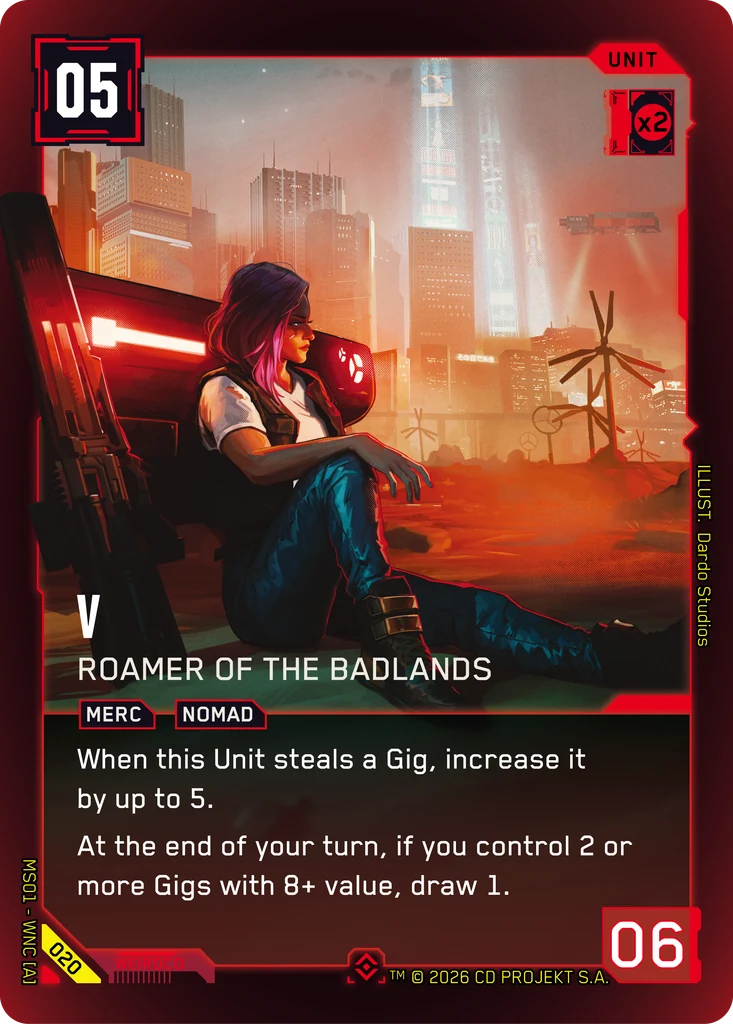
| V — Roamer of the Badlands | 020 | Red | Epic Rare |
| Valentino Guerrera | 021 | Red | Common |
| Rockn‘ Rockerboy | 052 | Yellow | Common |
| Safety Override | 069 | Yellow | Common |
| MaxTac Squadron | 082 | Green | Common |
| Riot Shield | 094 | Green | Uncommon |
| Synapse Burnout | 102 | Green | Uncommon |
| Hacked Corpo | 114 | Blue | Common |
| NetWatch Netdriver | 129 | Blue | Uncommon |
| Les Élémens | 133 | Blue | Uncommon |
| Unlikely Bond | 140 | Blue | Common |
Stats, effect text and illustrators for six of these cards have already been covered individually elsewhere on this site. What matters here is what they stand for as a group.
Green is the Legend color
All three green cards in this episode revolve around the same zone. MaxTac Squadron readies a friendly revealed Legend at end of turn if the Unit is spent. Synapse Burnout gives a Unit additional power for each friendly revealed Legend, though only in fights against opposing Units. And Riot Shield makes the opponent’s use of Go Solo two eddies more expensive, Go Solo being a Legend mechanic.
Cree says it out loud himself: „in green your legends probably matter the most like in in part of our green color tree. Legends is like a huge factor.“ Three cards in one episode, three points of access to the same resource type. That color tree is signposted in the open.
Blue removes without killing
The four blue cards share a pattern that tends to get lost in casual TCG vocabulary: blue clears opposing Units out of the way without beating them in a fight.
Hacked Corpo trashes three cards and pulls a Program from exactly those three into hand, „add a Program from among them“, not just any Program out of the trash. NetWatch Netdriver draws cards when something is spent. Unlikely Bond and Les Élémens put Units on the bottom of the deck, specifically not „defeat“. A bottom-decked Unit isn’t beaten, it’s gone, and in a realistic game it does not come back. If you’re coming from Magic or Lorcana, that’s the effect needing a mental adjustment: the game does have a graveyard, it’s called the Trash, and it can be interacted with. StreetKid V pulls a BRAINDANCE Program back out of it. What goes under the deck is what that recursion cannot reach.
The color identity gets described on the podcast through the bodies: low power, vulnerable attacks, in exchange for access to everything happening around them. Judy props up the weak bodies, and then comes the line, „you’re really like playing 3D chess while your opponent is trying to do the basics.“ Which of the two speakers says it isn’t cleanly delimited in the transcript. Plenty of self-congratulation either way, but the four cards back it up.
Red wins fights, yellow buys time
Red needs the least explaining in this episode. Both Epics are red, plus Valentino Guerrera and the 6/10 body. Paweł sums it up in a sentence so short it almost sounds apologetic: „red is aggressive. Red kind of wants to do its own thing.“ Raw numbers, win fights, no detours.
Yellow steals the opponent’s clock. Safety Override defeats the opposing Unit when a friendly Unit next loses a fight this turn, and charges RAM 3 for it. Cree hands the rules text to Paweł („please Bersa feel free to read out the text“), and Paweł describes what he personally uses the card for: „I actually play a couple of copies of this in my triple yellow smasher deck where I focus on playing a lot of blockers at the start. Kind of delay the game until I can get the smasher out.“ Blockers up, time bought, combat tricks as insurance. Yellow attacks the schedule; bodies and cards stay untouched.
So green goes after the Legend economy while blue works on card selection, red just wants bodies, and yellow attacks the opponent’s clock. Getting evidence for all four trees out of one episode doesn’t happen often.
The blue tilt has resolved itself
After Episode 19 we diagnosed a blue overweighting here, in Cyberdeck Ep19: Eleven Cards and a Blue Streak. Consider that diagnosis withdrawn. Episode 20 shows four blue, four red, three green and two yellow cards, and in the total count blue sits at 26 of 35 under the color-block derivation, tied with green at the bottom of the reveal rate. The tilt was a snapshot across one episode, not a property of the set. It happens. The advantage of collecting numbers instead of impressions is that you notice yourself when you got it wrong.
Johnny against the corporations
One of the thirteen cards in this episode is mechanically from a different rulebook. Johnny Silverhand as an Epic Rare with the number 011, red, RAM 2, 6 cost and 8 power, illustrated by Łukasz Poller, tagged Merc, Rocker and Samurai. The official rules text reads:
„The first time this Unit wins a fight each turn, ready it.
This Unit wins all fights against CORPO Units.“
The second sentence is the interesting one. It doesn’t hand out a stat bonus, it decides fights. No power comparison, no ceiling, no „up to“. A six-cost body beats any Corpo Unit of any size, and the first sentence makes sure it stands ready again afterwards. Read that line twice. You don’t often see it in a first printing.
Paweł lists on the podcast how far the Corpo tag reaches, and the list runs longer than it sounds on first hearing:
„cards that have the corpo tag, it’s a lot of things from like basic stuff that you saw in the demo decks like VC corporate exile has the corpo tag. Uh, field operator. Corpo. Corpo security. Corpo. Goro Takamura losing his way. Corpo. Such powerful cards. Goro Takamura hands unclean. Corpo once again. So Meredith Stout … Corpo.“
The list holds up under checking. All six cards are in the public database, and all six carry the Corpo tag: the V from the Heist starter, Field Operator with number 078, Corpo Security 076, both Goro Takemura cards (017 Losing His Way and 012 Hands Unclean) and Meredith Stout 014. The only error in the passage is pronunciation; the podcast says „Takamura“, the cards say „Takemura“. The database lists 17 cards with the tag in total, two of them Programs. Paweł’s verdict: „this is going to be like crazy in terms of that ability on this card is is so good.“
The tag runs across colors, the clause doesn’t
Corpo isn’t a Unit-only tag. Les Élémens, a blue Program with number 133, carries it too, and Paweł considers that the genuinely interesting part of the card: „I would say the corpo tag is the interesting part here.“ Hacked Corpo carries AI and Corpo at the same time. The tag is distributed across colors and across card types.
Johnny’s clause, though, explicitly says CORPO Units. Programs don’t fall under it. Sounds like small print, and it’s exactly the kind of templating that decides formats later. Play the card against a blue Program deck and you have a 6/8 with a ready effect and nothing else.
Newcomers get hit by that in a very specific way. One of the two free print-and-play demo decks WeirdCo distributes as a PDF is called „Embracing Power“, an Arasaka deck. The deck style new players learn the game with has a red Epic as its natural counter. Whether Adam Smasher carries the Corpo tag is the obvious follow-up, and it can be answered: both Adam Smasher cards sit in the public database with complete tag lists, and neither carries Corpo. Ender of Legends, number 001, red, Epic, nine power, is tagged Arasaka and Merc; Metal Over Meat, number 041, yellow, Epic, fifteen power, carries the same two tags. Johnny mows down half the starter deck and then stands in front of the fattest card in it with no special rights at all.
Lore fidelity as an explanation, not an excuse
You could read this as crude fan service. I read it as the most honest design decision in the whole episode. Johnny Silverhand is the character whose entire biography consists of „against corporations“. A card that equipped him with a plus-two-power bonus against Arasaka would be an insult on lore grounds. Paweł supplies the intent himself: „you want Johnny to have a cool ability. You want this card to be good.“
So the honest reading runs both ways. It’s a design decision made on purpose, and it’s a balance risk whose size can only be measured once Constructed actually runs. The first Beta events are in September, more in October at PAX Australia; there is no tournament format until then and therefore no data. Anyone shouting „broken“ right now is guessing. What you’re allowed to quote is Paweł’s own forecast, which is unusually incautious for someone with marketing responsibility: „this is going to be a staple for red in my opinion … You can quote me on that.“ Hereby done.
Common does not mean weak
The rarity distribution of this episode is unusual: seven Commons, four Uncommons, two Epics, and not a single Rare. Thirteen cards without a Rare, in a set that contains 32 of them. On its own that would be a footnote. It gets interesting when you lay the two speakers‘ enthusiasm over the top of it.
On Rockn‘ Rockerboy, Cree says „This card’s just actually insane“, Paweł calls it „one of the highlights for sure“. A Common. Animals Wrecker passes as „a big boy and an absolute powerhouse“, MaxTac Squadron is supposedly „really really really strong for multiple reasons“, Safety Override is „insanely insanely good with blockers“. Three more Commons.
On the other side: the weakest card of the episode is also a Common. Unlikely Bond gets marked down by both of them, Cree says „It’s like not the best thing for you to be doing a lot of the time“, and both independently land at one or two copies maximum. Valentino Guerrera draws the thinnest praise of the episode, garnished with Cree’s admission that „I haven’t messed around with this one too much“.
And the two Epics? They do two completely different jobs. Johnny is the gameplay chase, the card Paweł calls a „staple for red“. V — Roamer of the Badlands gets praised as the first Nomad V and above all for the artwork, „the art on this is absolutely stunning“. Nobody in this episode says anything comparable about its playing strength. V is the collector chase.
Of the thirteen cards, the four strongest and the single weakest are Commons. That’s the most defensible version of „built for players“ WeirdCo has.
If you get staples out of 60 Commons, you don’t need the chase slots to compete. A deck made of cards that statistically occupy seven of twelve slots in every pack is a perfectly normal deck. For a game whose most expensive Kickstarter tiers ran into four figures, and whose community debate is mostly about collectible value, that’s a preem argument, choom.
Except this argument appears nowhere in WeirdCo’s own collectibility article. That piece argues exclusively about supply policy: print runs, distribution channels, reprint commitments. About the distribution of playing strength across the rarity tiers, which is the one thing a player actually notices when buying cards, it contains not one sentence. That’s the point where communication and product at WeirdCo are drifting apart.
The collectibility manifesto: what it actually says
„Availability versus Collectibility“, published August 7 by the WeirdCo Team, contains four numbered commitments. The most important sentence sits in the second one and reads, word for word:
„We’ll use our data to tightly align our print runs with market demand, and after that’s done, we will not reprint the same set or configuration again.“
Set 1 will therefore never be printed again in this composition. Full stop. Anyone who has read a sentence that unambiguous in the TCG space before is invited to raise a hand.
The first commitment says: „We’re committed to reprinting cards, not packs“. Individual cards are supposed to get reprinted, but through other routes, namely „supplementary products, reprinting them as widely accessible promos, or adding them to our various tiers of Organized Play prizing“. Explicitly not through additional booster packs, and WeirdCo supplies its reasoning on the spot: „We want to increase the availability of a few key cards without flooding the market with additional copies of our highest rarity chase card variants.“
Commitment three is hobby store priority: „By distributing primarily through these stores, we can ensure a high volume of our products reach players‘ and collectors‘ hands at MSRP.“ Commitment four is short and unambiguous: „We will not run further Kickstarter campaigns for Cyberpunk TCG.“ Alongside it sits the decision to work with one exclusive distributor per region, „to give us the clearest view possible of where our product ends up“.
The genuinely clever idea gets no mention on the podcast
Commitment one and the no-reprint commitment are built so they can coexist. The set never returns; individual cards do. That splits playability from collectibility, and architecturally it is considerably better thought through than plain Reserved List logic. A card the tournament scene needs can come back as a promo or as an Organized Play prize without a single additional booster pack existing. The collector keeps a set printed once, the player gets the card.
That’s the most interesting statement in the entire article. And Cree doesn’t mention it on the podcast with a single syllable. He presents the text as anti-scalper positioning instead, which we’ll get to shortly.
The holes, and they are big
As elegant as the construction is, the edges are that non-binding. WeirdCo intends to target cards for reprint „if they become problematic from an accessibility point of view“. No criterion, no threshold, no timeframe, and no statement of who defines „problematic“ in the first place. That’s a commitment you keep at all times, because it interprets itself.
The print run size, they say, could be nailed down confidently thanks to the data, „helped confidently lock in the print run numbers“. The number itself is not named. There is no figure in any public source. On enforcing the recommended retail price, there is nothing beyond the assertion that distribution through hobby stores secures it. And in the same paragraph that contains the hobby store priority sits the clause „…though we don’t have any kind of policy explicitly preventing online sales.“
Commitment three softens itself inside its own wording. WeirdCo wants to explore partnerships and promotions, „with channels such as conventions or the CD PROJEKT RED Gear Store“, and is „open to exploring new sales channels in the future“. Hobby store priority is therefore a priority rather than a restriction, and the publisher’s own Gear Store is already named as an additional channel.
There’s also a gap you don’t have to explain by intent, you can simply note it: the FAQ on cyberpunktcg.com remains a pure Kickstarter FAQ. Not a single entry on reprints, print runs or edition size. The article shipped; the FAQ was not updated.
From guarantee to trust
Six months earlier, on February 5, the same blog carried a piece by Madeline Anthony titled „Built for Players: How the Cyberpunk TCG Is Fighting the Industry’s Scarcity Problem“. It promised WeirdCo would „guarantee that all players who want cards will receive them“, plus a „slower release schedule than industry leaders“.
Six months on, the guarantee has become a thesis. The new article puts it this way: „What truly builds a collectible is trust.“ That shift in register, from guarantee to trust, is a finding on its own. Guarantees are enforceable. Trust isn’t.
If your interest here leans toward the collecting side: a set printed once, 140 mechanically unique cards plus alt-arts, is a collecting project with a clearly defined target quantity. A nine-pocket side-loading binder covers a set that size without a second volume.
The word that isn’t there
Now to the discrepancy I flagged at the top. Cree describes the article on the podcast like this:
„We also do talk a little bit, I’ll be honest, we talk a little bit about like um the idea of like scalpers in the industry and like there’s a we want to make a very clear distinction that there is a big difference between people who like to collect these cards and then people who … are scalpers who are kind of trying to flip product, sell it.“
Paweł doubles down: „we kind of want to bypass uh scalpers.“ And Cree adds another layer: „we’re very transparent. We’re very honest. Um, more in my opinion than most TCG companies are.“
A full-text search of the article published that same day returns zero hits for „scalper“. The passage Cree describes does not exist there.
Before anyone lights a torch: several readings fit, and only one of them has anything solid under it.
The cheapest explanation is that Cree is describing an earlier draft. That the episode was recorded before Gen Con is something Paweł says in his opening line: „This is episode 20 and we’re just after Jen Con, but we’re recording … this before Jen Con. So that’s … we’re traveling in time right now.“ It carries through into the grammar afterwards. Cree says „I will have brought a lot of them to Gen Con“, future perfect, and elsewhere „Probably happened already. I probably already done it.“ Nobody who has a convention behind them phrases it that way.
The convention ran from July 30 to August 2, the article went live on August 7. So at least a week and a half sits between recording and publication, and Cree never quotes the text, he recounts it from memory: „we don’t really have too much time to dive deep into this“. That’s the only explanation with a date behind it.
A deliberate cut is the other candidate, and one internal contradiction argues for it in a way that’s hard to talk away: you can’t call out scalpers in a text that simultaneously states you explicitly do not have „any kind of policy explicitly preventing online sales.“ Plausible, but unsupported. Then there’s the boring option, that Cree simply misremembered. Can’t be ruled out, weakest evidence of all. What is emphatically not written here: that WeirdCo cut the passage. The discrepancy is documented. Its cause is not.
The same gap, second instance
That gap between description and content shows up a second time in the same week, this time in the official written channel rather than in a single spoken remark. The Kickstarter update of August 7 announces the episode like this: „With Gen Con 2026 in the books, Cree ‚Kawa‘ Gunning and Paweł Burza are catching up about everything that happened at the event, and giving their takes on the delicate balance between making cards widely available to players while maintaining collectibility.“
The second half of that sentence the episode delivers in full; the collectibility discussion is arguably its main subject. The first half it does not. In the opening seconds the speakers say themselves that they recorded before the convention, and Cree then speculates in the future tense about what he will have shown off there. At no point is the episode a Gen Con retrospective.
I’m not imputing intent to anyone, and there’s no need to. An announcement text written to fit the publication day is the normal case in any marketing department. What still stands at the end of both instances is the same pattern: WeirdCo describes its own content differently from how that content actually reads. For a company that says „we’re very transparent. We’re very honest“ in the same episode, that’s two avoidable instances on a single day.
The real-world test ran in parallel
The irony is that the question got answered in practice during the recording gap. The Gen Con promo Rebecca: Having a Moment was being traded on eBay while the convention was still running. Someone in the r/gencon subreddit wrote: „Scalpers have gone for them all 😭 they’re well over 400 dollars right now!“ In r/cyberpunktcg a parallel thread ran under the title „People are already selling and buying promo cards on ebay???“.
We could not confirm the 400 dollars, so I’m carrying it strictly as a Reddit statement. What is documentable are asking prices from search result snapshots taken on August 7: 89.95 and 100.00 US dollars for the Gen Con version, 150.00 and 157.50 US dollars for the Anime Expo variant. eBay renders prices via JavaScript, and sold prices were not readable. Those are asks, not closes. WeirdCo’s only documented countermeasure was on the Gen Con event page: „Any promotional materials are limited to 1 per person for the duration of Gen Con.“
Structure instead of rhetoric
The article does the anti-scalper work without using the word. No reprints of the same configuration, no additional booster packs as a reprint route, priority for brick-and-mortar stores, one exclusive distributor per region with full visibility into where product goes. Four structural interventions against speculation, phrased without a single fighting word.
Whether that’s discipline or cowardice is for everyone to decide on their own. „They lied“ it is not. And that perception doesn’t hang on vocabulary anyway is shown by a thread in the same community, titled „Very Cool Anti-Scalping Moves by WeirdCo“. That one dates from April, the period of the Reddit AMA, which makes it roughly four months older than the article and useless as evidence of how the article was received. What it does show is that people were already reading the measures before anyone bundled them into a manifesto.
What the promise is worth against the industry
„We will not reprint the same set or configuration again“ sounds like a sentence no publisher signs voluntarily. So: who has said anything comparably hard, and how did it turn out?
Magic: the list nobody touches anymore
Wizards of the Coast’s Reserved List is the reference case. The wording of the official Reprint Policy:
„Reserved cards will never be printed again in a functionally identical form. … In consideration of past commitments, however, no cards will be removed from this list.“
The foil loophole has since been closed. At the same time, Hasbro is running in precisely the opposite direction with everything that isn’t on the list. On the Q2 2026 earnings call the CFO said: „Entering the year, we made a deliberate decision to increase initial print and distribution runs for Magic releases.“ Magic grew 32 percent in Q2 2026, the Wizards segment 27 percent to 664 million US dollars. Freeze the list, crank the initial print runs. That’s Magic’s answer.
Lorcana: the cautionary case
The closest comparison for WeirdCo is Disney Lorcana, and it’s an uncomfortable one. The reprint of The First Chapter was announced on August 31, 2023 for the first quarter of 2024 and then pulled forward: North America got the extra wave during the 2023 holiday season, Europe in January 2024. Exactly what WeirdCo is ruling out, and faster than planned.
What happened next is in Ravensburger’s own January 2026 financial statement, and it’s blunter than corporate filings usually get:
„Those joining the brand with a primary interest in investment have since withdrawn, while the game continues to enjoy growing popularity among its core target group of players and collectors.“
Lorcana revenue declined in 2025, Ravensburger group revenue fell 5.9 percent to 744 million euros, and in the TCGplayer sales ranking Lorcana slipped from 6th to 8th place in the first quarter of 2026.
Only the story doesn’t end there. In the Q2 ranking, published July 22, 2026 and therefore a good two weeks before this article, Lorcana is back at number 5, three places higher than the previous quarter. That’s carried by the May release Wilds Unknown, about which TCGplayer notes: „Wilds Unknown boxes are holding at almost $100 over MSRP more than a month after release.“ The tidy narrative in which Ravensburger reprinted, drove off the speculators and kept the players does not survive that number. The investor withdrawal is in the balance sheet, granted, and two and a half years after the reprint the boxes of the current set are sitting a hundred dollars over recommended price anyway. A reprint corrects the price of one set rather than the behavior of the market.
What that looks like at the extreme was on display in London on July 17, 2026, three weeks before this piece. The Disney Store on Oxford Street canceled the launch of the Heroine Edition from the Curator’s Collection on the day itself. Disney, verbatim: „Following disruption outside our Oxford Street store overnight, we worked with local authorities … the planned in-store release of the Disney Lorcana: Curator’s Collection – Heroine Edition will no longer take place today“. What preceded it: a queue that had started twelve hours earlier, groups that walked past it and were identified as organized resellers, and police who had to attend. At a publisher that has already reprinted and whose investors, per its own balance sheet, have withdrawn. Whether you read Lorcana as a success or a warning depends mostly on which month you look at.
Star Wars Unlimited: reprint it and print more next time
Fantasy Flight took a third route. Designer Tyler Parrott described the situation after the Set 1 sell-out publicly, and the quote is unusually honest for corporate communication:
„The fact that we sold out the vast majority of our 3-month supply in 3 weeks was extremely exciting for us… and also extremely terrifying (how much ill will is our lack of availability going to cause us?). Obviously planning for this level of success is unrealistic, but it was a pretty big signal for us to pivot the print runs of all future sets.“
What Parrott describes is a three-month supply gone in three weeks. Set 1 was reprinted anyway: FFG vice president Jim Cartwright announced the restock for the holiday season, and Spark of Rebellion has been running through stores as its own reprint SKU since. What ran as allocation in the meantime concerned existing stock, going out to distributors in waves, explicitly to support Organized Play. As of the second quarter of 2026, Star Wars Unlimited no longer appears in the TCGplayer top 10. So Fantasy Flight did both: reprinted, and raised the subsequent print runs.
Pokémon and One Piece: volume and control
The Pokémon Company solves the same problem with the printing press. The official line in early 2025, which makes these statements about a year and a half old now: „We are actively working to print more of the impacted Pokémon TCG products as quickly as possible and at maximum capacity“ and „For new Pokémon TCG expansions launching in the future, we are maximizing production to increase product availability upon release.“ No unit numbers, no timetable.
The order of magnitude involved: roughly 10 billion cards in the fiscal year April 2025 to March 2026, cumulatively over 85 billion since 1996. On top of that come access controls nobody in Europe is seriously discussing yet. Nintendo president Shuntaro Furukawa talks about „made-to-order sales and agreements with marketplace operators“. In Japan, ID verification via the My Number card for priority lotteries starts around August 2026. Walmart in the US has capped purchases at five packs or boxes per customer per visit since November 5, 2025.
Bandai, meanwhile, prioritizes One Piece by behavior. The official English account wrote: „We are currently moving forward with reprinting OP-13 and EB-03, with distribution expected to begin around June. For this wave, priority allocation will be given to Bandai TCG+ stores that consistently support Organized Play.“
That is structurally identical to WeirdCo’s guaranteed 20 percent restock, which unlocks after Organized Play events have actually been run. The restock mechanism, in other words, isn’t new. The only new thing is the no-reprint commitment.
Four companies, and not one of them considers reprinting dispensable for its live product line. Wizards freezes a historical list while cranking initial print runs on everything else. WeirdCo is the only one in this round forbidding itself the reprint of the same configuration from the outset. The model has Magic’s shape with Star Wars Unlimited’s timing: couple the print run to demand up front, then never the same configuration again.
Why the promise is cheap today
The objection is obvious all the same. The Reserved List came about in 1996 under heavy pressure, retroactively, for cards already printed whose owners felt cheated. It was a repair job. WeirdCo is making its commitment before the product even exists. Right now that costs exactly nothing.
It gets expensive later, and the timing is foreseeable. A complete competitive ladder is already posted on the Organized Play page: District Open from Set 2 onward, Edgerunner Open Regionals, Black Sapphire Invitational, up to a World Championship. Anyone building a tournament pyramid needs cards in print. ICv2 formulated the collision for Magic long ago, in a column dated September 15, 2025: „One of the basic precepts for Standard format tournament play is that the cards for it are supposed to remain in print.“
How fast that goes wrong you can see at Magic itself, albeit in hindsight. In September 2025, stores were told about Edge of Eternities „not to expect reprints to arrive for ‚months'“, and Final Fantasy had been sold out since July 2025 with no firm restock date. Both examples are a year old now and say nothing about the situation at Wizards today. They do show where the limit sits when the publisher with the biggest print capacity in the industry, running an explicit strategy of raising initial print runs, reaches it.
The first real test for WeirdCo is easy to predict. Johnny Silverhand, Never Stop Fighting, of all cards, falls roughly once per 48 packs by my own calculation. If that card resurfaces in a year as an Organized Play prize or in a supplementary product, commitment one and the no-reprint commitment put each other on trial, and we find out which of the two WeirdCo actually means. If it doesn’t resurface, a tournament format has a problem.
The treatment ladder and the math behind it
At one point in the episode Cree does something WeirdCo has never done in writing anywhere: he describes how to identify a card’s rarity from the physical object. And he has a real card in his hand for it, „I brought … a Johnny Silverhand card to show off in person where you can really see the foiling.“
„you can really tell the difference between okay I’ve got like a common or common card which is non-foil standard like the rock and rocker boy on the screen but as soon as you get to a rare you’ll notice the foiling then the next step up is like you’ll see the frame break which is epic … And then for the secret rares as well, you’ll notice it still has the frame break, but it even has the kind of the line texturing. It has a little bit of cold foiling. And then once you get to an iconic, it’s just complete full art. Awesome foiling, awesome treatments.“
In plain terms: Common has no foil. At Rare the foiling appears. At Epic the artwork breaks out of the frame. At Secret Rare the frame break stays, joined by line texturing and some cold foiling. Iconic is full art with everything on it.
That is WeirdCo’s only public statement on the treatments so far. It comes from Cree „Kawa“ Gunning, in Episode 20 of the Cyberdeck Podcast, demonstrated on a physical card. None of it is confirmed in writing. On the treatments, the official record contains exactly one sentence: „Iconic Rares are foiled, alternate art cards.“ The Kickstarter update does have a section headed „Iconic Rare & Rarity Differences“, but that subdivides into Core, Legend and Secret Iconic Rare and says nothing about recognizing any of it on the cardstock. So I’m treating the ladder as exclusive information with clear attribution, not as a specification.
You can check it anyway, because Cree names three concrete spots. On V — Roamer of the Badlands, „it’s frame breaking with the gun on the car there“. On Judy, „it had like the fish kind of frame breaking up top“. On the Relic, „with the the hand pickup. It’s also a frame break up the top.“ All three cards are publicly retrievable in the database.
One tier is missing, and not the one you’d expect
The Kickstarter campaign page lists seven tiers under „Rarity System“: Common, Uncommon, Rare, Epic Rare, Secret Rare, Iconic Rare, Nova Rare. That section, however, consists exclusively of a graphic; there is no body text there. Cree’s ladder skips two of the seven.
Nova Rare is missing for a reason you can reconstruct. The Rebecca promo is a Nova Rare, listed in the database simply as number 005, and it sits outside the 140 booster cards. You don’t encounter it while opening packs, so it has no business in a description of opening packs.
Uncommon is missing for no reason you can reconstruct. The set contains 32 Uncommons, three of the twelve cards in every pack are Uncommons, and four of this episode’s thirteen cards are Uncommons. So Cree shows four of them himself and then leaves the tier out of a description whose entire purpose is letting you recognize what you pulled while flipping through. No disaster, but exactly the kind of gap that generates questions at the counter.
The math the collectibility article never does
The official pull rates are in Kickstarter update 4656837, and they are phrased like this, verbatim:
„Rare cards appear more than once per pack. Epic Rare cards appear in around one in four packs. Secret Rare cards appear in around one in 24 packs. Iconic Rare cards appear in around one in 18 packs.“
Beta and Retail explicitly have „the same chances of pulling a particular rarity“. Those rates apply to the tier, though, not to the individual card. Which is exactly where it gets interesting for anyone who wants one specific card.
From here I’m doing my own calculation, on the assumption that cards within a rarity tier are evenly distributed. That’s an assumption, not an official statement.
Twelve Epic Rares at a rate of one per four packs means roughly one copy of any given Epic per 48 packs, which is two retail displays. Four Secret Rares at one per 24 packs works out to roughly one specific Secret Rare per 96 packs, so four displays. 31 Iconic Rares per printing at one per 18 packs gives roughly one specific Iconic per 558 packs. That’s about 23 retail displays. For contrast, the relaxed end: with two hit slots per pack and 32 Rares, a given Rare falls roughly every 20 packs, so inside a single display.
In euros, calculated against the documented German retail prices of 89.99 to 119.00 euros per 24-pack display: one specific Epic Rare costs statistically around 180 to 238 euros. One specific Secret Rare around 360 to 476 euros. One specific Iconic Rare around 2,090 to 2,770 euros.
Pulling one specific Iconic Rare out of boosters costs statistically around 2,090 to 2,770 euros. That order of magnitude is the actual subject of the collectibility article, and it appears nowhere in it.
Anyone converting sums like that into cardboard should not be carrying the pulled card around in a trouser pocket. Matte standard-size sleeves are the cheapest line item in this entire calculation.
The Beta trap
One more derivation, and I’m flagging it as exactly that, because it hangs on a definitional gap. There are 62 Iconic Rares in total: 31 in the Beta configuration, 31 in Retail, each with different artworks. If „we will not reprint the same set or configuration again“ also covers the Beta configuration, then the 31 Beta Iconic artworks are a one-time printing that will never exist outside the Kickstarter Beta displays and their 36 packs. A European retail buyer on November 6 cannot, by definition, pull a Beta Iconic from a pack.
The catch: the article never defines „configuration“. Whether that means the set composition, the display size, the artwork selection or all of it together is written down nowhere. As long as that stays open, Beta exclusivity is a plausible reading rather than a confirmed fact. It would be the one sentence WeirdCo needs to add to the FAQ, and it isn’t there yet.
The community, incidentally, asked the counter-question back in April, long before the article. Surgical Ninja raised it on April 11 in a YouTube video with 3,711 views, titled „Cyberpunk TCG Pull Rates And Set Size Are SHOCKING…“: „With only 140 cards in the core set and a limited number of rares and epics, we could be looking at a TON of duplicates flooding the market. And with 2 rare slots per pack, supply is going to be HIGH.“ His guiding question was: „Is this good for accessibility… or bad for long-term value?“ The article four months later answers the value half by promising scarcity. The duplicates half stays unanswered.
Gen Con: a convention with no recap
Gen Con 2026 ran from July 30 to August 2 in Indianapolis, and the show was sold out. WeirdCo was present with „WeirdCo: HQ“ in Event Hall B, around 72 seats for demos, and Gen Con itself called it „the largest activation that the team has organized since launch“.
What happened there was narrowly framed. The events were exclusively learn-to-play demos: one hour, 0.00 US dollars, maximum 60 players, age rating „Mature (18+)“, and the catalog field said outright „Tournament: No, this is not a tournament.“ All slots sold out, public seats fully pre-booked, and on-site signup existed only for Kickstarter backers presenting a backer number.
What got delivered were four card reveals on July 31: The Relic: Experimental Biochip, Pacifica Netrunner, Pyramid Song and Johnny Silverhand — Rocking Renegade. Reportedly 13 Iconic variants also went into the digital card database, which cannot be verified from outside: the public API currently knows no card at all with the Iconic rarity. And there was the promo Rebecca: Having a Moment, a textless full-art foil Nova Rare, carried in the database under number 005. Its rules text arrives with Set 2, after which the card is fully playable and functionally identical to the regular version.
What didn’t come
Five days after the show closed, as of August 7, WeirdCo’s newest blog entry is still the one from July 31, meaning the one written during the convention. A demo count, a photo recap or a documented product sale at the booth are all still absent, tournaments and panels weren’t in the official event catalog to begin with, and nothing was announced that went beyond what the podcast already covered: the complete Organized Play structure was on the website beforehand.
For comparison, a recap does exist for Anime Expo, with a number in it: „Four days. 2,500 demos.“ For Gen Con, as of August 7, it doesn’t.
Some caution is warranted here. A missing blog post this soon after a convention is thin evidence for anything. Companies have vacations, editorial calendars and priorities. The only defensible statement is that one convention got a recap with a demo count and the other one so far hasn’t. That WeirdCo is withholding numbers is emphatically not claimed here.
What does sit openly in the podcast, though, is a promise nobody has delivered on:
„I’m going to be bringing a lot of them to Gen Con … I also want to take a lot more pictures and videos on my phone to really show you the highest quality as possible of all of the foil cards, all the iconic. So, be sure. Probably happened already. I probably already done it.“
The official Gen Con blog post from July 31 contains four card reveals and the addition of the Beta Iconics to the database. A photo series of the treated cards is not part of it. Whether physical Iconics were on display at the booth is not verifiable. The images in the Comicon.com report are renders, not convention photos.
The promo that sits on five conventions
The most defensible finding about Gen Con concerns the card rather than the convention anyway. The same Rebecca promo was or will be available at Anime Expo 2026, Gen Con 2026, Japan Expo 2026, Spiel Essen 2026 and at PAX Australia from October 9 to 11 at the Melbourne Convention & Exhibition Centre. On top of that, a digital convention event is planned for the WeirdCrew, at which backers are supposed to receive the same card after fulfillment starts.
So the „convention exclusive“ is neither exclusive to one convention nor permanently available only through conventions. Anyone buying it for 150 US dollars on eBay right now is buying a card with a supply that grows on schedule. That’s not a conspiracy, it’s in WeirdCo’s own event calendar. Nobody seems to read it before bidding.
A word on the press situation, because it skews the picture: the only tangible convention report comes from Comicon.com, August 4, by Anton Kromoff, and it’s positive throughout, saying the game is „going to be a major contender in the TCG space“. A critical con report does not exist. Polygon’s Gen Con roundup and the TCGplayer review were not readable, and neither were the comments in the impressions thread on r/cyberpunktcg, due to an IP block. Judge the convention purely by the available coverage and you’re judging it by a single uncritical source.
Europe: 123 stores, four dates, a 44 percent spread
Everything described so far gets concrete at exactly one point: where somebody is supposed to buy the product. And honestly, that part does not look good over here.
A count via the backend API of the official store locator returns roughly 3,400 listed stores worldwide on August 7, somewhere between 3,374 and 3,388 depending on when you query. The inventory drifts by a few entries daily. WeirdCo itself spoke of „More than 3000 game stores“ on July 17, which fits. Of those, 1,614 are in the US, or 47.6 percent. Germany accounts for 123. That’s 3.6 percent.
The European distribution in detail:
- United Kingdom 237, Italy 229, France 201, Spain 177
- Poland 78, Belgium 33, Netherlands 24, Sweden 23
- Switzerland 14, Austria 14, Denmark 14, Portugal 12, Ireland 10
- Slovenia 9, Finland 9, Greece 9, Bulgaria 8, Czechia 7, Norway 7
- Hungary 6, Croatia 6, Romania 3, Luxembourg 2, Slovakia 2, Lithuania 2
- Germany 123
Distribution for Germany runs through Luminous Cards, whose contract territory is the largest of the lot: Germany, Austria, Switzerland, the Netherlands, Luxembourg, Belgium, Hungary, Czechia, Slovakia. Nine countries. The sum of listed stores in that territory is 225, and that figure is an upper bound, because the French-speaking parts of Switzerland, Belgium and Luxembourg run through a different distributor.
The United Kingdom alone, with 237 stores, has more listed stores than Luminous’s entire nine-country territory. That’s the hardest single number in this research. Germany sits behind the UK, Italy, France and Spain.
Important for context: Europe as a whole is not underserved. The sum of the European countries listed above plus the UK gives 1,259 stores, a good 37 percent, against 47.6 percent for the US. Add the four small markets missing from the list and it’s 1,273. For a US publisher running a US Kickstarter campaign, that’s an acceptable ratio. The problem isn’t the European quantity. It’s the German distribution.
Something the announcements glossed over: France, French-speaking Belgium, Luxembourg in French and western Switzerland don’t run through Luminous but through Neoludis. WeirdCo’s stated strategy is „one dedicated distributor in each main market“, which in practice means the language border in Switzerland is also a distributor border. The two territories are not cleanly separated by that. Switzerland, Belgium and Luxembourg appear under Luminous as whole countries and under Neoludis with their French-speaking parts. Where a store in Biel or Brussels belongs is stated in neither announcement.
A possible cause, explicitly labeled speculation
There is a mechanical explanation that fits the data, and I’m flagging it as what it is: a supposition with no evidence for the causal link.
The allocation promise on the retailer page applies only to stores that ordered through an authorized distributor by May 1, 2026. Verbatim: „if you put in a reasonable order before May 1st, you should expect to receive 100 % of that order amount“, plus „a guaranteed 20 % restock“, and that exclusively for brick-and-mortar stores with play space. The Kickstarter campaign ran from March 17 to April 17, 2026. Fourteen days sat between the campaign ending and the allocation deadline.
A German store that first noticed the game through the Kickstarter headlines therefore had two weeks to place an order with a distributor it may have had to locate first. The dates are documented. That they explain the low German store count is my supposition and nothing more.
The same box, 44 percent difference
To the prices, all collected on August 7. In Germany, tcg-garden.com lists the 24-pack booster display at 89.99 euros with the note „erscheint am 06.11.2026“, and the starter deck at 24.99 euros. Card-collector.net lists the same display at 119.00 euros with the note „ab 15.10.2026“, and the starter deck at 29.00 euros, previously 29.99 euros.
For the identical product that’s roughly a 32 percent difference. No official German recommended retail price from WeirdCo or Luminous can be found. The gap between 89.99 and 119.00 euros is therefore pure retailer margin, not equipment.
Across Europe the spread widens. Play-in.com in France sells the display of the French version for 129.90 euros, reduced from 139.90, and the single booster for 5.50 euros, reduced from 5.90. Those booster prices apply to the French-language variant; for the English one, no price is currently posted there. Fusiontcg.com in the Netherlands sits at 119.95 euros, universetcg.com in Spain at 120.00 euros, reduced from 144.00, though marked „Out of Stock“. Ilcovodelnerd.com in Italy at 115.90 euros, dnacards.it, also Italy, at 119.90 with no strikethrough price. Turolgames.com in Spain lists a kit at 34.99 euros explicitly called „Prerelease Kit Welcome to Night City BETA“, so it’s the Beta kit rather than the retail pre-release. In the UK, The Card Vault asks 109.95 pounds for the 24-pack booster box, 649.95 pounds for a display case of six and 29.95 pounds per starter deck.
The European spread for the same 24-pack display therefore runs from 89.99 euros in Germany to 129.90 euros in France, roughly 44 percent. Per pack that’s 3.75 euros at the cheapest German seller and 5.41 euros at the French one, with the cheapest Italian at 4.83 euros. And play-in sells single boosters at 5.50 euros. Buy the cheapest listed display and you pay about two thirds per pack of what the cheapest listed single booster costs. At 24 times 12 equals 288 cards per display, the spread works out to 0.31 to 0.45 euros per card.
Two German shops want 89.99 and 119.00 euros for the same display. Across Europe the spread runs from 89.99 to 129.90. No official German price recommendation exists.
Four dates for one product
And then the calendar question, where it finally becomes a mess. Four different dates are currently circulating for Set 1, some of them from official sources, and they visibly don’t all mean the same thing.
The Beta events are supposed to run September 10 to 17 according to the website. The Kickstarter update of August 7 names September 10 to 20, and does so as an explicit correction: „We’ve made a small revision to our Beta Event scheduling window. We want to give stores two different weekends to plan around, so Beta Events will now run between September 10 and September 20.“ The valid end date is therefore the 20th, so the substance is settled.
Only it’s settled solely in the Kickstarter update. The four blog articles on the website still say the 17th, and a European store owner who isn’t a backer and therefore gets no update emails is still reading the old end date there. So far, WeirdCo maintains date changes only where the backers are. There’s also a window that appears in neither figure: at PAX Australia in October, Beta events are running too according to the official event page, a good three weeks after September 20.
October 15 turns up at Luminous Cards and at card-collector.net. Luminous lists three items with that release date: Starter Deck The Heist under B104287, Starter Deck Embracing Power under B104288, and the 24-pack booster display under B1001932 with EAN 00850082551026. That this date means delivery to the trade rather than an on-sale date is an obvious reading. It’s only a reading, though, and neither WeirdCo nor Luminous says so anywhere.
The pre-release weekend is officially October 30, with US distributor GTS listing „10/30/2026“ and play-in in France carrying both „10/29/2026“ and „10/30/2026“ on different pages. And the official full retail release is November 6.
What that means for you in practice: two German shops promise the same product on two dates three weeks apart, and one of those dates falls before the official pre-release. Order in October and you don’t know whether you get delivery in October or November.
Beta events, Essen and the customs question
The September Beta events take place only in stores that registered before May 1, 2026. How many of those are in Germany is not publicly disclosed, and the store locator doesn’t distinguish between „sells the product“ and „runs Beta events“. A German player cannot find out through official channels whether there’s a Beta event in their city. That’s the most avoidable information gap in the whole campaign.
The only listed EU convention date is Spiel in Essen, October 22 to 25, 2026, Messeplatz 1, 45131 Essen. Booth and program are officially marked „TBD“. The date falls between Luminous’s October 15 and the pre-release on October 30, so exactly in that window where the product sits with the trade according to the distributor and is not yet on sale according to WeirdCo. The same Rebecca promo is available there as at Gen Con.
That leaves customs, every EU backer’s favorite subject. The BackerKit FAQ says, verbatim: „Will EU backers pay customs? No, EU orders are shipped locally, and VAT is collected in advance in the pledge manager“, and adds „We use regional hubs in the US, EU, UK, and other global partners to optimize delivery and avoid customs issues“. That statement is dated April 13.
Kickstarter notified EU backers in the summer of 2026 about new EU import charges on shipments below 150 euros. Local EU delivery should keep that from applying. There are no reports of fees actually incurred, which is mostly because nothing has shipped yet. The commitment is concrete; the test hasn’t happened.
One more piece of context on sentiment that shouldn’t be waved away. Notebookcheck summarized the r/boardgames discussion back in March: „reactions are predominantly skeptical. Much of the discussion centers on the high prices of some pledge tiers, the strong collector focus and doubts about the game’s long-term future.“ Several users pointed to Android: Netrunner as an established alternative. European skepticism toward this game is documented and older than any price list.
What’s on the calendar now
For everyone who wants to follow this in practice, here are the dates on which it becomes visible whether the commitments hold.
The next checkpoints
- By the end of August: the last of the four Secret Rares gets revealed, along with the remaining 32 cards. Community reveals on August 19 (Paweł Sasko and Sebastian Kalemba), August 26 (Cree „Kawa“ Gunning) and August 28 (Braindance Podcast).
- Around September 1: fulfillment starts. From here, Beta displays are physically in transit.
- September 10 to 20: Beta events, explicitly extended by one weekend per the Kickstarter update of August 7. The website still says the 17th in four places.
- October 9 to 11: PAX Australia in Melbourne, with the Rebecca promo and further Beta events outside the September window.
- October 15: release date at Luminous Cards and card-collector.net for the display and both starter decks.
- October 22 to 25: Spiel in Essen, booth and program officially „TBD“, with the Rebecca promo.
- October 30: pre-release weekend at retail.
- November 6: full retail release.
More interesting than the dates themselves is whether an official German price recommendation appears before November 6. As long as it’s missing, the promise of a „high volume of our products reach players‘ and collectors‘ hands at MSRP“ is a sentence about a number that does not exist in Germany.
The real test question runs longer. Anyone building a competitive ladder up to a World Championship will eventually have to put a Set 1 Epic back into circulation. Until then, the no-reprint commitment remains the strongest statement this publisher has ever made, and the cheapest one at the same time. Ask me again in a year.
Sources
- „Availability versus Collectibility“, WeirdCo Team, August 7, 2026
- WeirdCo Organized Play structure, retailer allocation and 20 percent restock (deadline May 1, 2026), FAQ (still a pure Kickstarter FAQ), events page (including PAX Australia, October 9 to 11, 2026)
- Cyberdeck Podcast, Episode 20 with Cree „Kawa“ Gunning and Paweł Burza, published August 7, 2026 (full transcript)
- „Built for Players: How the Cyberpunk TCG Is Fighting the Industry’s Scarcity Problem“, Madeline Anthony, WeirdCo blog, February 5, 2026
- Kickstarter update 4656837 (pull rates), Production Update 1 of June 19, 2026 (fulfillment target), and the update of August 7, 2026 (Beta window revised to September 10 to 20, episode announcement)
- Official Cyberpunk TCG card database (107 of 140, colors, numbers, rarities) and the WeirdCo store locator backend (country breakdown; 3,374 to 3,388 stores worldwide), both as of August 7, 2026
- tcg-garden.com, card-collector.net, play-in.com, dnacards.it and further listed retailer prices from August 7, 2026
- Wizards of the Coast Reprint Policy (Reserved List) and the Hasbro Q2 2026 earnings call
- Ravensburger financial statement January 2026 on Disney Lorcana; TCGplayer GMV rankings Q1 and Q2 2026 (Q2 published July 22, 2026); Disney statement on the canceled Curator’s Collection release at the Oxford Street store, July 17, 2026
- FFG designer Tyler Parrott on Star Wars Unlimited Set 1 and FFG vice president Jim Cartwright on the Spark of Rebellion reprint
- The Pokémon Company and Nintendo (Shuntaro Furukawa) on production expansion and lottery verification; @ONEPIECE_tcg_EN on priority allocation for Bandai TCG+ stores
- ICv2, September 15, 2025, on the collision between Standard formats and print availability, and on Edge of Eternities and Final Fantasy
- Comicon.com, Anton Kromoff, Gen Con report of August 4, 2026; Notebookcheck on the r/boardgames reaction, March 23, 2026
- Reddit: r/cyberpunktcg and r/gencon on the Rebecca promo; the thread „Very Cool Anti-Scalping Moves by WeirdCo“ dates from April 2026
- Surgical Ninja, „Cyberpunk TCG Pull Rates And Set Size Are SHOCKING…“, YouTube, April 11, 2026

// KOMMENTARE (0)