Cyberpunk TCG: BackerKit Shut, Retail Starts Nov 6
AI TRANSLATION NOTE
This is the English edition of a deep-dive originally written in German. The translation was AI-assisted and human-reviewed for terminology, lore accuracy, and Rogue-persona tone. All direct quotes, whether the designer commentary from Lead Game Designer David McDarby or the card ability texts, come verbatim from the original English Kickstarter Update #54, not back-translated from German. The original German article is available at cyberpunk-tcg-news.de.
A tool finally went live this week that a lot of people have been waiting months for. The Cyberpunk TCG Store Locator. You type your area into cyberpunktcg.com/stores and up pops every shop near you that’ll soon carry Cyberpunk TCG and run official Organized Play. WeirdCo puts the count at over 3,000 registered OP stores worldwide. Big number. And for a game that until recently existed only as a Kickstarter figure, yeah, it kind of is.
But before you get too excited, what does „live“ actually mean here? That’s the trap Update #54 clears up, and you want to know it before you go tearing off to the map. What’s online is the directory. Not the product. The tool points you at the shops where you’ll be able to buy and play the game „later this year.“ That little word „later“ is the real story, and it finally has a date bolted to it: the full retail release of the Welcome to Night City set starts on November 6, 2026. Until then the shelves stay bare, however many pins land on the map.
Wondering why anyone’s making this much noise over a card game? Cyberpunk TCG comes from WeirdCo together with CD PROJEKT RED, and the Kickstarter behind it pulled 28.35 million US dollars out of 50,773 backers. The most expensive tabletop Kickstarter in history, and the third-most-funded Kickstarter project ever, any category. When a game launches with that kind of money and one of the planet’s biggest gaming licenses at its back, a stumble hurts. Update #54 is where the record number turns into a store product with a schedule: store directory, staggered tournament play, a European distribution network, a hard backer deadline, and the first concrete roadmap all the way to retail.
The tournament roadmap, the European distribution network, the BackerKit deadline. That’s what’s actually new here, so let’s go through them one at a time. The week’s card reveals, Hanako Arasaka up front, already ran in our deep-dive on Cyberdeck Podcast Ep. 17, so I’ll only touch them briefly.
Organized Play arrives in four tiers, and somebody thought it through
The 3,000 figure deserves a bit of perspective before we go further. A store locator going online before sales start is completely normal in this business. Pokémon, Lorcana and One Piece all run directories like this for their OP, often well before a new set hits. As an opening number for a game that hasn’t sold a single pack, 3,000 registered shops is respectable. It just shrinks fast next to an established network. Pokémon’s participating-store count worldwide is probably five figures. So Cyberpunk TCG launches solid. Not eye-to-eye with the giants, but solid. And since WeirdCo hasn’t published a country-by-country breakdown, nobody knows how many of those 3,000 even sit in Europe. Good start. Not a triumph.
The number isn’t even the most interesting part of the locator, honestly. It’s what WeirdCo wrote about it in the accompanying developer blog. (Quick aside so nobody goes hunting for a second announcement that doesn’t exist: the „this week’s developer blog post“ the update mentions and the store-locator blog post are the same thing, not two sources.) That post lays out the whole roadmap for organized play, and for a first attempt it’s surprisingly well considered. Four tiers, spread across three months, from „just come poke around“ all the way to „people are throwing elbows over promos here.“
Beta Events: the September warm-up
Beta Events kick things off in mid-September 2026, with the dates landing somewhere around September 10 to 17. Format: Sealed. Anyone who’s done a prerelease at Magic or Pokémon knows the drill. Everybody cracks fresh boosters and builds a deck on the spot out of whatever falls out. Nobody brings a tuned Constructed list, everyone starts from zero. There’s no fairer or more relaxed way in. You get to know the cards without some netdeck veteran running you over.
The catch, straight from the blog post: the Beta Events need a Beta Event Kit. Which means they only happen where the shop is registered as an OP location and joins in. Ordering was open only to brick-and-mortar stores that signed up in time anyway. So before you’re standing at a locked door in mid-September, check the locator first, choom, and give the shop a call.
The pre-release weekend at the end of October
The weekend of October 30, 2026 brings the pre-release for Welcome to Night City. Sealed again, only this time with real retail boosters. The exact product that lands in stores days later. It’s the classic community event just before launch that every big TCG runs in some shape. You get the finished set in your hands a good week ahead of everyone else, play it loose in Sealed, and go home knowing what you actually want to buy on November 6.
For WeirdCo a weekend like this is worth its weight in eddies. Packed shop tables, people physically in the store, hype at exactly the point in the calendar where it counts most. Pokémon’s been running that playbook for years with its Build & Battle boxes, and it ropes in the casuals too. That Cyberpunk TCG bakes the step in from the start instead of bolting it on later says somebody involved here has watched a TCG launch up close before.
Night City Brawls: this is where it gets real
From November 6, 2026, the day the set hits stores regularly, the Night City Brawls start. Weekly Constructed events. That’s the switch. No more spontaneous Sealed decks now, but home-built lists you bring and tune. The first genuinely competitive tier that runs on an ongoing basis. Whoever’s collected their Starter Decks and boosters by then and filed down a Netrunner or Corpo deck gets the first open target here.
Weekly is the word that matters. A weekly event is the spine of any local TCG scene. It hands people a reason to keep coming back to the same shop, face the same opponents, watch a metagame take shape. Without that steady beat a card game stays a pile of pretty cardboard. With it, it becomes a hobby you actually practice.
Anyone coming from the Magic or Pokémon world knows the idea under other names. Friday Night Magic, League Challenges, the weekly locals. Lowest competitive threshold there is. No travel, no signup marathon, just show up and play. And this entry tier is exactly where a scene either grows or dies. A game can throw the shiniest world championship on earth, but if nobody’s at the table on Tuesday night, it’s dead anyway. That Cyberpunk TCG arms the Brawls right at release instead of announcing them as vague someday-music weighs heavier for me than any grand tournament reveal.
The jump from the Sealed formats before to the Constructed format here isn’t a formality, by the way. These are two different hobbies under one roof. Sealed rewards whoever squeezes the most out of random material: card evaluation, gut feel, flexibility. Constructed rewards whoever tinkers at home, tunes lists, shows up with a plan. Most people get in through Sealed because it’s cheaper and forgives more, then stick around through Constructed because that’s the part where you can get properly good. Offering both worlds in exactly this order is no accident. That’s the road a curious newcomer walks down to become a regular.
Night City Showdowns: the season’s peak
On top sit the Night City Showdowns. One tournament per store per set, the big event the weekly Brawls build toward. Win a Showdown and you walk out with exclusive champion promos, cards you can only get here and can’t buy. That’s the retention hook that holds a scene together across a whole set season. You grind the Brawls week after week not just for laughs, but because there’s a tournament at the end with something on the line that no money on the shelf can touch.
The „one tournament per store per set“ cadence is smart. It makes the Showdown rare without making it unreachable. It exists in every participating shop, but only once per set. Miss it and you wait for the next set. And that scarcity is what turns a won promo into a status symbol you flash at the table. Chase cards tied to an athletic result instead of a lucky booster pull carry a particular kind of worth in the TCG world. They don’t prove you had money, they prove you were the best in the shop on a given weekend. Whether WeirdCo keeps the promos scarce and coveted or waters them down over time will be one gauge of how seriously the studio means the competitive layer.
Step back and a clean curve appears. Sealed to learn the ropes in September, Sealed as a community party right before release at the end of October, weekly Constructed as the ongoing beat from November, and the tournament with exclusive promos on top as the peak. It’s the onboarding curve Magic and Pokémon have refined over decades, except here it’s fully defined from day one. Magic and Pokémon still own by far the deepest competitive infrastructure in the business; Lorcana is only now expanding its Play Hub system at Ravensburger and runs a smaller scene. Cyberpunk TCG launches with a complete four-tier model. Ambitious, no question. Whether participation and store coverage end up filling the frame, the play from September on will have to show. A plan on paper isn’t a full tournament hall yet.
Europe: where this stuff actually comes from
Now the question that matters most on this page. What does a player in Berlin, Vienna or Zurich get out of it? Because that 3,000-shop number sounds nice, but it tells nobody in Europe whether even one of them sits within their commuter-rail reach. The locator is a JavaScript tool with no regional counter. How many of those stores lie in Europe, or specifically in Germany, WeirdCo hasn’t published. So anyone hoping to prove with the 3,000 figure that the shop next door is on board has nothing in hand but the pin in the locator itself.
The reliable news for the German-speaking region lives somewhere else, in the official retailer structure. Cyberpunk TCG won’t be wildly imported into Europe. It’ll go through a fixed network of regional exclusive distributors, one per country or region. And for Germany, Austria and Switzerland, plus the Netherlands, Luxembourg, Belgium, Hungary, Czechia and Slovakia, that distributor is called Luminous Cards.
Luminous Cards is Luminous Cards GmbH, based in Gera, a B2B wholesaler that carries the products into brick-and-mortar retail, Starter Decks in German included. That detail matters more than it sounds. German-language Starter Decks mean the product is being localized, not just US stock passed along with a sticker slapped on. For an entry product built specifically to pull new people to the table, a German version is a real difference. Anyone who’s ever tried to explain English card text to a newcomer while three others drum their fingers knows to appreciate it.
For the completists, here’s the rest of the European network exactly as the official retailer page lists it:
- Luminous Cards: DE, AT, CH plus NL, LU, BE, HU, CZ, SK
- Neoludis: France (incl. the French-speaking parts of Belgium, Luxembourg and Switzerland)
- Bliss Distribution: UK, Ireland, South Africa, Channel Islands, Gibraltar
- Manicomix: Italy, Turkey, Greece, Cyprus, Malta
- TCG Factory: Spain, Portugal
- Rebel: Poland
- Zvezdar: Balkans (Slovenia, Croatia, Serbia, Bosnia, Montenegro, Kosovo, Albania, North Macedonia, Bulgaria, Romania)
- Spilbræt: Nordics and Baltics (Denmark, Sweden, Norway, Finland, Iceland, Latvia, Estonia, Lithuania)
This one-distributor-per-region model is the standard established trading card games use to serve the European trade. Unspectacular, which is exactly the good sign. Cyberpunk TCG plugs into the structure that’s worked in the hobby for years, no special path required. For a shop, a named regional distributor means predictability. It knows who it orders from, who restocks, who handles complaints. For you as a player it means availability doesn’t hinge on customs or grey imports.
That the Starter Decks of all things come in German is maybe the most important footnote for the German-speaking market. A Starter Deck is the product a game uses to catch new people. The thing you shove into a buddy’s hand who’s never rolled a die, the box that sits on the shop counter next to the register to reel in walk-in traffic. Put that entry product in the mother tongue and the barrier drops for exactly the group you need most: casual players, younger newcomers, folks who know the Cyberpunk franchise from the game or the show but have never touched a TCG. English rules text measurably scares this group off. A German starter box takes that friction right out. Whether the boosters and competitive products get localized too, the update doesn’t say. But for first contact it’s the starter that counts most, and that one checks out.
Who gets product, and who doesn’t
The allocation logic is where it gets interesting, because it explains why not every shop will be on board at launch. Before May 1, 2026, ordering was open only to brick-and-mortar shops with their own play space. No pure online shop, no counter without tables. Whoever ordered by May 1 got a guaranteed allocation assured; final quantities were communicated by May 31. On top of that there’s a 20 percent restock tied to successful OP events. Shops that actually run events and move their community get resupplied more easily.
That’s deliberate steering. WeirdCo favors shops that make the game playable, not just sellable. You can argue about whether a model like this shafts the small newcomers who hadn’t even clocked by May 1 that they’d need to order. But the core idea, funneling product to where the game gets played, is probably the smarter call for a scene’s long-term health. A card game that only sits in a cabinet sells exactly once.
The honest limit: no prices yet
And here’s the part I won’t sugarcoat. There are no concrete euro prices. Nowhere. What’s floating around are US reference points from American retailers: a booster box runs in the low three-digit USD range over there, a single Starter Deck around thirty US dollars. Those are US listings, unconverted. I’m deliberately not writing down a euro figure I’ve cobbled together from an exchange rate, because that would be a made-up number, and made-up prices are exactly what you don’t do to a reader. What Luminous Cards and the other EU distributors ultimately hand the trade, and what ends up on the price tag in the shop, simply isn’t public yet.
Realistically that means: come November 6 you’ll see euro prices in Germany that diverge from the US figures, sometimes a bit higher through distribution margin and VAT, sometimes maybe surprisingly close. The moment Luminous or the first retailers name concrete numbers, we’ll add them here. Until then everything else is reading tea leaves.
Want to use the wait productively? Whatever the set ends up costing, anyone serious about getting in needs a few basics regardless. Standard-size card sleeves and a decent deck box, for a start. The freshly bought or freshly delivered Starter Decks want protection before their first Brawl round. That kind of thing is system-agnostic, for example as standard sleeves and deck boxes for TCGs, and it doesn’t age.
Backers, listen up: the BackerKit door is shut
For everyone who backed the campaign, Update #54 carries the most urgent practical news of the lot, and I want to spell it out plainly, because it drops a deadline you can no longer do anything about. WeirdCo writes in the update that all BackerKit surveys are locked. Outstanding amounts get charged „soon,“ address and order changes are off, refunds are off the table. From here the order stands as it is. Set in stone.
These specifics about the lock come solely from the Kickstarter update email and haven’t been cross-checked externally. They’re stated that way in the update, and I’m passing them along as what they are: WeirdCo’s own word to the backers. The consequence is brutal. Anyone who didn’t finish their survey before the lock will forfeit express wave one shipping. In the original: „forfeit express wave one shipping.“ The whole order then slides into the second fulfillment wave, provided the survey still gets done before the deadline for wave two. Anyone who hasn’t received or completed a survey at all by now should reach out via Kickstarter, per the update. (The official FAQ documents the underlying two-wave structure as well; the survey lock itself and the loss of express shipping are stated that way in the update.)
One important warning so nobody walks into a trap here: the update doesn’t name the exact date of that wave-two deadline. It stands only as a condition („as long as the survey is done first“), no concrete calendar date. I’m not inventing one. So if this hits you, don’t trust some date floating around a forum. Complete the survey as fast as you can and, if in doubt, check straight with WeirdCo.
How the fulfillment is actually structured
For the wave logic to make sense, here’s the frame as the FAQ and the production update describe it. Fulfillment runs in two waves. Wave one falls in the third quarter of 2026 and ships express; in it are the Starter Decks, the Beta Booster Displays, and the corresponding add-ons (add-on Starter Decks and add-on Beta Booster Displays). Wave two falls in the fourth quarter of 2026 and runs standard shipping; in it are the accessories from the Netrunner Starter Kit tier upward, the Beta Box, the add-on accessories, and the Lucy cards in non-foil and foil.
Shipping to backers begins from September 2026. And one point that keeps tripping people up but is actually reassuring: the shipping fee you paid at pledge covers both waves. So no second invoice lands just because your order gets split across Q3 and Q4. You pay once, you get delivered twice.
Notice how much overlaps in the timing? Backer shipping from September, Beta Events from September, retail from November, all of it converging in the same autumn. Whether that’s a deliberately timed choreography where one piece triggers the next, none of the sources say. So I’ll present the alignment as what it is, an observation, not a proven master plan. But it’s an observation that takes the nerves off a backer. The machine spins up in all three channels at the same time.
And the new card? Hanako Arasaka, in brief
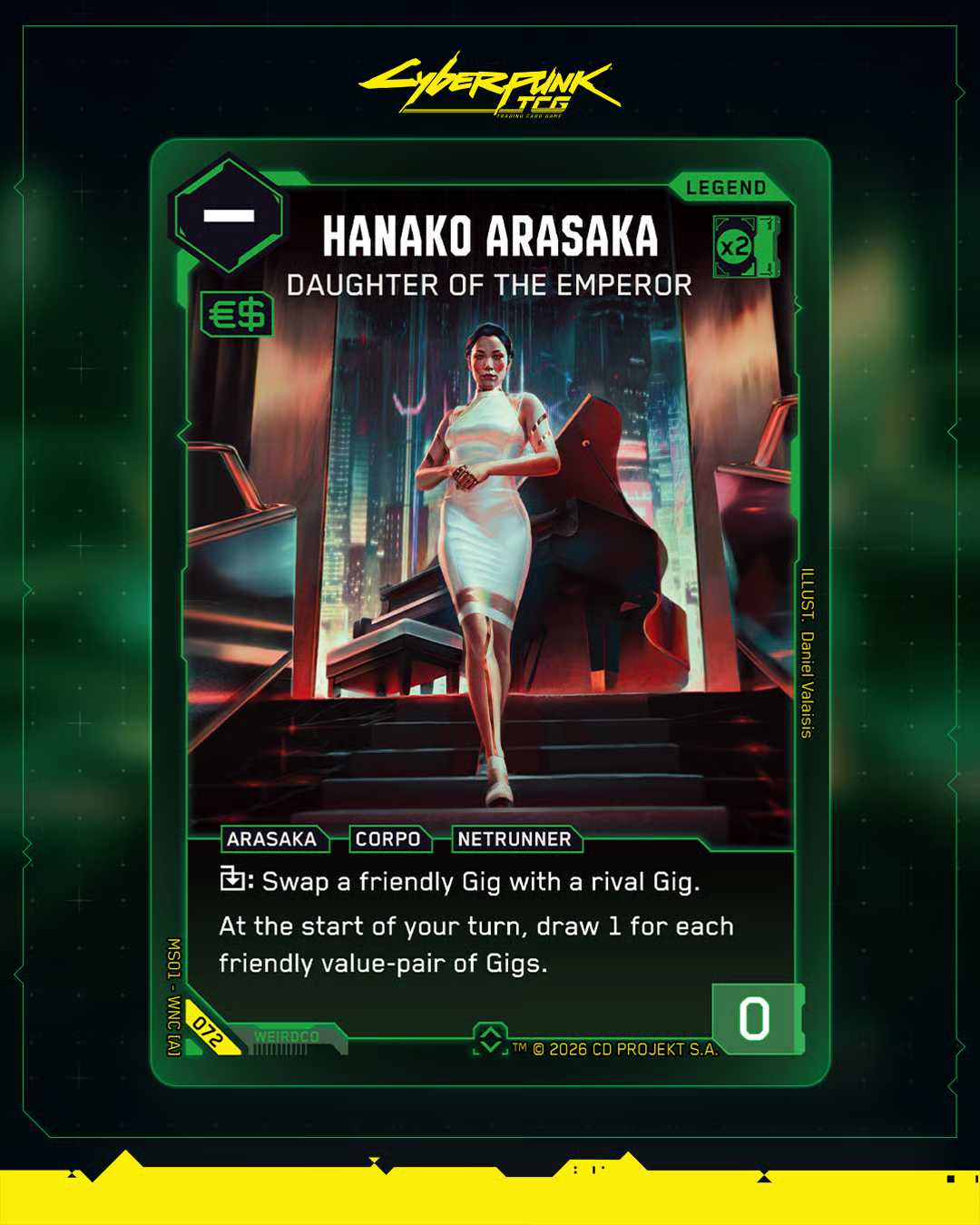
Update #54 also drops a card reveal on top: Hanako Arasaka „Daughter of the Emperor,“ a Legend with the tags ARASAKA · CORPO · NETRUNNER and PWR 0. Her trick, as the reveal image shows it: she swaps a friendly Gig for a rival one and, at the start of your turn, draws a card for each friendly value-pair, meaning two dice showing the same number. An engine card that wins on control and card advantage rather than combat, and one that, per Lead Designer David McDarby, is built to grow stronger as the card pool expands.
We already pulled apart the full reveal in our deep-dive on Cyberdeck Podcast Ep. 17: the Gigs dice mechanic from the ground up, the deck-building around Sandayu Oda and Goro Takemura, and how she differs from the older „In a Gilded Cage“ Hanako. The same card ran there for the first time this week. If you want to actually play Hanako, the long version lives there. Here the focus stays on what Update #54 means for retail and for backers.
Where WeirdCo talks, and where the community does
If you want to dig deeper, a quick word on the channels all this runs through. Officially WeirdCo accompanies the store-locator launch via the Cyberdeck Podcast, whose episode 17 „Local Game Store Locator“ premiered on YouTube in mid-July 2026. The hosts are Cree „Kawa“ Gunning of WeirdCo and Paweł, better known as Burza. Episode topic: the new store locator plus the week’s card reveals. That’s the channel the studio side frames its updates through. Anyone who wants the official perspective firsthand is in the right place there.
On the community side there are real, findable formats, for example „Cardrunners: A Cyberpunk TCG Podcast,“ which in episode 06 under the title „How to ANALYZE Cyberpunk Cards“ does exactly what the name promises, and makes a good starting point for people who want to get deeper into card evaluation. If you’d like to keep browsing, there’s more English-language coverage in our English Edition.
The update also gives two community-spotlight names: Speci and Fresh Lobster of the „Braindance Cyberpunk TCG Podcast“ with a video „RATING CYBERPUNK CARDS!“ I’m hitting the brakes here deliberately: this podcast could not be verified externally. It’s named in the update but may exist under a different title or on a different channel. So I’m listing it as „mentioned in the update,“ not a vetted recommendation. Curious? Best to search yourself and form your own picture.
What sticks from Update #54
After 54 updates, we’ve reached the point where a Kickstarter record becomes a store product. The store locator is online, the distribution network stands, the tournament play has a four-tier plan from September into winter, and the backers now know their orders are final and go out from autumn. For November 6, 2026 there’s a date you can hold onto.
What stays open I won’t bury, because these gaps are real. The euro prices are missing entirely. Until Luminous Cards and the retailers name numbers, every price figure is a guess. How many of the 3,000 registered shops sit in Europe or in Germany, nobody says, because the locator has no regional counter. And whether those shops are actually stocked and running events by November 6 is something the season from September on has to prove. Keep those in mind and you’ll read the update right.
For a title that launched as the most expensive tabletop Kickstarter in history, it was never seriously about whether enough money would come together; that was obvious. The open question was always whether it’d become a game you can buy at the shop around the corner and play week after week. Update #54 is the first proof WeirdCo takes that second, harder question seriously. The rest gets decided from September on, at real tables.
Sources
- Cyberpunk TCG Store Locator (cyberpunktcg.com/stores), incl. the developer blog post with OP rollout and the retail date November 6, 2026
- Cyberpunk TCG Card Database (cyberpunktcg.com/cards): Hanako Arasaka „Daughter of the Emperor“ and „In a Gilded Cage“
- Kickstarter Update #54 (WeirdCo): store locator, BackerKit lock, Hanako reveal, designer commentary from David McDarby
- Cyberdeck Podcast Ep. 17 „Local Game Store Locator“: Cree „Kawa“ Gunning & Paweł „Burza“
- Cardrunners: A Cyberpunk TCG Podcast, Ep. 06 „How to ANALYZE Cyberpunk Cards“
- Official retailer/distributor page: regional distribution network (DACH: Luminous Cards GmbH, Gera)

// KOMMENTARE (0)