BBG Control Deck Guide: Alt, Hanako, Jackie
AI TRANSLATION NOTE
This is the English edition of a deep-dive originally written in German. The translation was AI-assisted and human-reviewed for terminology, rules accuracy, and Rogue-persona tone. All direct quotes from RareTotem’s videos and Wild Things Games come verbatim from the original English sources, not back-translated from German. The original German article is available at cyberpunk-tcg-news.de.
Short version (as of October 13, 2026)
BBG wins by taking away every Unit the opponent plays before it can steal Gigs, while drawing more cards than they do. The engine is the min Gig: you push your own Gigs down to value 1. Each one makes Alt’s next Program cheaper, two of them form a pair, and Hanako draws one card per value-pair at the start of your turn. 23 of the 40 main deck cards remove or lock something, but almost all of them only under a condition, such as 4 or 5 power at most or only against Units without Gear.
As single cards, Legends and main deck cost €35.05 by Cardmarket trend prices (as of October 14), €35.96 with the sideboard. With the premium prints of the circulating list it’s €562.65.
Whether BBG really is the best deck, nobody knows yet. RareTotem relays the community view that it’s “widely considered to be the best deck in the format” and calls it “one of the top decks in the format” in their own words. Wild Things Games talks about the dominant strategy. Hanako and Alt each sit in more than 400 lists on ExBurst, and in Gamertag Mythras‘ count of 716 decks from September 16 (all decks with the given Legend, not just BBG) Alt ranks 3rd and Hanako 4th. Official constructed tournaments only start after the retail launch on November 6, and ExBurst tracks no event wins.
The meta series
- Overview: the meta before the first tournaments
- BBG Control (Hanako, Alt, Jackie)
- River’s Closet: River Ward Gear
- Mono-Blue Judy
- RRY: Smasher, Dum Dum, V and Yorinobu
If you want to bring a control deck to the Night City Brawls from November 6 or the Night City Showdowns from November 13, you’ll often run into three names: Alt Cunningham, Hanako Arasaka and Jackie Welles in the “Pour One Out For Me” version. The third slot isn’t settled, though. RareTotem says: “The most effective legend combination tends to either be Hanako, Jackie, and Judy, or Hanako, Jackie, and Alt.” In the tier list, RareTotem picks Judy (“I’m going Judy”). The Wild Things Games sample list runs Judy instead of Jackie. The scene calls the combination BBG, and one list note calls it “The Big Bad Boogeyman of set 1”.
Back in May, our German-language piece on the first meta decks covered the print-and-play phase, back when all we had were early sketches. Today the public deckbuilders hold hundreds of lists with these Legends, plus videos and retailer breakdowns. One list keeps circulating, identical on two platforms, sideboard and all. Who built it first can’t be settled, and that’s not what this guide is about.
We’re taking that list apart. Every card gets its card text, a reason for its count and a note on where it fails. Add combos, three sample turns counted down to the Eddie, mulligan numbers and sideboard plans against four opponent types. The rule references sit behind the asterisks.
BBG is popular, nothing is proven
BBG being the best deck is a gut call so far, not a measurement. According to Gamertag Mythras, official, sanctioned constructed tournaments only start after the retail launch on November 6, and ExBurst lists “Event wins: None tracked yet” for all three Legends.
The gut calls do line up, though. RareTotem calls BBG “widely considered to be the best deck in the format” in the video from September 9. In the tier list from September 1, Hanako is “easily the best legend in the game”, Jackie in this version is “S tier” and Alt is “A tier, borderline S tier”. Randy Muir of US retailer Wild Things Games writes on October 4 of a “dominant deck archetypal strategy”. None of these voices gives a win rate or a measurement, and neither does the list note with the “Boogeyman”. RareTotem’s BBG video sits at roughly 19,170 views (as of October 13).
The only hard numbers come from the deckbuilders, and they show popularity, not wins. ExBurst has 443 public lists with Hanako, 434 with Alt and 240 with Jackie. Alt is Hanako’s most common partner at 36%.
Why so many people back this deck is right there in the card text. Almost everything BBG wants hangs on one action: pushing Gigs down to 1. A single Trust No One or Jackie trigger pays into several cards at once: Alt’s discount, Three Mouths, Chrome Reverie, Pyramid Song, Hanako’s draw, Pepe and, through low Street Cred, Towerfall too. Which card switches on at which min Gig is covered in the min Gig section.
The weakness is in the card text just the same. Nearly every removal card has a condition: 4 or 5 power at most, the smallest Unit, no Gear, a d4 at 1 or less Street Cred than the opponent. Play Units with 7 or more power, equip your Units, park small decoys next to them, keep your own Street Cred low or attack right away with Adrenaline, and you hit BBG where the list is thin. 6 power isn’t quite enough, because Floor It plus Towerfall catches that too. Only two cards remove a target of free choice with no power cap: Maman Brigitte, who needs a Unit without Gear and two discarded Programs, and Placide, who sits in the sideboard, costs 8 €$ and discards a Program every time he triggers.
So treat this guide as a blueprint with the reasoning shown. It becomes a results report once the first events have been played.
Forty cards and seven in reserve
The list sits in the official Netdeck builder on cyberpunktcg.com as “Hanako Control” (created September 11 UTC, last changed October 8) and on ExBurst as “BBG Alt” (updated October 10). Both versions match card for card, sideboard included. Who copied whom is open. The reasoning, the comparison with eight independent lists and all the math in this text are ours.
| Count | Card | Type | Color | Cost |
|---|---|---|---|---|
| Legends (3) | ||||
| 1 | Alt Cunningham: Soulkiller Architect | Legend | Blue | – |
| 1 | Hanako Arasaka: Daughter of the Emperor | Legend | Green | – |
| 1 | Jackie Welles: Pour One Out For Me | Legend | Blue | – |
| Units (11) | ||||
| 3 | Jacked-In Voodoo Boy | Unit | Blue | 2 |
| 3 | Pepe Najarro: Working Doubles | Unit | Green | 4 |
| 2 | Lizzy Wizzy: Delicate Weapon | Unit | Blue | 5 |
| 3 | Maman Brigitte: Spirit of Death | Unit | Blue | 5 |
| Programs (29) | ||||
| 2 | Floor It | Program | Blue | 1 |
| 3 | Peace Offering | Program | Green | 1 |
| 3 | Trust No One | Program | Blue | 1 |
| 2 | Take Control | Program | Green | 2 |
| 3 | Three Mouths, One Desire | Program | Blue | 2 |
| 3 | Chrome Reverie | Program | Blue | 3 |
| 3 | Nocturne OP55 N1 | Program | Blue | 3 (or 1) |
| 3 | Pyramid Song | Program | Blue | 3 |
| 2 | Memory Relapse | Program | Green | 4 |
| 3 | Les Élémens | Program | Blue | 5 |
| 2 | Towerfall | Program | Blue | 6 |
| Sideboard (7) | ||||
| 2 | Modded Kusanagi | Unit | Blue | 6 |
| 2 | Placide: Voodoo Sentinel | Unit | Blue | 8 |
| 3 | Riot Shield | Gear | Green | 2 |
| Cost | 0 | 1 | 2 | 3 | 4 | 5 | 6 | 7+ |
|---|---|---|---|---|---|---|---|---|
| Cards | 0 | 8 | 8 | 9 | 5 | 8 | 2 | 0 |
The curve is flat, with an average of 3.1 €$. The main deck stops at Towerfall for 6 €$, and everything pricier waits in the sideboard. That’s unusual for a control deck, and probably deliberate: the list wants to do two things every turn, and that only works with lots of cards between 1 and 3 €$.
It’s tournament-legal, too. 3 Legends and 40 cards, no card more than three times, nothing banned, and it uses the Legends‘ color limits exactly: Alt and Jackie together allow Blue cards up to RAM 4, Hanako allows Green up to RAM 2.
Hanako is the only Green Legend in the list, and only her RAM of 2 lets Green cards into the deck at all (3.20.5.1). Without her, the ten Green main deck cards couldn’t be in the list, meaning Pepe, Peace Offering, Take Control and Memory Relapse, plus Riot Shield in the sideboard. Swap Hanako for another Legend and you’re refilling all of those slots from scratch.
Every Legend has its own job
Before the individual Legends, a quick word on money, because every turn hangs on it. Each Legend can pay 1 €$ per turn, plus one sell per turn. On turn N that gives you roughly N Eddies plus 3 €$ from the Legends, so about 6 €$ on turn 3. No card in this list makes Eddies under the rules. The only extra source is Pepe, who readies Alt and Jackie so they can each pay 1 €$ again that turn.
The abilities come with a price tag. Both of Alt’s abilities and Hanako’s swap require spending the Legend. A spent Legend pays no €$ that turn,*1 so every ability you use is one Eddie less for cards. Hanako’s draw and Jackie’s trigger, on the other hand, cost nothing and run in the background.
And then there’s chance. A face-down Legend pays, and that’s all it does. You don’t know which one you’ll flip, because the three are shuffled and face-down, even for their owner.*2 The first Call hits each Legend with a probability of 1/3. Leave 1 €$ open on the opponent’s turn and you can Call again when they attack, which gets all three face-up faster.*3 How to play depending on which Legend comes up first is in the game plan.
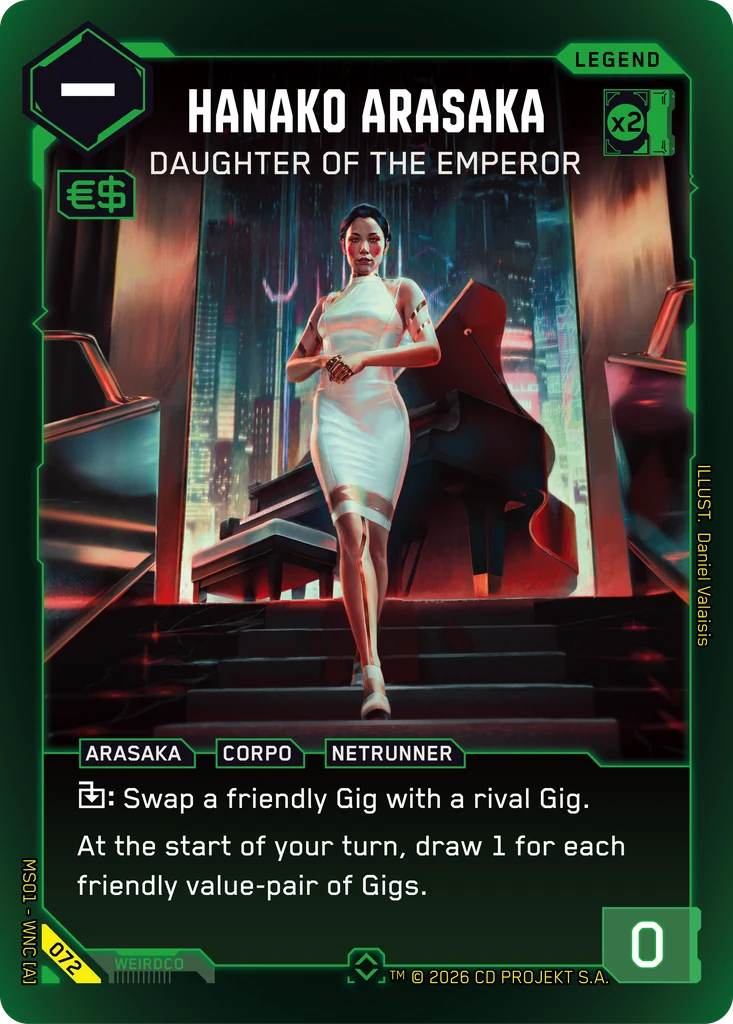
Hanako: the engine that costs nothing
“{Spend} Swap a friendly Gig with a rival Gig.”
“At the start of your turn, draw 1 for each friendly value-pair of Gigs.”
Hanako is the deck’s engine, and she does two things.
She draws cards for free. At the start of each of your turns you get one card per value-pair, meaning per two of your Gigs showing the same value. All she needs is to be face-up; no spending, no paying. It kicks in on turn 3 at the earliest, though.*4 At the start of turn 2 you only have one Gig, and the Gig that arrives during the current turn doesn’t count yet. That’s why BBG looks so tame for two turns. If Hanako is up early, bring the Gigs from turns 1 and 2 to the same value, easiest both to 1 or via Peace Offering.
Her second tool is the swap. For a Spend, meaning the Eddie she’d otherwise have paid that turn, you trade one of your Gigs for one of the opponent’s, and both keep their number. Nothing gets stolen, but you get your d4 back, complete your own pair or break theirs. Trade a high Gig of yours for a low one and you also drop your own Street Cred until Towerfall gets both effects.
Hanako’s real enemies are opponents who change Gig values on purpose. RareTotem names Dexter DeShawn “and the other fixers” as counters and rates El Capitán as a good pick against Hanako decks. And since Hanako isn’t a Merc, Pepe can’t ready her.
Alt: discount and a second copy
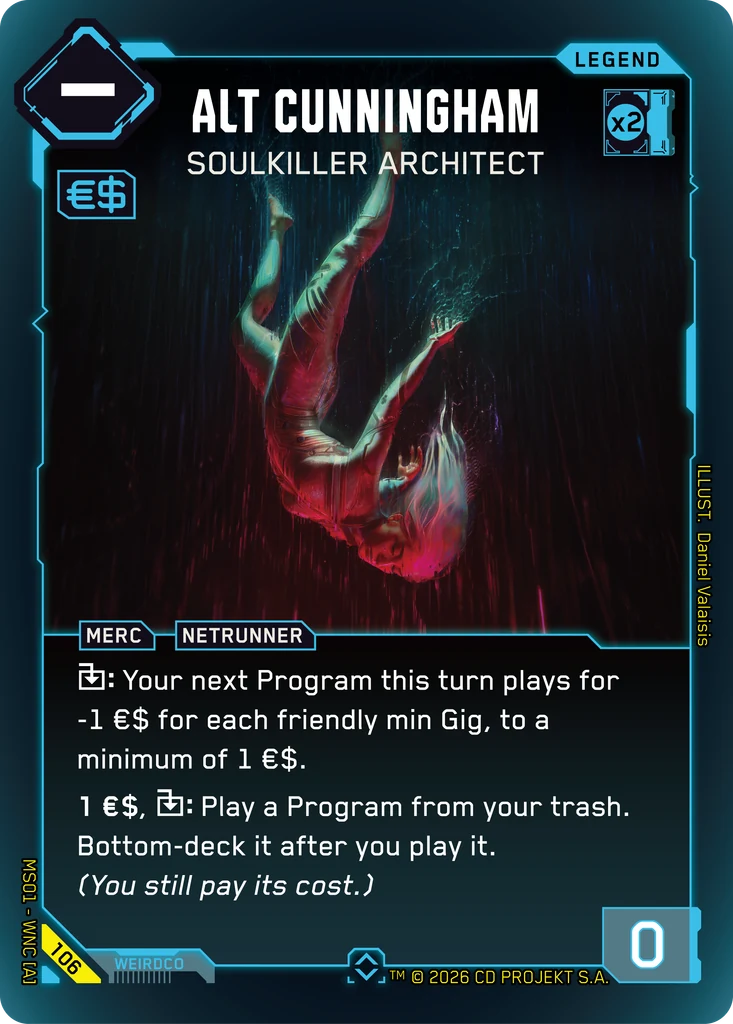
“{Spend} Your next Program this turn plays for -1 €$ for each friendly min Gig, to a minimum of 1 €$.”
“1 €$, {Spend} Play a Program from your trash. Bottom-deck it after you play it. (You still pay its cost.)”
Alt makes the expensive Programs cheaper and plays removal from the trash a second time. Both cost her Eddie for that turn, so you have to check whether it’s worth it.
The discount only pays off from two min Gigs. It cuts the next Program by 1 €$ per min Gig, but Alt doesn’t pay her own Eddie for it. Net, you keep the number of min Gigs minus 1. With three min Gigs, Les Élémens drops from 5 to 2 €$, and no Program gets cheaper than 1 €$.
Timing is everything here. Spend Alt only once every min Gig of the turn is down, because the size of the discount is locked in when you spend her.*5 And spend her right before the Program you want cheaper. The discount goes to the next Program, whichever it is, and a free Program via Lizzy Wizzy likely eats it too.
Discount and trash Program on the same turn only work if Pepe readies Alt. Then the discount even applies to the Program from the trash, and two discounts in a row add up.
A Program from the trash is pricey: 1 €$ plus Alt’s Spend plus the full cost. Les Élémens comes to 1 + 5 €$ plus Alt’s Eddie, 7 €$ worth in total. In return you get a second bottom-deck, and the card goes under your own deck afterwards, which helps against running out of cards.
Two claims at Wild Things Games don’t match the card text. They describe the discount as a “discount … by each pair of min-gigs”, but the card says “for each friendly min Gig”, so per min Gig. And for Programs from the trash WTG says “an extra ~2 eddies”. Per the card it’s 1 €$ plus Alt’s Spend. The “~2” only holds if you count Alt’s lost Eddie, and WTG doesn’t say so.
RareTotem considers Alt’s trash ability “very powerful, though very expensive” and expects it to see less use than Judy’s ability. The notes on one comparison list say: “Alt Cunningham is interchangeable with Judy Alvarez.” In the builders, Alt is the partner in 36% of Hanako lists and 51.5% of Jackie lists.
Jackie: min Gigs without a Spend
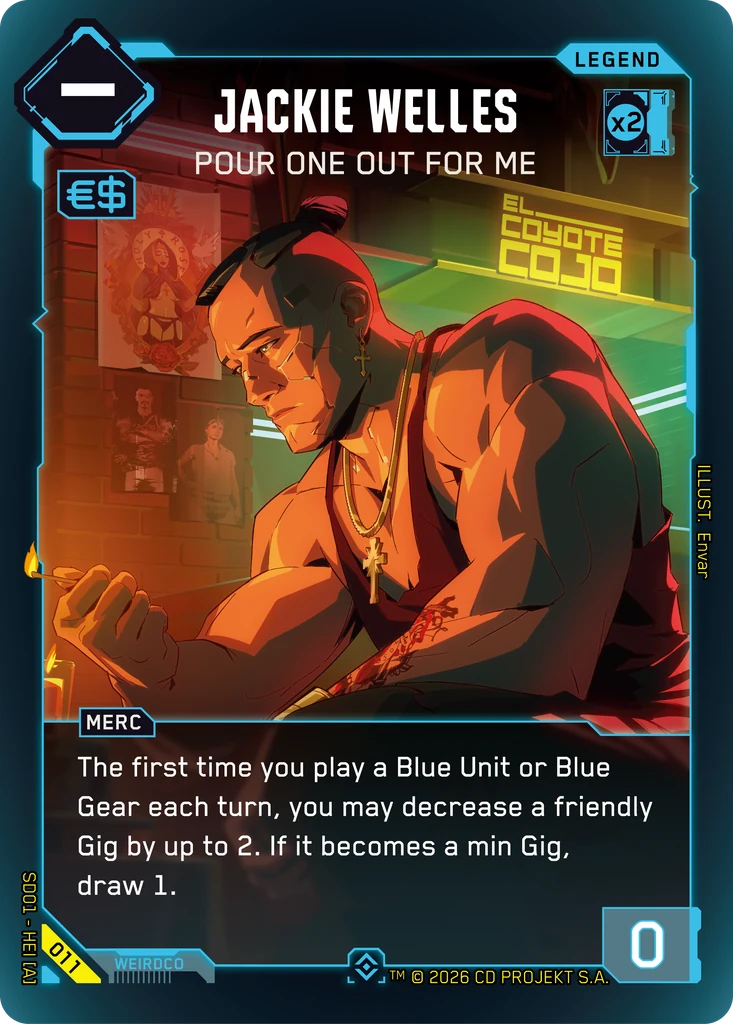
“The first time you play a Blue Unit or Blue Gear each turn, you may decrease a friendly Gig by up to 2. If it becomes a min Gig, draw 1.”
Jackie pushes Gigs down to 1 without costing her Eddie. She keeps paying like any Legend and lowers a Gig on the side. According to RareTotem, that’s exactly what separates her from Wakako: “you have to spend her to alter gig values unlike Jackie”.
Only the first Blue Unit or Gear of the turn triggers her. In the main deck that’s eight cards: three Voodoo Boy, two Lizzy Wizzy, three Maman Brigitte. Kusanagi and Placide add to that from the sideboard. Pepe is Green, so is Riot Shield, and Programs don’t count at all, not even the ones from the trash. Play a Blue Unit first and flip Jackie afterwards, and you get no trigger that turn at all, not even with a second Unit.*6
You only draw if Jackie is what brings the Gig to 1. A d4 or d6 at 2 or 3 lands on 1 and draws. A d8 at 7 only gets to 5, which draws nothing. Pick a Gig that’s already at 1 and you don’t draw either. Since she lowers by “up to 2”, you can also let the trigger go unused.
In the builders, Jackie is the partner in 25.6% of Hanako lists and 28.3% of Alt lists. She comes as SD01-011 from the Heist starter.
One Gig at 1 unlocks half the deck
Every Gig at 1 serves two goals at once, Alt’s discount and Hanako’s draw. The description of the circulating list says it outright: “We want to make a lot of Min Gigs for Alt Cunningham and Hanako, who will make our programs cheaper and draw us lots of cards respectively.” RareTotem splits the two further, min Gigs “to get Alt Cunningham’s program discount ability online” and pairs so that “Hanako snowball”. That one action delivers both follows from the rules: every min Gig has value 1, and two equal values are a pair.
The cards switch on at different points. A single min Gig is enough for Chrome Reverie’s free Call and, if it’s the d4, for both effects of Pyramid Song. Three Mouths takes one more card per min Gig. Alt’s discount only pays off from the second one, and only from the second one is there a pair for Hanako and Pepe.
With four min Gigs everything fires at once. That’s two pairs, so two extra cards per turn through Hanako. Alt’s discount is 4 €$, net 3. Three Mouths takes all three cards it looks at, Pyramid Song gets both effects as long as the d4 is among them, Chrome Reverie hands out the free Call, and Pepe readies two Legends when he attacks. Six effects from a single resource.
The d4 belongs on the table on turn 1
Roll in the d4 as your first Gig. You pick which die gets rolled in; only the d20 has to come last. Pyramid Song explicitly needs your own d4 at 1. Roll it in on turn 1 and the Trust No One plus Pyramid Song combo is ready from turn 2.
Trust No One is the sure way there. It lowers by up to 3, so a d4 reaches 1 from any value. Jackie only lowers by 2 and gets a d4 at 4 no further than 2. RareTotem nails it: “Trust No One can automatically change that D4 to a one regardless of what value it was rolled at, so it’s a sure thing.”
The d4 is also the softest spot. The opponent can steal it or swap it away with their own Hanako, and then Pyramid Song only gets one effect. Wild Things Games rightly tells opponents to “play around Pyramid Song when they have a min value d4”: it has to be the d4, any min Gig won’t do.
Low Street Cred is weapon and shield
Lots of Gigs at 1 keep your Street Cred low, and that’s exactly what Towerfall needs. If you want the system itself explained, our piece on Streetcred as the deepest system in TCGs covers it. Street Cred is the sum of all Gig values. Four min Gigs make 4, an opponent with Gigs at 6 and 3 has 9. Towerfall only gets both effects if we have less Street Cred than the opponent, and the min Gig plan delivers that almost as a side effect. One exception: an opponent with no Gigs at all counts as less than 0, so against them we never have less.*7
Hanako’s swap can help on purpose. Trading a high Gig of ours for a low one of theirs drops our sum and raises theirs. In the mirror all of this works worse, because both sides push their values down. Who ends up lower is anyone’s guess.
As a shield, the low sum works against MT0D12 Flathead from Judy lists: “If you have less ☆ (Street Cred) than a Rival, this Unit can’t be blocked.” The lower our Street Cred, the less often the Flathead player has less, and the more often Flathead stays blockable.
Memory Relapse only draws with even Street Cred. Two min Gigs make 2, three make 3. If you want to play the card, steer the sum beforehand with Trust No One or a Jackie trigger.
Every card with text, count and weak spot
The percentages after each card are ExBurst builder rates: the share of lists in ExBurst’s consensus breakdown for the given Legend that run the card. That breakdown covers 356 of the 443 lists for Hanako, 357 of 434 for Alt and 196 of 240 for Jackie. They show what gets built, not what wins. The circulating list doesn’t explain its card counts; the reasoning here is ours.
A good half of the deck removes or locks, but only eleven cards actually take a Unit off the table. RareTotem puts the share at “roughly 60%”. We count 23 of 40 cards, so 57.5%: three Maman, two Floor It, two Take Control, three Chrome Reverie, three Nocturne, three Pyramid Song, two Memory Relapse, three Les Élémens, two Towerfall. You could also count Floor It and Take Control as tricks. Only Maman, Pyramid, Les Élémens and Towerfall remove anything; the other twelve push the problem back a turn. And even those eleven only send Units to the very bottom of the opponent’s deck.*8 They come back once the opponent has drawn that far.
3× Jacked-In Voodoo Boy
“This Unit can’t attack unless you played a Program this turn.”
Blue Unit, 2 €$, power 2. Voodoo Boy is the cheapest Jackie trigger and steals a Gig early. His condition, playing a Program first, barely matters with 29 Programs in the deck. Easy to miss: as a small Unit he’s a decoy against an opposing Les Élémens. Wild Things Games advises BBG’s opponents to use shields like that, and in the mirror the same goes for us.
Three copies, because you want to see him on turn 1 or 2. He’s in the opening hand 39.4% of the time (math in the mulligan section). In the builders he shows up in 36% of Hanako lists and 53.1% of Jackie lists, and two of the three Judy variants in the comparison skip him entirely. RareTotem sees him as a turn-1 card: “put an attacker on the board turn one … your rival will likely not want to waste any removal”.
3× Pepe Najarro: Working Doubles
“{Attack} If you control a value-pair of Gigs, ready up to 2 MERC Legends in your Legends area.”
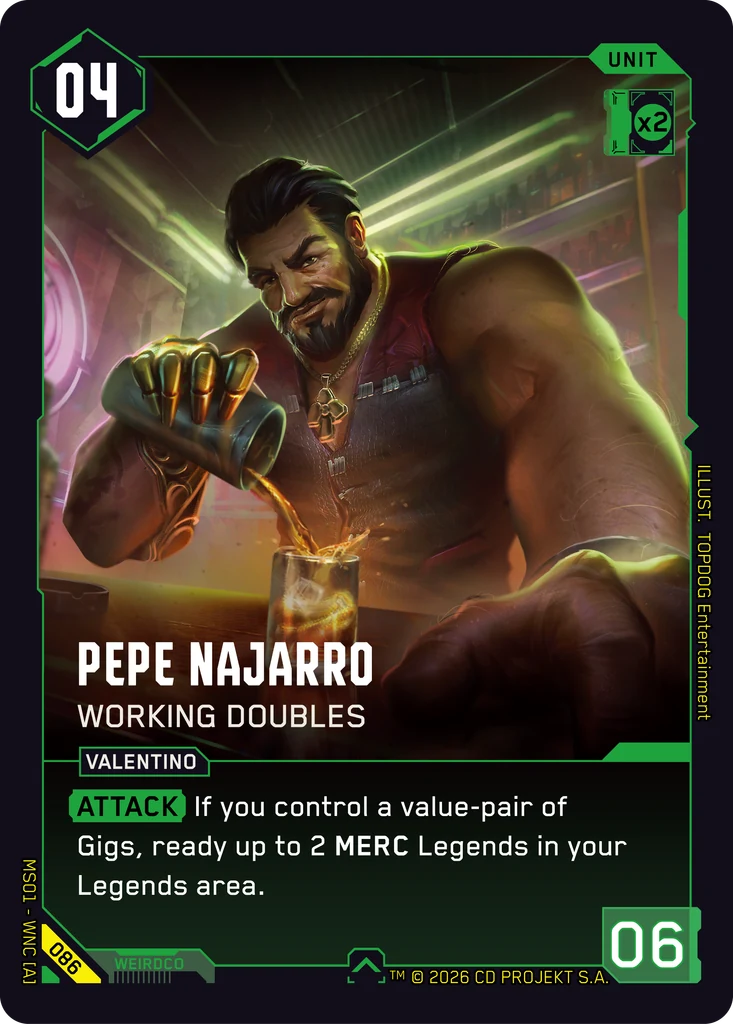
Green Unit, 4 €$, power 6. Pepe looks like an attacker, but he’s a money source. When he attacks and you have a pair, he readies Alt and Jackie, both Mercs. That happens the moment he attacks, before the opponent can react.*9 If they block or play Take Control, Alt and Jackie are back up anyway. That’s 2 €$ extra or a second Alt activation on the same turn.
His 6 power survives a mirror opponent’s Pyramid Song (6 − 4 = 2) and Towerfall (6 − 5 = 1), though Floor It plus Towerfall takes him to 0. Les Élémens hits him as soon as he’s the smallest Unit. He has three weak spots, too. He’s Green and doesn’t trigger Jackie, he only attacks the turn after he’s played, and with no pair when he attacks, nothing happens at all.
Three copies, because besides selling he’s the only extra money source. One comparison list runs two, three of the eight skip him. Builder rate 41.6% with Hanako and 29.6% with Jackie, where he’s only an option.
2× Lizzy Wizzy: Delicate Weapon
“{Play} You may play a Program with cost 3 or less from your hand or trash for free. Bottom-deck it after you play it.” “{Blocker}”
Blue Unit, 5 €$, power 2. Lizzy brings three things at once: a blocker that can block on the turn she’s played, a Jackie trigger and a free Pyramid Song, Chrome Reverie or Nocturne, even from the trash. The free Program saves up to 3 €$, so body and trigger effectively cost 2.
Lizzy is one of the clearest deviations from consensus. Builder rate 50.3% with Hanako, 83.5% with Alt, 80.1% with Jackie. Five of the eight comparison lists run three copies, one runs two (Wild Things Games), one a single copy, one none. Our read: eight cards already sit at cost 5, and a third Lizzy would clog the curve there. If you’re reworking a slot, she’s still the first pick.
3× Maman Brigitte: Spirit of Death
“{Play} You may discard 2 Programs. If you do, bottom-deck a rival unequipped Unit.”
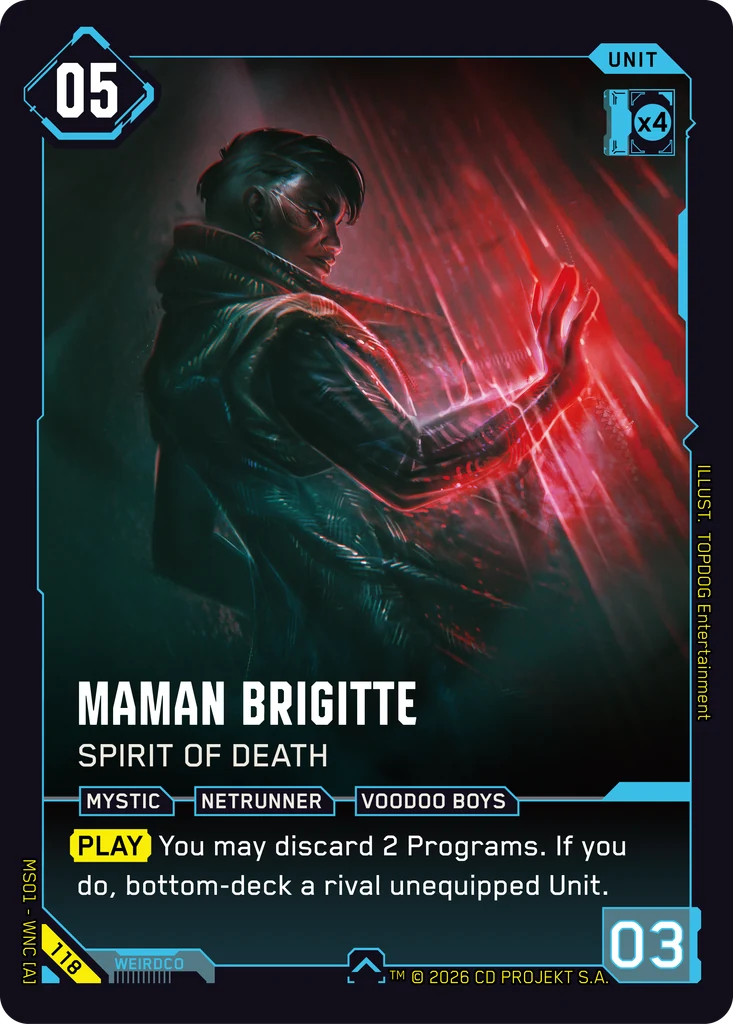
Blue Unit, 5 €$, power 3, RAM 4. Maman picks her target freely and has no power cap. The only other main deck card that can say that is Les Élémens, and it only hits the smallest Unit. The price is 5 €$ and two Programs from hand, both or none. They aren’t wasted; they stock the trash for Alt and Lizzy. One word sinks her: “unequipped”. That’s why she decides Gear matchups more than any other card.
Three copies, because the list puts Maman in the main deck instead of Placide. Builder rate between 34.6 and 56.1%, and five of the eight comparison lists run two. RareTotem calls her “costly to use early” on turn 2 and advises: “use her sparingly”.
2× Floor It
“{Quick} Give a rival Unit -1 power this turn. Draw 1.”
Blue Program, 1 €$, {Quick}, so you can play it on the opponent’s turn too. One point of power sounds like nothing, but it shifts three thresholds. An attacker with 10 power drops to 9 and steals one Gig instead of two. In a fight against a blocker, a loss turns into a tie, and on a tie both lose. Above all, Pyramid Song then reaches up to 5 power and Towerfall up to 6. Floor It isn’t a Braindance Program, so in a Judy variant it doesn’t trigger Judy’s power bonus.
Two copies. Builder rate between 33.4% with Hanako (option only) and 64.3% with Jackie. Two comparison lists run three, three skip it entirely.
3× Peace Offering
“You may set a Gig’s value to the value of another Gig. Then, if you control a value-pair, draw 1.”
Green Program, 1 €$. Peace Offering builds pairs for Hanako and Pepe and draws a card while it’s at it. Because it says “a Gig”, you can also use it to break an opposing pair, which in the mirror or against an opposing Hanako costs them a card per turn. You draw off any pair of yours; the Gig you set doesn’t have to be part of it. Break their pair while you already hold one, and you still draw.
The card has three limits. Dice in the fixer area are off-limits. The new value has to exist on the die, so a d4 can’t go to 6. And a Gig can’t be set to the value it already shows.
Three copies. At 85.7%, Peace Offering is the most-played card in Hanako lists.
3× Trust No One
“Decrease a Gig by up to 3. Then, if you control a min Gig, draw 1.”
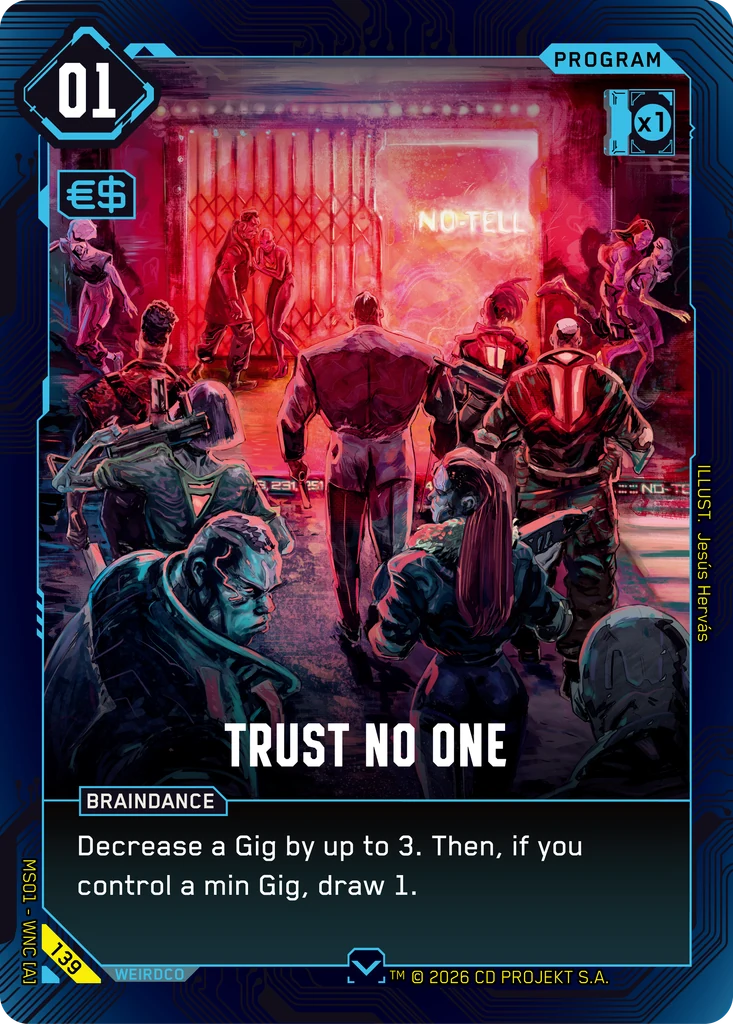
Blue Program, 1 €$. The surest way to bring the d4 to 1, from any value, plus a card. You draw as soon as any Gig of yours sits at 1. So you can also lower an opposing Gig with Trust No One and still draw, as long as there’s already a 1 on your side.
Three copies. Builder rate 55.9% with Hanako, 81% with Alt and 83.2% with Jackie, where it ranks first.
2× Take Control
“{Quick} A rival Unit steals 1 fewer Gig this turn. If that Unit is an AI, DRONE, or VEHICLE, draw 1.”
Green Program, 2 €$, {Quick}. Besides Floor It, the only card you can play on the opponent’s turn. Any attacker with 1 to 9 power steals nothing on that attack, and the cut also applies that turn to Gigs a Unit steals through an effect. You draw against Modded Kusanagi, Valentino Street Racer and MaxTac AV (Vehicle), MT0D12 Flathead (Drone) and Delamain: Rideshare AI (AI), all cards from opposing variants. The price is discipline: you need 2 €$ left at the end of your own turn.
Two copies, and together with Memory Relapse this is the real signature of the list. Only two of eight comparison lists run Take Control, and the builder rate with Hanako is 32.9%, option only. If you’re reworking the list, cut here first.
3× Three Mouths, One Desire
“Search the top 3 cards of your deck. Add 1 to your hand. You may add 1 more for each friendly min Gig. Bottom-deck the rest.”
Blue Program, 2 €$, RAM 3. Filter and card advantage in one. With two min Gigs you take all three cards for 2 €$, and the rest goes under the deck and lengthens it. Wild Things Games counts the card among the “auto-include programs”. Three copies, builder rate 43.8% with Hanako and 74.5% with Jackie.
3× Chrome Reverie
“A rival Unit can’t attack until your next turn. If you control a min Gig, you may Call a Legend for free. (You can only Call a Legend once per turn.)”
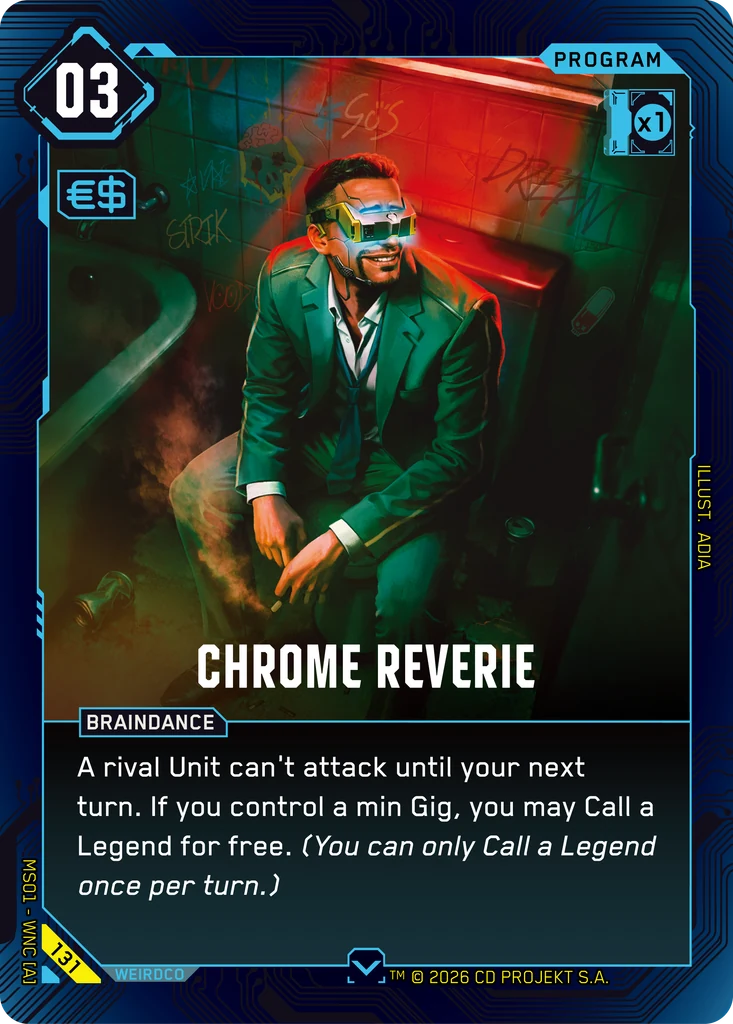
Blue Program, 3 €$. Locks an attacker until your next turn and saves 1 €$ with the free Call. No {Quick}, so your own turn only. The catch is in the parentheses: one Call per turn. If you already called, the bonus is gone, and you have to take the free Call right away; you can’t save it. Three copies, builder rate between 48.9 and 79.1%.
3× Nocturne OP55 N1
“If your fixer area is empty, play this Program for 1 €$. Choose one effect. Draw 2. // A Unit can’t attack until your next turn. // A friendly Legend may use {Go Solo} for -2 €$ this turn, to a minimum of 1 €$.”
Blue Program, 3 €$ or 1 €$. Early on, Nocturne is a second Chrome Reverie or a Draw 2 for 3 €$. From your sixth turn it costs only 1 €$, because by then all six Gig dice are rolled in and the fixer area is empty. That applies from that turn’s Main Phase, as long as nothing puts dice back, and the cheap price is then mandatory.*10
The third effect is dead in this list, since none of the three Legends has Go Solo or can hit the field. Effect 2 says “A Unit”, by the way, not “a rival Unit”; in practice it doesn’t matter. Three copies, builder rate between 36 and 51.5%, and three of the eight comparison lists skip it.
3× Pyramid Song
“Choose one effect. If a friendly d4 is a min Gig, choose both instead. Give a rival Unit -4 power this turn. // Bottom-deck a rival Unit with power 0.”
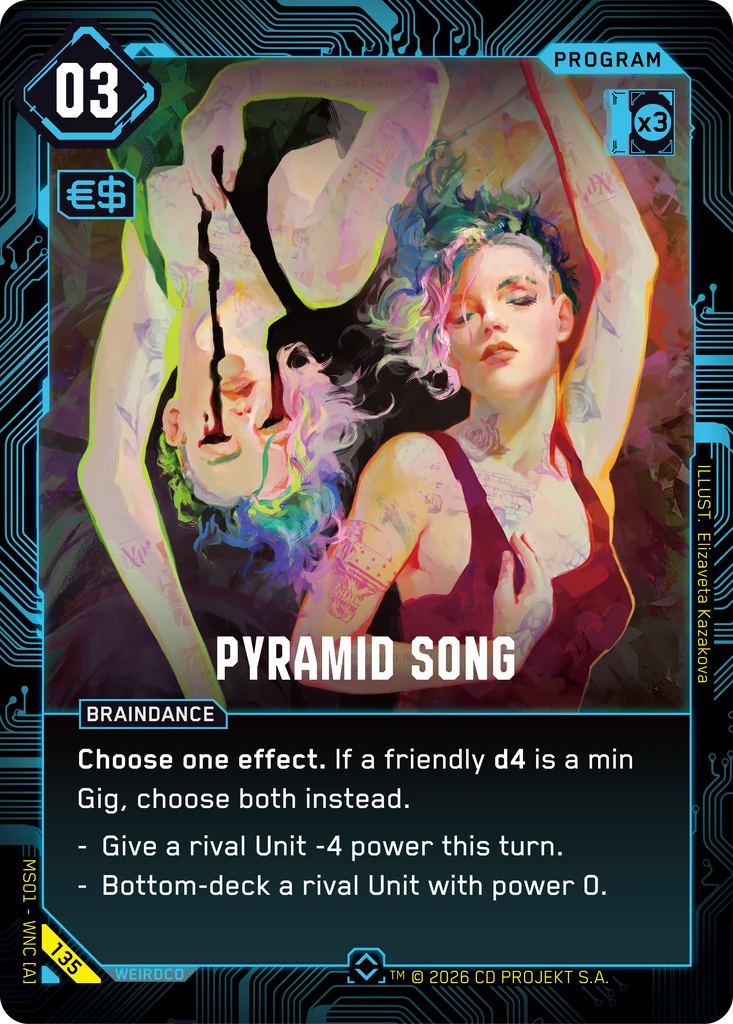
Blue Program, 3 €$, RAM 3. The cheapest real removal in the list, with two conditions: your d4 sits at 1, and the target has no more than 4 power. Then it first gets −4 and goes under the deck afterwards, because power below 0 counts as 0.*11 With Floor It first, it reaches up to 5 power. Lizzy plays Pyramid Song for free, even from the trash. Three copies, builder rate between 47.8 and 77%.
2× Memory Relapse
“Spend a rival Unit. It can’t ready until your next turn. If your ☆ (Street Cred) is an even number, draw 1.”
Green Program, 4 €$. The answer to big Units that survive Pyramid and Towerfall: it stays down until our next turn. The target can already be spent, in which case only the ready lock does anything. None of our sources mentions a second use: you’re allowed to attack a spent opposing Unit. Pepe can beat it in combat that way if he has more power. You draw with even Street Cred, and you can steer that through min Gigs.
Two copies. Four of the eight comparison lists skip it, two run three. Builder rate 49.2% with Hanako and 30.1% with Jackie, where it’s an option. Memory Relapse and Take Control split the scarce Green slots.
3× Les Élémens
“Bottom-deck a Rival’s lowest-power Unit. (If there are multiple, choose 1.)”
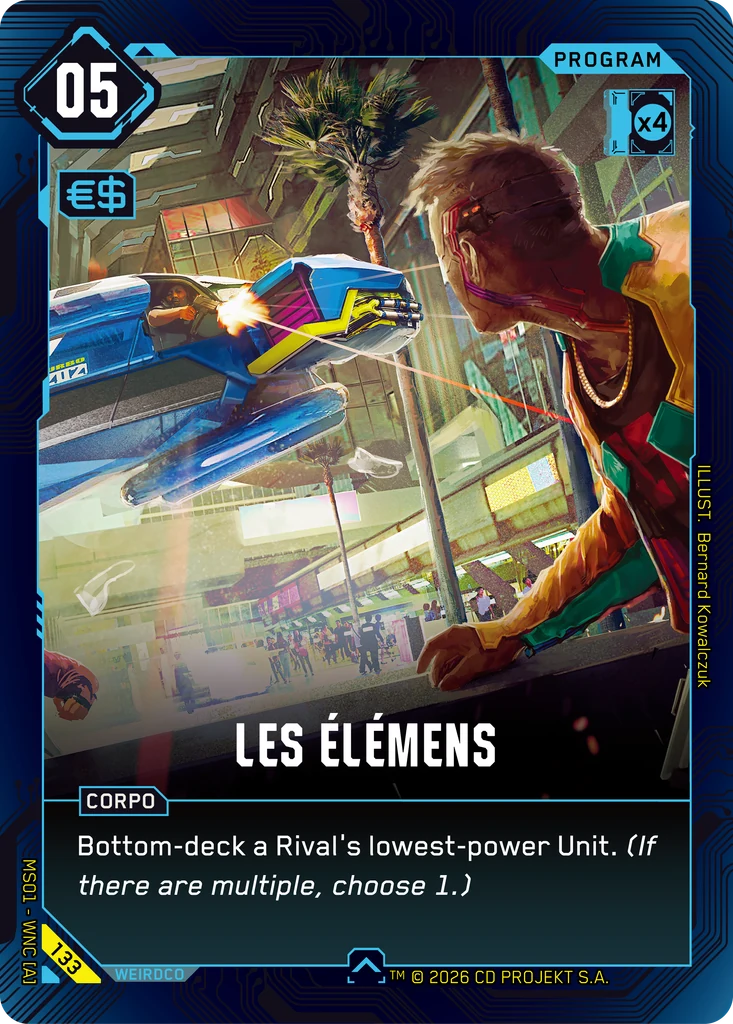
Blue Program, 5 €$, RAM 4. Les Élémens doesn’t care about power or Gear, but it always hits the opponent’s smallest Unit. What counts is total power including Gear, not the printed number.*12 On a tie, whoever plays the card picks. With Alt and two min Gigs it costs 3 €$, with three only 2.
Gear moves the target. Gear on the actual threat keeps a small decoy next to it in the role of smallest Unit. Gear on the decoy, on the other hand, can lift it above the threat and expose the threat. Mandibular Upgrade has power 0 and turns a decoy into a blocker without changing its power.
The decoy is the weak spot. If the opponent parks a small Unit next to their threat, Les Élémens hits the decoy. So Pyramid Song or Maman on the decoy first, Les Élémens after. RareTotem names the card as the turn-2 answer to an early Pepe: “the choice is easy, Les Elements”. Three copies, builder rate between 41.9 and 67.9%.
2× Towerfall
“Choose one effect. If you have less ☆ (Street Cred) than a Rival, choose both instead. Give all rival Units -5 power this turn. // Bottom-deck all rival Units with power 0.”
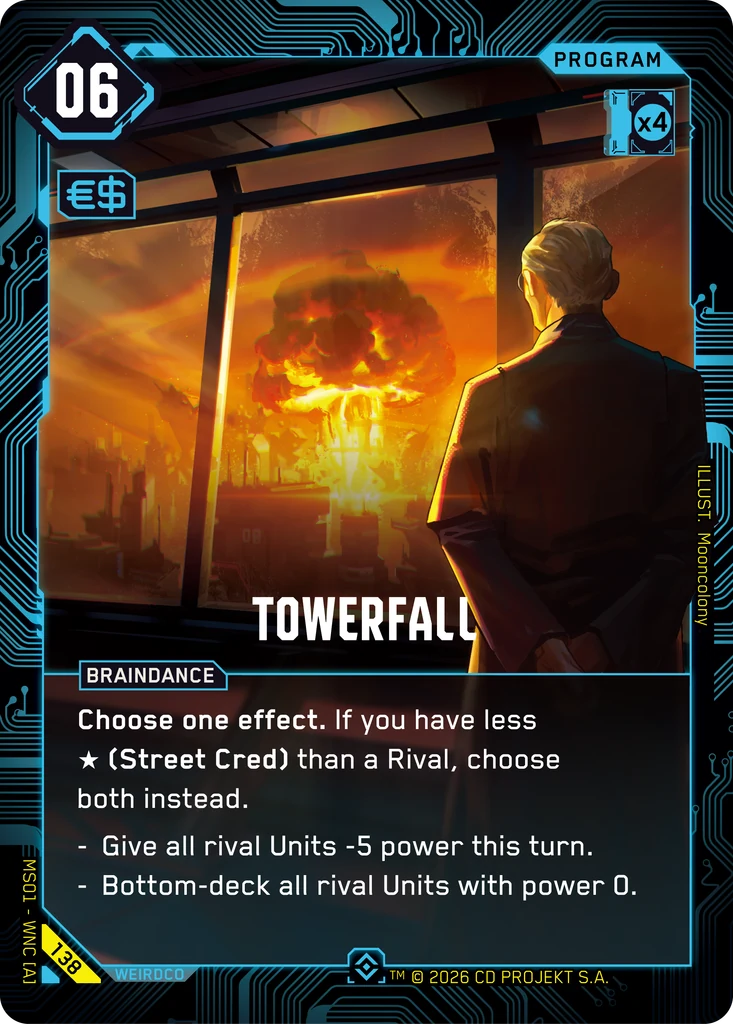
Blue Program, 6 €$, RAM 4, Epic. The board wipe: every opposing Unit up to 5 power goes under the deck if we have less Street Cred than the opponent. On equal Street Cred you only get one effect. The second effect on its own only clears Units that already have 0 power, such as Delamain: Rideshare AI, Evelyn Parker or Misty from Judy lists.
Two copies instead of three. Towerfall is the priciest card in the main deck and drives the cost: €19.98 of the €25.92 for the 40 main deck cards go to the two copies. Four comparison lists run three. After Lizzy, Towerfall is the second candidate to bump up.
Every combo chain has a breaking point
Each chain comes with the spot where it snaps, and that spot is exactly what opponents care about. RareTotem describes the first chain; the rest we derive from card text and rules.
Trust No One, then Pyramid Song
For 4 €$, a Unit with up to 4 power is gone, you draw a card, and the d4 stays at 1. Trust No One for 1 €$ lowers your d4 to 1 and draws, because now there’s a min Gig. Pyramid Song for 3 €$ then gets both effects, −4 and bottom-deck.
The chain snaps if there’s no d4 in your Gig area because it’s still waiting in the fixer area, got stolen or got swapped away. If the d4 already sits at 1, Trust No One changes nothing but still draws. At 5 power or more you’re done, at 6 or more with Floor It, and Gear or buffs can push a target over the threshold.
Jackie trigger plus Lizzy, Pyramid for free from the trash
For 5 €$, a blocker on the field, a Unit with up to 4 power gone, and maybe a card. Lizzy is the first Blue Unit of the turn, Jackie lowers the d4 by up to 2 and draws if it lands on 1. Lizzy plays Pyramid Song for free from hand or trash with both effects, and Pyramid goes under the deck afterwards.
Order matters: Jackie and Lizzy trigger at the same time, and you resolve Jackie first so the d4 is already at 1 when Pyramid arrives.*13 The chain snaps if the d4 sits at 4, if Jackie is still face-down or already triggered this turn, say off a Voodoo Boy, or if there’s no Pyramid in hand or trash. Lizzy can also fetch Chrome Reverie, and then you get the free Call on top, as long as you haven’t called yet this turn.
Alt discount on Les Élémens or Towerfall
Build min Gigs first, then spend Alt, then fire the expensive Program right away. Les Élémens costs 3 €$ with two min Gigs, only 2 with three. Towerfall costs 3 €$ with three min Gigs, only 1 with five.
The chain snaps if any other Program comes between Alt and the target Program, including a free one via Lizzy. With just one min Gig the discount nets nothing, and if Alt is already spent, there’s no discount at all.
Maman fills the trash, Lizzy and Alt replay
Maman for 5 €$ removes a Unit without Gear and puts two Programs in the trash while she’s at it, say Pyramid Song and Chrome Reverie. As a Blue Unit she triggers Jackie. Next turn, Lizzy plays the discarded Pyramid for free, or Alt brings back a discarded Les Élémens for 1 €$ plus Spend plus cost.
The chain snaps if all of the opponent’s Units carry Gear or you don’t have two Programs in hand. And the trash is public; the opponent sees exactly what can come back.
Pepe attacks, Alt and Jackie stand back up
Pepe comes down a turn earlier for 4 €$. On your turn Alt and Jackie pay as usual, you set up a pair, with two min Gigs or Peace Offering, and attack with Pepe. Alt and Jackie are ready again immediately, before the opponent can react. Alt then gets a second activation, and Jackie pays another 1 €$.
The chain snaps if Pepe was removed or locked on the opponent’s turn, say by a mirror opponent’s Chrome Reverie, Nocturne or Memory Relapse, or if there’s no pair when he attacks. No target means no attack, either: if the opponent has no Gigs and no spent Unit, Pepe can’t attack. Hanako isn’t a Merc and stays down.
Chrome Reverie with a min Gig, Call on the house
A min Gig has to be down, via Trust No One for 1 €$ or a lucky roll. Chrome Reverie for 3 €$ locks an attacker and gives a free Call. Which Legend it flips is up to chance as long as more than one lies face-down. If only one is left face-down, the hit is certain. The chain snaps if you already called this turn or there’s no min Gig.
Low Street Cred, Towerfall with both effects
Your Gigs stay at 1, and if needed Hanako trades a high Gig of yours for a low one of the opponent’s. Then Towerfall for 6 €$, cheaper with Alt, gets both effects: every opposing Unit up to 5 power is gone, and with Floor It first, one up to 6 as well.
The chain snaps if our Street Cred is equal or higher, typically in the mirror or against opponents with few, low Gigs. An opponent with no Gigs at all has the lower Street Cred.
Memory Relapse, then Pepe attacks the spent Unit
Memory Relapse for 4 €$ spends an opposing Unit that stays down until our next turn, with a card on even Street Cred. Pepe attacks exactly that Unit and wins if he has more power. He steals no Gig doing it, but he still readies Alt and Jackie. The chain snaps against a target with 6 power or more, or if a blocker pulls the attack onto itself, which also works when Pepe attacks a Unit rather than the Gigs.
The game plan has three phases
Turns 1 and 2: firing up the engine
Going first, you have only 2 €$ on turn 1; going second, you have 4. The starting player has to spend two of their three Legends at the start, and since the row is shuffled and face-down, chance decides which one stays ready. That leaves one Eddie from selling plus that one Legend. By our math, that’s the biggest difference in the opening. RareTotem sums up the normal case briefly: “Usually you sell a card and call a legend and then pass your turn”.
Call first, decide after. The first Call is a blind grab, each Legend comes up with 1/3, and the plan has to work with all three outcomes. Play a Blue Unit first and flip Jackie afterwards, and you get no trigger that turn.
If Jackie comes up first, the engine runs right away. Going second, that’s enough on turn 1 for Call, Voodoo Boy and the d4 at 1 without Trust No One, if the d4 shows 2 or 3. On a 4 Jackie only gets it to 2, so Trust No One joins in.
If Hanako comes up first, you lose little, since she can’t draw before turn 3 anyway. Bring the first two Gigs to the same value with Trust No One or Peace Offering so she draws right away from turn 3.
If Alt comes up first, that’s the weakest early flip. Her discount only pays off from two min Gigs, and her second copy needs Programs in the trash. The first min Gig then comes via Trust No One, and Alt simply pays her Eddie.
Your odds go up with every Call. A specific Legend is face-up with 1/3 after the first Call, with 1/3 + 2/3 × 1/2 = 2/3 after the second, and for certain after the third. Chrome Reverie’s free Call replaces your turn’s Call and saves 1 €$; an extra Call only exists on the opponent’s turn.
That reaction Call is your best tool against chance. Leave 1 €$ open at the end of your turn and you can Call when the opponent attacks, which tells you more before your next turn. Call on turn 1 and react on the opponent’s turn, and you have two Legends face-up before turn 2. Jackie is then face-up with 2/3, and a Voodoo Boy on turn 2 gets its trigger. Same for Hanako: for her to draw at the start of turn 3, she has to be face-up by then. With one Call each on turns 1 and 2 that’s 2/3, and with a reaction Call on top it’s certain. The price is the Eddie you hold back, and whether the opponent attacks at all is their call.
The d4 comes in on turn 1, no matter who goes first. From turn 2 the Trust No One plus Pyramid Song chain is ready, and it hangs on no Legend. That’s why Trust No One is so valuable in the opening: in two out of three games Jackie is still face-down after the first Call, and then it’s the only sure path to the first min Gig.
One comparison list notes a similar plan, in the Italian original: “T1- o aggro con Jack o min gig assicurato (trust) + flip”. That means turn 1 is either aggro with “Jack”, most likely Jacked-In Voodoo Boy, which the list runs three of, or a guaranteed min Gig via Trust No One plus a flip, then remove and attack on turn 2. For the second player it adds the option of playing slower and flipping as a reaction when the opponent attacks and an Eddie is free. Our Jackie branch only works on turn 1 in a third of games because of the blind Call; Trust No One and the reaction Call work regardless.
Who goes first: in game 1 the winner of the random procedure chooses, in the Top Cut the higher seed, and in games 2 and 3 always the loser of the previous game. RareTotem tells BBG’s opponents to go first themselves: “One quick tip I can provide right now that will greatly improve your chances of winning against this deck is to opt to go first whenever you can. This deck has an overwhelmingly high win rate percentage when going first, and a big reason why is because this deck is reactive rather than proactive.” Later it comes up again: “if you’re up against it, try and go first”. The video gives no win rate number. Our math only shows that the second player can drop a Pepe with 4 €$ as early as turn 1.
Turns 3 to 5: drawing cards, clearing threats
Now every min Gig pays off several times over, and Hanako draws one card per value-pair at the start of each turn. The midgame belongs to Lizzy, Maman and Les Élémens, and the order matters more than the amount: decoys first with Pyramid Song or Maman, then Les Élémens on the actual threat. Pepe ideally lands on turn 4 or 5, so he can attack with a pair the turn after and ready Alt and Jackie. If you hold Take Control, keep 2 €$ open as soon as the opponent has an attacker down that can steal Gigs.
Turn 6 and later: cheap Nocturnes and the endgame
From turn 6, BBG gets cheap and draws a lot. Nocturne costs 1 €$, Alt pulls Les Élémens from the trash, Pepe gives Eddies back, and Hanako draws two cards per turn with two pairs. Wild Things Games writes that against balanced decks BBG “almost always wins the late-game top-deck war”, because two Legends supply cards.
The endgame hands the second player an edge. Normally you win if you have 7 Gigs at the start of your turn. In Overtime you win on the spot. Overtime begins at the end of the second player’s turn 7, because by then both players have started two turns in a row with an empty fixer area, unless an effect puts dice back.*14 If the second player has 7 Gigs at that point, they win immediately and the starting player doesn’t get another turn. If instead the starting player has 7 Gigs at the end of their seventh turn, Overtime hasn’t started yet, and the second player gets turn 7 to steal back.
Wild Things Games calls this the “Player 2 Overtime Trap”: “If a BBG player enters turn 7 near the Gig threshold, they can trigger an immediate win condition going into overtime”. The rules back that up for the second player.
Heading into Overtime, count the cards in your deck first. Hanako and all the cantrips draw a lot, Three Mouths, Lizzy and Alt put cards back under the deck, and an empty deck loses the game.
Three sample turns, counted down to the last Eddie
The math uses Eddies from selling plus the three Legends. Legend abilities only work face-up, and the starting player draws on their first turn too. In examples 2 and 3 all three Legends are face-up, which takes three Calls on three different turns.
Example 1: second player, turn 1, with a blind Call
Setup: all three Legends are face-down and ready; only the starting player has to spend two. We don’t know which one sits where. We roll in the d4 as our first Gig, and it shows a 3. Our hand includes Voodoo Boy and Trust No One. We sell a Program and have one Eddie plus three Legends, so 4 €$.
The Call comes first, paid with the Eddie, leaving 3 €$. Only now do we know which Legend is face-up, and only now do we commit.
If the Call hits Jackie (1/3): Voodoo Boy for 2 €$, paid with the two face-down Legends, leaving 1 €$. Jackie lowers the d4 from 3 to 1, which draws a card. Jackie stays ready as the last Eddie, for Floor It or a reaction Call on the opponent’s turn. Trust No One stays in hand.
If the Call hits Hanako or Alt (2/3 together): Voodoo Boy for 2 €$ with no trigger, then Trust No One for the last Eddie on the d4. It goes from 3 to 1, so one card. 1 + 2 + 1 = 4 €$, it adds up exactly.
Either way the board ends up the same: Voodoo Boy, ready to attack from turn 2 if we play a Program, the d4 at 1, Pyramid Song with both effects from turn 2, one card up. The Jackie hit only saves Trust No One for later. That’s exactly why the Call goes at the start of the turn.
If the d4 shows a 4, little changes. With Jackie, the trigger lowers it to 2 and Trust No One brings it to 1. Without Jackie, Trust No One alone does it, 4 − 3 = 1. Both cost 4 €$.
Without Trust No One in hand, the first min Gig is there on turn 1 with 5/12, about 41.7%. With 1/4 the d4 already shows a 1. With 2/4 it shows 2 or 3, and then the Call has to hit Jackie (1/3) so Voodoo Boy triggers her. On a 4 Jackie can’t do it alone. 1/4 + 2/4 × 1/3 = 3/12 + 2/12 = 5/12. That only holds for the second player with Voodoo Boy in hand. The starting player can’t pay for Call and Unit on turn 1 and can only hope to roll a 1, which is 1/4. Their options with 2 €$: Call plus Trust No One, or Voodoo Boy without a Call and therefore without a trigger.
Example 2: turn 5, decoy and threat in one turn
Setup: 5 Eddies and 3 Legends, so 8 €$, all Legends face-up. Our Gigs: d4 at 1, d6 at 2, d8 at 1, plus two more. Pyramid Song has been in the trash since turn 3. The opponent has a Pepe with 6 power and next to him a Unit with 2 power as a decoy against Les Élémens.
First Lizzy Wizzy for 5 €$, paid with 4 Eddies and Hanako. That leaves one Eddie, Jackie and Alt. Jackie lowers the d6 from 2 to 1, one card, and now three min Gigs are down. Lizzy plays Pyramid Song for free from the trash, both effects on the decoy: 2 − 4 = −2, counts as 0, under the deck. Pyramid then goes under our own deck.
Only now do we spend Alt, and with three min Gigs the next Program costs 3 €$ less. Les Élémens costs 5 − 3 = 2 €$, paid with the Eddie and Jackie. The opponent’s smallest Unit is now Pepe, and he goes under the deck.
Balance: 8 €$ used, 5 for Lizzy, Alt’s Spend and 2 for Les Élémens. The opponent’s board is empty, Lizzy stands as a blocker, and we’re up a card. Next turn two of the three min Gigs form a pair, the third stays alone, and Hanako draws at least one card.
The order is mandatory. With Alt before Lizzy, the discount would have gone to the free Pyramid, and it would only have counted two min Gigs anyway. With Les Élémens before Pyramid, the decoy would be gone and Pepe would have stayed. The turn fails if the d4 isn’t at 1 (then only −4, no bottom-deck), if the decoy has 5 power or more, if Jackie already triggered or if Pyramid is neither in the trash nor in hand.
Example 3: turn 6, Pepe doubles the resources
Setup: 6 Eddies and 3 Legends, so 9 €$. Pepe has been down since turn 5 and can attack. Two of our Gigs sit at 1, a pair. The fixer area is empty after the roll-in this Start Phase. Les Élémens is in the trash. The opponent has a Unit with 7 power, above both thresholds, and one with 3 power.
Chrome Reverie for 3 €$, paid with Alt, Jackie and one Eddie, on the 7-power Unit. The free Call comes along but does nothing here, because all Legends are face-up. Then Pepe attacks the opponent’s Gigs. Since a pair is down, Alt and Jackie are ready again right away, even if the opponent blocks or plays Take Control.
Now Alt: 1 €$ plus Spend, Les Élémens from the trash for 5. That’s 6 €$ together, paid with Jackie and the 5 remaining Eddies. The 3-power Unit is the smallest and goes under the deck, and Les Élémens goes under ours afterwards. Finally Nocturne for 1 €$ because the fixer area is empty, paid with Hanako: Draw 2.
Balance: we spent 3 + 6 + 1 = 10 €$ plus Alt’s Spend for the recursion. Pepe readied Alt and Jackie. That lets Jackie pay 1 €$ a second time, while Alt pays no Eddie; her second use is the Spend. So 9 €$ turn into 10, plus the second Alt activation. The 7-power Unit is locked, the 3-power Unit is gone, a Gig is stolen unless blocked, and we’re up two cards.
This fails if Pepe got locked or removed on the opponent’s turn 5, if the opponent broke the pair beforehand with Peace Offering or a Hanako swap, or if the fixer area weren’t empty and Nocturne cost 3. The 7-power Unit is only postponed. Next turn the answers left against it are Les Élémens if it’s the smallest by then, Maman if it carries no Gear, Memory Relapse, or Placide from the sideboard.
The mulligan is pure math
Our own derivation
None of our sources gives mulligan criteria for BBG. Everything in this section is derived from the rules and the list, and the probabilities apply to an opening hand of 6 cards out of 40.
You get exactly one mulligan: the whole hand goes back, it gets shuffled, you draw 6 new cards. The starting player decides first, and the second player sees that decision. These numbers sit behind our criteria:
- At least one Trust No One (3 copies): 39.4%
- At least one Trust No One or Peace Offering (6): 65.0%
- At least one tool for the first min Gig, meaning Trust No One, Voodoo Boy or Peace Offering (9): 1 − C(31,6)/C(40,6) = 80.8%
- At least one card costing 1 (8): 76.4%
- At least one Blue Unit for Jackie (8): 76.4%
- At least one Voodoo Boy (3): 39.4%; at least one Pyramid Song (3): 39.4%
- At least one hard removal from Maman, Pyramid, Les Élémens, Towerfall (11): 87.6%
- At least one removal or lock (19, excluding Floor It and Take Control): 98.6%
- At least two cards costing up to 3 (25): 97.9%
- At least one sellable Program (29): practically 100%
- Three or more cards costing 5 or 6 (10): 15.3%
- Three or more Units (11): 19.6%
Keep any hand with three things: a tool for the first min Gig on turn 1 or 2 (Trust No One, Voodoo Boy, Peace Offering), an answer up to 5 €$ (Pyramid Song, Chrome Reverie, Nocturne, Les Élémens, Maman) and at least one Program you can sell without pain. Calculated across all card combinations, 76.4% of opening hands meet all three criteria, if you count every Program as sell fodder.
Send back a hand with three or more cards at 5 or 6 €$ and no card up to 2 €$. Three expensive cards show up in 15.3% of hands, and combined with no way in it’s rarer still. The list can’t do anything with those cards on turns 1 to 3. Also send back a hand with three or more Units and no removal, because the Units in this list can’t be sold and block selling once the Programs run out.
A hand without Trust No One but with Voodoo Boy is a keep if the rest fits. Going second, the first min Gig is then there on turn 1 with 5/12, about 41.7% (math in example 1); going first, 1/4. With a reaction Call on the opponent’s turn, Jackie is face-up with 2/3 before your own turn 2, and Voodoo Boy gets his trigger there. The min Gig just shows up a turn later, via Jackie or a Trust No One you draw.
Going first, the 1-drops count. With 2 €$ on turn 1, Trust No One and Peace Offering are worth more than a Voodoo Boy, because Call plus Unit costs 3 €$, which the starting player doesn’t have, and you only hit Jackie with 1/3 anyway. Going second with 4 €$, the package of Call, Voodoo Boy and Trust No One is the most stable opening, because it works with any Legend, as example 1 shows. A Trust No One is worth more than its 39.4% suggests. If the opponent can drop a Pepe or similar with 4 €$ on turn 1, you want a Les Élémens or Pyramid Song in hand; RareTotem explicitly names Les Élémens as the answer on turn 2.
In games 2 and 3 you know the opponent. Against Red aggro, blockers like Lizzy and cheap locks count for more, in the mirror Kusanagi and card advantage through Three Mouths. Against Gear, Maman loses value while Les Élémens and Placide gain.
Four sample hands to practice with. Trust No One, Voodoo Boy, Pyramid Song, Chrome Reverie, Les Élémens, Peace Offering: clear keep, with a way in, answers and sell fodder. Floor It, Three Mouths, Maman, Towerfall, Nocturne, Memory Relapse: narrow keep even though the tool for the first min Gig is missing, because Three Mouths digs through the top three cards for Trust No One, Voodoo Boy or Peace Offering for 2 €$, and there’s plenty to sell. Lizzy, Maman, Maman, Towerfall, Les Élémens, Pepe: mulligan, nothing below 4 €$ and four Units. Pepe, Voodoo Boy, Les Élémens, Memory Relapse, Take Control, Chrome Reverie: keep, since it meets all three criteria, with Voodoo Boy as the tool and Les Élémens and Chrome Reverie as answers. Going first it’s weaker, as 2 €$ on turn 1 only covers Voodoo Boy without a Call, or a Call and a sell. Going second, even Pepe is on the table on turn 1.
The flex slots give the list away
We compared the circulating list with eight independent public BBG lists. “BBG Alt” on ExBurst is the same list and doesn’t count. The counts are data; the interpretation in the right-hand column is ours.
| Slot | Circulating list | Comparison lists | Interpretation |
|---|---|---|---|
| Placide | 0 main / 2 side | Main deck in 7 of 8 | The majority wants Placide in the main deck; this list keeps the curve low |
| Take Control | 2 | Only 2 of 8 play it | The list’s signature, first cut candidate |
| Memory Relapse | 2 | Missing in 4 of 8, two lists run 3 | Split opinion, competes with Take Control for Green slots |
| Lizzy Wizzy | 2 | 3 in five lists, 2 in one (Wild Things Games), 1 in one, 0 in one | Most common increase |
| Towerfall | 2 | 3 in four lists | Second most common increase, €9.99 apiece |
| Floor It | 2 | 3 in two lists, 0 in three | Cantrip slot |
| Maman Brigitte | 3 | 2 in five lists | Gets trimmed in favor of Placide |
| Pepe Najarro | 3 | 2 in one list, missing in 3 of 8 | Depends on Alt and Jackie as Mercs |
| Nocturne | 3 | Missing in 3 of 8 | Missing mainly in Judy lists |
| New in other lists | – | Psycho Squad, NetWatch Netdriver, Valentino Street Racer, Rita Wheeler, Delamain, Evelyn Parker, MT0D12 Flathead, Tetratronic Rippler, Sandayu Oda | More bodies and Gear bring more pressure and less control |
Placide is where the list strays furthest. Seven of eight comparison lists run him in the main deck, and in ExBurst’s consensus breakdown he shows up in 47.2% of Hanako lists (356 lists), 81.2% of Alt lists (357) and 75% of Jackie lists (196). Wild Things Games writes: “Most versions of BBG run at least 1 copy of Placide”. The circulating list moves him to the sideboard without explanation. Our read: Placide costs 8 €$ and is playable on turn 5 at the earliest. He’s only needed where Maman, Pyramid and Towerfall fail, against Gear or big Units. Otherwise he’d be a dead card in hand that you can’t even sell.
The second big question is Alt or Judy. RareTotem says: “doesn’t really matter too much … I’m going Judy”, and the notes on one comparison list say “interchangeable”. In the builders, Judy plays in 24.7% of Hanako lists, Alt in 36%. It isn’t a simple swap, though. With Judy, Alt’s discount and her second activation via Pepe drop out, and the list gets more Unit-heavy, as two of the Judy variants in the comparison show. RareTotem describes Judy as a Legend that “tends to lean heavier into combat strats”. Since Legends can’t go in the sideboard, the choice holds for the whole tournament.
RareTotem also shows more aggressive variants with Valentino Street Racer, MaxTac AV, NetWatch Netdriver and Psycho Squad. Netdriver gives +2 power, but only a Unit with 8 power like MaxTac AV gets to 10 power and therefore two stolen Gigs with it. Psycho Squad (6) and Valentino Street Racer (3) don’t get there. RareTotem also mentions “several BBG decks with more than 40 cards … to help fuel these units”, and in our comparison three lists run 41, 42 and 43 cards.
Four opponent types get a sideboard plan
The sideboard has exactly seven cards, you get two minutes between games to swap, and the Legends stay fixed. The circulating list comes without a sideboard plan; the plans below are our suggestions, with reasons.
| Opponent | In | Out |
|---|---|---|
| Red aggro | 3 Riot Shield, 2 Placide | 3 Pepe, 2 Memory Relapse |
| Yellow Gear (River Ward) | 2 Placide; against Royce also 2 Riot Shield | 2 Maman; against Royce also 2 Voodoo Boy |
| Judy Braindance | 2 Placide, 2 Kusanagi | 2 Floor It, 2 Voodoo Boy |
| Mirror | 2 Kusanagi, 3 Riot Shield | 2 Floor It, 2 Memory Relapse, 1 Voodoo Boy |
The three sideboard cards show up in every plan, so here’s a quick word on each first.
Modded Kusanagi: “{Adrenaline} (This Unit can attack the turn it’s played.)” “At the end of your turn, return this Unit to its owner’s hand.”
Blue Unit, 6 €$, power 8, Vehicle. Kusanagi attacks right away and is back in hand by the opponent’s turn. Since almost all BBG removal only works on your own turn, an opposing BBG barely finds a target; only blockers and Take Control help. Every new cast triggers Jackie. RareTotem considers Adrenaline “incredibly useful against BBG” and says: “Some people like to experiment with using Modded Kusanagi”. Many, according to the video, did better with Valentino Street Racer: “many have had success with the Valentino Street Racer card”.
The loop: Kusanagi for 6 €$, Jackie triggers, Kusanagi attacks, 8 power steals a Gig, and at end of turn he goes back to hand. On the opponent’s turn there’s no target for Les Élémens, Pyramid, Maman or Towerfall. Next turn, cast him again, Jackie again. It breaks if the opponent blocks (Lizzy, Rita Wheeler, Riot Shield), because then Kusanagi wins the fight but steals nothing. Take Control stops him and even draws a card, since he’s a Vehicle. And 6 €$ every turn is a lot of money.
Placide: Voodoo Sentinel: “{Play} {Attack} You may discard 1 Program. If you do, bottom-deck a rival Unit.”
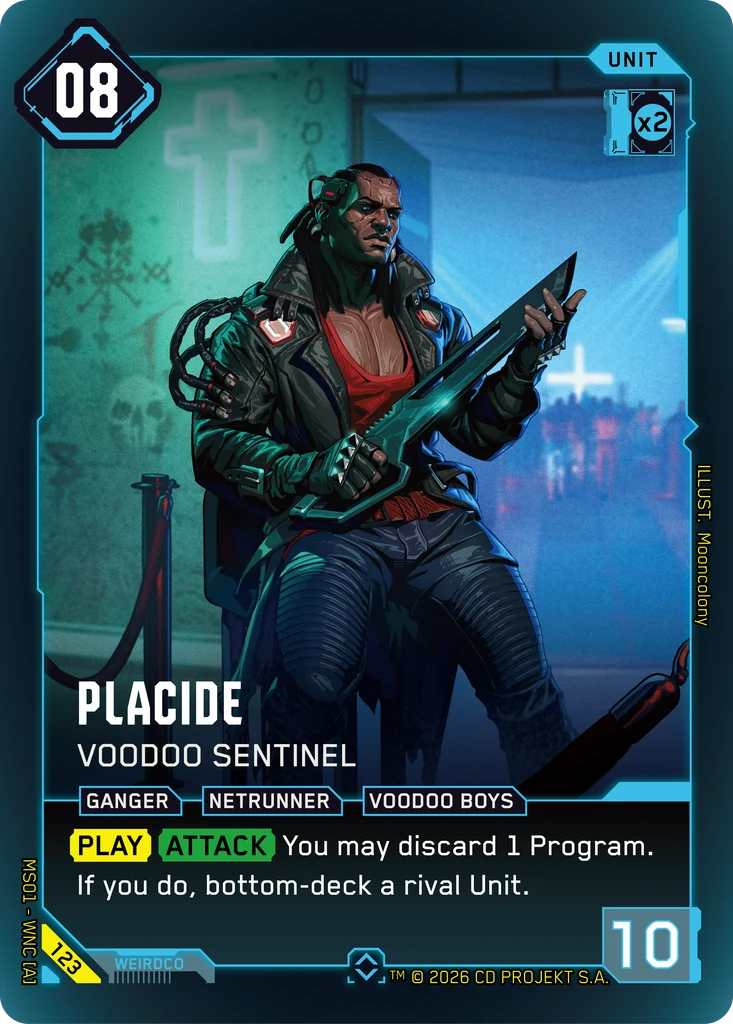
Blue Unit, 8 €$, power 10. Placide removes things without caring about Gear or power, on cast and again on every attack. Each trigger costs a discarded Program, though. With 10 power he steals two Gigs and survives Pyramid (10 − 4 = 6) and Towerfall (10 − 5 = 5). Against Gear he’s the most important tool. Wild Things Games describes the plan some BBG players run against aggro: give up the early Gigs and drag the game into the late game, “stall them to the late-game where Placide deletes their board”.
Riot Shield: “(Equip to a friendly Unit or face-up Legend.)” “{Blocker} …” “Rivals must pay +2 €$ to use {Go Solo}.”
Green Gear, 2 €$, power 1. Riot Shield does three jobs. It turns a Unit into a blocker against aggro. It taxes opposing Go Solo: Adam Smasher: Ender of Legends from 9 to 11 €$, Royce: Psycho on the Edge from 6 to 8, V: Streetkid from 5 to 7. And in the mirror the opposing Maman can’t hit a Unit carrying Gear. It doesn’t trigger Jackie, since it’s Green. If the wearer gets bottom-decked, the Gear goes with it. The power 1 adds to the wearer: Voodoo Boy and Lizzy go to 3, Maman to 4, and all of them stay within reach of an opposing Pyramid. On a Legend the blocker is useless, because a Legend only blocks on the field.*15 On Lizzy it’s redundant, since she already has Blocker.
Against Red aggro
Survive turns 1 to 4 and the matchup tips. Wild Things Games rates it as “Moderate”: “Aggro decks attempt to outpace BBG before its RAM stabilizes … if BBG survives turns 1–4 and bounces all of RRY’s big threats, the match swings drastically in BBG’s favor. The best card for putting pressure on a BBG player is Yorinobu Arasaka.” The “bounces” is imprecise; more on that in “How to take BBG down”. RareTotem names RRY with Yorinobu and Bonnie and Clyde as a tough opponent.
Maman connects often here, but not always. Adam Smasher: Ender of Legends sits in 326 decks in the builders (as of October 10). In the consensus breakdown (231 lists), Mantis Blades shows up at 75.3%, Satori: Sword of Saburo at 71%, Meredith Stout at 65.4%, Industrial Assembly at 55.4% and Yorinobu: Steel Dragon at 47.2%. On average the decks are 39% Units, 21% Gear and 40% Programs. Since Mantis Blades and Satori sit in roughly three of four lists, plenty of Units carry Gear, but not all of them.
Adam Smasher is the most dangerous card because he attacks the same turn. He’s a Legend with Go Solo for 9 €$ and power 9. The card text: “{Go Solo} … It can attack this turn. If it leaves the field, remove it from the game.” and “{Play} Defeat a rival Unit.” He hits the field ready, defeats one of our Units and attacks right away. That works on the turn he was flipped, even if he’s already spent, and he can spend himself as an Eddie for his Go Solo. Flipping him alone doesn’t trigger his {Play}.*16
Against his first attack, only Take Control and blockers help. Chrome Reverie, Nocturne and Memory Relapse come too late, since they only work on your own turn. Take Control cuts his 9 power from one stolen Gig to zero. A blocker like Lizzy stops him but dies doing it. Floor It does nothing, because 8 power still steals a Gig.
After that, Smasher sits above both thresholds (9 − 4 = 5, 9 − 5 = 4). Pyramid and Towerfall don’t reach him, Les Élémens only if he’s the smallest Unit, Maman only without Gear, Placide always. Every bottom-deck removes him from the game entirely. Riot Shield raises his Go Solo to 11 €$.
Mantis Blades and Satori shift the thresholds by 2 power each. Mantis Blades costs 1 €$, Satori 2 €$ and draws when it wins a fight against a Unit; both have power 2 and protect their wearer from Maman. A Unit with 3 power and Mantis Blades has 5, so Pyramid only gets there with Floor It. With Mantis and Satori it’s 7, and Towerfall is out too. The consolation: a bottom-deck takes the Gear along, turning one removal into a two-for-one or three-for-one.
While Meredith Stout is down, keep your hands off opposing Gigs. Meredith is a Unit for 4 €$ with power 5, {Blocker} and +2 against Legends. Her extra text: “When a Rival adjusts or swaps 1 or more friendly Gigs, you may add a card from your trash to your hand.” Every Trust No One, Peace Offering or Hanako swap on opposing Gigs hands the opponent a card from their trash, and several at once still give only one. With 5 power, Pyramid only reaches her with Floor It (5 − 1 − 4 = 0), while Towerfall with both effects gets her exactly (5 − 5 = 0). With Mantis Blades she has 7, and then even Floor It plus Towerfall falls short (7 − 1 − 5 = 1), leaving Les Élémens if she’s the smallest, Placide and the locks. As a blocker she stops Voodoo Boy. Pepe wins the fight with 6 against her 5 but steals nothing.
Industrial Assembly can push our d4 back up. The Program costs 1 €$: “Increase a Gig by up to 4. If you control a Gig with 8+ value, draw 1.” Here too it says “a Gig”. The opponent can lift our d4 from 1 up to 4, and then Pyramid only gets one effect, or break a pair, which hits Hanako and Pepe. On the flip side, the card drives their own Street Cred up, and Towerfall is more likely to get both effects.
Royce: Don’t Call Me Simon always hits our small Units. He costs 5 €$, has power 4 and the text “{Play} Defeat a rival Unit with power 2 or less. If you have more ☆ than a Rival, … power 3 or less instead.” Voodoo Boy and Lizzy at 2 power are always fair game. He hits Maman at 3 as soon as the opponent has more Street Cred, and our min Gig plan takes care of that almost by itself. Royce himself sits within Pyramid’s reach at 4 power.
Yorinobu Arasaka: Steel Dragon brings a second Unit for free. He costs 7 €$, has power 9, and his {Play} pulls a Unit costing up to 4 from hand or trash into play for free, which can attack the opponent’s Units, and with {Adrenaline} even the Gigs. He himself sits above both thresholds, Les Élémens only hits him as the smallest Unit, and the free Unit is smaller. The answers are Maman if he carries no Gear, Placide and the locks. With 9 power he steals one Gig, and Take Control sets that to zero. Unlike Smasher he comes in with Lag, so we get a turn of our own for a lock or removal. The Legend Yorinobu Arasaka: Embracing Destruction (“The first time a friendly ARASAKA Unit attacks each turn, draw 1. Then, if you have less than 20 ☆ (Street Cred), discard 1.”) has no direct bearing on our removal. The “nine-power” Unit in RareTotem’s video is most likely the Steel Dragon Unit (9 power).
Bonnie and Clyde costs 3 €$: “Defeat a rival Unit with power 4 or less. You may defeat 2 instead if a Rival controls at least 2 Gigs more than you.” So the card only hits two Units if BBG has at least two more Gigs than the Bonnie player. Voodoo Boy, Lizzy and Maman all sit inside the power cap; only Pepe doesn’t. Steal Gigs early as BBG and keep the opponent small, and you’re the one enabling the double version, same story as the Adrenaline Converter further down. Wild Things Games writes that some BBG players “concede the early game gig-steals” in the aggro matchup. Playing that way shuts it off.
The sideboard plan: three Riot Shield in, as blockers on Voodoo Boy or Maman and as a Go Solo tax against Smasher and Royce: Psycho on the Edge. Two Placide in, because they ignore Mantis and Satori. Three Pepe out; he’s slow, Green and doesn’t trigger Jackie. Royce and Bonnie don’t reach him, but Smasher’s {Play} hits any Unit. Two Memory Relapse out, since they come too late against Smasher, and against Yorinobu, Chrome Reverie does the same job for 3 €$. Take Control stays in because, alongside blockers, it’s one of the few answers to Smasher on the same turn.
At the table, that means: as soon as Smasher can reach 9 €$, or 11 with Riot Shield, keep 2 €$ open for Take Control. Leave opposing Gigs alone while Meredith is down. Towerfall comes when the Street Cred fits, Placide after that.
Against Yellow Gear built around River Ward
This matchup comes down to Faceplate and Gear. River Ward sits in 585 decks in the builders (October 13). In the consensus breakdown (535 lists), Zetatech Faceplate is in 86%, Adrenaline Converter in 57.6, Gorilla Arms in 55.5, Augmented Negotiators in 52.7, Mandibular Upgrade in 51.8, Viktor Vektor: You Might Feel a Little Pinch in 45, Mantis Blades in 37 and Kiroshi Optics in 36.3%. The most common partners are Dum Dum (34.8%), Royce (26), Viktor (18.1) and Panam (15.1). The decks are 44% Units, 38% Gear and 18% Programs. In Gamertag Mythras‘ count of 716 decks from September 16, River Ward shows up in 27.8%. All of that shows what gets built, not what wins.
River Ward can’t counter our removal, but she can counter our attacks. Her first text: “{Quick} {Spend} Play a Gear with cost 2 or less from your hand for free.” She uses it in response to an attack, but not against our Programs or {Play} effects on our turn. So she can’t equip after the fact against Maman, Les Élémens, Pyramid and Towerfall; Maman’s “unequipped” is checked on resolution. When we attack with Voodoo Boy, Pepe, Kusanagi or Placide, though, she slaps on Mandibular Upgrade for free (cost 1, {Blocker}) and has a blocker on the spot. That badly weakens the Kusanagi plan.
Her second text: “When a friendly equipped Unit is defeated, search the top 2 cards of your deck and trash 1.” Bottom-decking doesn’t count as defeating, so our removal doesn’t trigger it. Only our fights do, say Pepe against a spent Unit or Lizzy as a blocker.
Dum Dum: Maelstrom Triggerman swings fights, not our removal. On Call he draws (“{Call} You may defeat a friendly Gear. If you do, draw 2. Otherwise, draw 1.”), in combat he pumps (“{Quick} 1 €$, {Spend} Give a friendly Unit +1 power this turn for each of its equipped Gear.”). Against Lizzy blocks and Pepe fights that can flip the math, but he can’t touch our Programs in our own Main Phase. Viktor Vektor: Sit Down and Relax digs through the top five cards on Call for up to two Gear costing up to 2, card advantage with no bearing on our removal.
Royce: Psycho on the Edge is smaller on our turn than he looks. He’s the partner in 26% of River Ward decks, with Go Solo for 6, power 6 and “During your turn, this Legend has +2 power for each of its equipped Gear.” The bonus only applies on his turn. On our turn he has 6 power plus the power of his Gear. Pyramid (6 − 4 = 2) and Towerfall (6 − 5 = 1) aren’t enough. With no Gear, or only Mandibular Upgrade (power 0), Floor It and Towerfall bring him to 0, but Kiroshi Optics (+1) already breaks that (7 − 1 − 5 = 1). A bottom-deck removes him from the game, and Riot Shield raises his Go Solo to 8.
Zetatech Faceplate is the most dangerous card for BBG’s engine. It’s Gear for 2 €$ with power 2: “When this Unit or Legend is spent, adjust a Gig by up to 1. Then, if you control 3 or more Gigs with different values, draw 1.” “A Gig” includes our Gigs. Every time the wearer attacks or blocks, the opponent can move our d4 from 1 to 2, on an attack even before we can react, and then Pyramid only gets one effect. Or they break a pair, which hits Hanako, Pepe, Three Mouths and Alt’s discount. Memory Relapse on a Faceplate wearer is a mistake, because the Spend triggers the Faceplate for the opponent. Trust No One and Jackie fix the d4 again, and any bottom-deck of the wearer takes the Faceplate along.
A Faceplate on a Legend is out of our reach entirely. Every Gear card can go on a face-up Legend, and our removal only targets Units. On a Legend, the Faceplate triggers every time the opponent pays with that Legend, after the paid-for card is played.*17 That’s a Gig adjust every turn, with no attack needed and a wearer we can’t remove.
Adrenaline Converter punishes too much Gig denial. The Gear for 2 €$ with power 3 grants Adrenaline “If a Rival controls at least 2 more Gigs than you”. Keep the opponent’s Gigs small and the Unit attacks on the turn it’s played, before our removal can reach it. Then only Take Control and blockers help.
Against attackers under 10 power, Take Control shuts Gorilla Arms off completely. The Gear for 4 €$ with power 3: “The first time this Unit steals 1 or more Gigs each turn, steal a rival Gig with a value not shared by a friendly Gig.” If Take Control makes the Unit steal zero Gigs, Gorilla Arms never fires. Kiroshi Optics (1 €$, power 1) and Mantis Blades (1 €$, power 2) add power and protect against Maman. Mandibular Upgrade (1 €$, power 0, {Blocker}) doesn’t change power but protects against Maman just the same.
Cyberpsychosis can hit our attackers too. The {Quick} Program gives a Unit with Gear +3 power per Gear, and if it steals or fights, it’s defeated at end of turn. As a reaction to our attack it makes our attackers lose fights. The opponent can also pick our attacking Unit if it carries Gear, Riot Shield for example: per the official FAQ it “gets the power boost for the ensuing fight and is defeated at the end of the turn.”*18 On their own turn they pump attackers with it, and from 10 power those steal two Gigs. If their Unit dies that way, River Ward searches.
Augmented Negotiators is the ideal decoy. The Unit costs 3 €$, has power 2, {Blocker} and “When this Unit uses {Blocker}, a Rival discards 1.” Pyramid reaches it, but it shields the threat next to it from Les Élémens. Every block costs us a card from hand, which Maman or Placide then lacks as discard fodder.
Our bottom-decks starve Viktor. Viktor Vektor: You Might Feel a Little Pinch (3 €$, power 3) plays Cyberware Gear costing up to 2 from the trash for free when he comes down. Bottom-deck sends Gear under the deck instead of to the trash, while defeating fills it: fights, Dum Dum’s Call and Cyberpsychosis. Viktor Vektor: Drop Your Illusions (5 €$, power 5, first Cyberware Gear each turn −3 €$) sits right on the edge without Gear: Pyramid only with Floor It, Towerfall with both effects exactly (5 − 5 = 0). With any Gear except Mandibular he’s above that, and with Floor It plus Towerfall he’s reachable up to 6 total power.
Adam Smasher: Metal Over Meat wipes the board and then becomes easy prey himself. The Yellow Unit costs 9 €$, has power 15 and “{Play} Defeat all other Units.” On ExBurst he shows up among the options in 24.1% of River Ward lists, and one of the most popular River Ward lists is even called “Metal Over Meat”. 15 power steals two Gigs, and Pyramid and Towerfall don’t stand a chance. Afterwards, though, he’s usually the only and therefore smallest Unit, and Les Élémens hits him for sure. Add Maman if he carries no Gear, and Placide.
The more Gear hangs on a Unit, the more the removal load shifts to Les Élémens and Placide. Gear power counts in full, while our reductions only hit the Unit. Negotiators (2) with Faceplate (2) has 4, and Pyramid is enough. Add Gorilla Arms (3) and it’s 7, and even Floor It plus Towerfall falls short (7 − 1 − 5 = 1). Negotiators with Gorilla Arms and no Faceplate comes to 5: Pyramid only with Floor It, Towerfall yes. Viktor Pinch (3) with Faceplate and Converter comes to 8, leaving only Les Élémens, Placide and the locks. On the upside, the two-for-one on a bottom-deck gets bigger.
The sideboard plan: two Placide in, since they ignore Gear and power and don’t defeat, so River Ward’s trigger stays off. Two Maman out, with the third staying for Negotiators and Viktors without Gear. If the opponent showed Royce as a partner in game 1, two Riot Shield come in, making his Go Solo cost 8, and two Voodoo Boy go out, because they run into Negotiators and Mandibular blockers and die in combat. Take Control stays, against Gorilla Arms and Adrenaline Converter. Kusanagi explicitly stays out, because River Ward makes a free blocker in the React Step.
At the table, that means: aim removal first at the Unit with the Faceplate or the most Gear, which gets you the two-for-one and protects the d4. Don’t attack while River Ward is ready and might have Mandibular in hand. Keep opposing Gigs small, but not two below our count, or the Adrenaline Converter switches on. And hold at least one Trust No One to reset the d4 after a Faceplate.
Against Judy Braindance
Judy decks lean on big Units, and against those Maman and Les Élémens do the work. Judy only shows up as a BBG variant, in three of the eight comparison lists, including the Wild Things Games sample list. Judy: Braindance Maestro sits in 23.5% of 716 decks (count from September 16), and we don’t know her partners.
This is what the known Judy lists look like. One runs three Sandayu Oda (8 power), three Psycho Squad (6), two MT0D12 Flathead (7), three Tetratronic Rippler, two Placide and three Towerfall, but no Nocturne, Pepe, Lizzy, Floor It or Take Control. Another relies on three Evelyn Parker and three Delamain at 0 power each, two Flathead, two Rippler, two NetWatch Netdriver and two Maman. The Wild Things Games sample list has two Corpo Security, two Misty at 0 power, two Rita Wheeler, two Rippler, two Riot Shield and two Maman.
Judy’s Legend bonus works on our turn too, but not against our removal. The text: “When you play a BRAINDANCE Program, give a friendly Unit +1 power this turn.” and “{Spend} Trash the top card of your deck. If it’s a Program, you may add it to your hand.” The bonus also comes off Braindance Programs from the trash and off {Quick} Braindance Programs on the opponent’s turn, so it can swing our fights.*19 It can’t reach our Programs in the Main Phase. Her Spend fills the trash.
Judy Álvarez: Nothing to Doubt is best locked with Memory Relapse. The Unit costs 6 €$, has power 6 and “1 €$, {Spend} Reveal the top card of your deck. You may play it for free. Otherwise, add it to your hand.” Every use is at least one extra card. She sits above both thresholds (6 − 4 = 2, 6 − 5 = 1), Floor It plus Towerfall brings her to 0, and without Gear Maman hits her. Memory Relapse spends her and blocks her Spend until our next turn, while Chrome Reverie and Nocturne only stop attacks. On the turn she’s played she can’t use the Spend yet, so we get a turn to answer.
Delamain: Rideshare AI is a pure decoy. She costs 3 €$, has power 0 and draws 2, but never steals. The second effect of Pyramid or Towerfall takes her out with no condition. Delamain Cab (4 €$, power 4, readies an Eddie when it has stolen) sits within reach of Pyramid (4 − 4 = 0) and Towerfall. Take Control prevents the steal and with it the Eddie, and since the Cab is a Vehicle, you draw a card too.
Against the big Units, Les Élémens, Maman, Placide and the locks are what’s left. Sandayu Oda (8 power, “{Play} Spend a rival Unit for each friendly value-pair of Gigs”) can attack spent Units on the turn he’s played. Les Élémens only hits him as the smallest Unit. Psycho Squad (6, no card text) gets treated like Nothing to Doubt, just without the Spend. Against MT0D12 Flathead (7, unblockable if its owner has less Street Cred), our min Gig plan helps by keeping our sum low. Tetratronic Rippler (+1) and NetWatch Netdriver (+2) protect their wearer from Maman and raise the power. Evelyn at 0 power plus Netdriver has 2, and then Towerfall’s second effect alone no longer does it, but Pyramid still does.
V: Streetkid might run in Judy decks, but that’s not documented. The Red Legend (“{Call} Trash 3. Then, add 1 BRAINDANCE Program from your trash to your hand.”, Go Solo 5, power 6) fits thematically. She attacks via Go Solo on the same turn, and Take Control and blockers help against that. Riot Shield makes it 7 €$, and a bottom-deck removes her from the game.
Decoys first, big Units after. The Judy variants run Units with 6 to 8 power that sit above Pyramid and Towerfall, the 6s only without Floor It. The 0-power Units are decoys against Les Élémens, so clear them first with the second effect of Pyramid or Towerfall and then send Les Élémens at the big Unit, as in example 2. Maman stays valuable because the big Judy Units in the known lists mostly carry no Gear. Peace Offering can break opposing pairs, so Sandayu spends fewer Units. And Take Control draws against Flathead (Drone), Delamain: Rideshare AI (AI) and Delamain Cab (Vehicle).
The sideboard plan: two Placide in, against big Units and Rippler wearers. Two Kusanagi in, because two of the three Judy comparison lists, the ripperdeck list and the Wild Things Games sample list, play neither Floor It nor Take Control and can barely respond to his attack. The third runs two Floor It but no Take Control, so Kusanagi is less safe against it. Blockers like Rita Wheeler or Corpo Security remain a risk. Two Floor It out, because one point against 6 to 8 power rarely does enough. Two Voodoo Boy out; they die to any removal without holding Gigs. That leaves plenty of Jackie triggers: Lizzy, Maman, Kusanagi, Placide. Maman and Memory Relapse stay in.
In the mirror
The mirror is about the d4 and the pairs. RareTotem talks about the “dreaded and very common mirror match” and says: “These can go either way”. Adrenaline, according to the video, is “incredibly useful against BBG”. Wild Things Games describes a related matchup, control RRY against BBG, as a “Skill Matchup”, decided by “who manages their hand size, unit count, gigs”.
Both sides have only two cards for the opponent’s turn, Floor It and Take Control, and you can’t answer an opposing {Quick} with one of your own.*20 Kusanagi attacks and is back in hand by the opponent’s turn, so the other side can barely catch him. Riot Shield protects against the opposing Maman but only raises power by 1, so Voodoo Boy and Lizzy stay vulnerable to Pyramid. Towerfall rarely gets both effects, because both players push their Street Cred down, and Hanako’s swap becomes the tool for shifting the sums.
The opponent’s d4 is target number one. Trust No One can only lower it, not raise it. Peace Offering sets it to another Gig’s value, say 3, and then the opposing Pyramid only gets one effect, and you break a pair on the side. The Hanako swap is even more direct: trade your own high Gig for the opponent’s d4 at 1, and they lose the d4 and a pair in one go. Both trashes are public, so each side sees what Alt and Lizzy can bring back for the other.
The sideboard plan: two Kusanagi and three Riot Shield in, two Floor It, two Memory Relapse and one Voodoo Boy out. Two Voodoo Boy stay as decoys against the opposing Les Élémens. Card advantage through Hanako and Three Mouths comes before early pressure, opposing pairs get disrupted, and Kusanagi takes Gigs the opponent can’t take back.
Midrange and Fixers
Against midrange you don’t need a dedicated plan; against Fixers, guard your pairs. Wild Things Games sees BBG ahead against midrange (“Favorable”): “Because BBG commits 2 legends to card draw, it almost always wins the late-game top-deck war”. RareTotem names Dexter DeShawn “and the other fixers” as a brake on Hanako because of their “guaranteed gig manipulation”, and rates El Capitán as B tier, a good option for Yellow against Hanako and Blue decks. Against Fixer Legends, hang on to Trust No One for the d4.
These mistakes lose BBG games
Most BBG mistakes are sequencing mistakes within a turn. We derived the following ones from card texts and rules.
Timing mistakes with the Legends
Spending Alt first and then playing Lizzy costs you the discount. Lizzy’s free Program is the next Program of the turn and eats it. Alt always goes right before the Program you want cheaper. The discount is just as wasted with only one min Gig: it nets nothing, and Alt is spent for the rest of the turn.
Jackie’s trigger comes once per turn. Burn it on a Voodoo Boy and then play Lizzy or Maman to lower a more important Gig, and you get nothing. And Chrome Reverie after a regular Call throws away the free Call.
Attacking with Pepe without a pair readies nothing. Check before the attack whether the pair still stands, especially against Peace Offering, Hanako, Industrial Assembly or Faceplate.
Removal mistakes
The classic: firing Les Élémens while a decoy is smaller than the threat. Clear the decoy with Pyramid or Maman first. And Maman without two Programs in hand is just a 3-power body for 5 €$.
Recount the Street Cred before Towerfall. It’s the sum of the values, not the number of Gigs, and an opponent with no Gigs counts as less than 0.
Memory Relapse on a Unit with Zetatech Faceplate triggers the Faceplate for the opponent. They move our d4 off 1, and the next Pyramid only gets one effect. Touching opposing Gigs with Trust No One, Peace Offering or the Hanako swap while Meredith Stout is down hands the opponent a card from their trash.
Resource and dice mistakes
Roll in the d4 late and Pyramid only gets one effect until turn 3 or later. Leave no €$ open at the end of your turn and you can’t play Take Control or Floor It on the opponent’s turn. And if you count on Nocturne as a one-Eddie card too early, you come up short: before the sixth roll-in it costs the full 3, only after that 1.
Ignoring your own trash is a quiet mistake, because that’s where the ammo for Lizzy and Alt lives. When you discard, for Maman say, discard with a plan. And heading into Overtime without counting the cards left in your deck risks an empty deck.
The last mistake happens before the tournament even starts: bringing a spindown d20. The tournament rules ban it.
How to take BBG down
If you’re facing BBG, pressure early and break the conditions on its removal. Wild Things Games has the most detailed tips: “Force Actions Early”, “Bait Counter-Programs” and “Watch the Turn Count … Allowing a BBG player to comfortably cruise into turn 7 with 6–7 Gigs setup is a recipe for a swift loss”. Add to that “play low power units to shield” and the warning that “playing units under 5 power is a disadvantage”. RareTotem names Adrenaline Units, Yorinobu and Bonnie and Clyde, and against Hanako the advice is: “keep them from getting gig pairs”.
The card texts hand you a few more levers. Steal the d4 or swap it away, and Pyramid only gets one effect. Break pairs, since every pair you prevent costs BBG a card per turn. Park a small decoy next to the threat against Les Élémens, and hang Gear on the threat against Maman. Play Units with 7 power or more that survive even Floor It plus Towerfall, or Units with Adrenaline that attack before the removal arrives. Keep your own Street Cred below BBG’s, and Towerfall only gets one effect. Empty BBG’s hand: Maman discards two Programs, Placide one. And in the Top Cut, every Gig of lead decides after time is called, because the game keeps going until someone is ahead. In Swiss rounds that isn’t enough: after time, only a player with 7 Gigs wins, otherwise it’s a draw.
A few claims from the retailer analysis don’t hold up as written. “Expect chrome reverie turn 2 always, and the free call targeting Hanako” misses two things. The free Call only comes “If you control a min Gig”. And it only targets Hanako on purpose if Alt and Jackie are already face-up and Hanako is the last one face-down, because the owner doesn’t know which Legend sits where either. With a Call on turn 1 and a reaction Call on the opponent’s turn, that can already be the case on turn 2, with a probability of 1/3. Chrome Reverie on turn 2 also needs 4 €$ for Trust No One plus Chrome Reverie, or a lucky min Gig roll.
“Bounces” is misleading too. Nothing in this list returns to hand; Les Élémens, Pyramid Song, Towerfall, Maman and Placide send cards under the deck. For the opponent that makes a difference: the Unit sits at the very bottom, nothing gets shuffled, and the order is only random when several cards go under at once. It’s back only once the deck has been drawn through.
Wild Things Games calls Jackie a “key part of most BBG builds”, yet its own sample list runs Judy instead of Jackie. “Towerfall is ubiquitous”, it goes on, while the builder data show 38.5% with Hanako, 59.1% with Alt and 66.3% with Jackie. Common, yes; everywhere, no. And “Expect a Les Elemens on curve” sits in an analysis whose own sample list gets by without Les Élémens.
The tournament rules that hit BBG directly
Tournament rules at a glance
- Deck: 3 Legends, 40 to 50 cards, no more than 3 copies, RAM limits (7.3 through 7.3.4, 3.20.5). The list is legal, Blue 4/4, Green 2/2, no card banned.
- Sideboard: exactly 7 cards (D.1), Legends can’t be swapped, 2 minutes between games.
- Format: Bo3 in 50 minutes (3.4.5, C.1), Top Cut 75 minutes.
- Who goes first: in game 1 chance decides (7.5.2); in the Top Cut the higher seed chooses instead (TR 3.4.1). In games 2 and 3 the loser of the previous game chooses, Top Cut included.
- Mulligan: once, the starting player decides first (7.9.2).
- Dice: spindown d20 banned (2.1.4). One symbol face is allowed, for min or max, applied consistently. On day 2 or on stream, players “may be required to use official Cyberpunk TCG dice” (2.1.4). At Competition-level events, 4.1.2 states for day 2 rounds and all single-elimination rounds: “all players will be provided with official Cyberpunk TCG dice”. Anyone handed replacement dice on day 1 “must use the provided pair of dice”.
- Dice check (4.1.2): a d4 counts as suspicious at 28 identical results over 80 rolls, a d20 at 11.
For a control deck, the clock is the rule that matters most. A Bo3 has 50 minutes. When time is up, the current turn is finished, then each player gets one more full turn, five minutes at most in total. Whoever has 7 or more Gigs then wins; otherwise the game ends in a draw. In single-elimination rounds, Top Cut with 75 minutes included, the game keeps going instead, “until one player has more Gigs than their Rival”. If the game is already in Overtime when time runs out, the procedure doesn’t apply.
BBG needs little at round end. Wild Things Games writes that BBG often only steals “1-2 gigs across the match” and keeps the opponent at zero. Whether a deck like that draws more often in the Swiss rounds, we haven’t calculated. But if your own six dice are rolled in and untouched, a single steal is enough for 7 Gigs and the win. In single-elimination rounds the Gig lead decides anyway, and that’s where Gig denial pays off. If you’re taking BBG to a tournament, play briskly and keep an eye on the clock.
Check your dice before it starts. The dice check is a judge test with practice rolls and has nothing to do with the rolls in your games; even a d4 that BBG mostly manipulates has to pass it. You need d4, d6, d8, d10, d12 and d20, and a spindown d20 is banned. Search for sets with all six types: dice set with d4 through d20 (affiliate link).
Among others, these dates are on the board according to the announcements: the Night City Brawls from November 6, the Night City Showdowns from November 13 to December 6, and the first Edgerunner Open Regionals in Chicago (December 11 to 13, 2026) and Warsaw (January 30 and 31, 2027). Brawls and Showdowns run in stores, both Constructed. Per the tournament rules a Brawl always has three rounds, with Bo3 recommended, though the store can also run Bo1. A Showdown is Bo3 Swiss with an optional Top Cut, one per store and time window. Per the tournament rules, EOR organizers are approved by WeirdCo and CD PROJEKT RED. Over three fixed Brawl rounds, every game that runs into round end weighs heavily.
By Cardmarket trend prices the deck is playable from about €35
BBG is cheap, except for Towerfall and Jackie. RareTotem notes that “many of the cards in this deck are not very high in rarity”, and the official Cardmarket price guide for Cyberpunk backs that up (trend values in euros, as of October 14). The 40 main deck cards come to €25.92 together, €19.98 of which goes to the two Towerfall at €9.99 each. The Legends cost €9.13, almost all of it Jackie from the Heist Beta Starter at €8.04. If you want to know how that starter stacks up, our starter deck comparison covers it. Legends and main deck make €35.05, and with the sideboard at €0.91 it’s €35.96.
Two caveats come with that. The price guide doesn’t separate card languages; a filter for English cards only exists on the website. And by our observation, Cardmarket lists many Beta Rares and Epics only with a foil price, which in this list covers Alt, Hanako, Jackie, Lizzy, Nocturne, Pyramid Song and Placide. Towerfall, on the other hand, has a regular trend price. Their values therefore come from the price guide’s foil field.
The circulating list goes for premium prints. The price guide has the Iconic variants of Alt at €255.09 and Hanako at €186.44, and the Iconic variant of Towerfall at €30.83 apiece. For Jackie, listed as Nova Rare β005, we use the foil variant at €52.61, most likely the Box Topper; we inferred that match from the product data. With those versions we get €494.14 for the Legends, €61.66 for two Towerfall, €5.94 for the other 38 main deck cards and €0.91 for the sideboard, €562.65 in total. That probably also explains the skewed median ExBurst shows for Jackie decks (“$568 from $3”), but that’s our guess.
Jackie also comes in the retail starter “The Heist”, which sits at a €28.11 trend in the price guide. Jackie alone costs €8.04, so the starter gets you the rest of its cards for about €20 more. We’re not recommending the Iconic prints. They play exactly the same (shine doesn’t steal Gigs).
Buying in Europe
All prices are trend values from the official Cardmarket price guide (October 14, 2026): Legends and main deck €35.05, of which €19.98 for the two Towerfall and €8.04 for Jackie from the Heist Beta Starter; with sideboard €35.96. With the premium prints of the circulating list: €562.65. The retail starter “The Heist” sits at a €28.11 trend and includes Jackie. Cardmarket lists many Beta Rares and Epics only with a foil price, and the guide doesn’t separate card languages.
Sleeves have to be uniform at tournaments. A deck that draws, searches and tucks cards under itself as much as BBG gets handled constantly. Deck and sideboard need sleeves that match in size, color and design, are opaque and can’t be told apart. The Legends need sleeves that set them apart from the main deck and look identical to each other face-down.*21 Search for sleeves: matte standard-size card sleeves (affiliate link). 40 cards, 7 in the sideboard and 3 Legends add up to 50 cards plus dice. Search for deck boxes: deck box for 100+ cards with a dice compartment (affiliate link).
The rules behind the asterisks
Here are the rules and FAQ answers behind the spots marked with an asterisk. Click the number to jump back into the text.
*1 Legends pay 1 €$ each, face-down too (5.7.2). Paying with a Legend doesn’t trigger its ability (11.15.2), and a face-down Legend has no ability (3.4.1, 5.7.6). Per the official FAQ, a freshly called Legend can use its {Spend} ability on the same turn.
*2 The Legends are shuffled and laid out face-down, the opponent may cut (7.7.2), and in tournaments the opponent even does the shuffling (TR 3.4.1). Face-down Legends are hidden from their owner too: “You cannot look at them unless specified otherwise” (5.7.4.1). A Call therefore picks a position, not a name (11.11.1).
*3 A Call is also allowed in the React Step of an opposing attack: “You may also ‘Call a Legend’ during the React Step during your Rival’s turn” (8.12.2, 11.11.2.2). That this comes on top of the Call on your own turn is our reading of 8.12.2 together with 5.7.3 (“once per turn”); the official FAQ doesn’t decide it explicitly.
*4 The Start Phase runs in a fixed order: win check, start-of-turn effects, ready, draw, then the turn’s Gig is rolled in (8.6, 8.6.5). Rule 5.10.1 contradicts that: there the dice stay in the fixer area “until you roll them in during you[r] Main Phase”. This guide follows 8.6.5. That changes nothing for Hanako. If 5.10.1 applies, the sixth die stays in the fixer area until it is rolled in during the Main Phase, and Nocturne only costs 1 €$ after that.
*5 Per the official FAQ, “the reduction amount is determined when you activate the effect”, so a min Gig made afterwards doesn’t count. The discount also applies to Programs from the trash, and two discounts stack if Alt is readied in between. That a free Program via Lizzy uses up the discount follows from “next Program”; the FAQ doesn’t decide it. Floor of 1 €$ (11.8.3).
*6 Official FAQ: if a Blue Unit or Gear was already played before Jackie flipped, she doesn’t trigger that turn. A Gig that was already at 1 draws no card. Lowering by 0 is allowed (2.8).
*7 A player with no Gigs has null Street Cred, which counts as less than 0 (5.11.4.2). On equal Street Cred, Towerfall only gets one effect, per the official FAQ.
*8 Bottom-deck puts the card under its owner’s deck (11.12.1, 11.12.1.2). Nothing gets shuffled; the order is only random when several cards go under at once (11.12.1.3). Equipped Gear goes along (4.12.3).
*9 {Attack} effects resolve as soon as the Unit is spent to attack, before the opponent’s React Step (11.21.2, 11.21.2.2).
*10 Per the official FAQ, the fixer area is empty once no Gig die is left in it, and then you have to play Nocturne for 1 €$. There are six dice, d4 through d20 (6.1.1, 7.2). For the exact moment on turn 6, see footnote *4.
*11 Negative power counts as 0 (2.10.1). Per the official FAQ, both effects of Pyramid Song and Towerfall always go top to bottom: “you must resolve the top effect first, then the bottom one.”
*12 Power means total power including equipped Gear (3.17.2, 3.17.3, 3.17.3.1, 11.6.5), not the printed base power (3.17.4). Reductions like Floor It, Pyramid or Towerfall hit the Unit, while the Gear power stays fully in the total (3.17.3.3). On a tie, per the official FAQ, “The Player activating the card Chooses.”
*13 Simultaneously triggered effects are pending (10.16.2): “If you have multiple pending effects, you may resolve them in any order” (10.12). The official FAQ confirms this for a {Play} effect next to a triggered effect.
*14 “Overtime begins after two consecutive turns in which both players begin with an empty fixer area” (1.11.1); the note about seven turns only sits in parentheses there. With six dice (7.2), both players begin their turn 7 with an empty fixer area, Overtime starts immediately after the second player’s turn 7 (8.17), and whoever has 7 Gigs then wins (1.11.2).
*15 Per the official FAQ, “The Legend must be on the field to use [BLOCKER]”, not in the Legends area (see also 9.9, 11.24.1).
*16 Official FAQ on Adam Smasher: Ender of Legends: {Play} triggers on Go Solo, not on the Call or a flip. Go Solo also works on the turn of the Call and with a spent Legend, the Legend can spend itself for €$ while doing it, and cost reductions lower the Go Solo price too. If Smasher leaves the field, he’s out of the game.
*17 Paying with a Legend means spending it (5.7.2, 3.7), and Faceplate triggers on “spent”. Per the official FAQ: “Play the card first, then adjust the Gig.” On an attack, the opponent adjusts the Gig “before moving on to your Rival’s react step”.
*18 Per the official FAQ, Cyberpsychosis can target an equipped opposing Unit. Played as a reaction on the attacking opponent, their Unit “gets the power boost for the ensuing fight and is defeated at the end of the turn.”
*19 Per the official FAQ, Judy’s first effect also triggers off Braindance Programs from the trash and off {Quick} Braindance Programs played as a reaction on the opponent’s turn.
*20 Official FAQ: you can’t respond to an opposing {Quick} with a {Quick} of your own. During an opposing attack, though, you can play more than one {Quick}.
*21 Tournament rule 2.4.2: “Sleeves used for the deck and sideboard must be identical in size, color, and design, while also being opaque and indistinguishable from one-another”. Which sleeves are allowed is also covered by 7.3.7.
The data has holes
They’re thinnest on results. There are no official constructed tournaments yet, and no win rates. Every statement about the deck’s strength is opinion or popularity. The builder rates mix lists with Judy, Alt and Jackie, and they measure what people build.
For River Ward we have card texts and builder rates, but no concrete reference list and no matchup opinion. We know Judy Braindance as an opponent only from a handful of BBG variants, with no partner data. Whether V: Streetkid runs in Judy decks is open. Mulligan criteria and sideboard plans are entirely our own derivation; no source supplies them.
Most rules questions are settled by the rulebook, and the references sit behind the asterisks. Two points stay blurry: when exactly the turn’s Gig gets rolled in (footnote *4), and whether the reaction Call comes on top of your own Call (footnote *3). Also still open is RareTotem’s claim of a high win rate when going first, for which the video gives no number. Our money rule of thumb holds for this list: no card makes Eddies under the rules, and the only extra source is Pepe, who readies Alt and Jackie so they can each pay 1 €$ again that turn.
Official rulings do exist: the rules FAQ has 269 entries (as of September 15, 2026). The card API’s rulings field is empty for all 151 cards, but the FAQ lives separately. Wherever it touches a point in this guide, that’s in the footnotes.
The euro prices are trend values from the Cardmarket price guide of October 14, without a split by card language. The removal share of 57.5% depends on whether you count Floor It and Take Control. And bottom-deck isn’t forever. Draw a deck all the way down in a really long game and the opposing Units come back.
The first tournament results for BBG can come no earlier than November 6, when the Night City Brawls start in stores according to the announcement.
Sources: “Hanako Control” decklist on cyberpunktcg.com (as of 10/08/2026); the same list on ExBurst; netdeck.gg card API (card texts); official tournament rules and Comprehensive Rules; official rules FAQ (269 entries, as of 09/15/2026, also via the FAQ API); ExBurst builder rates for Hanako, Alt, Jackie, River Ward and Adam Smasher (as of 10/10 to 10/13/2026); comparison lists on ExBurst (880, 1899, 1222, 2673) and ripperdeck (nwahagmf, 9dokrywf, pnlmuhu1); RareTotem: BBG video from 09/09/2026 and Legends tier list from 09/01/2026; Wild Things Games, BBG overview by Randy Muir (10/04/2026); Gamertag Mythras, 716 community decks (09/16/2026); Cardmarket price guide, Cyberpunk (Oct 14, 2026; guide data); dates: Gamertag Mythras on Night City Brawl and Showdown, EOR Warsaw on cyberpunktcg.com.
Matching products on Amazon*
TCG Würfel-Set | Kartenhüllen | Deckbox
*Affiliate links: we earn a small commission on purchases. The price stays the same for you.

// KOMMENTARE (0)