Cyberpunk TCG Upgrade Battle: The One-Eddie Mistake
AI TRANSLATION NOTE
This is the English edition of a deep-dive originally written in German. The translation was AI-assisted and human-reviewed for terminology, rules accuracy, and Rogue-persona tone. All direct quotes from the Cyberpunk TCG upgrade battle video come verbatim from the original English broadcast, not back-translated from German. The original German article is available at cyberpunk-tcg-news.de.
The move he called out himself
There is a particular moment in card game videos where somebody thinks out loud and narrates their own defeat without recognizing it as one. Late in the new upgrade duel on the official Cyberpunk TCG channel, Steve „LD“ George produces exactly that sentence. He spots an option, calls it needlessly risky before anybody asks him to, and takes it anyway.
There’s something very — there’s a really needlessly risky route here. And uh maybe I could just go for it.
He goes for it. What he actually needs on that turn is one single thing: a sellable card. Any card with a Sell tag he can slide face down into his Eddies area to make it worth one €$, and one €$ is what puts a blocker on the board. One Eddie, one blocker, one more turn alive.
What he’s holding is Fool on the Hill, a two-cost Program that reveals the top two cards of his own deck and then asks a strange question: the Rival decides whether they go to his hand or into the trash. Trashed, and he draws two fresh random ones instead. Steve casts it to dig for sellable material.
Cree „Kawa“ Gunning, on the other side of the table, weighs it briefly and picks the trash. Steve draws two random cards, and they are the wrong ones. His reaction arrives in the same second he sees them.
Why did I take that risk? [laughter] That’s going to cost me the whole game.
He turns out to be right. Cree wins shortly after, both say GG, and then the genuinely interesting part starts: a post-mortem in which Steve refuses to file his mistake under bad luck and takes it apart as a thinking error instead. Fool on the Hill is itself a sellable card. He spent the solution to go looking for the solution.
This article works its way toward that scene, because the scene doesn’t function without everything around it. You need to know why seven gigs against six of your own dice force aggression, why a ten on a card is worth twice as much as an eight, and why a single Eddie decides whether a blocker exists. After that it stops being an anecdote and becomes a clean piece of arithmetic with a wrong answer, one that carries over to every other card game where people play search cards.
Two decks, second round
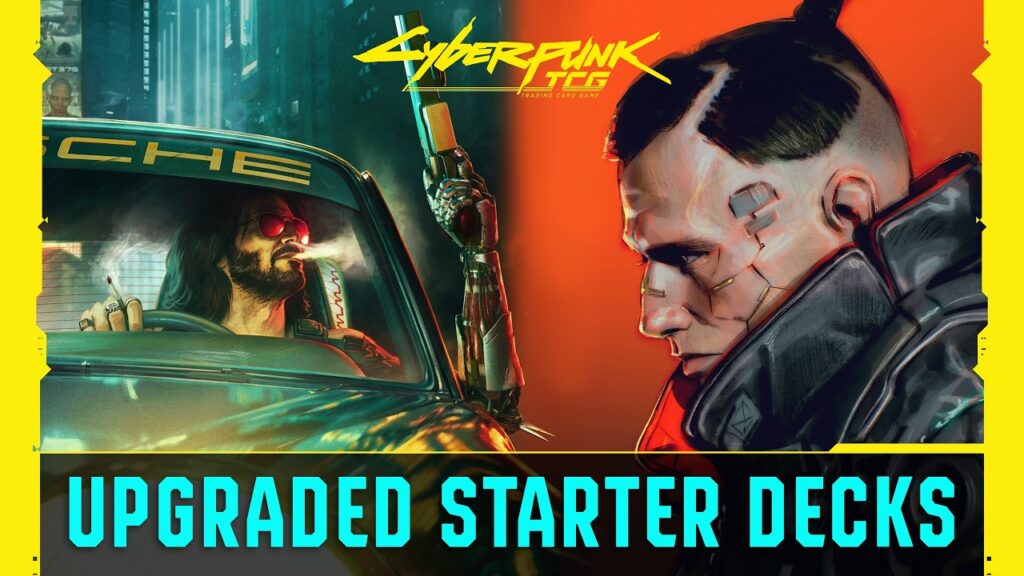
The video is officially titled „💪 Upgraded 💪 Starter Deck Gameplay | 🔵🔵🟡 vs 🔴🟢🟢 | Cyberpunk Trading Card Game“ and went up on the Cyberpunk TCG channel on August 29, 2026. The description carries the hashtag #WeirdCo, and both hosts are named in it: Cree „Kawa“ Gunning and Steve „LD“ George.
This is official manufacturer content, and that’s worth knowing before anything else. No independent test here, no tournament context, no third deck to cross-check against. Two people who work on the game play a format they invented themselves. That caps how far the footage reaches: „the format has proven itself“ cannot be drawn out of one game. The observation stays useful, it just needs the right weight. What can be said is this much: the publisher is explaining, in its own words, how it imagines you upgrading its starters. That matters to anyone who will soon have one of those starters sitting on a shelf.
Cree plays The Heist, colors blue, blue, yellow. Steve plays Embracing Power in red, green, green. The colors sit right there in the title emojis and turn out, later on, to be the single most valuable piece of public information at the table. Cree wins.
Anyone who has watched these two decks meet before watched them unupgraded. The earlier video is titled „Starter Deck Gameplay | The Heist 🔵🔵🟡 vs Embracing Power 🔴🟢🟢 | Cyberpunk Trading Card Game“, and the intro of the new one points back at it: „you may have previously watched our starter deck brawl“. We covered that first duel on August 25, and it’s worth taking our report on the first starter duel along. Not for completeness. One of the eight card picks in the new video makes no sense without the first game, because Steve justifies one of his two rare slots explicitly with what Cree did last time.
That is metagaming inside the smallest possible metagame: one opponent, one known deck, one played game as the entire data set. In a game that isn’t even on retail shelves yet, that’s roughly all the experience there is.
The house rule: eight names, that’s it
Before anybody draws a card, Steve explains the format. It’s the two of them making something up, written into no rulebook and legal at no tournament. They state the goal behind it themselves: the decks should get better and stay recognizable. Cree puts the purpose in the intro as restrictions that exist „so that the decks don’t like completely completely change“.
We are allowed to choose exactly one epic, […] two rares, […] a mixture of five commons and uncommons, and then any number of copies of those.
Exactly one Epic, two Rares, five cards out of the mixed Common and Uncommon pot. Eight distinct card names. Copy count is free, and the game allows up to three copies of a card. The video does the math out loud, with the speaker changing mid-sentence: „it’s a maximum of eight cards total changed, which would, you know, […] at three copies, 24. So, just over half the deck if we’re maxed out on all of them.“
The math holds up, and it’s mildly understated. A starter contains 43 cards, of which 3 are Legends and 40 make up the main deck. 24 out of 40 is 60 percent. Push the limit and you swap out considerably more than half the main deck while still getting to claim it’s the same deck.
The official frame this house rule sits inside is quick to describe. A deck is exactly three Legends with distinct names plus a main deck of 40 to 50 cards, three copies maximum per card. On top sits the color limit set by the RAM total of those three Legends. The starters deliver exactly the minimum, 3 plus 40, and that’s the number the 24-card calculation runs against. So you swap inside a deck sitting at the bottom edge of the legal size, and every swapped card weighs accordingly. In a 50-card deck those same 24 cards would be 48 percent.
The qualifier Steve adds himself matters: „I don’t think I maxed out on all of them, but uh around half the deck changed.“ Neither of them took the maximum. The 24 cards and the 60 percent are a hypothetical ceiling, not a record of what was on the table. Nobody names concrete copy counts anywhere in the video. So if you read that these decks were rebuilt by 60 percent, you’re reading something that wasn’t said.
Who the format is aimed at gets spoken out loud too, clearly enough that it can’t be missed:
for a lot of people, they’ll be picking these starter decks up and thinking about, you know, maybe they’ve got boxes, maybe got some extra packs. How where do we go from here with these starter decks?
That’s the situation of just about everybody who buys a starter at launch and puts three boosters next to it, which is why the house rule is the reusable piece of news here, no matter who wins. It solves a problem every entry-level product has: at what point is the deck no longer the deck you bought? Their answer is a numeric corset instead of a matter of taste.
Steve’s working instruction to himself sounds appropriately dry: „Let’s come up with some natural upgrades. Let’s think about some things the decks are missing.“ Don’t hunt the strongest cards in the set, close the holes in your own deck. Rebuild the format at home and you have a usable opening question, plus a brake against the reflex to dump every booster straight into the one list you already play.
An honest footnote: no public discussion of this format was findable while researching this article. No community threads, no variants, no criticism. All that proves is that we found no source besides the video, which was hours old at the time.
Seven gigs, six dice: why nobody gets to wait
You win Cyberpunk TCG by starting a turn with seven gigs. The official Gameplay Guide puts it in five words: „Start your turn with 7 gigs to win.“ Gigs are dice, and specifically the polyhedrals you know from tabletop RPGs. Each player brings six of them: d4, d6, d8, d10, d12 and d20.
Six dice of your own, seven to win. That gap of exactly one is the most important design decision in the whole game, and the community rules collection at ripperdeck.gg writes it down without ceremony: „With only 6 dice per player, you must steal at least one Gig from your rival“. You cannot build up, dig in and eventually win. A second win condition does exist, but it lands on the same number: under the heading „Overtime“ the guide describes a sudden death that begins after the last player’s seventh turn, won by whoever holds the majority of all gig dice in their area (Comprehensive Rules 1.11.1 and 8.17). With twelve dice in play, that’s seven again. Never attack and you never win in overtime either.
The procedure itself is simple. Each turn you take a die out of your Fixer area, roll it and place it in your Gig area. The d20 always has to come last, which forces the buildup of your six dice into a fixed order. Steal your rival’s gigs and they join yours. A second condition sits on the losing side: if you would have to draw from an empty deck, you lose at that moment. What triggers it is the forced draw, not the empty deck as such. That’s a loss condition, not an alternate win condition, which retires „burn the opponent out“ as a plan A.
Everything else follows from that construction. Every card you put into this game answers one of two questions: how do I steal, or how do I stop the stealing. Cards that do neither feed one of the two, usually through card draw. Down in the evaluation of the eight upgrades per player, not a single card falls outside that grid.
The dice carry several jobs at once, which makes them the most interesting resource in the game. A gig is a win-condition counter, a numeric value and a card switch simultaneously. The face value sets Street Cred, it decides odd and even effects, and it turns on card text keyed to a min Gig, meaning a die showing its lowest possible value. A d4 on 1 is a min Gig, a d10 on 10 is a max Gig. Both are written out officially: the Comprehensive Rules define in 6.3.1 that „A min Gig is any Gig die at its lowest possible value“ and in 6.3.2 that „A max Gig is any Gig die at its highest possible value“, complete with a d4 example. That rules document was published on August 28, 2026, one day before the video.
Street Cred itself is the sum of all face values in your own Gig area, stolen dice included. Worth flagging here, because the video mentions the number offhand quite often: Street Cred is not a score. When Cree sits at 52 in the endgame, that gets him no closer to winning. The number unlocks card effects, nothing more. Exactly one effect in this video hangs off it: Yorinobu Arasaka forces his controller to discard a card below 20 Street Cred, which is why Steve pushes his dice up fast early on. Cree comments after the first turn, „we’re already well on our way to 20 street credit“. Later the numbers 27, 46 and 52 come up, and none of them is a waypoint toward seven gigs.
A practical side effect for anyone about to put this game on a table: you roll constantly, and you reach for other people’s dice constantly. Anybody who has tried to work out whose d8 is showing what in a six-player game knows why clearly separated sets aren’t a luxury. A second, visually distinct polyhedral dice set with d4 through d20 settles more arguments at the table than it costs, precisely because stolen gigs end up in your own area and should be identifiable at a glance once they get there.
The rest of the game is the question of how you get that seventh die. And that’s where it turns into arithmetic.
The number this is actually about
An attack on your rival’s Gig area steals one die. Fine so far. Then comes the clause that explains both players‘ entire deckbuilding: at 10 power an attack steals an additional gig, once per full 10 power. The official Gameplay Guide writes it as a ladder: power 10+ gives 2 gigs, power 20+ gives 3 gigs. The community rules at ripperdeck.gg say the same thing.
A unit with 8 power and a unit with 10 power therefore do not differ by 25 percent of fighting strength. They differ by 100 percent of yield. With a win condition that forces exactly one stolen gig, going from one to two stolen dice per attack is not a gradual advantage.
Which explains why the number 10 shows up in both deckbuilding monologues as a reason rather than an aside. Steve does the math out loud on his Epic:
So in any kind of gear like the embracing power deck where you’ve got mantis blades sati [Satori] both of which give two powers pushing this eight to a really important threshold of 10. If I get to take out one of your units ready and then steal two gigs it’s incredibly powerful.
Johnny Silverhand has 8 power. Mantis Blades give 2. That’s 10. Steve is buying a threshold rather than a card, and he buys it from two directions at once, because his deck already contains gear that supplies exactly those 2 power. Cree takes the same road from the other end: he buys a unit that brings the threshold along natively. Placide: Voodoo Sentinel costs 8 and has 10 power, and his justification runs exactly one line long: „Pretty powerful. A[n eight] cost 10 power.“
The threshold reaches backwards into cards that look like filler on paper. Mantis Blades cost 1, give 2 power and have no text. Satori: Sword of Saburo costs 2, gives 2 power and draws a card when the equipped unit wins a fight. Both are vanilla gear in the dullest sense. Run them past the 10-power threshold and they become yield doublers. Probably why the video finds its own theme, which one of the two eventually sums up as „gear is going to be the story of the occasion.“
To see why a 10-power unit still doesn’t win on its own, you need the second group of rules. Cards are either ready, standing upright, or spent, lying sideways. At the start of your turn they ready again. The decisive part: ready units cannot be attacked. Only what lies sideways is a target. Attack, in other words, and you make yourself attackable.
Blocker units may be spent to redirect an attack onto themselves. And here sits the rule that shapes the game twice in this video: when a blocker intercepts a direct attack on the Gig area, no gig is stolen. Not even when the blocker loses the fight and dies. The official guide on the redirected attack: „Even if you defeat it, you don’t steal any Gigs for that attack.“ And a few lines further, generally: „In general, if an effect redirects or stops a direct attack on your Rival, you don’t get to steal a Gig.“
A blocker cancels the theft entirely, then. Measured against the win condition, a 4-cost unit trades itself for two gigs when it intercepts a 10-power attack. Counted in cards that’s a loss. Counted in the only currency that matters, it’s a profit.
Fights themselves are blunt and therefore calculable: compare total power, higher number wins, on a tie both die. Units cannot attack on the turn they’re played. Every fight is an open calculation that only face-down Quick cards can upset. Steve turns that into a ritual that matters later: before he attacks, he checks what his rival could play to change the math.
Money, Legends, RAM: the small economy
The economic layer of Cyberpunk TCG is small, constant and tight, which is exactly why it decides the game. Amounts between 1 and 4 Eddies determine what a turn contains.
The central mechanic is called Sell. Once per turn, a card in hand with a Sell tag may be revealed and placed face down into the Eddies area. It is then worth one €$. One. Whether it would have cost 1 or 8. A six-cost Epic sold brings in exactly as much as a one-cost Program.
Which makes every card in hand two things at once: a play and a coin, and turns every card you spend into a decision with a hard floor, because a played card is an unearned Eddie as well. How often that bites shows in the sell list, a selection: Sandevistan, an Afterparty at Lizzie’s, a Memory Relapse, a Trust No One, a Satori, two Peace Offerings, a Dying Night, a Tetratronic Rippler, and one more Afterparty at Lizzie’s in the endgame. Almost every turn turns a card into money.
Steve’s spending over the game shows how narrow the band is: 4 for the 6th Street Recruits, 4 for Meredith Stout, 3 for Sandevistan, 2 for Corpo Security. One missing Eddie in this economy is one missing blocker. Hold onto that until the second-to-last section.
The second income stream is the Legends. Every deck has exactly three of them, each with a distinct name. Any Legend with a Sell tag can be spent for one €$ per turn and readies afterwards, which makes it reliable recurring income. The Comprehensive Rules draw a line in 5.7.2.2 that never comes up at this particular table: a face-up Legend without a Sell tag cannot be turned into money. All six Legends in this game have one. On top of that, once per turn you may pay one €$ to „call“ a face-down Legend, flipping it up and bringing its ability into play. The starting player begins with two already-spent Legends to offset the turn advantage, which Steve ticks off at the start: „I make sure I start with these two spent.“
Legends are more than an ATM, though, because they define the game’s third resource. RAM is a colored resource, and it comes exclusively from the three Legends. The sum of a color’s RAM across all three Legends caps which cards of that color may be in the deck at all. No red Legend, no red cards. Full stop.
That rule has a consequence rarely as visible as it becomes in this video: Legends lie face up on the table once called, and so the color limit of the opposing deck lies face up too. You can’t see your rival’s hand, but you can see the space of possibilities that hand was drawn from. A bluff claiming a card that cannot legally exist in that deck’s colors is therefore mostly an invitation to do arithmetic. That’s exactly what happens in the video, and the section on it comes later.
Which leaves gear. Gear cards attach to a friendly unit or a face-up Legend, hand out power and effects, and travel with the card they’re attached to. They’re the tool for reaching thresholds, and simultaneously the most vulnerable investment in the game, because they stack onto a single card. The video demonstrates both halves of that sentence at length.
Assemble those six building blocks, seven gigs, the 10-power threshold, ready and blockers, Sell for one Eddie, Legends as money and color source, and gear as attachable power, and you can follow every turn of the game. More importantly, all sixteen deckbuilding decisions.
Cree’s eight cards
Cree’s selection fits the format’s corset exactly: one Epic, two Rares, five cheap cards. And it follows a visible line. He buys nothing that reinvents his deck; he buys cards that work with what is already inside it.
Jackie Welles: Ride or Die Choom (No. 048)
Unit | Cost 6 | Power 8 | RAM 2 | Epic
{Attack} Give this Unit +2 power this turn for each friendly Gig with an even value. {Defeated} Draw 1 for each friendly Gig with an odd value.
Cree’s reasoning: nostalgia plus synergy with the dice manipulation already sitting in the starter.
The Epic also happens to be the card with the most interesting backstory. Cree introduces it with a nod to the early backers: „Some of the hardcore cyberpunk TCG fans may remember this card as a menace within the alpha kit deck, but uh super strong epic, really, really solid.“
The comparison is worth making because it’s documented. The alpha version of the same card carried the number α013, cost 6 for 6 power, and had a single very flat sentence: this unit has +2 power for each friendly Gig. With six dice in your own area that’s up to +12 power. The retail printing still costs 6, has 8 power, and halves the scaling: +2 only for even values, and in exchange a card draw per odd value when it dies. A textbook nerf that makes the card more interesting, because it now rewards dice manipulation in both directions. For anybody who came to the game through Kickstarter that’s real information: balancing visibly went to work between beta and retail. What’s documented, though, is one card. No conclusion about a reworked set follows.
Cree justifies Jackie through synergy rather than raw numbers: „it actually works quite well in this deck where sometimes you care about having odd values, sometimes you get care about having even values, and stuff like the Zeta[tech] Face Plate, which was already in the deck, enables you to pick and choose how you like there.“
Placide: Voodoo Sentinel (No. 123)
Unit | Cost 8 | Power 10 | RAM 2 | Rare
{Play} {Attack} You may discard 1 Program. If you do, bottom-deck a rival Unit.
Cree’s reasoning, in full: „Pretty powerful. A[n eight] cost 10 power.“
The first rare slot is the 10-power threshold in its purest form, plus a removal effect that shoves the strongest rival unit under the deck. Eight Eddies is a lot, but Placide solves two problems at once. How effective the card is shows up in the video precisely through the fact that it never gets played. More on that later.
Pyramid Song (No. 135)
Program (Braindance) | Cost 3 | RAM 3 | Rare
Choose one effect. If a friendly d4 is a min Gig, choose both instead. | Give a rival Unit -5 power this turn. // Bottom-deck a rival Unit with power 0.
In the game: never played, discarded off Rita Wheeler’s draw-discard trigger.
The second rare slot is the dual mode. With his own d4 on 1, Cree gets both halves: first -5 power on a rival unit, then removal of that same unit if it drops to 0. A clean example of how tightly this game laces dice manipulation into card text. Small footnote for rules pedants: Cree says „-4 power“ in the video, the card does -5. We’re going with the official value.
The five cheap slots make the line even clearer.
Rita Wheeler: No Stupid Questions (No. 125)
Unit | Cost 4 | Power 4 | RAM 2 | Common
{Blocker} The first time this Unit is spent each turn, draw 1, then discard 1.
Cree’s reasoning: „Solid four cost four power blocker card.“
Rockn‘ Rockerboy (No. 052)
Unit | Cost 5 | Power 8 | RAM 1 | Common
Rules text: none.
Cree’s reasoning: „Super good stats. Vanilla. It’s just a five cost eight power card.“
Chrome Reverie (No. 131)
Program (Braindance) | Cost 3 | RAM 1 | Common
A rival Unit can’t attack until your next turn. If you control a min Gig, you may Call a Legend for free.
Cree’s reasoning: the card „prevents my opponent’s units from attacking“.
Three Mouths, One Desire (No. 137)
Program (Braindance/Doll) | Cost 2 | RAM 3 | Common
Search the top 3 cards of your deck. Add 1 to your hand. You may add 1 more for each friendly min Gig. Bottom-deck the rest.
In the game: cast for 2 Eddies on the winning turn, three cards drawn.
Trust No One (No. 139)
Program (Braindance) | Cost 1 | RAM 1 | Common
Decrease a Gig by up to 3. Then, if you control a min Gig, draw 1.
In the game: sold once, discarded once. Never used for its effect.
Three of the five cheap cards turn dice or draw cards off dice values. Two are bodies: a blocker and a cheap attacker with eight power. So Cree buys interaction with what he already has, plus two cards that simply do their job. The Zetatech Faceplates he later stacks onto the Rockerboy are not among the eight upgrades, incidentally. Those were in the starter already, three of them, and Cree mentions them during deckbuilding only as a synergy anchor for Jackie. That detail matters more than it sounds, because those pre-existing commons are what decides the game.
Steve’s eight cards
Steve builds differently. Where Cree looks for things that connect, Steve looks for numbers, and he does it so uncompromisingly that he gives up his own deck’s theme to get them.
Johnny Silverhand: Never Stop Fighting (No. 011)
Unit | Cost 6 | Power 8 | RAM 2 | Epic
The first time this Unit wins a fight each turn, ready it. This Unit wins all fights against CORPO Units.
In the game: no appearance documented over the course of the video.
Embracing Power is an Arasaka deck, and Johnny Silverhand is roughly the opposite of an Arasaka employee. Steve knows it and says so before anyone can ask: „Doesn’t exactly meet the criteria of the Arisaka [Arasaka] Themes deck. [laughter] However, stay with me here.“
The reasoning is pure arithmetic. 8 power plus 2 from gear already in the deck makes the ten. Then the ready effect: win a fight with Johnny and he stands back up, meaning he can swing again the same turn and isn’t attackable in between. The second ability, the automatic win against CORPO units, Steve devalues in the same breath: „Not expecting a massive amount of corpo units […] That’s not necessarily the focus here.“
In fairness: Johnny never shows up again after deckbuilding. That doesn’t support the conclusion that the card failed. What’s documented is only that no cast is documented. Six Eddies is a serious hurdle in an economy where a turn pulls one Eddie out of one sold card.
Fool on the Hill (No. 099)
Program (Merc) | Cost 2 | RAM 3 | Rare
Reveal the top 2 cards of your deck. A Rival chooses whether you add them to your hand or trash them. If you trash them, draw 2.
In the game: cast twice. Once well, once catastrophically.
Steve presents the card himself during deckbuilding, and his description already contains the trap he later walks into: „It’s a two cost program. Uh, reveal the top two cards of my deck. Uh, you get to decide if I have them or if they go to the trash and I draw two other random cards. So, yeah, puts a bit of decision-m[aking] pressure on you.“ He reads the card as leverage against his rival. That the leverage points both ways only becomes relevant around minute 19.
Meredith Stout: Stone Cold Corpo (No. 014)
Unit | Cost 4 | Power 5 | RAM 1 | Rare
{Blocker} This Unit has +2 power while fighting a Legend. When a Rival adjusts or swaps 1 or more friendly Gigs, you may add a card from your trash to your hand.
In the game: blocks the upgraded Rockerboy, prevents two steals, dies doing it.
The second rare slot is the card that makes no sense without the first duel. Steve justifies it twice over. First on tempo: „If I’m going second I want something super relevant to do on turn one“. Four Eddies is realistic on turn one, and a blocker is a play you can make immediately. Second, and this is the interesting part, as a direct answer to Cree’s behavior in the previous game:
That first game, if any, if people watched it, I probably would have returned my whole trash to my hand with Meredith.
Meredith’s third line rewards exactly what Cree did nonstop in the first game: fiddle with dice. Every rival adjust and every rival swap fetches Steve a card back out of the trash. That is metagaming in its purest form, aimed at a single known opponent. Ironically, Cree adjusts noticeably less in this second game than he himself thinks is right, and Meredith ends up dying as a plain blocker. Whether those two facts are cause and effect the video doesn’t say; it’s a plausible reading and no more.
6th Street Recruits (No. 006)
Unit (6th Street/Ganger) | Cost 4 | Power 6 | RAM 1 | Common
When a friendly Unit steals a d6, increase a Gig by up to 6.
Steve’s reasoning: „four cost six power unit, very very strong at the start of the game.“
Three of the five cheap slots can be pinned down from the deckbuilding monologue. The 6th Street Recruits are the most important of them, because in the game they become the gear carrier and therefore Steve’s main threat. Alongside them come extra copies of MaxTac AV, and finally Memory Relapse, which Steve introduces as „A nice little controlling program“.
Memory Relapse (No. 100)
Program (Braindance) | Cost 4 | RAM 2 | Uncommon
Spend a rival Unit. It can’t ready until your next turn. If your ☆ (Street Cred) is an even number, draw 1.
In the game: sold once for an Eddie, later dropped on Cree’s Rockerboy in the endgame.
The card does two things at once, and both count in the late game. It spends the targeted unit immediately, making it attackable, and holds it sideways for a full turn. The card draw hangs off a condition that shifts with every roll: only on even Street Cred does Steve draw for it. Cree notes out loud at one point that in the situation on the table „you don’t get the card draw“. Three Eddies is no bargain for that, not in an economy where a turn often produces one Eddie.
The gear Steve uses to assemble his ten is not part of the upgrades. Mantis Blades, Satori: Sword of Saburo and Sandevistan are in the starter already, and Steve’s Johnny math reaches back to them explicitly. What he actually bought was not the gear. It was the body the gear fits on.
Both of them buy the same number
Put the two shopping lists side by side and the first thing that stands out is what appears on neither: a card that does anything other than steal or prevent stealing. The grid handed down by the win condition holds across all sixteen decisions.
On the stealing side sit Jackie, Johnny, Placide, the Rockn‘ Rockerboy and the 6th Street Recruits. On the prevention side, Rita Wheeler, Meredith, Chrome Reverie and Pyramid Song. Card draw is the third category, the one that serves the other two: Fool on the Hill, Three Mouths, One Desire and Trust No One. Not a single upgrade falls outside, and neither player treated himself to a card that just looks nice.
The real convergence sits deeper. Both players independently bought one blocker for exactly four Eddies. Cree takes Rita Wheeler with 4 power, Steve takes Meredith with 5 power and a bonus against Legends. Two people, two decks, two color combinations, one identical diagnosis: the starter is missing an early body that can absorb a direct attack. And it is precisely that class of card whose absence decides the game at the end.
The second convergence is the ten. Steve assembles it by buying an eight and putting existing gear on top. Cree buys it prebuilt by taking a unit with native 10 power. Two roads, one destination, and in both monologues the number is the justification rather than the card text. Buying upgrades in this game means buying threshold values.
Where the two genuinely differ is the philosophy underneath. Steve optimizes the number and accepts that his most expensive slot sits sideways to his deck’s theme. Cree optimizes interaction with cards he already owns and stays inside his colors. Neither position is refuted by one game. They pull the two basic questions of upgrading a starter cleanly apart: do I buy the strongest card I can pay for, or the card that gets more out of the cards I already have?
Steve pushes his line far enough that he gives up his own card’s flavor for it, and he comments on it with audible regret. The 6th Street Recruits carry their six power in the name. Over the game Steve puts Satori and Sandevistan on them, shoving them first to eight and then to ten, and remarks: „everything is themed around the number six and I’ve changed its power. That’s a flavor loss.“ An aside, but one that shows how tightly this game laces theme into mechanics, and how fast the hunt for a threshold trades the one for the other.
What’s missing from both lists is worth noticing too. Neither player picked up a card that destroys rival gear, even though gear becomes the theme of this game and both of them talk about it explicitly. Detonate costs a single Eddie and hits exactly one piece of gear. At the moment of Cree’s bluff a single Faceplate sat on the Rockerboy, putting it at exactly ten power; one Detonate would have pushed it back to eight and broken the threshold. In the endgame with three Faceplates and fourteen power, the same card would have left twelve standing, and the Rockerboy would have kept taking two gigs per attack. Cree isn’t allowed to play it on color at all. Steve is allowed to, and notes himself that he doesn’t have it. That’s the kind of hole you only notice at deckbuilding once it has already hurt you in a game, and a decent reason to keep at least one slot free for answers instead of threats when you upgrade at home.
Opening: a d12 on 12 and a d10 on 10
Before the first turn comes the mulligan. Six cards to start, one single swap allowed, entire hand back into the deck, six new ones. The monologue over it is spoken back and forth in the video and can’t be cleanly assigned to either player, so it stands here without a name: „This is super greedy, but I am going to keep it. […] I think I’m going to send it back.“ Two sentences containing the whole conflict of that decision, and a neat preview of what happens in minute 19.
As the starting player Steve does the compulsory bit first: „I make sure I start with these two spent.“ Two of his three Legends begin spent, offsetting the turn advantage. Then he rolls his d12 and gets a 9. And immediately plays the card that makes the whole principle of dice manipulation explicable in one turn.
Industrial Assembly (No. 033)
Program | Cost 1 | RAM 1 | Uncommon
Increase a Gig by up to 4. If you control a Gig with value 8 or more, draw 1.
In the game: Steve’s first turn, d12 from 9 to 12.
Steve on it: „Increase the gig by up to four. So, I will put this all the way up to 12.“ Arithmetically 9 plus 4 would be thirteen, but a d12 has no 13. The die caps it, and Steve effectively takes only three of the four available points. It’s the cleanest demonstration of the rule you could ask for: the bonus is a maximum, not an amount, and the shape of the die is the ceiling.
That a gig at value 8 or higher triggers the draw clause, Steve collects on the way through. And Cree immediately connects the turn to the resource hanging off it: „we’re already well on our way to 20 street credit“. The line sounds offhand but works as a warning to himself. Yorinobu Arasaka in Steve’s deck forces his controller to discard below 20 Street Cred after the first Arasaka attack. A d12 on 12 in turn one shoves Steve out of that zone considerably faster than an ordinary roll would have.
Cree answers with tempo instead of arithmetic. He puts Rita Wheeler down early, the four-cost blocker with four power. In a game where the opponent has to steal, a body on the board in the opening turns is worth more than an effect you could pay for better later. That same Rita block will later draw a card and force a discard, and the card that lands in the trash is Pyramid Song, the rare slot Cree never gets to cast.
Then comes the first appearance of Fool on the Hill, and that appearance is the reason the second one hurts. Steve rolls his d8 to 1 and plays the card. Revealed are a Satori: Sword of Saburo and a Corpo Security. Cree thinks briefly and decides on keeping:
I think I’ll let you have them. […] Solid cards for you. I think I’m a bit scared of you getting some more powerful cards but
Several short interjections from both sides sit between those two halves in the transcript, and the last sentence breaks off on the „but“. The sense of it: he lets Steve keep both cards because they’re solid, and because the idea of Steve drawing two stronger ones instead worries him more. Two known mediocre cards beat two unknowns, from where he’s sitting. Steve then sells the Satori for one Eddie and pays four for Meredith. So the card did exactly what it’s supposed to do, and it did it despite the rival making the choice.
Cree, visibly pleased that the game is getting going, comments at that point:
This is — we got a game going now here.
Remember that assessment. Known cards beat the lottery ticket, as far as Cree is concerned. Ten minutes later he flips it, and then it costs Steve the game.
Three pieces of gear on a vanilla common
Look at the upgrade rule and instinct says the single Epic slot is the main prize. One Epic per deck sounds like the card that decides the game. In this game, what decides it is a common with no rules text carrying three uncommons.
The Rockn‘ Rockerboy costs five, has eight power and does nothing. Cree calls it „vanilla“ himself. Then he puts a Zetatech Faceplate on it.
Zetatech Faceplate (No. 064)
Gear | Cost 2 | Power 2 | RAM 2 | Uncommon
When this Unit or Legend is spent, adjust a Gig by up to 1. Then, if you control 3 or more Gigs with different values, draw 1.
Already in The Heist starter three times over, so not an upgrade.
Eight plus two is ten. That puts the Rockerboy over the threshold, and Cree doesn’t wait a second:
I am going to just swing into you directly and try and take a gig. Take two gigs actually.
Two gigs instead of one, out of a two-cost card on a five-cost body. And it doesn’t stop there. Cree puts a second Faceplate on the same unit and pulls a third one over the course of the game. He comments on it with a certain unease himself: „it’s definitely a bit of a weird play“. The math works out anyway, because each Faceplate delivers three things at once. It pushes power. It turns a die on every attack, because spending the carrier unit triggers the adjust. And if three gigs with different values are then sitting in his area, it draws a card.
A vanilla unit thereby becomes a double thief, a dice manipulation engine and a card motor simultaneously. Three uncommons on a common produce the strongest card on the table, in a format whose rule makes the one Epic slot look like the jackpot.
On the other side of the table the same thing happens in miniature. Steve puts Satori: Sword of Saburo on the 6th Street Recruits, turning six power into eight, and follows up later with Sandevistan.
Satori: Sword of Saburo (No. 026)
Gear | Cost 2 | Power 2 | RAM 1 | Uncommon
When this Unit wins a fight against a rival Unit, draw 1.
In the game: on the 6th Street Recruits, 6 plus 2 equals 8. A third copy gets sold.
Sandevistan (No. 095)
Gear | Cost 3 | Power 2 | RAM 3 | Uncommon
At the end of your turn, ready this Unit or Legend.
In the game: makes Steve’s attacker unattackable at the same time. Cree on it: „What a swing. What a swing in the game that was.“
Mantis Blades (No. 025)
Gear | Cost 1 | Power 2 | RAM 1 | Common
No effect, just +2 power.
In the game: lands on Goro Takemura: Hands Unclean.
Mantis Blades show the mechanism at its most naked. One Eddie, two power, no text. On paper the dullest card in the starter; against the threshold, the cheapest doubling of steal yield the set offers, provided the body underneath already brings eight power. Steve puts them on his Legend Goro Takemura: Hands Unclean, which gear is explicitly allowed to do.
Then comes the moment all of this rules machinery leads to. The upgraded Rockerboy swings into Steve’s Gig area with ten power. Steve has Meredith on the board and calculates out loud:
So, do I want to lose the Meredith to prevent you from steal[ing] the two gigs or keep it up? Do I let it happen? I think I just lose the Meredith. I think I can’t take two at this point in the game.
He sacrifices a four-cost unit with five power to save two dice. Counted in cards he loses, counted in gigs he wins, and gigs are the currency that ends the game. Cree confirms the calculation from his own side:
If you didn’t have a blocker, it would be a different bit of math for me. But you do, and that’s an issue.
Without a blocker it would be different math. So the existence of a four-Eddie body on the board changes the rival’s attack decision before anybody has rolled anything. And the blocker pays out fully even when it dies, because the rule voids the theft entirely once a direct attack has been redirected. Meredith costs Steve a card and saves him two gigs. That same calculation gets opened one more time on the final turn of the game, and by then he is exactly one Eddie short of it.
The bluff that dies on a color
Over the game Steve picks up a habit you’d recommend to any beginner. Before he attacks he runs through his rival’s options. A fight is an open calculation, and the only unknown is a Quick card from hand. So he asks out loud what could be cast for one Eddie to tip it: „see if you have anything […] that costs one that could change the math.“
Cree takes the opening immediately and throws in: „Detonate. Detonate.“ Steve stalls, works through the card, and starts a sentence he doesn’t have to finish.
Detonate (No. 031)
Program (Quickhack) | Cost 1 | RAM 2 | Common
{Quick} Defeat a rival Gear with power 2 or less.
The card that would have taken a Faceplate off Cree’s stack. Red, and therefore not playable in The Heist.
Cree gives up before Steve is done: „I can’t play detonate. I don’t have any red cards.“ And follows it with something half annoyed, half amused: „Damn. I was trying to psych him out. I was trying to psych him out.“
The bluff was refutable from the first second, thanks to the RAM rule. RAM comes exclusively from the three Legends, and the sum of a color’s RAM across those three determines which cards of that color may be in the deck at all. Cree’s Legends are blue twice and yellow once. Detonate is red. The card cannot be in that deck.
The six Legends at the table
The Heist (Cree): V: Corporate Exile (blue, Cost 5, Power 8, Go Solo) | Viktor Vektor: Sit Down and Relax (yellow, Cost 0, Call: search the top 5, up to 2 Gear costing 2 or less to hand) | Jackie Welles: Pour One Out For Me (blue, Cost 0, the first blue Unit or Gear each turn decreases a friendly Gig by up to 2; if it becomes a min Gig, draw 1)
Embracing Power (Steve): Goro Takemura: Hands Unclean (green, Cost 5, Power 7, Go Solo, Blocker) | Saburo Arasaka: Stubborn Patriarch (green, Epic, 2 green RAM, starter-deck exclusive) | Yorinobu Arasaka: Embracing Destruction (red, Cost 0, the first friendly ARASAKA attack each turn draws 1; below 20 Street Cred, discard 1 afterwards)
Values from the official card database and the decklists in the publisher blog post of August 21, 2026.
Steve’s second green Legend is more than a footnote here. Goro Takemura and Saburo Arasaka bring 2 green RAM each, for 4, and only with those 4 does a Sandevistan and its 3 green RAM fit into the deck at all. The color sequence 🔴🟢🟢 in the video title counts off exactly that trio.
In game-theory terms this is a clean example of two different kinds of information. Your rival’s hand is hidden, which is incomplete information, and only probability helps against it. A deck’s color limit, by contrast, lies face up on the table the moment the Legends are revealed. That’s complete information about the possibility space. Read it and you can rule out entire classes of cards in a single glance without seeing one card in hand.
Steve develops that skill live, mid-turn, under time pressure and with a camera running. The aftermath is close to slapstick: Steve notes, half joking, „Where are my Detonates? I can play Detonate and I’m not.“ He would have been allowed to play the card on color. He just doesn’t have it.
Scared of a card he isn’t even holding
Placide never gets cast in this game. Cree doesn’t have the card in hand at the decisive moment, says so, and then gets asked again because Steve won’t believe it: „I don’t have [Placide] in my hand.“ „Do you actually not?“ „I don’t.“
The card shapes Steve’s turns for minutes anyway. As his upgraded 6th Street Recruits become the main threat, he says the fear out loud:
Don’t do it. We’re not in [Placide] territory yet. But when that six [th Street] recruits gets [Placide]’d, I am going to be deeply unhappy.
Eight Eddies for a unit with ten power that discards a Program on play or on attack and shoves a rival unit under the deck for it: that would erase Steve’s entire gear investment in one turn. Not destroy it, put it under the deck, along with everything attached. Which makes Placide a card costing eight Eddies on the deckbuilding sheet, and a card costing zero inside the opponent’s head, because its mere existence is enough.
On the other side of the table the same fear runs with the signs reversed. Cree knows he has stacked everything onto one card, and he names the risk himself:
I’ve put a lot of gear on one unit. And uh yeah, there are downsides to doing that occasionally.
Except he then fears the wrong card. He names Synapse Burnout and describes it as a beast.
Synapse Burnout (No. 102)
Program (Quickhack) | Cost 1 | RAM 1 | Uncommon
{Quick} A friendly Unit has +1 power for each friendly face-up Legend while fighting rival Units this turn.
A combat trick for your own side, not gear removal.
The rules check is unambiguous. Synapse Burnout pumps one of your own units for a fight, scaling with the number of your own face-up Legends. Against a stack of gear the card does nothing at all. It can swing a fight, but it never touches a Faceplate. The card that would actually have reached Cree’s construction gets named in the same scene by Steve himself: „There’s also a card we just talked about called Detonate as well.“ Detonate destroys rival gear with power 2 or less, and Faceplates have exactly 2 power. One piece per copy, though, which is why timing decides the effect: against the Rockerboy with one Faceplate it breaks the ten threshold, against the Rockerboy with three it takes two power off and leaves twelve standing.
So two hosts of the official channel fear the wrong card in the decisive phase, and the one who names the right card doesn’t cast it because it isn’t in his hand. No blame in that. It’s an observation about a format nobody has mapped: no tournament results, no tier lists, no community consensus about which one-cost card is most dangerous when. Even the people who built the game are working on instinct here.
For readers with a starter on the shelf there’s a very practical lesson in that, and it costs nothing: if you stack gear, know which card in the set is the antidote, and whether your opponent is even allowed to play it on color. Both pieces of information lie face up on the table. You just have to look.
Fool on the Hill, second cast
To see why this one turn tips the game, you need the position right before it. It’s precisely describable, and every number in it is known.
Cree is ahead. His Rockn‘ Rockerboy is carrying several Faceplates by now, he sits somewhere between 46 and 52 Street Cred, and he’s stealing in series. Shortly before, he noticed himself that he has been giving away part of his own potential: „I should have been adjusting these the whole time.“ The player currently in the process of winning says he should have been turning dice the entire game.
Steve, immediately before that, dropped a Memory Relapse on the Rockerboy. The effect as it plays out on camera: „your rocker boy doesn’t ready. And I draw a card“. So the threat lies sideways for a turn, which buys Steve exactly one window.
And then Cree says the thing that turns a turn into a deadline: „you’re gonna have one more turn after this.“ Steve has one turn left. One. His requirement for it is exactly quantified: one sellable card. A card with a Sell tag into the Eddies area, that’s one €$, and with that Eddie plus what he already has, a blocker hits the board.
One Eddie. One blocker. And because a blocker voids the theft entirely, that blocker is worth two saved dice in gig terms.
Steve looks at his hand, sees the option, and announces it. That’s the part that lifts the scene above an ordinary misplay: he knows in advance that it’s risky, and says so out loud.
There’s something very — there’s a really needlessly risky route here. And uh maybe I could just go for it.
He casts Fool on the Hill for two Eddies. Among the revealed cards is a Satori: Sword of Saburo. And now the decision sits with Cree, the way the card text intends.
Cree’s deliberation is documented as thinking out loud, and it’s the most interesting passage in the whole game:
you’re gonna have one more turn after this. I feel more comfortable giving you those cards than units. […] Oh, actually, maybe I don’t want to give you card draw. Yeah, once you have one more turn, you haven’t played any more units to the board. I’m going to say trash those.
The passage is ambiguous and shouldn’t be smoothed over. Cree first says he prefers those cards to units, flips mid-sentence, and decides on trashing, which is the branch that triggers the double draw. The most plausible reconstruction: he considers two known, usable cards more dangerous in a final turn than two random ones, because he can see them and gauge what they do. With two random cards all he knows is that Steve has no further units on the board and no time to do much with whatever shows up. That’s a reading, not a statement made in the video.
And right here sits the first clean argument that this card is well designed. The same player answers the same card twice in the same game, differently. In the opening he left Steve the revealed cards, because they looked more harmless than the unknown. Just before the end he inverts the assessment, because the threat level changed. Neither option dominates. On cards whose effect the opponent chooses, that’s the exception rather than the rule; most of them tip quickly toward one branch, after which the choice is made pro forma.
Steve draws two random cards. They are the wrong ones. His summary, in the same second:
the risk was — I needed one sellable card and you just chose to trash.
Then the spontaneous self-assessment, laughter in the background: „Why did I take that risk? [laughter] That’s going to cost me the whole game.“ And shortly after, more soberly: „The reward for that risk was so low. There was no need to make that decision.“
What follows is settlement. Cree does everything at once on his winning turn. He sells an Afterparty at Lizzie’s, casts Three Mouths, One Desire for two Eddies and draws three cards off the min Gigs in his area. He readies Eddies through the gear on his V.
Dying Night: V’s Pistol (No. 128)
Gear | Cost 2 | Power 2 | RAM 2 | Rare
{Attack} Decrease a Gig by up to 2. At the end of your turn, if this Unit is named „V“, ready 2 Eddies.
In the game: Cree’s economy engine on the winning turn, „ready two because of V’s pistol“.
Then he takes the dice. Four of them in one turn: a 12, a 10, a 14 and a 2. Jackie fetches two of those alone, as Cree counts off: „then Jackie will take your 14, your d20, and your two, your D4“. So the Epic delivers, and exactly where it has to. The turn that would have started with seven gigs never arrives: Steve works through the remaining chance, gets zero, and concedes. „I can take two and then I pass back and you still get there. Yeah. GG.“
Why it was a sequencing error and not bad luck
After the GG comes the part that turns a marketing format into a teaching film. Steve takes his own turn apart, and he does it with the right question.
So, I needed one sellable from the fall [Fool] on the hill so that I could sell a card and play a blocker that last turn. And I could have just played the blocker and sold the fall [Fool] on the hill. Like, what am I trying to gain by playing that first?
The whole thing sits there in four sentences. He needed a sellable card in order to sell and cast a blocker. Fool on the Hill is itself a sellable card. He could have cast the blocker and sold Fool on the Hill, no risk, guaranteed outcome. Instead he spent the resource to go looking for the resource.
The expected value of that search was structurally negative, regardless of what sat on top of his deck. He needed exactly one sellable card. He was holding exactly one sellable card. At best the search produced the same result as doing nothing, at worst a worse one, and the choice between the two belonged to his opponent. You play search cards when the search yields more than the search card itself is worth. When your requirement is exactly one resource and the search card is that resource, the condition can never be met.
It sharpens further. Sell is capped at one Eddie per turn, whatever card you feed it. So Steve didn’t need a good card, he needed any card with a Sell tag. That’s the lowest bar this game has, and he was holding it. The difference between the safe road and the risky one wasn’t the quality of the outcome, only whether an outcome happened at all. A requirement that doesn’t improve when you exceed it is one you meet and move on.
Add a subtlety that card games make easy to miss. A delegated decision is not a random variable. With a randomly drawn card you can compute probabilities. With „a Rival chooses“ you’re computing against a person who reads the same board you do and knows perfectly well that this is the last turn. Fool on the Hill is therefore strongest when both branches help you, and weakest when you need one narrowly defined resource. Steve was in the worst conceivable use case for his own card.
The conversation afterwards is interesting too. Steve briefly doubts the scale of it: „I don’t know how much it changes because that’s a really big turn still“. Cree contradicts him, in his opponent’s favor: „I actually think it did matter. Yeah, it definitely mattered.“ So the winner argues against the loser’s self-consolation. Steve then works the counterfactual himself:
Yeah, it mattered a lot because if I block the V’s attack, then you don’t take anything. Then the Jackie only takes one. I could take two back. I could play two more blockers this turn.
The chain is concrete and checkable against the rules from the earlier sections. Blocker cast instead of searched, so V’s attack gets redirected, so zero gigs are stolen. Jackie then takes one instead of two. Steve pulls two back and puts down two more blockers. What that documents is not that Steve would have won. It documents that the game would have continued. Worth leaving as it stands.
Cree’s closing line is the shortest possible version of the same analysis: „But such is the nature of greed. [laughter] If you are needlessly greedy, it can lose you games.“
What lifts this above a play-by-play is Steve’s own framing. He doesn’t say he got unlucky. He asks what he was trying to gain by playing that first. Bad outcome and bad decision are two different things, and most players confuse them in both directions: good decisions with bad outcomes get called mistakes, bad decisions with good outcomes get called skill. Steve draws the distinction himself, on his own channel, straight after a loss. The error works the same way in every card game with search cards in it.
What you take away from it, and what that costs
The most usable thing in this video is the house rule, and it’s free. One Epic, two Rares, five cards from the Common and Uncommon pot, copies unrestricted. Eight names, that’s it. Go at a starter with that and you get a deck that measurably improves and is still the deck printed on the box, plus a brake against the reflex to jam every good pull straight in until two identical piles of good cards end up playing each other.
Steve’s working instruction is half the job: close holes instead of stacking strengths. With these two starters the hole was the same on both sides, a blocker for four Eddies, and both of them closed it independently.
The data situation belongs in the picture too. One game, two players, one publisher channel. Nothing about a metagame follows from that, neither about the strength of blockers nor about whether gear stacks are too good or too fragile. What can be said is narrower and still useful: in this game the 10-power threshold drove every buying decision, the blocker rule voided a double steal twice, and the sell math on the final turn was mathematically unambiguous. Those three points are arithmetically secured. Everything else is observation of a single case.
On money. The „Welcome to Night City“ booster display holds 24 packs of 12 cards, carries EAN 00850082551026 and comes from WeirdCo; distribution in Germany runs through Luminous Cards. There is no publicly verifiable price for the display, because the distributor keeps its Cyberpunk section behind a retailer login and quotes net prices there anyway. Anyone coming out of the Kickstarter phase should watch the comparison: that display had 36 packs, the retail display has 24.
On the release date, check the source. The publisher writes in its blog post of August 21, 2026 that the starters are „available in Hobby Stores everywhere on November 6th“. German retailers list a different date, October 15, 2026, and flag it as provisional themselves: Feenturm and Card Collector both name it with that caveat. For the French edition some shops say October 30, 2026. Preorder and budget for the date moving.
There’s no official price for the starters either. What exists is preorder listings from individual retailers: Card Collector currently has a starter at 29.00 euros against a struck-through 29.99, FiguYatta asks 31.90 euros. Roughly 30 euros is the ballpark to plan around.
And now the awkward calculation. The format demands exactly one Epic and two Rares, the two rarest categories in the set. Nothing about the retail set’s pull rates is public, so no probability goes here, only the structure: eight names, three of them from rare slots, copy count free. If you need one specific card, you buy it as a single rather than chasing it in a display. And maxing the limit out would take three Epics, six Rares and fifteen Commons or Uncommons at three copies per name. That’s considerably more than „a few packs“, which fits neatly with the fact that neither host maxed out.
What does pay off immediately: cards that travel back and forth between games want protecting. Upgrade a 30-euro starter and add Epics out of boosters and you’re not getting around standard size card sleeves in 66×91, if only because this upgrade format has you swapping constantly. And since a starter plus its alternatives runs to 60 or 70 cards fast, a deck box for around 100 cards is the lesser evil next to a rubber band.
The video closes with the announcement that constructed is next, meaning built decks without the starter corset. Until then this is the only place the publisher explains how it pictures the upgrade path. And the only place where one of the hosts, after a loss, calculates out loud why he deserved it.
Sources
- Cyberpunk TCG: „💪 Upgraded 💪 Starter Deck Gameplay | 🔵🔵🟡 vs 🔴🟢🟢“ (YouTube, August 29, 2026)
- Official Gameplay Guide (cyberpunktcg.com)
- Official Comprehensive Rules (as of August 28, 2026)
- Official decklists for the „Welcome to Night City“ starters (blog post of August 21, 2026)
- ripperdeck.gg: community rules collection and card database
- Luminous Cards, German distributor (Cyberpunk section visible only after retailer login)
- Our report on the first starter duel (August 25, 2026)
Matching products on Amazon*
TCG Würfel-Set | Kartenhüllen | Deckbox
*Affiliate links: we earn a small commission on purchases. The price stays the same for you.
Correction, 4 September 2026: Memory Relapse was listed here at cost 3, because that is what the official card database returned at the time. The printed card art shows 4, and the database now says 4 as well. The card data block has been corrected and the Eddie figure in the play-by-play removed. The change does not appear on the official errata page.

// KOMMENTARE (0)