Mono-Blue Judy Deck Guide: Every Card, Every Turn
AI TRANSLATION NOTE
This is the English edition of a deep-dive originally written in German. The translation was AI-assisted and human-reviewed for terminology, rules accuracy, and Rogue-persona tone. All direct quotes from Surgical Ninja’s and RareTotem’s videos come verbatim from the original English sources, not back-translated from German. The original German article is available at cyberpunk-tcg-news.de.
Two Blue Legends plus another color, or three Blue Legends: if you want to play Judy, you get to pick. This guide takes the Mono-Blue version apart card by card and turn by turn. Wherever gut feeling and arithmetic disagree, the arithmetic wins.
Short version. Mono-Blue Judy tucks rival Units under the deck instead of beating them in combat, and it wins late with a few big bodies: Judy Álvarez: Nothing to Doubt, Psycho Squad and Placide. The deck runs three Blue Legends (Alt, Jackie, Judy) for exactly one card, the Judy Unit with RAM 5.
On Cardmarket the list costs at least €54.45 (sum of the lowest offers, trend €83.45), and €53.30 of that sits in three cards. The reference list’s biggest gap is min Gigs, meaning Gig dice that show their 1. Trust No One supplies them reliably and appears in all 16 comparison lists. This list doesn’t run it.
As of October 14, 2026. No official Constructed tournaments have happened yet, so anything said here about strength is an estimate or an opinion.
The meta series
Judy is all over the deck builder, which means you’ll be staring at her across the table a lot. Gamertag Mythras counted her in 168 of 716 decks on September 16. That’s 23.5%, second place behind River Ward. The color question is a lot less settled. On October 14, netdeck lists 269 Judy decks: 83 in Blue-Blue-Red (BBR for short: two Blue Legends and one Red), 77 in Mono-Blue with three Blue Legends, and 67 in Blue-Blue-Green (BBG).
Looking for the green version? Read our BBG guide, which we won’t rehash here. Hanako (a Green Legend) and Peace Offering make BBG a different animal, and it shows up again in the matchup section. For the print-and-play meta, see our German article from May. Back in May there were no builder numbers yet. In Gamertag Mythras’s September 16 count, Judy sits in second place.
You should always know what kind of claim you’re reading. Builder numbers measure popularity and tell you nothing about win rates. And in the handful of spots where we’re speculating, we say so.
Mono-Blue exists because of a single card with RAM 5
If you don’t own Judy: Nothing to Doubt or don’t want to play it, go build BBG or BBR and skip the detour. Mono-Blue without that card gives up everything the other colors do well and gets nothing in return.
Blame the RAM limit*1. RAM is a card’s color requirement, and your Legends decide how high it’s allowed to go. Every Blue Legend brings 2 Blue RAM. Three Blue Legends put your limit at 6, two put it at 4. The only Blue card in the pool with RAM 5 is Judy Álvarez: Nothing to Doubt. Everything else in Blue sits at RAM 4 or lower and fits fine into a deck with two Blue Legends.
Our reference list comes from Surgical Ninja, who doesn’t dance around it in the deck tech video.
“And why mono blue? It’s because I want to get um five up of my RAM requirement, so we can play Judy the unit” (Surgical Ninja)
The builder numbers back that up. Judy: Nothing to Doubt sits in 80.5% of the 77 Mono-Blue Judy lists on netdeck. In BBG Judy lists it appears in zero, because the limit there is 4.
The card itself is simple. It costs 6 €$ (Eddies, the game’s currency), has 6 power and RAM 5. Its ability costs 1 €$ and {Spend}, which means turning the card sideways for the turn. You reveal the top card of your deck and play it for free, or else you put it into your hand.
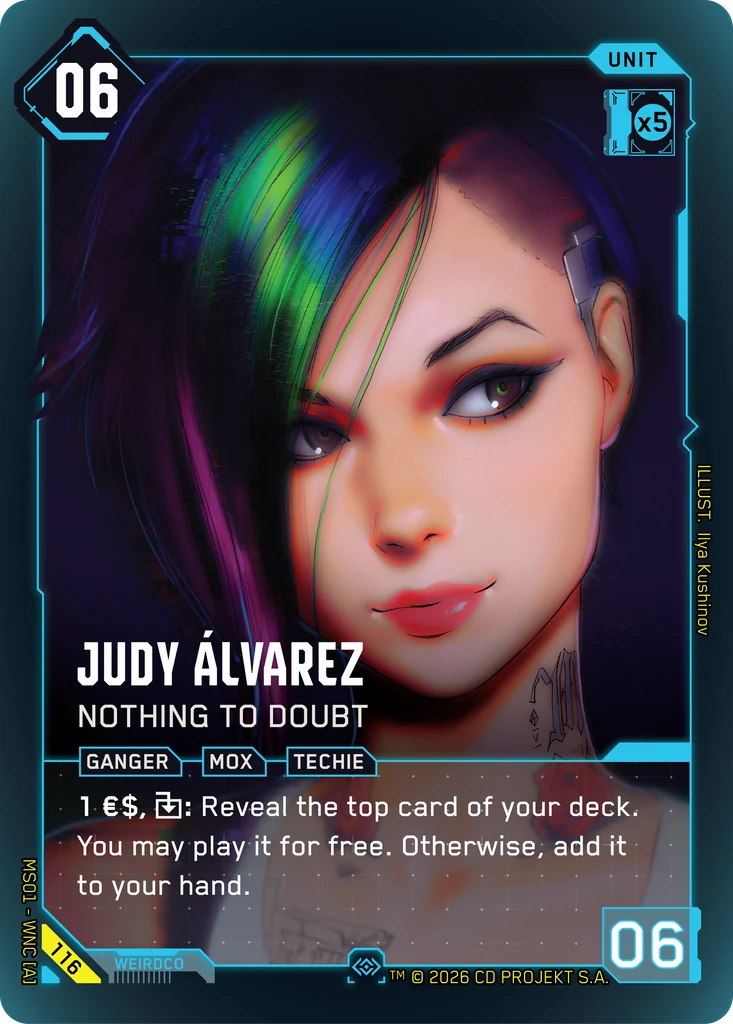
At the table, every turn from her second one on hands you a card, usually at a nice discount. The netdeck API reports an average cost of 4.2 for the reference list. Take off the 1 €$ activation and you save about 3.2 €$ per activation on average. She never whiffs, either: a card you don’t want to play just goes into your hand. And the body holds up. With 6 power she survives an opposing Pyramid Song (−4) and Towerfall (−5).
Before you buy, know the catches. Three copies cost at least €28.50 on Cardmarket, and that’s a foil price, because the price guide only has foil offers for this card. She needs 6 €$ to hit the table and, thanks to Lag, can’t activate until the turn after (Lag means new Units can’t attack or use Spend on their first turn, though they can block). Also worth knowing: two of the nine Mono-Blue comparison lists we looked at don’t run her at all.
The famous combo with V and Delamain belongs to a different deck
If you’re chasing the much-quoted “Judy, Delamain, V: Streetkid” combo, that road doesn’t lead to Mono-Blue. V: Streetkid is a Red Legend with RAM 2 in Red, so with V in the deck your Blue limit drops to 4 and Judy: Nothing to Doubt is out.
Delamain: Rideshare AI is a Blue Unit, not a Legend: cost 3, power 0, RAM 3, text “{Play} Draw 2.” The official FAQ, the publisher’s collection of rules rulings, clarifies that the draw is mandatory. The combo lives in Blue-Blue-Red, with Alt, Judy and V: Streetkid (48 decks on netdeck) or Jackie, Judy and V: Streetkid (17 decks).
RareTotem sums up Delamain with Judy as turning “what would otherwise be a dead card on the board into an attacker stealing a gig each turn you play a brain dance”. (Gigs are the dice that count toward the win.) Delamain fits Mono-Blue too, since RAM 3 is under 6, and it shows up in 39.0% of Mono-Blue lists. The reference list skips it, so here it’s a flex option.
The reference list comes from Surgical Ninja, who explains every card on video
We picked this list for one reason. Its creator explains every single card.
The list is called “Ninja’s Mono Blue Control” and comes from Surgical Ninja. You’ll find it as a deck page in the official builder and as the deck tech video “MONO BLUE CONTROL Is BRUTAL!” on Surgical Ninja’s channel. Every copy count spoken in the video matches the netdeck list, as does the split into 21 Programs and 19 Units.
In the builder, nobody’s exactly lining up for it: 29 views and 0 likes on October 14. The most visited Mono-Blue Judy list is a different one, “Ghost in the Shell Blue” by DanteMM on ExBurst, with around 1,300 visits and 2 likes on October 14. Surgical Ninja also has a BBG list called “BBG Control”, which gets a lot more attention in the builder with 203 views and 2 likes.
For a guide, reasons beat clicks. Surgical Ninja says why each card made the cut, gives copy counts for several of them, and for Psycho Squad even admits the number is a test. A list you can argue with is a list you can learn from. “Ghost in the Shell Blue” rides along as the comparison, and wherever DanteMM builds differently, we point it out.
There’s one loose end. In the video, Surgical Ninja mentions “still some changes” to talk about “at the end of the video”. Then the end of the video arrives with no changes in it. What was meant, we don’t know. The netdeck list dates from September 7 and was last edited on September 13.
| Copies | Card | Type | Cost | Power |
|---|---|---|---|---|
| 1 | Alt Cunningham: Soulkiller Architect | Legend | – | – |
| 1 | Jackie Welles: Pour One Out For Me | Legend | – | – |
| 1 | Judy Álvarez: Braindance Maestro | Legend | – | – |
| 3 | Mox Inciters | Unit, Blocker | 3 | 2 |
| 2 | Psycho Squad | Unit | 4 | 6 |
| 3 | Rita Wheeler: No Stupid Questions | Unit, Blocker | 4 | 4 |
| 3 | Lizzy Wizzy: Delicate Weapon | Unit, Blocker | 5 | 2 |
| 3 | Maman Brigitte: Spirit of Death | Unit | 5 | 3 |
| 3 | Judy Álvarez: Nothing to Doubt | Unit | 6 | 6 |
| 2 | Placide: Voodoo Sentinel | Unit | 8 | 10 |
| 3 | Reboot Optics | Program, {Quick} | 2 | – |
| 3 | Three Mouths, One Desire | Program, Braindance | 2 | – |
| 3 | Chrome Reverie | Program, Braindance | 3 | – |
| 3 | Pyramid Song | Program, Braindance | 3 | – |
| 3 | Unlikely Bond | Program | 4 | – |
| 3 | Les Élémens | Program | 5 | – |
| 3 | Towerfall | Program, Braindance | 6 | – |
It’s legal: three Legends with different names, 40 cards in the main deck, at most three copies per card, highest RAM 5 against a limit of 6, all Blue. The builder marks it valid.
Keep these numbers in your head, they’ll keep coming back. The list has 19 Units, 21 Programs and no Gear. Twelve cards are Braindances, which means Judy triggers. You can only sell the 21 Programs, because no Unit in the list has a Sell Tag, the icon that lets you sell a card for an Eddie. Average Unit power is 4.4.
| Cost | 2 | 3 | 4 | 5 | 6 | 8 |
|---|---|---|---|---|---|---|
| Cards | 6 | 9 | 8 | 9 | 6 | 2 |
The curve starts at 2. Nothing costs 1 €$, and the first player is going to feel that in a moment.
Judy brings more cards than power
Treat Judy as a power buff and you’re tossing out the half of the card that draws you cards. In this list she’s a value engine. Alt and Jackie are there to make your Programs cheap and your dice small.
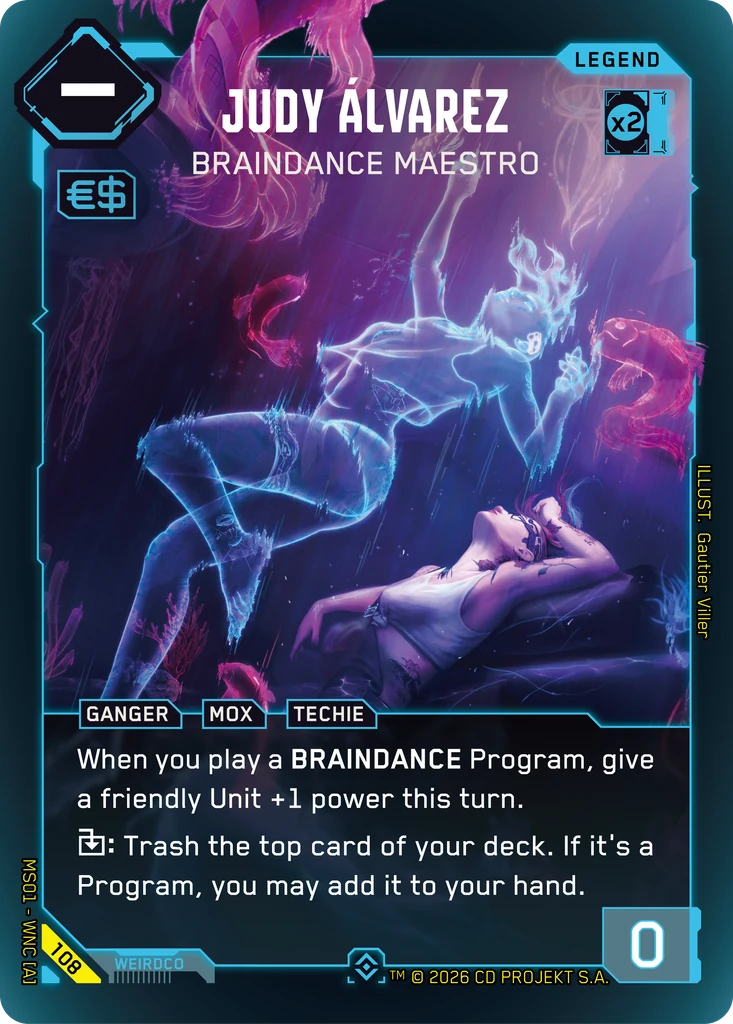
Judy Álvarez: Braindance Maestro
When you play a Braindance Program, one of your Units gets +1 power this turn. On top of that, with {Spend} you trash the top card of your deck; if it’s a Program, you may put it into your hand.
The buff stacks, because it counts every Braindance*2. Surgical Ninja compares it to Storm from Magic, a mechanic that grows with every spell cast in a turn: “you could trigger this multiple times”. A Braindance played from your trash (your discard pile) counts as well. That’s why Alt and Lizzy Wizzy are in this list.
People tend to miss the limitation here. No Blue Braindance in the whole pool has {Quick}, the keyword for cards you can also play in response to a rival attack. Every Braindance gets played on your own turn, so the buff never helps you block. Where it does help: attacking a spent (sideways) rival Unit, or stealing Gigs.
Gig stealing has a threshold*3. At 10 power a Unit steals 2 Gigs. Judy: Nothing to Doubt with 6 power would need four Braindances in the same turn to get there, and that rarely happens. In real games the buff does something smaller and still useful: it wins you a fight you’d otherwise have lost.
Her {Spend} isn’t free, by the way. It effectively costs you 1 €$. Judy sits face-up in the Legends area with a Sell Tag and could pay 1 €$ instead*4. With a full deck, the Spend hits a Program in 21 of 40 cases, or 52.5%. Surgical Ninja calls it “a 50/50 shot”, and that’s about right. The other 47.5% of the time a Unit goes to the trash, and nothing in the list brings Units back. Trash a Placide and it’s gone for good.
The card text doesn’t care how Judy is turned. Spend her to pay and the buff keeps working. No FAQ entry covers this, but the text supports it. Judy herself can never hit the field, because as a Legend she has no cost, so the buff always needs some other Unit of yours.
The community doesn’t agree on how to read her, though the two takes below are both about BBG. RareTotem says “Judy tends to lean heavier into combat strats”. Randy Muir of Wild Things Games writes instead that “Judy gives you more card draw as most of your removal are braindances”. For Mono-Blue, the second one is closer to the truth.
Braindance-wise, this list leaves Judy triggers on the table. It plays 12 of 40: three each of Three Mouths, Chrome Reverie, Pyramid Song and Towerfall. In our own count, the comparison lists run 11 to 20 Braindances, with a Mono-Blue median of 14.
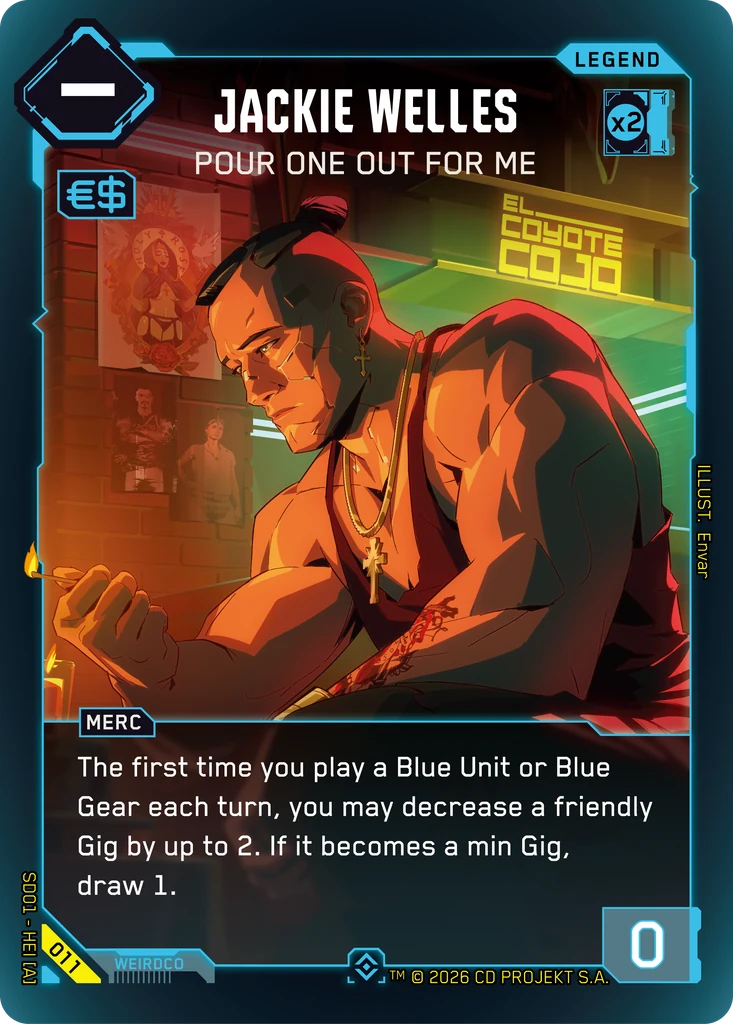
Jackie Welles: Pour One Out For Me
Jackie is the only card in this list that pushes your dice down to 1 on purpose, which makes him a bigger deal here than in BBG. The first time each turn you play a Blue Unit or Blue Gear, you may decrease one of your Gigs by up to 2. If that makes it a min Gig, you draw a card.
Min means the die shows its 1*5. Three cards in the list and the Legend Alt get stronger with min Gigs: Alt lowers costs, Three Mouths gives more cards, Chrome Reverie a free Call, Pyramid Song both effects. (A Call flips a face-down Legend and normally costs 1 €$.) Surgical Ninja keeps the Jackie pitch short: “This helps us modify our dice and lets us draw.” No Gear in the list, so here Jackie only triggers off Blue Units.
The draw needs a real change. A Gig that already shows 1 gets you no card from Jackie, and you can’t “decrease” it to its own value. The FAQ confirms this.
The d4 is your most important die, and the math is short. You decide every turn which die you roll in, meaning roll from your supply and add to your Gigs. Only the d20 has to come last, once nothing else is left. If you roll in the d4 first, it lands on 1 a quarter of the time (25%). With Jackie face-up and a Blue Unit that turn, a 1, 2 or 3 all end up min, so 75% of the time. On a 2 or 3 you draw a card on top, which is 50%.
No Jackie face-up, and you’re stuck at 25% for the d4 and 16.7% for the d6. The annoying part is that Jackie isn’t the first Legend up in two out of three games (more on that in the next section).
Careful when shopping for Jackie: he isn’t in retail boosters. It comes in the starter deck “The Heist” (SD01-011), plus printings from the Merc Demo, Box Topper and Edgerunner Open.
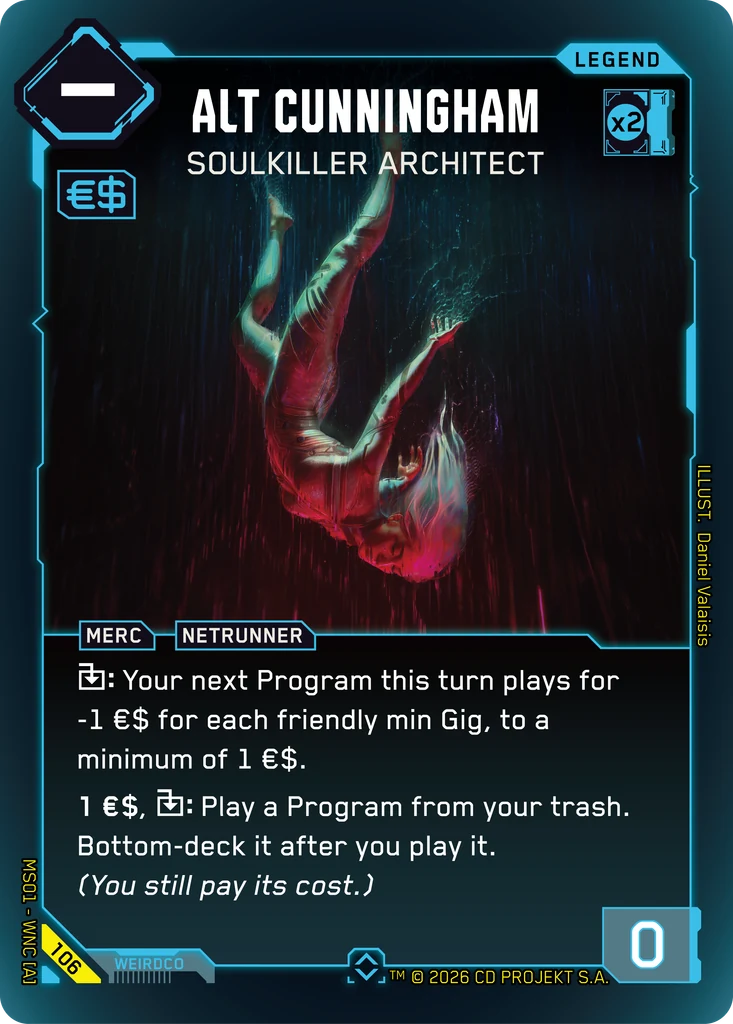
Alt Cunningham: Soulkiller Architect
Alt doesn’t pay off until you have two min Gigs. Activate her blind and you’re bleeding value. With {Spend}, your next Program this turn costs 1 €$ less for each of your min Gigs, but never less than 1 €$*6.
Here’s the catch. Alt herself would otherwise be 1 €$ of payment, so with exactly one min Gig you save 1, lose 1 and net zero. From two min Gigs on you come out at least 1 €$ ahead. The discount also applies to Programs you play from the trash.
Her second ability pulls a Program out of the trash: pay 1 €$, spend Alt, play the Program at full cost, and afterward it goes to the bottom of your deck. In practice that’s the Program’s cost plus 2 €$, so a second Towerfall from the trash runs you 8 €$ worth of resources. Surgical Ninja says it “combos very nicely with Judy”, and the FAQ backs that up: a Braindance from the trash triggers Judy’s buff.
Early on the trash is empty and min Gigs are scarce. With a single dedicated min Gig source in the list, Alt usually ends up a late card. By turn 4 or 5 the trash has Programs in it and the recursion starts pulling its weight. Best targets: Towerfall, as a second board wipe, and Pyramid Song, which is cheap and counts as a Braindance.
RareTotem calls Alt “A tier, borderline S tier” and an “evergreen design”. That rating is about BBG, where Hanako and Peace Offering push Gigs around constantly. She’s popular here too: she appears in 56.5% of all 269 Judy decks on netdeck and in 64 of the 77 Mono-Blue decks. The most common Mono-Blue pairings are Alt with Jackie (23 decks), with V: Corporate Exile (13), with Wakako (12), with Sasha (10) and with Evelyn (6).
Which Legend flips first decides your first three turns
Which Legend comes up first is out of your hands. The order of your actions isn’t, and your early turns hang on it.
Your three Legends lie face-down and shuffled, and a Call flips a card you can’t identify*7. The first Call is a one-in-three shot each for Judy, Jackie or Alt. After two Calls, Judy is face-up two times out of three; after three, she’s guaranteed. Each Call costs 1 €$, and Chrome Reverie with a min Gig makes one of them free.
Going first adds a wrinkle. The first player spends their two leftmost Legends, and those don’t ready on turn 1, which leaves you a single ready Legend on turn 1: the rightmost one. A Called Legend keeps its orientation when flipped.
Jackie first is the best start
Jackie up first makes your d4 min 75% of the time and switches on Pyramid Song’s double mode, the extra card from Three Mouths and the free Call from Chrome Reverie. He just has to be face-up before your first Blue Unit of the turn*8.
Judy first digs, Alt first waits
Judy first lets you Spend her on the very turn you Call her and dig for Programs; the FAQ allows that. The buff still needs a Unit of yours on the field, though. No early Unit in hand, and Judy first is just a shovel.
Alt first is the worst of the three. No min Gigs, no discount. Empty trash, no recursion. What’s left is 1 €$ of payment you’d have had face-down anyway.
The fixed order within a turn
Until all Legends are face-up, every turn follows the same rule: Call first, then play your first Unit. When you Call, flip a ready face-down Legend (you pick which face-down card gets flipped). That means paying for the Call with an Eddie or a Legend that’s already face-up. Pay with a face-down one and you may run out of ready face-down Legends, at which point a flipped Judy or Alt lands face-up but spent and her Spend waits until next turn.
On the play, only the rightmost Legend is ready on turn 1. Call it and you’re rolling a one-in-three shot each for Judy, Jackie or Alt.
Every card has its reason, and four of them are up for debate
Some cards are locked in, others you can tune. Each one gets its role, a copy count with a reason (ours, where Surgical Ninja doesn’t give one), builder data and its limits.
Mox Inciters (3 copies)
Your cheapest Unit, and your Jackie trigger for the first two turns. Mox costs 3, has 2 power and Blocker. When you play it, a rival Unit must attack next turn if it can.
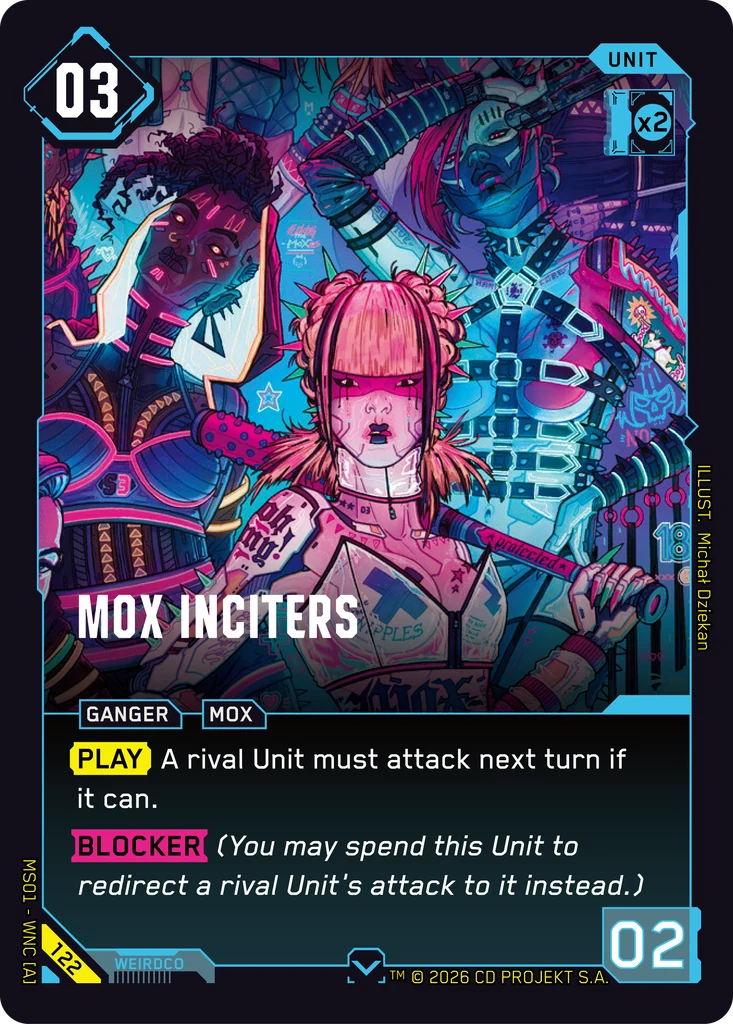
The plan, per Surgical Ninja: make the opponent “attack into your Rita Wheeler”. The attacker gets spent and stays that way until the start of its next turn*9. So on your turn it’s still sideways, a sitting target for your attacks and for Unlikely Bond.
Three copies make sense because Mox is the only 3-cost Unit in the list. On the draw, your turn 1 is exactly Call plus Mox, which is 4 €$. (A Unit whose text says it can’t attack isn’t forced.)
The downside is that 2 power dies to every Towerfall, to Bonnie and Clyde and to Royce: Don’t Call Me Simon. In the Mono-Blue consensus Mox shows up in 54.5% of lists, but in only 3 of the 16 comparison lists. When you need a slot, Mox is the first card we’d look at.
Psycho Squad (2 copies)
Best power per €$ in the list, and it survives an opposing Pyramid Song and Towerfall. Cost 4, power 6, no text. That’s it.
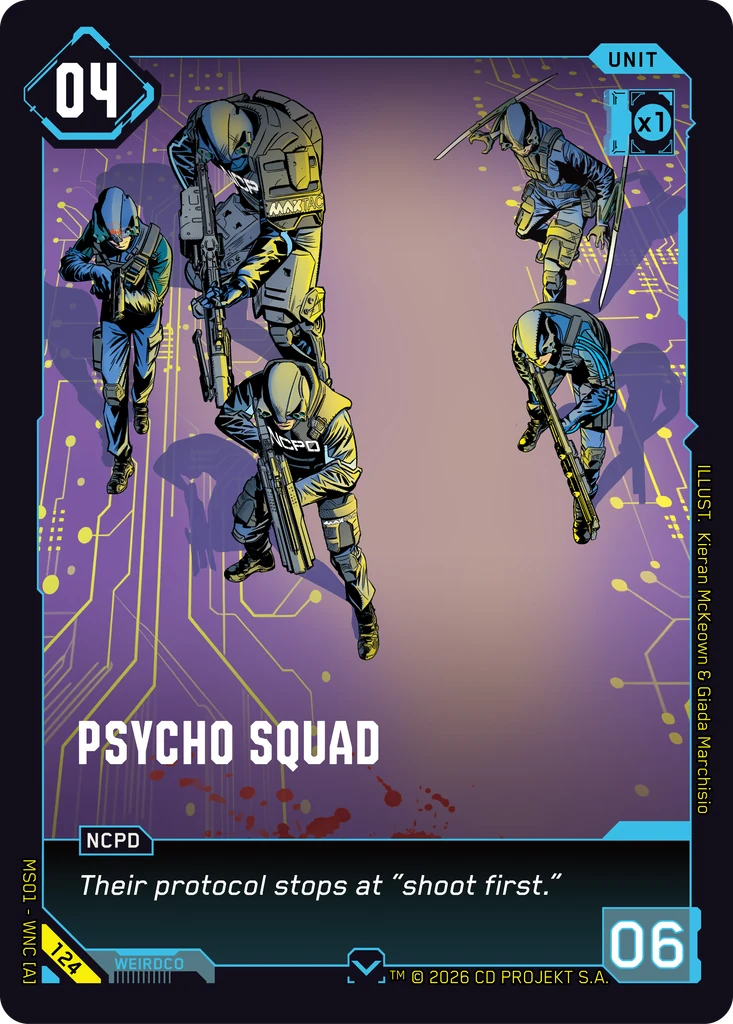
Surgical Ninja thinks “six-power for four is pretty good” and adds: “I’m just running two of it. I want to just test it out.” The 2 is a test, by the author’s own admission. In the Mono-Blue consensus Psycho Squad appears in 28.6% of lists, and in 4 of the 16 comparison lists.
Its value is all about the threshold. Towerfall takes away 5, 6 minus 5 is 1, and Psycho Squad stays on the board. With two Judy buffs, it beats any spent rival Unit with 7 power on your turn.
Rita Wheeler: No Stupid Questions (3 copies)
A blocker that quietly filters your deck while she’s at it. Cost 4, power 4, Blocker. The first time each turn she’s spent, you draw a card and discard one.
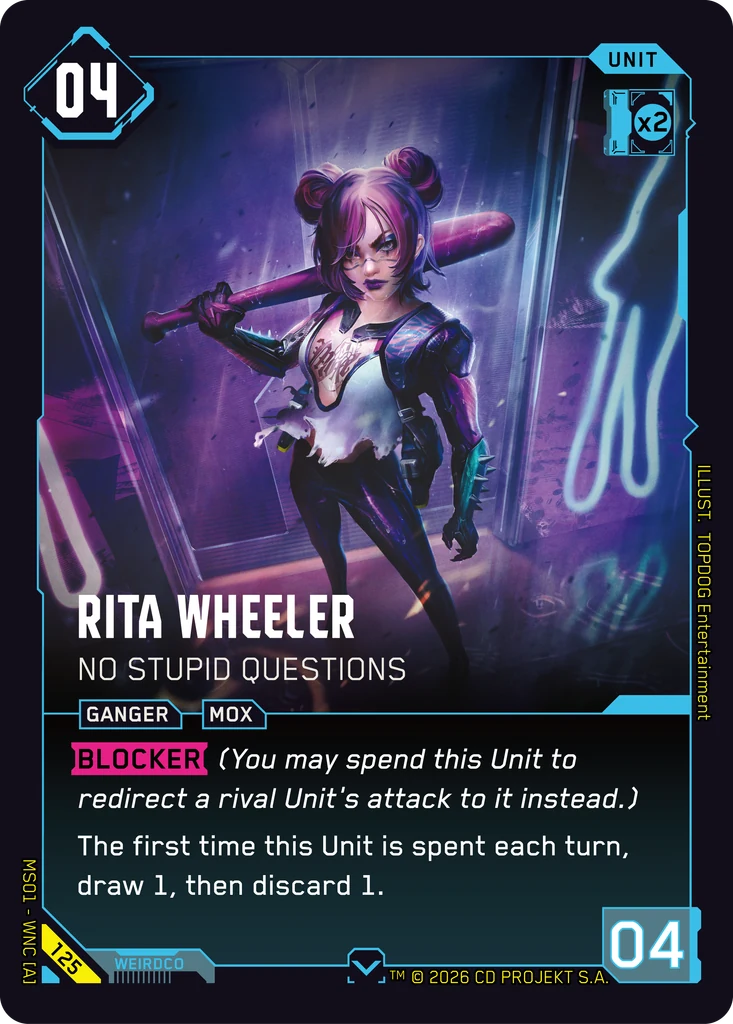
Surgical Ninja calls her “a nice chunky blocker” and explains the synergy: discard a Program, and you can play it from the trash with Alt. Blocking spends a Unit, so Rita filters on the opponent’s turn too, and every discard stocks the trash with Programs for Alt and Lizzy.
We stay at three Ritas. Together with Mox and Lizzy she forms the blocker net (nine blockers total). In the Mono-Blue consensus she shows up in 67.5% of lists, but in only 3.3% of the 30 BBG lists with Hanako, Jackie and Judy. Watch your deck size, though. A player who has to draw from an empty deck loses on the spot, and Rita’s draw counts.
Lizzy Wizzy: Delicate Weapon (3 copies)
Lizzy replays a cheap Program for free and then stands around blocking. Cost 5, power 2, Blocker. When you play her, you may play a Program with cost 3 or less from your hand or trash for free, and afterward it goes to the bottom of your deck.
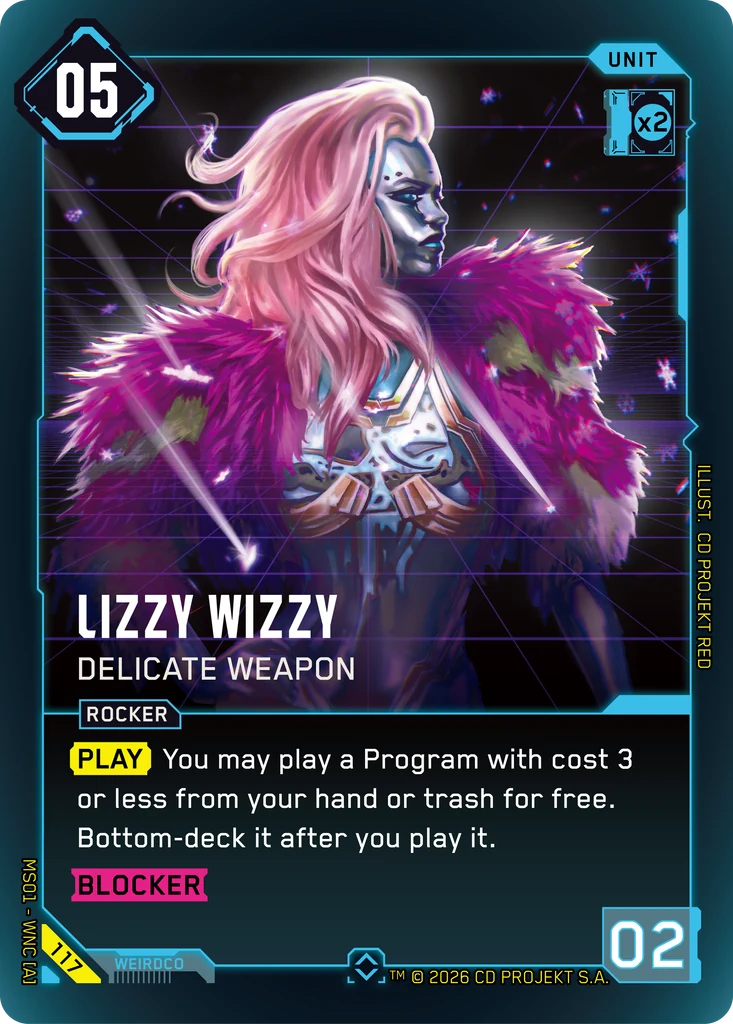
Surgical Ninja puts it in terms Magic players get instantly: “This is literally a Snapcaster Mage.” (That’s the Magic card that lets you cast a spell from your graveyard again.) The builders clearly agree: 84.4% in the Mono-Blue consensus and 14 of 16 comparison lists.
Your targets are Three Mouths, Chrome Reverie and Pyramid Song, all Braindances and therefore Judy triggers. Reboot Optics technically works, but on your own turn it’s close to worthless. Towerfall, Les Élémens and Unlikely Bond cost too much. Most games, Lizzy is a second Pyramid Song stapled to a blocker, and if she’s your first Unit of the turn she triggers Jackie on top.
Maman Brigitte: Spirit of Death (3 copies)
Removal on a body, provided you can discard two Programs. Cost 5, power 3. When you play her, you discard two Programs and then bottom-deck a rival Unit with no Gear attached (bottom-decking means putting the card at the very bottom of its owner’s deck). One Program isn’t enough. It has to be exactly two, or nothing happens.
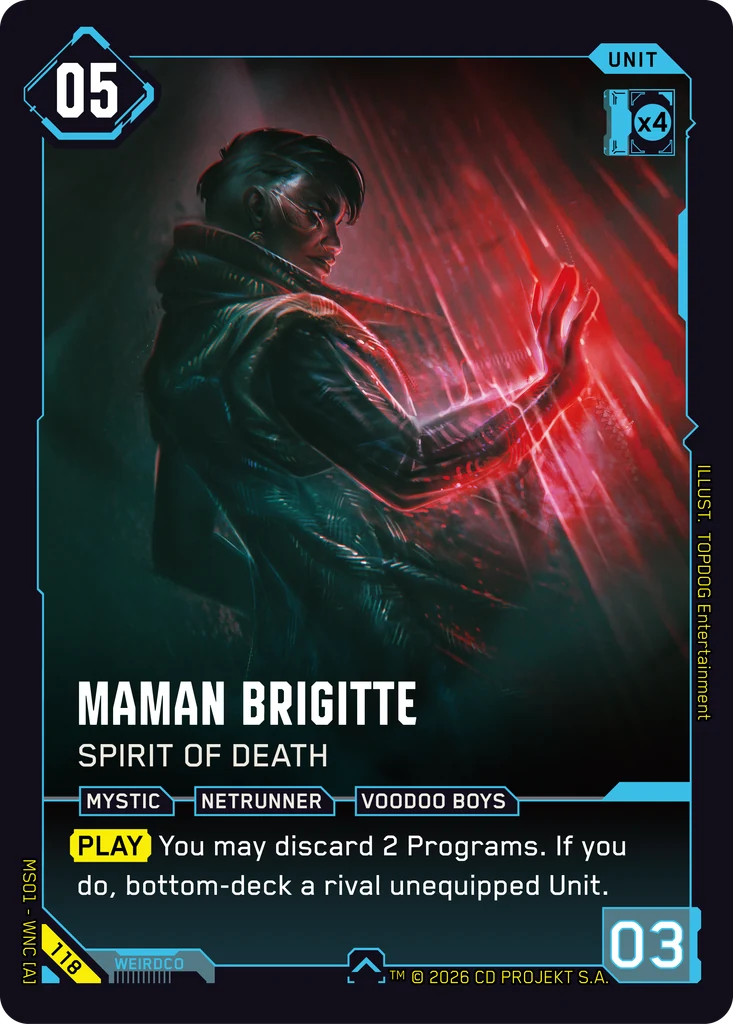
Surgical Ninja names the limit right away: “this cannot hit Voltron targets”. Voltron is community slang for Units loaded up with Gear. On the plus side, the video points out the deck has plenty of draw, so Maman shouldn’t be hard to trigger.
The way we count it, you pay 5 €$ plus two cards for one rival card. The discarded Programs land in the trash, where Alt and Lizzy get some of them back. Against Gear, Maman does nothing. In the Mono-Blue consensus she appears in 51.9% of lists, and in 80.0% of the 30 BBG lists with Hanako, Jackie and Judy. She’s our second flex candidate, and we’d lean toward two copies.
Judy Álvarez: Nothing to Doubt (3 copies)
The reason Mono-Blue exists. From the turn after you play her, she hands you a card every turn. Surgical Ninja: “Reveal the top card of your deck and play it for free. That is amazing”, and a bit later, “That is card advantage”.
On the turn she comes down, she doesn’t attack and can’t Spend, because she has Lag*10. After that she pays rent: around 3.2 €$ saved per activation on average, 6 €$ for a free Towerfall, 8 €$ for a free Placide.
Three copies is right in our book. The card works on a delay, and a lone copy eats removal easily (Maman Brigitte or Les Élémens, for example). Bonnie and Clyde can’t touch her at 6 power. Players who run her run 2.21 copies on average.
Placide: Voodoo Sentinel (2 copies)
Placide clears a rival Unit when you play him and again every time he attacks. Connect on the Gig zone and he steals 2 Gigs. Cost 8, power 10. On play and on every attack, you discard a Program and bottom-deck a rival Unit. According to the FAQ, you may discard even if the opponent has no Unit at all.
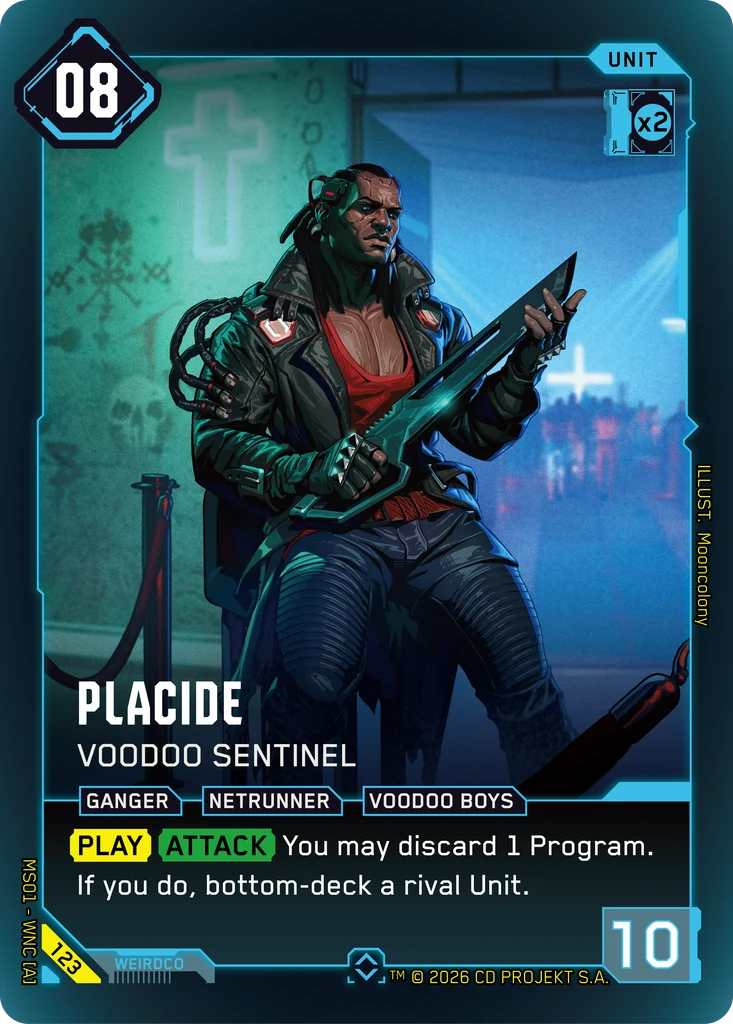
“this is the name of the game is why we are playing blue” (Surgical Ninja on Placide)
The attack is where it gets nasty. Attack effects resolve before the opponent can react*11, so Placide can bottom-deck the ready blocker before it ever gets to block, then steal 2 Gigs with 10 power. Surgical Ninja calls Placide “one of the best removal on a stick”.
Two copies are plenty. At 8 cost he doesn’t arrive before turn 5 anyway, and the Judy Unit can reveal him for free. Builder data: 88.3% in the Mono-Blue consensus, at 2.12 copies on average.
Reboot Optics (3 copies)
Reboot Optics saves a blocker on the opponent’s turn, and when it doesn’t, you sell it. Cost 2, {Quick}, not a Braindance. The next time a rival Unit fights this turn, it doesn’t defeat your Unit. According to the FAQ, your Unit still loses the fight.
Surgical Ninja: “if you don’t need it, you can sell it for Eddies”. The video talks about protecting a “Voltron unit” with it, but the card protects any of your Units. It’s the only real reaction this list has on the opponent’s turn, and no, it doesn’t count as a Braindance.
The data’s split: 67.5% in the Mono-Blue consensus, only 3 of 16 comparison lists. As sell fodder it does its job. If you want room for Trust No One, these three go first.
Three Mouths, One Desire (3 copies)
Three Mouths is cheap card selection that gets better with every min Gig. Cost 2, Braindance. You look at the top three cards, take one into your hand plus one more for each of your min Gigs, and the rest go to the bottom of your deck.
Surgical Ninja: “If you have two minimum gigs, you draw all three.” It appears in 97.4% of Mono-Blue lists. The rest goes under the deck, so your deck doesn’t shrink and the cards you looked at stay in it. On the play, Three Mouths is one of your two possible turn-1 plays.
Chrome Reverie (3 copies)
Chrome Reverie stops an attacker, and with a min Gig it saves you a Call as well. Cost 3, Braindance. The text reads “A rival Unit can’t attack until your next turn.” With a min Gig you may also Call a Legend for free.
Surgical Ninja says the card “lets you do two things for one”. The video says the Unit “can’t attack you”, but the card text goes further. The Unit can’t attack at all, which covers your Units too.
There are traps. You Call at most once per turn*12, so Chrome Reverie goes before your regular Call. And lock down the very Unit that Mox Inciters forced to attack, and you’ve just cancelled your own combo, since the Mox compulsion doesn’t override the lock. In the Mono-Blue consensus Chrome Reverie shows up in 83.1% of lists. Randy Muir writes about BBG: “Expect chrome reverie turn 2 always”.
Pyramid Song (3 copies)
With a min d4, Pyramid Song removes anything up to 4 power. Without one, it’s a combat trick. Cost 3, Braindance, Rare. You choose one of two effects. If your d4 is a min Gig, you get both: one rival Unit gets −4, then you bottom-deck a rival Unit with 0 power. The effects resolve top to bottom.
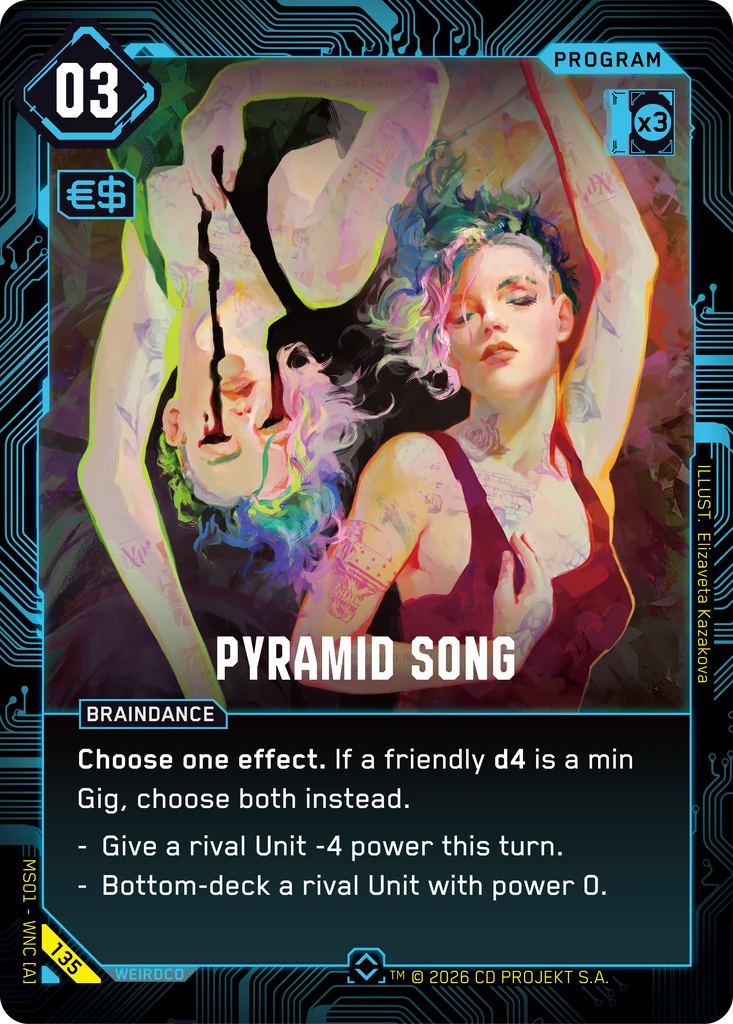
“I don’t see why you would not want to run this.” That’s Surgical Ninja, and the builders are on board: 98.7% in the Mono-Blue consensus and all 16 comparison lists.
No min d4 means Pyramid Song only removes Units that already sit at 0 power, like Delamain, Evelyn Parker: Scheming Siren, Misty or Secondhand Bombus. With a min d4, it removes anything up to 4 power, attached Gear included.
Unlikely Bond (3 copies)
Unlikely Bond swaps one of your ready Units for a spent rival Unit, however big or geared up that one is. Cost 4, not a Braindance. Your own ready Unit hits the bottom of the deck first, then the spent rival Unit follows. Yours goes even if the opponent has no spent Unit. That follows from the card text, and the FAQ confirms it for the case where the opponent has no Unit at all.
Surgical Ninja: “You could use those chippy units who aren’t doing anything to get rid of one of your rival units.” It can even remove a 12-power Unit carrying three Gear, as long as two conditions from the card text are met: you have a ready Unit of your own to sacrifice, and the rival Unit is spent, for example because it attacked. Only Placide does that unconditionally, and Les Élémens only when the big Unit is the only one or the weakest.
Bond goes before your own attack, because your Unit has to be ready. Best sacrifice is Mox Inciters: 2 power, job already done. Bond appears in 35.1% of Mono-Blue lists and in 5 of the 16 comparison lists, which makes it one of this list’s quirks.
Les Élémens (3 copies)
Les Élémens removes the rival’s weakest Unit. Against a lone Voltron Unit, that’s a guaranteed hit. Cost 5, not a Braindance, sellable. On a tie you choose, and you may play the card even with no rival Unit on the board.
Surgical Ninja nails it: “This is one of the hard counters to Voltron. … all those gear go with it.” Bottom-decking takes everything attached to the Unit along*13.
On a wide board it hits the smallest Unit, which is often the wrong one. Against piles of small Units (BBG, say) Les Élémens is sell fodder. Against Gear it’s a centerpiece. The numbers: 66.2% in Mono-Blue, 96.7% in the 30 BBG lists with Hanako, Jackie and Judy.
Towerfall (3 copies)
Towerfall is your board wipe for everything up to 5 power, as long as you have less Street Cred than the opponent (Street Cred being the sum of your Gig values). Cost 6, Braindance, Epic. You choose one of two effects. If you have less Street Cred than a Rival*14, you get both: all rival Units get −5, then you bottom-deck all rival Units with 0 power.
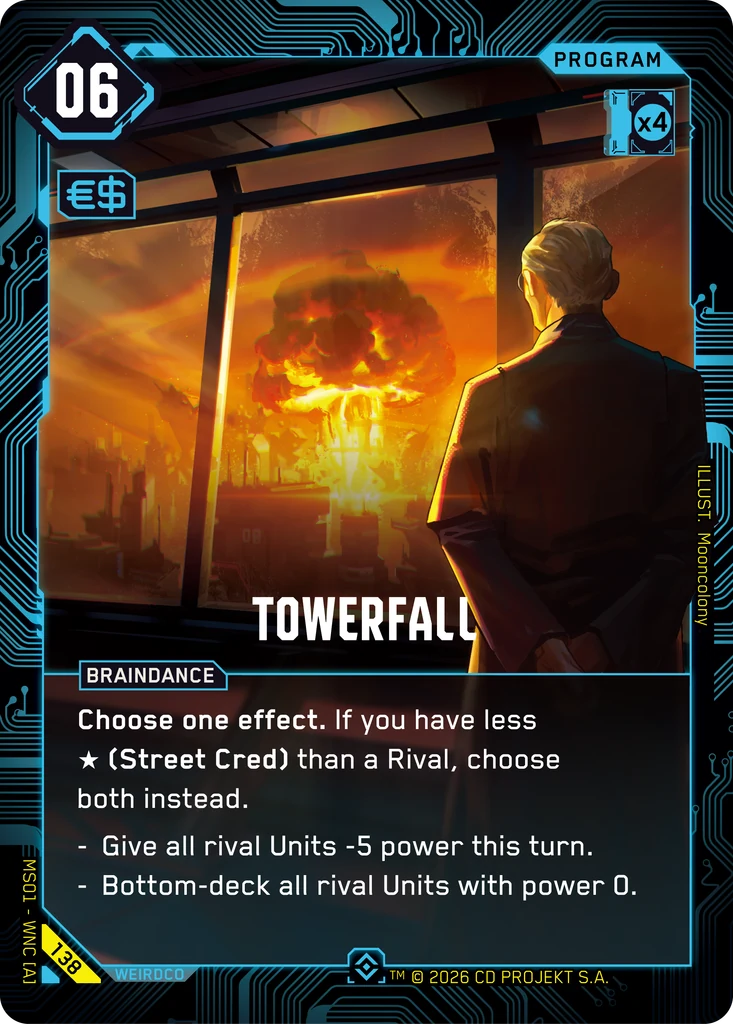
The reason it reaches everything up to 5 power is that negative power counts as 0*15. A Unit with 4 power sits at −1 on paper after −5, so it counts as 0. Pyramid Song with both effects works the same way, up to 4.
Surgical Ninja: “you need a board clear and this is our board clear … following this card up with a Placide, ooh, it is painful.” (At one point the video calls Towerfall “this unit”. It’s a Program.)
Jackie lowers your own Street Cred along the way, so min Gigs and Towerfall pull in the same direction. When you only get one effect, take −5 if your own attacks on spent Units follow, and save the bottom-deck effect for Units already at 0 power.
Towerfall appears in 94.8% of Mono-Blue lists, at 2.42 copies on average, and in 63.3% of the 30 BBG lists with Hanako, Jackie and Judy. It’s also the second biggest cost driver after the Judy Unit: three copies run at least €18.00 on Cardmarket.
Ten chains carry the deck, and each one snaps at a specific point
Once you know the chains, you can plan a turn backward from its condition and spot the breaking point before you get there. All of them come straight from card text and the FAQ.
Jackie, min d4, Pyramid Song with both effects
Jackie’s face-up, you play your first Blue Unit, drop the d4 by up to 2 and cast Pyramid Song with both effects. That’s 3 €$ for removal up to 4 power, a Judy buff, and a card if Jackie actually brought the d4 down to 1.
It breaks if the d4 hasn’t been rolled in yet, got stolen, or shows 4 (Jackie only manages 2). Same if a Blue Unit came down before Jackie flipped, if BBG’s Hanako swaps the d4 away, or if Gear pushes the target above 4 power.
Lizzy, Braindance from the trash, Judy buff
Lizzy comes down and brings a free Pyramid Song, Chrome Reverie or Three Mouths from the trash along. You get the Program’s effect, the Judy buff and a 2-power blocker, plus a Jackie trigger if Lizzy is your first Blue Unit of the turn.
No Program costing 3 or less in your trash or hand, and it falls apart. Same story when Reboot Optics is the only one available, or when Pyramid Song without a min d4 only gives −4.
Alt’s discount for a cheap Towerfall
You build up min Gigs, spend Alt and cast Towerfall for 6 minus your min Gigs. With three min Gigs, Towerfall costs 3 €$, and you come out 2 €$ ahead.
Fewer than two min Gigs breaks it (break-even or a loss). So does activating Alt before the Jackie trigger, because the discount gets locked in on activation. Still open is whether a Program played for free in between, such as Lizzy’s, eats the discount. No FAQ covers it. We play it safe and put Lizzy before Alt.
Alt’s recursion for a second Towerfall
You pay 1 €$, spend Alt, cast Towerfall from the trash at the full 6 €$, and afterward it goes under the deck. Second board wipe, second Judy buff. It takes 8 €$ worth of resources (6 plus 1 plus Alt herself), and your Street Cred still has to be below the opponent’s.
Chrome Reverie with a min Gig for a free Call
Chrome Reverie goes first thing in your turn: lock down an attacker, Call for free. You save 1 €$ and your next Legend shows up sooner. It snaps if you’ve already Called, have no min Gig, have all Legends face-up, or if the new Legend is Jackie and a Blue Unit has already come down.
Mox, forced attack, Unlikely Bond
Mox hits the table. On the opponent’s turn one Unit has to attack, Rita or Lizzy blocks, Reboot Optics protects. On your turn that Unit is still spent, and you either remove it with Unlikely Bond (Mox as the sacrifice) or swing at it with Psycho Squad plus Judy buffs. The opponent loses a Unit, and you never had to reach a power threshold.
It breaks if the Unit’s text says it can’t attack, or if you locked it down with Chrome Reverie. Also if the opponent attacks your Gig zone with no blocker ready, or if Mox attacked before Unlikely Bond and is no longer ready.
Rita blocks, the Program comes back
Rita blocks on the opponent’s turn, draws a card and discards a Program. On your turn, Alt or Lizzy plays it from the trash, so the filtering doubles as setup for recursion. Breaks on an empty deck (that one’s the loss), when Alt isn’t face-up, or when the Program costs more than 3 and Lizzy can’t grab it.
The Judy Unit reveals for free
The turn after you play it, pay 1 €$, spend Judy: Nothing to Doubt, reveal the top card, play it for free. On average you save 3.2 €$, and a Towerfall or Placide on top swings the game. It snaps on the turn you play her (Lag) and if Placide shows up with no Program in hand to discard. According to the FAQ you may activate her with an empty deck, but nothing happens.
Pyramid Song and Towerfall against big Units
Pyramid Song first (−4, plus the bottom-deck effect with a min d4), Towerfall after (−5, then everything at 0 power goes under the deck). Together they clear Units up to 9 power, including Yorinobu Arasaka: Steel Dragon at 9 and an Adam Smasher: Ender of Legends played via Go Solo at 9, who is then removed from the game. The chain costs 9 €$, needs lower Street Cred and snaps if the target goes above 9 with Gear.
Placide attacks, the blocker vanishes
Placide attacks the opponent’s Gig zone, his attack effect discards a Program and bottom-decks the ready blocker, then he steals 2 Gigs with 10 power. It snaps if you have no Program in hand or the opponent has two blockers. Take Control from Green knocks one of the two Gigs off the haul. Chrome Fang (Red) only protects Gigs with a value above 10. Westbrook Netrunner only works against Legends, so it doesn’t help the opponent against Placide.
The BBR variant as a preview
Pick V: Streetkid over Judy: Nothing to Doubt and a whole different chain opens up. V: Streetkid trashes three cards on Call and then returns any Braindance from the trash to your hand, according to the FAQ not just one of those three, but only one. Targets are the red Braindances Bonnie and Clyde, Shattered Memories, Industrial Assembly and Carnage at the Colosseum. Delamain goes from 0 to 1 power with a Judy buff and then steals a Gig. The price is the Blue limit of 4, and with it, no Judy Unit.
Three turns with the math show where the deck tips
Sequencing is where games are won, and you can count the difference in €$. Ground rules for all three examples: you sell one card per turn, always a Program, since no Unit can be sold, so your Eddies match the turn number. All three Blue Legends pay 1 €$ each, face-down or face-up. The opponent’s cards have their real stats.
Turn 3 on the draw: Towerfall after a Mox-forced attack against Red Aggro
The opponent is on the play with Red-Red-Yellow and has 6th Street Recruits (6 power), Ruthless Lowlife (4) and Valentino Guerrera (4) on the board.
Your turn 1: 4 €$, meaning one Eddie and three Legends. Sell Reboot Optics, Call with the Eddie, and Jackie flips. Mox Inciters comes down for 3 €$, paid with the three Legends. Jackie triggers: the d4 shows 3, minus 2 is 1, min Gig, one card.
Turn 2, 5 €$. Sell Unlikely Bond, Call with an Eddie, Judy flips, and the second Mox comes down for 3 €$. Jackie triggers again, but the d6 shows 4, minus 2 is 2. No min Gig, no card. The second Mox forces 6th Street Recruits to attack next turn, and 1 €$ goes unused.
On the opponent’s turn 3, Recruits attacks and the first Mox blocks and is defeated (2 against 6). Recruits is now spent, and it stays that way until the start of the opponent’s next turn.
Your turn 3 brings 6 €$. Les Élémens gets sold, since it does little against Red Aggro. You roll in the d8 and it shows 5. Your Street Cred is 1 plus 2 plus 5, so 8. The opponent has three Gigs at 4, 6 and 5, so 15. You’re below and get both effects.
Towerfall costs all 6 €$. All rival Units get −5: Recruits drops to 1, Lowlife and Guerrera to −1 on paper, which counts as 0. The second effect sends Lowlife and Guerrera under the deck. Judy’s buff gives the second Mox +1, so it now has 3 power. Judy is spent at this point. That the buff still works is our reading of the card text, which sets no condition on Judy’s orientation; no FAQ confirms it. The Mox has been in play since turn 2, so no more Lag. It attacks the spent Recruits, 3 against 1, and Recruits is defeated.
The rival board is empty. You paid 6 €$ for three Units and lost one Mox.
Now the tipping points. With equal or higher Street Cred you only get one effect, so you take −5 and send Mox into the spent Recruits while Lowlife and Guerrera stick around. And without the second Mox forcing the attack, Recruits would be ready on your turn 3 and not a valid attack target. The first Mox from turn 1 forces the attack on the opponent’s turn 2, which only helps you on your turn 2. The compulsion has to land the turn right before the Towerfall turn.
On Street Cred: Jackie’s two decreases lowered yours by 4. Without them you’d sit at 12 instead of 8, which still beats 15. Against an opponent who rolls low, though, those 4 points decide it.
Turn 5: value turn with Judy: Nothing to Doubt against a BBG-style board
The Judy Unit has been in play since turn 4, Lag is gone, and Psycho Squad is standing next to her. All three Legends are face-up, and your d4 shows 1. The opponent has a 4-power Unit and Yorinobu Arasaka: Steel Dragon with 9 power. You have 8 €$: five Eddies and three Legends.
Sell Reboot Optics. Spend the Judy Legend and trash the top card: Pyramid Song, straight into your hand. Judy can’t pay anymore, so 7 €$ remain.
Next, Judy: Nothing to Doubt for 1 €$ and Spend. Out comes Placide, played for free. Jackie triggers because Placide is your first Blue Unit of the turn: d8 from 3 to 1, min Gig, one card. Placide discards Unlikely Bond and sends Yorinobu under the deck. 6 €$ remain.
Pyramid Song costs 3 €$. Your d4 is min, so you get both effects: the 4-power Unit drops to 0 and goes under the deck. Judy’s buff still works with Judy spent, raising Psycho Squad to 7. Then you play Three Mouths for 2 €$. With two min Gigs (d4 and d8) you take all three cards into your hand, and the buff raises Psycho Squad to 8. Psycho Squad attacks the opponent’s Gig zone and takes a Gig. Placide has Lag and stays home.
Add it up: 7 of your 8 €$ worth of resources used, 1 €$ left over. Two rival Units are gone, you got three cards from Three Mouths, one from Jackie and one through Judy’s Spend (Pyramid Song, played right away), and you stole a Gig.
It could tip a few ways. If the Judy Unit reveals Mox Inciters instead, you get a free Mox (3 €$ of value and a Jackie trigger) but nothing for Yorinobu. Placide with no Program in hand arrives without an effect. And Three Mouths before Placide means Jackie hasn’t lowered the d8 yet, so Three Mouths only brings two cards. Unit before Programs pays off here.
Turn 6: Lizzy before Alt, then Towerfall for 3
Pyramid Song is in the trash. All six dice are rolled in: d4 at 1, d6 at 1 (rolled that way), d8 at 3, d10 at 6, d12 at 9, d20 at 12. Your Street Cred is 32, the opponent’s 38. All Legends are face-up, and you have 9 €$.
Lizzy Wizzy comes down for 5 €$, paid with five Eddies. Two effects are now waiting, Jackie’s and Lizzy’s, and since both are yours, you pick the order. Jackie first: d8 from 3 to 1, min Gig, one card. Then Lizzy: Pyramid Song for free from the trash, d4 min, both effects, a 4-power Unit goes under the opponent’s deck and Pyramid Song under yours. Judy’s buff goes on Lizzy.
Now Alt. Three min Gigs (d4, d6, d8) means the next Program costs 3 less, locked in right now. Towerfall costs 6 minus 3, so 3 €$, paid with an Eddie, Jackie and Judy. Your Street Cred is now 1 plus 1 plus 1 plus 6 plus 9 plus 12, so 30 against 38: both effects. Judy’s buff applies again, here too despite the Spend.
5 plus 3 makes 8 €$ paid, Alt spent, all 9 used. Without Alt the same turn would have cost 11 €$.
Sequence matters most here. Alt before Lizzy only counts two min Gigs, because the d8 still shows 3, and the discount might get stuck on the free Pyramid Song. A d4 that isn’t min leaves Pyramid Song removing only Units at 0 power. And if the opponent stole your d20 earlier, your Street Cred drops further, which actually helps Towerfall.
Seven out of ten opening hands are keepable
Keep or ship it back. The percentages below help with that call and show what a mulligan actually buys you. Rules: six cards, at most one mulligan, the whole hand goes back, shuffle, six new cards, no card penalty. The first player decides first, and the second player sees that decision. The tournament rules spell it out: “Players may only mulligan once per game.”
We ran the numbers hypergeometrically for 40 cards:
- At least one Unit costing 4 or less (Mox, Psycho Squad, Rita, 8 cards total): 76.4%.
- At least one Braindance (12 cards): 90.2%.
- At least two Programs: 92.9%; at least three: 71.7%.
- No Unit: 1.41%. No Program: 0.71%. At most one Program: 7.1%.
- Three or more Units costing 5 or more (11 cards): 19.6%.
Our keep rule is at least one Unit costing up to 4 and at least two Programs, one to sell and one to play. 69.6% of opening hands clear that bar. Mulligan everything else, keep whatever comes second, and you end up with such a hand in 69.6 plus 30.4 times 69.6 percent of cases, which is 90.8%.
Add a Braindance to the requirement and it’s 64.1% on the first hand, 87.1% after a mulligan.
Good hand or bad hand mostly comes down to sell fodder. Two Units and four Braindances force you to sell a Braindance on turn 1. On the play you only have 2 €$ on turn 1, so a hand without a 2-cost card just Calls or does nothing (which on its own isn’t a reason to mulligan). On the draw you have 4 €$, and Mox or Rita gets more valuable for turn 1.
Against Red Aggro, you need an early Unit, period. Against BBG and in the mirror, Three Mouths or Chrome Reverie plus late cards is a perfectly fine keep.
By your own turn 3 you’ve seen nine cards, on the play or on the draw. The first player draws on turn 1 too; the rules make no exception. With those nine cards, the chance of at least one Towerfall is 54.5%, of at least one Judy Unit also 54.5%, of either one 80.8%, and of Placide 40.4%. If you’ve drawn an extra card, through Jackie or Rita for example, ten cards give you 58.9% for Towerfall, 84.5% for either one and 44.2% for Placide.
Against BBG the d4 decides, against Gear the power threshold
Four decks keep showing up across the table. Below is what matters against each and what you side in and out.
Against BBG
This one is won on Gig values more than on card count. BBG plays small Units: Jacked-In Voodoo Boy with 2 power, Delamain with 0, Lizzy with 2, Maman with 3. Towerfall with both effects clears almost everything, and Pyramid Song removes Delamain even without a min d4.
Hanako is the whole matchup. Her Spend swaps one of her player’s Gigs for one of yours. According to the FAQ that’s not stealing, and Hanako picks both dice, which means BBG can trade your min d4 for a high Gig. There goes Pyramid Song’s second half, and since your Street Cred goes up, Towerfall’s second half goes with it.
Expect Take Control from Green as well. It takes a stolen Gig away from an attack. Placide then only takes one, and attackers under 10 power like Psycho Squad or the Judy Unit steal nothing.
The builder data shows where the decks differ (BBG with exactly Hanako, Jackie and Judy, 30 lists, against all 77 Mono-Blue Judy lists):
| Card | BBG (Hanako, Jackie, Judy) | Mono-Blue Judy |
|---|---|---|
| Peace Offering | 100% | 0% (Green) |
| Memory Relapse | 86.7% | 0% (Green) |
| Jacked-In Voodoo Boy | 86.7% | 40.3% |
| Delamain: Rideshare AI | 80.0% | 39.0% |
| Les Élémens | 96.7% | 66.2% |
| Towerfall | 63.3% | 94.8% |
| Rita Wheeler | 3.3% | 67.5% |
| Judy: Nothing to Doubt | 0% | 80.5% |
Our reading: BBG gets its cards through Hanako (“draw 1 for each friendly value-pair of Gigs”) and Peace Offering, Mono-Blue through Judy’s Spend, the Judy Unit, Rita and Jackie. BBG plays small tempo Units, Mono-Blue bigger bodies and blockers: Rita at 4, Psycho Squad and the Judy Unit at 6, Placide at 10. The line at 6 power matters because Towerfall clears everything up to 5. The Judy Unit and Psycho Squad survive both, Placide anyway, while almost all of BBG’s Units sit below 5. Randy Muir writes: “Towerfall is ubiquitous, playing units under 5 power is a disadvantage in the current meta.”
Why BBG runs Towerfall less often is something we can only guess at. Hanako’s swap and Peace Offering work with value pairs, while Towerfall wants less Street Cred than the opponent. The card texts don’t directly get in each other’s way.
BBG’s Les Élémens hits your weakest Unit, so Mox and Lizzy shield the Judy Unit and Placide. BBG’s Maman hits the Judy Unit, because she carries no Gear; BBG’s Pyramid Song and Towerfall don’t reach her on their own. Memory Relapse, in 86.7% of the 30 BBG lists with Hanako, Jackie and Judy, spends one of your Units until the opponent’s next turn: a blocker drops out, and the spent Unit becomes attackable.
RareTotem advises going first against BBG and claims: “This deck has an overwhelmingly high win rate percentage when going first”. RareTotem gives no number or source for that. As mirror tech for BBG, RareTotem names Adrenaline cards, Modded Kusanagi and Valentino Street Racer. Randy Muir warns about an overtime trap: “If a BBG player enters turn 7 near the Gig threshold, they can trigger an immediate win condition going into overtime”.
Our sideboard plan against BBG: two Modded Kusanagi and a Placide in, two Reboot Optics and a Mox out. Kusanagi has {Adrenaline}, so it can attack despite Lag; it comes in with 8 power, attacks right away and returns to your hand at end of turn. BBG’s removal runs almost exclusively on its own turn, and Kusanagi isn’t on the field then. Every replay triggers Jackie. Reboot Optics has few targets against a deck that doesn’t fight much.
Against River Ward Gear
Against Gear, one question decides it: which removal card can even reach the Gear-boosted power. Our Gear guide on “River’s Closet” describes the deck, and you’ll find the power values of River’s Units there. The rule that runs through all of it: Gear power counts*16.
River Ward’s own text: “{Quick} {Spend} Play a Gear with cost 2 or less from your hand for free. When a friendly equipped Unit is defeated, search the top 2 cards of your deck and trash 1.” Yellow Gear in the pool ranges from Mandibular Upgrade (0 power, Blocker) through Kiroshi Optics (1) and Zetatech Faceplate (2) up to Adrenaline Converter, Gorilla Arms and The Relic (3 each).
Your thresholds: Pyramid Song with both effects removes up to 4 total power, Towerfall with both up to 5, both together up to 9. A Unit with 10 or more power steals 2 Gigs. Maman Brigitte can’t target an equipped Unit.
Don’t attack a River Unit while River Ward is still ready. River can use {Quick} in response to your attack to attach Gear for free to the defending Unit, even one with no Gear yet, and make it bigger for the fight. Pyramid Song and Towerfall, on the other hand, you play in your Main Phase, the core part of your turn, and River can’t answer a Program with {Quick}*17. So: removal before the attack, and no attacks while River is ready.
Three cards remove any size: Placide always, Les Élémens against a lone Voltron Unit, and Unlikely Bond when the Unit is spent after attacking and you sacrifice a ready Unit of your own. And bottom-decking isn’t “defeat”. River’s trigger “When a friendly equipped Unit is defeated …” doesn’t fire, and neither do The Relic (“{Defeated} Play another Unit … from your trash”), Screw (“{Defeated} Add another Unit …”) or Caliber (“{Defeated} A Rival discards 1”).
Sideboard against Gear: one Placide and one Modded Kusanagi in, two Maman Brigitte out. Blue lacks real Gear removal; Detonate and Heywood Ripperdoc aren’t Blue.
Against Red Aggro with Adam Smasher and V
Against Red, the question is which red cards knock over your blockers. Bonnie and Clyde is a red Braindance for 3: “Defeat a rival Unit with power 4 or less. You may defeat 2 instead if a Rival controls at least 2 Gigs more than you.” That hits Mox, Rita, Lizzy and Maman. Royce: Don’t Call Me Simon hits Units up to 2 power, or up to 3 with more Street Cred. Yorinobu Arasaka: Steel Dragon has 9 power and plays a Unit costing up to 4 for free, which can attack Units immediately.
Adam Smasher: Ender of Legends comes in via Go Solo, meaning straight onto the field as a Legend, for 9 €$ with 9 power, attacks immediately and triggers his Play effect. Against that first attack, only what works on the opponent’s turn helps: a ready blocker like Mox, Rita or Lizzy, and Reboot Optics with {Quick} so Smasher doesn’t defeat your blocker in the fight. Westbrook Netrunner only works if you already played it on your own turn before. Chrome Reverie has no {Quick}, so it comes on your next turn and then keeps Smasher from attacking until the turn after that. Also only on your turn: Placide or Les Élémens, which remove him from the game as a Legend when bottom-decked, Pyramid Song plus Towerfall, and Unlikely Bond while he’s still spent from his attack.
The tempo problem doesn’t go away. Towerfall arrives on turn 3 at the earliest, Placide on turn 5. You have to bridge turns 1 to 3 with Mox, Rita, Psycho Squad and Reboot Optics.
Two opinions from the BBG side still help. RareTotem rates Red decks with Yorinobu and Bonnie and Clyde as strong against BBG; the arguments (small Units, tempo) partly apply to the reference list as well. Randy Muir writes for BBG against Red-Red-Yellow: “if BBG survives turns 1–4 and bounces all of RRY’s big threats, the match swings drastically in BBG’s favor.”
Sideboard against Red: two Westbrook Netrunner and two Floor It in, two Maman Brigitte and two Mox out. Westbrook Netrunner costs 4, has 5 power and the text “Until your next turn, rival Legends can’t steal friendly Gigs with value less than their power.” Against Smasher with 9 power, that means all your Gigs below 9 are protected, according to the FAQ even if Westbrook gets defeated first. Floor It costs 1, has {Quick}, gives −1 and a card, and is sellable. Against a 5-power attacker, Floor It brings Rita to a tie. On a tie both Units lose, so Rita dies but takes the attacker with her.
In the mirror
In the mirror, Street Cred and Placide decide it, and card count matters less. Both sides want less Street Cred than the opponent. Whoever steals more Gigs loses the Towerfall condition, so you steal low-value Gigs when Towerfall is looming.
The Judy Unit and Placide survive opposing Pyramid Songs and Towerfalls. What matters are Les Élémens, Placide, Unlikely Bond and Maman. Les Élémens hits the smallest Unit, so it never hits the Judy Unit while Mox or Lizzy are on the board.
Long mirrors end in Overtime. It begins after two turns in which both players start with an empty Fixer area, meaning no unrolled Gig dice left, usually after seven turns each. Then you win immediately with 7 Gigs*18. Placide steals 2 Gigs per hit and closes out a mirror in Overtime.
Sideboard for the mirror: two Modded Kusanagi and a Placide in, two Mox and a Reboot Optics out.
The list has no sideboard, so seven cards fill the gap
The reference list doesn’t come with a sideboard. For the Showdown, where a decklist isn’t required but highly encouraged by the tournament rules, we put together seven cards. In tournaments it’s exactly seven cards, main-deck cards only and no Legends, swapped one for one.
| Copies | Card | RAM | For |
|---|---|---|---|
| 2 | Modded Kusanagi | 2 | BBG, mirror, Gear |
| 2 | Westbrook Netrunner | 2 | Red Aggro, Adam Smasher |
| 2 | Floor It | 1 | Red Aggro |
| 1 | Placide: Voodoo Sentinel | 2 | Gear, BBG, mirror |
| Opponent | In | Out |
|---|---|---|
| BBG | 2 Modded Kusanagi, 1 Placide | 2 Reboot Optics, 1 Mox Inciters |
| River Ward Gear | 1 Placide, 1 Modded Kusanagi | 2 Maman Brigitte |
| Red Aggro | 2 Westbrook Netrunner, 2 Floor It | 2 Maman Brigitte, 2 Mox Inciters |
| Mirror | 2 Modded Kusanagi, 1 Placide | 2 Mox Inciters, 1 Reboot Optics |
Comparing other lists backs up the selection. Four comparison lists on netdeck have a sideboard we could check. Lash101 runs 2 Westbrook, 1 Maman, 1 Placide, 2 Reboot Optics and 1 Unlikely Bond. Morsdraconis goes with 3 Maman, 3 Kusanagi and 1 Placide. Sean has 2 Westbrook, 2 Lizzy and 3 Les Élémens. Soul plays BBR and has 2 Psycho Squad, 2 Johnny Silverhand and 3 Detonate. Westbrook and Placide each appear in two of these sideboards, Kusanagi three times over in morsdraconis’s.
What the other 16 lists do differently
When you tune the main list, the comparison with 16 other lists helps, because it shows where the reference list goes its own way. The selection and the count come from our own research on netdeck and ExBurst. They include “Ghost in the Shell Blue” by DanteMM, “Triple B – Mox Runners” by Lash101 and the lists by morsdraconis, Sean and Soul. Nine of the 16 lists are Mono-Blue. Count as of October 14, 2026.
| Card | In how many of the 16 lists |
|---|---|
| Trust No One | 16 (48 copies total) |
| Three Mouths, One Desire | 16 (46 copies) |
| Pyramid Song | 16 (46 copies) |
| Chrome Reverie | 16 (40 copies) |
| Towerfall | 15 |
| Lizzy Wizzy | 14 |
| Maman Brigitte, Nocturne OP55 N1, Les Élémens | 13 each |
| Placide | 12 |
| Floor It | 10 |
| Rita Wheeler, MT0D12 Flathead, Jacked-In Voodoo Boy | 8 each |
| Judy: Nothing to Doubt | 7 (7 of 9 Mono-Blue) |
| NetWatch Netdriver, Delamain: Rideshare AI | 7 each |
| Unlikely Bond | 5 |
| Psycho Squad | 4 |
| Reboot Optics, Mox Inciters | 3 each |
The last four rows are the reference list’s quirks. In the broader Mono-Blue consensus of 77 lists, Reboot Optics and Rita are common, at 67.5% each. The 16 comparison lists aren’t a random sample, so read the numbers as a direction.
“Ghost in the Shell Blue” by DanteMM differs like this: plus three Trust No One, three Nocturne, three Netdriver, three Hacked Corpo, three Flathead, two Floor It and one Placide; minus three Reboot Optics, two Psycho Squad and one each of Mox, Les Élémens and Unlikely Bond. That brings DanteMM’s list to 50 cards.
The flex candidates
Trust No One sits at the top of our change list. The card costs 1, is a Braindance and reads “Decrease a Gig by up to 3. Then, if you control a min Gig, draw 1.” It appears in 87.0% of the 77 Mono-Blue lists and in all 16 comparison lists. It turns any die into a min Gig, triggers Judy and draws a card. That makes Alt, Pyramid Song, Chrome Reverie and Three Mouths reliable. The three Reboot Optics come out for it.
MT0D12 Flathead costs 5 and has 7 power. It’s unblockable when you have less Street Cred, the same condition as Towerfall. It’s the only sellable Blue Unit and survives Towerfall. Out for it: one or two Maman.
NetWatch Netdriver is a Gear for 3. Attached to the Judy Legend, every Judy Spend draws an extra card; according to the FAQ, Judy’s effect resolves first, then the draw. As a Blue Gear, Netdriver also triggers Jackie, and on the Legend the Gear is safe from bottom-deck removal. The reference list runs no Gear.
Nocturne OP55 N1 costs 3, or only 1 with an empty Fixer area, and one of its three selectable modes draws two cards. According to the FAQ, the 1 €$ is mandatory. Nocturne is not a Braindance. Floor It is cheap, sellable and a reaction on the opponent’s turn. Delamain draws two mandatory cards and becomes a 1-power attacker with a Judy buff, but for the opponent it’s a 0-power Pyramid Song target.
When picking partners, RareTotem’s tier list only helps in general terms. It rates the Legends without reference to Judy: V: Corporate Exile as “a solid A tier legend”, Wakako in C tier, Sasha as “the worst legend in the game currently”. In the BBG video, RareTotem is even skeptical of V in Program decks, saying V “lacks the synergy with the rest of the legends”. Without Jackie, the list loses its only card that pushes Gigs to 1 on purpose; Wakako only lowers a Gig by up to 2. So Alt with V: Corporate Exile calls for Trust No One in the main deck.
The most common mistakes each cost a card or a turn
We can’t prove how often these mistakes happen in practice, so they’re sorted by how much they hurt.
You play a Unit first and Call afterward. If the Called Legend is Jackie, he no longer triggers off the Unit you already played. Just as costly: you flip a spent face-down Legend on a Call while a ready one is still available. If it’s Judy or Alt, she lands face-up and spent, and the Spend has to wait until next turn. You choose which face-down card to flip.
You activate Alt with only one min Gig. That nets zero, and with Lizzy’s free Program in between, the discount may be lost entirely.
You cast Towerfall at equal Street Cred and get only one effect. Count first. A Unit played beforehand can still lower your Street Cred through Jackie.
Your min Gig is on the d6 and you cast Pyramid Song. The card wants the d4, so you get one effect. Roll the d4 in first.
Chrome Reverie after your regular Call wastes the free Call, because you only Call once per turn.
Selling a Braindance and keeping Reboot Optics gets it exactly backward. Every Braindance you sell is one Judy buff fewer.
Unlikely Bond goes before the attack. Afterward your Unit is spent, and Bond can’t sacrifice it.
You play Maman Brigitte with only one Program in hand or against an equipped Unit, and nothing happens. The same goes for Placide without a Program in hand: no removal, neither on play nor on attack.
You cast Braindances with no Unit of your own on the field. The buff needs a Unit, and Judy herself doesn’t count. And if you want to activate the Judy Unit the turn you play it, Lag stops you.
Sending every blocker into the attack backfires. Mox, Rita and Lizzy are your defense, and Judy’s buff doesn’t help you on the opponent’s turn.
Lock down the Mox target with Chrome Reverie and the forced attack disappears.
You use Judy’s Spend without thinking. With a full deck it trashes a Unit 47.5% of the time, and Units don’t come back in this list. Especially while Placide is still missing, the Spend is a risk.
That leaves the deck itself. Rita and Judy’s Spend both burn deck cards, and with an empty deck you lose the moment Rita’s Spend makes you draw.
To beat Mono-Blue Judy, build above 5 power and steal the right Gigs
If you’re on the other side of the table, card text gets you further than gut feeling.
Play Units with 6 or more power. Towerfall reaches up to 5, Pyramid Song up to 4, and Gear counts. Equipped Units make Maman Brigitte useless, but Les Élémens, Placide and Unlikely Bond stay dangerous. Go wide rather than relying on a single big Unit, because Les Élémens only hits the weakest one, and Placide and Maman only hit one each.
Steal the low Gigs when Towerfall is looming. As the attacker, you choose which Gigs you take*19. A stolen min d4 takes away Pyramid Song’s second half and only shifts Street Cred by 1 on each side. A stolen high Gig, on the other hand, lowers the Judy player’s Street Cred a lot and makes Towerfall easier. Keep your own Street Cred low if you have Gig manipulation. Even a tie cuts Towerfall down to one effect.
Apply pressure early. On the play, Mono-Blue Judy has only 2 €$ on turn 1, Towerfall comes on turn 3 at the earliest, Placide on turn 5. RareTotem recommends going first against BBG; whether that also holds against Mono-Blue, nobody has shown.
Bring Defeat removal for the blockers. Bonnie and Clyde hits Mox, Rita, Lizzy and Maman, and if the Judy player is ahead by at least 2 Gigs, it hits two of them. Don’t attack into a block-ready Rita without a plan, because she draws on the block and drops a Program into the trash, which feeds Alt and Lizzy.
Units that return to your hand, like Modded Kusanagi, can’t be attacked on the Judy player’s turn. Chrome Fang from Red (“rival Units can’t steal friendly Gigs with value higher than their power”) protects almost all your Gigs against small attackers, but against Placide with 10 power only values above 10.
And keep an eye on the clock. Control decks play slowly. At Round-End, whoever has 7 Gigs wins. Otherwise, in Swiss (the qualifying rounds with pairings by record), the game ends in a draw no matter who’s ahead. Only in single elimination does the player with more Gigs win.
In tournaments, Gig count decides at the end, and card advantage won’t save you
Before your first Brawl or Showdown, sort out two things: what you submit and how a round ends. The basis is the official tournament rules as of September 25, 2026.
Store events run under the name Night City Gauntlet: Pre-Release, Brawls and Showdowns. You play best-of-three (Bo3: win two games to take the match) with 50 minutes, or best-of-one (Bo1: a single game) with 30 minutes plus 3 minutes of pre-sideboarding. In Bo3 you get 2 minutes between games to sideboard. In competitive Bo1, both players reveal their Legends to each other before pre-sideboarding, so you know which Legends you’re siding against. Casual Bo1 has no sideboard.
Decklists are mandatory at Competition level and go through the tournament platform Melee.gg: name, ID, exactly three Legends, 40 to 50 main-deck cards and seven in the sideboard. For Showdowns they’re “not required but highly encouraged”, and the organizer can require them.
The procedure: a random method decides who chooses; in the single-elimination rounds of the top cut, the higher seed chooses. Your opponent shuffles your Legends, and they’re laid face-down from left to right. One mulligan per game. The loser of the previous game chooses who goes first. After the match, all Legends are revealed.
Round-End is a different thing from in-game Overtime. When round time is up, you finish the current turn and then each play one more full turn, 5 minutes at most combined. Whoever has 7 or more Gigs after that wins; otherwise the game is a draw. If time runs out during Overtime, you get 5 minutes of Overtime, then a draw. In single elimination you keep playing until someone has more Gigs.
For a control deck, that’s a real limit. A Bo3 in 50 minutes with Towerfall turns and Judy topdecks can get tight. If you can send Placide in during Round-End, you take 2 Gigs.
Three cards make up almost the whole price
Where the money goes is quick to explain. Why the total is only a floor takes a little longer. All prices come from the Cardmarket price guide as of October 14, 2026.
The sum of the lowest offers per card comes to €54.45 for the reference list, and the trend for the same products to €83.45. €53.30 of that goes to three cards.
- Judy Álvarez: Nothing to Doubt: lowest offer €9.50, foil trend €13.21, three copies €28.50. The alternate-art print starts at €800.
- Towerfall: lowest offer €6.00, trend €9.99, three copies €18.00. The alternate print starts at €23.
- Jackie Welles: Pour One Out For Me from the Heist Beta Starter: lowest offer €6.80.
The Judy Legend starts at €0.20, its alternate-art print at €270. Alt starts at €0.18.
Four caveats come with these numbers. Cardmarket only lists Cyberpunk singles for the Beta and for starter, Pre-Release, Demo and Alpha Kit products so far; singles from the retail set aren’t there yet, only sealed product. For Rares, Epics and Secrets the guide often only has a foil price, which affects Alt, the Judy Legend, Lizzy, Placide, Pyramid Song and the Judy Unit. The price guide doesn’t separate by language, so German and English cards are lumped together. And offers from €0.02 are single listings at the bottom end that tell you nothing about getting three copies at that price.
The cheap Beta printings are legal in tournaments. All the lowest prices above come from the Beta or the Beta Starter, and Beta cards are tournament-legal according to the tournament rules, likely including the Beta Starters under Appendix B*20.
Sealed, the Retail Booster Box starts at €100 (trend €105.16), a single Retail Booster at €5. The Heist Retail Starter, which contains Jackie (SD01-011) and V: Corporate Exile, sits at a minimum of €26 (trend €28.11).
Where the cards come from at retail: Jackie only comes in the starter “The Heist”. Judy: Nothing to Doubt, Towerfall, the Judy Legend, Alt, Placide and Pyramid Song come from “Welcome to Night City”. Commons like Three Mouths, Chrome Reverie or Unlikely Bond also turn up in single boosters.
Buying in Europe
All prices above are from the Cardmarket price guide (October 14, 2026): €54.45 for the list at the lowest offers, €83.45 at trend, with €53.30 in three Judy Units, three Towerfall and Jackie. The guide doesn’t separate card languages, so a cheap offer may be German, English or another print language. Singles exist only for Beta, starter, Pre-Release, Demo and Alpha Kit products so far, and Beta cards are tournament-legal. Jackie only comes in “The Heist” starter, which starts at €26 (trend €28.11) and also contains V: Corporate Exile.
For comparison, calculated the same way: “Ghost in the Shell Blue” costs €74.09 (trend €111.98), “Triple B – Mox Runners” €67.12 (€100.04), “Ladies of the Blackwall” €54.23 (€82.16). The BBR list “BBRaindance v2” without the Judy Unit comes to €19.90 (€34.63). That’s a little over a third of the Mono-Blue price, and the difference is the Judy Unit plus a third Towerfall, which BBRaindance v2 doesn’t run.
Every asterisk points to a rule
The rules behind the asterisks, each in a sentence or two. Click the asterisk and you jump back to the spot in the text.
*1 A color’s RAM limit is the sum of your Legends‘ RAM values in that color. Each Blue Legend brings 2, so three Blue Legends make 6. RAM only determines which cards are allowed in the deck, not what you can play in a turn.
*2 Judy’s buff counts every Braindance Program you play: one from the trash too, multiple times in the same turn, and multiple times on the same Unit. That’s what the official FAQ for the card says.
*3 A Unit with 1 to 9 power steals 1 Gig on a successful attack, with 10 to 19 power 2 Gigs. At 0 power it steals nothing and defeats nothing in combat.
*4 Every Legend in the Legends area can pay 1 €$: face-down always, face-up only with a Sell Tag. All Blue Legends have one.
*5 A min Gig is a Gig die showing its 1. Pyramid Song specifically requires the d4; for the other cards, any die counts.
*6 Cost reductions never push a card below 1 €$. Alt’s discount is locked in when you activate Alt, not when you play the Program.
*7 Your Legends lie face-down and shuffled, and your opponent may cut them. You may not look at them. When you Call, you choose one of the face-down cards without knowing which Legend it is. The tournament rules forbid rolling dice to pick the card.
*8 Jackie only counts the first Blue Unit played after he flips. If you already played a Blue Unit earlier in the same turn, he won’t trigger that turn.
*9 An attacking Unit gets spent and stays spent until the start of its owner’s next turn. In the turn in between, it’s a valid attack target.
*10 New Units have Lag: until the end of the turn they enter, they can’t attack or use Spend effects (11.3.1.1, 11.3.1.2, 11.3.2). The Lag rule names no exception for {Quick}.
*11 Attack effects resolve completely before the opponent may react.
*12 You Call at most once per turn, including through card effects. If you’ve already Called, Chrome Reverie doesn’t give you a second Call, and the free Call only happens as the card resolves.
*13 Bottom-decking puts the card under the deck. Attached Gear goes with it, and a Legend that was played as a Unit is removed from the game.
*14 Street Cred is the sum of your Gig values. Towerfall requires strictly less than the opponent’s. On a tie you only get one of the two effects.
*15 Negative values count as 0 in all comparisons. A Unit with 2 power that gets −3 counts as 0 power; if it then gets +2, it has 1.
*16 A Unit’s power is its own power plus the power of all attached Gear. Every power comparison uses that total.
*17 Per rule 11.26.1, {Quick} means: “You may also activate this effect (or play this Program) as a reaction to a rival Unit’s attack.” The only reaction it provides for is a rival attack; the rule names no reaction to a Program.
*18 In Overtime you win the moment you have 7 Gigs, not at the start of a turn.
*19 The attacker chooses which rival Gigs to take.
*20 According to Appendix B of the tournament rules, all cards from official sets from Welcome to Night City Beta and Retail onward are tournament-legal. The only exceptions are the Alpha Kit (except the Nova Rare Alpha cards), test prints and “Jackie & V – Chooms to the End”.
The data counts decks in the builder, and it counts no wins
Every percentage in this guide is a frequency in the builder and says nothing about win rates. There are no official Constructed tournaments with results yet.
The sources disagree because they count different platforms on different dates. Gamertag Mythras analyzed 716 decks on September 16: Judy in second place with 168 decks and 23.5%, River Ward in first with 199 decks and 27.8%, “Mono Blue” with 66 decks and 9.2%. Our own netdeck pull on October 14 counts 269 Judy decks, 83 of them BBR, 77 Mono-Blue and 67 BBG. ExBurst shows 382 and 298 Judy lists on the same page, and under event wins it says “None tracked yet”.
So the list counts are snapshots. What a deck does at the table only shows once the first events report results. According to Gamertag Mythras, Brawls start on November 6 the first Showdown window runs from November 13 to December 6, with a second one in early 2027; the source gives no regional breakdown. According to the official blog, the first Edgerunner Open Regionals (EOR) are Chicago on December 11–13, 2026, and Warsaw on January 30–31, 2027.
Sources: Surgical Ninja, “MONO BLUE CONTROL Is BRUTAL!” (YouTube); “Ninja’s Mono Blue Control” in the official builder (netdeck); DanteMM, “Ghost in the Shell Blue” (ExBurst); ExBurst, Judy lists; RareTotem, BBG video; RareTotem, Legends tier list; Wild Things Games (Randy Muir), BBG deck overview; Gamertag Mythras, community decks; Comprehensive Rules, tournament rules and official FAQ via netdeck; Cardmarket price guide, as of October 14, 2026; Gamertag Mythras, Brawl and Showdown dates; official blog, EO announcements.
Matching products on Amazon*
TCG Würfel-Set | Netrunner Kartenspiel | Ghost in the Shell
*Affiliate links: we earn a small commission on purchases. The price stays the same for you.

// KOMMENTARE (0)