Cyberpunk TCG: Is the Pledge Really That Expensive?
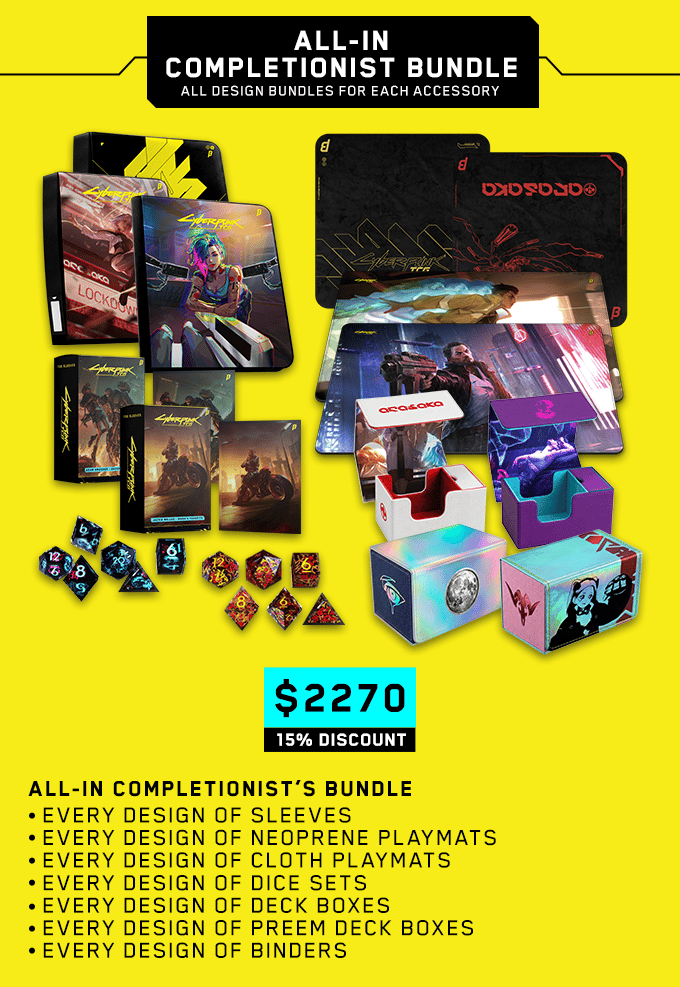
72 hours before the finish line, the numbers feel like abstract art. Over 21.4 million US dollars. More than 33,900 backers. The most-funded TCG in Kickstarter history, by a clear margin. Then Update #32 drops with the headline „Final 72 Hours: We’re Going All-In With Accessories!“, and suddenly new bundles flicker across the page: the Completionist Bundle for 2,270 dollars, the All Dice Bundle for 427 dollars, two new Premium Deck Boxes featuring Rebecca and Lucyna. Fifteen percent discount everywhere. Clock ticking everywhere.
The comments start doing what Kickstarter comments always do. „Great, keep promoting this for the 1%“, writes a user named Harrow. „This kickstarter is for rich people“, adds a Superbacker named Jan. „Too broke for this, but +1 for more options for people“, notes Todor Ivanov without a trace of irony. And between all the „Shut up and take my money“ posts, Christoffer Schor states quietly: „Great with all this bundle, but it’s to expensive.“ Read that again. He’s staying with his current pledge. He’s letting the new bundles go.
This is the moment the vibe shifts. Up to this point, the campaign has been a triumphant success story: broken records, sold-out premium tiers, a CDPR license legitimizing the hype. From here on out, it becomes a pricing conversation. And pricing conversations are more uncomfortable than record-breaking, because they force you to ask whether the accessories marketed as „discount bundles“ are even priced fairly to begin with.
For European backers, a second question piles on top. What does all this stuff actually cost once it lands in Germany? And how does that compare to the premium accessories every TCG store already has on the shelf?
The finding: more expensive than it looks. In places you don’t spot on first glance. The plain USD-to-euro conversion systematically underestimates the final price for European backers: 19 percent import VAT gets added via the pledge manager, shipping gets calculated only there. WeirdCo states this clearly on the campaign page: „You’ll also pay for shipping, as well as any regional sales tax or VAT associated with your final pledge amount.“ The model is DDP: Delivered Duty Paid, WeirdCo collects the tax directly, no post-delivery customs scramble with the DHL driver. For the Completionist Bundle, that concretely means: 2,270 dollars become, after shipping estimate and VAT, around 2,734 euros landed. 650 euros more than the naive conversion. Only the two highest tiers (Afterlife Package and Night City Legend) ship free; everything else adds shipping on top. We’ve walked through the landed-cost mechanics for Kickstarter orders from the USA in more detail elsewhere; the summary sits here so the follow-up math rests on solid ground.
This article was originally written in German and translated to English with AI assistance, reviewed by the author. For the original German version, use the language switcher.
- What This Text Is Actually About
- The Market Comparison WeirdCo Doesn’t Offer
- The Partner Trick: Dragon Shield Ships, WeirdCo Prices
- Bundle Architecture as Cost Driver
- The Psychology: Anchors, Scarcity, Exclusion
- The Pledge-Over-Time Controversy
- The Lock-In Model: 90 Percent Refund, 10 Percent Captured
- The Counter-Position: Why Some Backers Still Find the Price Fair
- The Alternative: What 500 Euros Buy You Otherwise on the TCG Market
- The Retail Transition: What Happens After the Campaign?
- The Economics of Serialized Metal Cards
- The Ironic Punchline
- A Verdict Without a Verdict
What This Text Is Actually About
The interesting question isn’t whether the Netrunner Starter Kit at 415 euros landed costs more than the 349 dollars on the campaign poster suggest. The interesting question is what WeirdCo does in the final 72 hours with the accessory bundles. The Completionist Bundle at 2,270 dollars. The All Dice Bundle at 427 dollars. The new Premium Deck Boxes at 80 dollars each. The All Premium Deck Boxes twin-pack at 144 dollars. Fifteen percent discount here, ten percent there, clock ticking, „for all pledge tiers opened“. That’s the moment the campaign stops being a celebration and turns into a pricing conversation.
Each of these add-ons is, individually, a smaller transaction than the main pledge. An 80-dollar deck-box pair feels like pocket change next to a 2,799-dollar tier. Together, though, the Optional Buys can double or triple the cart of a Netrunner Starter Kit backer. That’s exactly what the Update #32 communication is tuned for. This text takes the add-on pledges apart: dice bundle, Premium Deck Boxes, Completionist, sleeve sets, playmats, binders. It compares the prices to the open market for licensed TCG premium, dissects the bundle psychology, and looks at the end to see whether the sum is what it’s advertised as: a „discount deal with 15 percent savings“. Or rather an aggressive pricing position that only works because the reference values don’t sit next to it.
The Market Comparison WeirdCo Doesn’t Offer
To figure out whether 2,734 euros for an accessory set is a lot or a little, you need a reference. WeirdCo provides that reference only partially. Single-unit prices for the Cyberpunk sleeves, playmats, and deck boxes aren’t prominently listed on the public campaign overview page. You have to click through the pledge flow and scroll through the Optional add-on sections to see them. The big discount banners don’t cite an anchor value. If you see the Completionist Bundle advertised with „15 percent discount“, you’re looking at a discount against a number you can only reconstruct after several clicks, and that’s not intuitively available for most backers who just read the bundle communication.
The way to compare works differently. You look at what market-available premium TCG accessories cost in the same quality class. Ideally in Germany, inclusive of VAT, on Amazon or at specialized TCG retailers. The result is a table the WeirdCo campaign carefully doesn’t show.
Deck Boxes: The Most Obvious Price Differential
For deck boxes, the MTG-licensed premium segment is clearly defined. The Ultimate Guard Sidewinder 100+ XenoSkin in the „Bloomburrow“ edition costs 29.52 euros inclusive of VAT on Amazon.de. The Flip’n’Tray 100+ XenoSkin Monocolor: 29.58 euros (RRP 31.64 €). The larger Arkhive 400+ XenoSkin with TMNT artwork: 52.72 euros. Want a true luxury piece? The Dragon Shield Magic Carpet XL sits at around 79 euros in the Green/Black version, the top-of-market premium with integrated playmat transport.
The Cyberpunk Premium Deck Box with Rebecca or Lucyna artwork costs 80 dollars. Bought individually as an Optional Buy, it lands in Germany at around 107 euros once shipping and VAT are factored in. Bundled with the companion box, the per-unit share drops to about 89 euros landed. In either case, the price sits far above what Ultimate Guard charges for a comparably sized, officially licensed premium product.
The math is uncomfortable. Against a UG Sidewinder 100+ XenoSkin MTG (29.52 euros), the Rebecca box standalone marks up 263 percent. Against the Flip’n’Tray 100+ (29.58 euros): plus 262 percent. Even against the larger Arkhive 400+ with TMNT license (52 euros), a 103 percent premium remains. Only the Dragon Shield Magic Carpet XL, a luxury outlier at 79 euros, sits comparatively close. And that’s a playmat transport system, not a standard deck box.
A detail that often gets lost in communication: the Cyberpunk Premium Deck Boxes include an integrated dice tower. That’s a design feature standard deck boxes from the major manufacturers don’t offer. You find comparable constructions in some Gamegenic models and from a few handcrafted boutique makers, priced in the upper two-digit range or into three digits. The dice tower feature justifies an upcharge. Not at the order of magnitude WeirdCo is taking, but there’s an upcharge to be made.
Sleeves: The Hidden Markup
For sleeves, the math is equally sobering, with a particular twist. Dragon Shield (WeirdCo’s sleeve partner, more on that in a moment) sells its Matte Art 100-count packs with official licenses on Amazon.de for 17.41 euros inclusive of VAT. For instance the Diao Chan variant from the Fantasy line. The Ultimate Guard Katana 100 MTG Bloomburrow costs 17.71 euros. Dragon Shield Matte Black in plain color as the base version: 13.95 euros. KMC Perfect Fit Hard, the Japanese premium segment: 8.42 euros. The premium-licensed 100-count sleeve segment sits stable between 14 and 18 euros.
For the Cyberpunk sleeves, no single-pack prices are prominently listed in the public campaign space. Grossly back-calculating the bundle math (Completionist Bundle 2,270 dollars, minus the known Premium Deck Boxes at 160 dollars MSRP and the dice at 474 dollars MSRP, distributed over an estimated 27 remaining items in sleeve, playmat, deck box, and binder categories) lands at an average per-item price of around 55 euros landed. For a 100-pack of sleeves. Against 17 euros in the open market at comparable quality. A markup of roughly 220 percent.
The plausibility of this estimate cross-checks. The Afterlife Package and Night City Legend each contain an „Accessories Bundle“ with one sleeve pack, one cloth playmat, one neoprene playmat, one deck box, one binder (only one design each). Per WeirdCo communication the bundle’s value sits at around 300 dollars, i.e. about 60 dollars per item on average. That confirms the order of magnitude: 55 to 60 euros landed per single item.
For comparative context, Pokémon helps. The official Pokémon TCG Elite Trainer Box retails at 49.99 dollars and contains 65 sleeves with character art, a dice set, a playmat, a deck box, and eight boosters. The accessory share makes up about 30 dollars. A Pokémon sleeve pack with Charizard art runs around 8 to 12 dollars. Licensed artwork from the strongest IP in the world, markedly cheaper than Cyberpunk TCG sleeves.
Playmats: Closer to Market, but Not Close Enough
On playmats, the picture gets a bit more moderate. The Ultimate Guard Play-Mat for Magic: The Gathering „Edge of Eternities“ with Watery Grave artwork costs 21.17 euros on Amazon. The monochrome version without license: 16.23 euros. Dragon Shield Limited Art Playmats sit in specialty retail between 24 and 30 euros. Several variants are currently listed as „currently unavailable“ on Amazon.de, indicating seasonal sell-outs.
The Cyberpunk Cloth Playmat in the bundle lands proportionally at an estimated 40 euros: a premium of around 90 percent against the direct UG reference, and about 50 percent above Dragon Shield Limited. The neoprene variant (higher-grade material, thicker, more slip-resistant) sits slightly above that, at an estimated 45 to 50 euros. This isn’t outright gouging. It’s premium pricing with moderate license surcharge. Playmats are the category where the Cyberpunk TCG price level is most defensible.
One aspect that speaks for the WeirdCo playmats: the designs per WeirdCo’s own account come from prominent artists, some with signature lines. If the playmats include unique artwork (Johnny Silverhand in a specific pose, Rebecca in her characteristic gear), they carry an intangible value that exceeds pure material cost. An MTG playmat with standard-set artwork is universally available. A Cyberpunk playmat with campaign-exclusive art is not.
Dice: The Area That Still Makes the Most Sense
Dice are the area where the Cyberpunk TCG price most closely fits the premium market corridor. Dispel Dice, listed on WeirdCo’s official partner list as the dice supplier, sells its standard polyhedral sets on dispeldice.com for 70 US dollars per 7-piece set. The Iconic line and comparable premium designs cost 85 dollars. Liquid Core, the high-end segment, sits at 95 dollars. CHONK, the oversized D20 line, runs up to 215 dollars for individual pieces.
A single Cyberpunk Dice set, proportionally calculated in the bundle, costs about 106 euros landed. That corresponds roughly to what a Dispel Iconic-class set ordered directly from the USA costs European buyers after shipping and VAT. Consistent. But still more expensive than a licensed D&D dice set like „Icewind Dale: Rime of the Frostmaiden Dice and Accessories“, available on Amazon.de for 29.61 euros. The similarly equipped D&D Character Dice set „Witchlight Carnival“ runs at 22.69 euros.
For the Chessex floor comparison: a 12mm d6 36-count block in Gemini coloring costs 10.53 euros. That’s the budget version, no license, no special design. A Pound-O-Dice (mixed pack with 36 to 48 dice in random colors) costs 38.23 euros. Metal polyhedral sets with gold plating are available starting at 12 euros. That’s no-name gear but functionally usable.
The dice category is where the WeirdCo price is most transparent. Dispel Dice is an established premium label with publicly listed prices. The math works directly: want a premium acrylic set with exclusive Cyberpunk art? You pay around 106 euros landed in the WeirdCo bundle. Want a premium acrylic set with standard Dispel art ordered directly from the USA? You pay about 110 euros landed. Near-identical. The upcharge here is the license’s intrinsic value, not a margin distortion.
Binders: Closing the Gap to Market Prices
For binders, the picture comes full circle. The Ultimate Guard Zipfolio 480 XenoSkin MTG × TMNT with „Pizza Box“ artwork, a genuine license flagship, costs 59.05 euros. The smaller Zipfolio 360 with Bloomburrow license sits at 45.82 euros. The Vault X 12-Pocket Exo-Tec 480 in Teal (unlicensed but very high quality) runs 33.73 euros. The Dragon Shield Zipster Midnight Blue as an alternative: 33.78 euros. Ultra Pro Pokémon Ball 9-Pocket Pro Binder EX with license: 38.05 euros.
The Cyberpunk binder in the bundle, proportionally: around 65 euros. That’s the only category where the Cyberpunk premium remains moderate, just over 10 percent above UG’s license flagship, but around 90 percent above the cheaper Vault X or Dragon Shield alternatives. A result speaking for the binder: the artwork is exclusive, the size accommodates 480 cards, and the price lands at premium-once rather than premium-multiple.
A Kickstarter commenter, Craig Griffiths, raises a sore point about the binders: „Let’s do a Johnny Silverhand binder! Stop with the Lucy stuff and start giving us characters from the actual 2077 IP 😭“. The concern reveals a structural issue running through the campaign. The Edgerunners IP (Rebecca, Lucyna, David) gets played much harder than the 2077 IP (V, Johnny Silverhand, Judy). The marketing logic is understandable. Edgerunners has the younger, more active fanbase. But it comes at the expense of the 2077 purists who have waited since 2020 for TCG material.
The Partner Trick: Dragon Shield Ships, WeirdCo Prices
It’s worth a look at the partner list in the campaign description. WeirdCo expressly thanks: „SUMMONER, Netdeck.gg, Wild Blue Studios, Pulling Power Media, Backerkit, Dispel, Displate, CGC, Pvramid, Dragon Shield, Evoretro.“ The list reads like a peek behind the production curtain. Dragon Shield makes the sleeves. Dispel makes the dice. CGC grades the cards. Evoretro prints metal cards. Displate supplies metal posters. The rest are content and platform partners.
In plain English: the sleeves from the Completionist Bundle are Dragon Shield products. Dragon Shield sells the same product class (Matte Art Sleeves with licensed artwork) on Amazon.de. A 100-count pack with Diao Chan fantasy art costs 17.41 euros. A 100-count pack with, say, Rebecca artwork would, per bundle calculation, sit around 45 euros landed. Two-and-a-half times. Same manufacturer, same product quality, only different printing.
The upcharge doesn’t flow to Dragon Shield. The wholesale price is comparable in both cases. Possibly identical, because Dragon Shield provides the printing masters and the rest is standard production. The upcharge flows to WeirdCo, to the CDPR license, to Kickstarter and payment processor fees (together around eight to ten percent of campaign volume: five percent Kickstarter plus three to five percent Stripe), to BackerKit fees (a further three-and-a-half percent for pledge manager transactions), and to general campaign production costs.
Part of this upcharge is rational. Small-batch production is more expensive per unit than mass manufacturing. Exclusive artwork carries intrinsic license value. Items not available in regular retail have immaterial collector value. That justifies a 20 to maybe 50 percent surcharge against standard premium retail goods. Three- to four-fold pricing it does not justify. The rest is positioning, and the positioning only works because the single-unit prices remain out of sight in the public space.
In a German-speaking community discussion in a Cyberpunk TCG Discord server, the question gets sharpened. One participant, an experienced TCG retailer, argues that the price sits in the range of what custom deck-box boutique makers charge for handcrafted one-off products. Another pushes back: „Natürlich kommen die vom Fließband“ (of course they come off an assembly line). The Cyberpunk TCG deck boxes are industrially manufactured, not hand-glued. A third brings the point home: „Handmade heißt auch nicht zwingend Handmade.“ Handmade doesn’t necessarily mean handmade. The typical „custom“ deck box boutique sources semi-finished parts from large productions and assembles them in the backyard, with Cyberpunk artwork and a higher price tag.
That’s the core of the debate. Between „the price is premium-boutique level, so it’s okay“ and „the price is Chinaware with fancy printing, so it’s not okay“ lies a lot of argumentative space. Both sides have points. The Cyberpunk deck boxes are probably qualitatively premium. At this level of public scrutiny, WeirdCo can’t afford production sloppiness. But they’re not handcrafted; they come from specialized industrial manufacturing. The price sits more than twice as high as the premium segment of established brands. That’s positioning, not a production-cost markup.
Bundle Architecture as Cost Driver
An interesting detail hides in the tier descriptions that’s easy to overlook. The Afterlife Package at 2,799 dollars contains an Accessories Bundle, but only one design per category. One sleeve pack, one cloth playmat, one neoprene playmat, one deck box, one binder. Same for the Night City Legend at 7,999 dollars. If you actually want all sleeve designs, all playmats, all deck boxes, you also have to buy the Completionist Bundle for 2,270 dollars on top.
Sharper still: the Premium Deck Boxes with Rebecca and Lucyna are explicitly NOT included in the Afterlife Package or the Night City Legend. WeirdCo explains this in Update #32 with a „Kickstarter limitation“ (existing tier contents supposedly can’t be modified after the fact). Technically true. Economically it means: even the most expensive backers have to pay extra for complete accessory variety.
The full bill for a Night City Legend backer who really wants everything: 7,999 dollars for the base tier, plus 2,270 dollars for the Completionist Bundle, plus 144 dollars for the All Premium Deck Boxes Bundle. Sum: 10,413 dollars. Landed in Germany with the free-shipping rule applied only to the 7,999 tier and shipping plus VAT added to the two other bundles: around 11,700 euros.
For comparison, a complete premium setup from the open market. Six UG 100-count sleeves with MTG license at 17.41 euros each makes 104 euros. Six UG Playmats MTG at 21 euros each makes 126 euros. Six UG Flip’n’Tray 100+ XenoSkin MTG at 29.58 euros each makes 178 euros. Four UG Zipfolio 480 MTG × TMNT at 59 euros each makes 236 euros. Five D&D Icewind Dale Dice sets at 29.61 euros each makes 148 euros. Grand total: 792 euros.
The Cyberpunk TCG Completionist setup landed in Germany is three-and-a-half times that. Not one-and-a-half. Three-and-a-half. And that’s against licensed premium material from manufacturers also selling brand artwork, some even from producers WeirdCo itself contracts.
Brad Potter captures the bundle architecture’s effect from a satisfied-customer perspective in a Kickstarter comment: „I must say, you guys at WeirdCo REALLY know how to tease a campaign all the way till the end! GREAT marketing strategies, keeping people interested in new product all the way to the last tic of that clock. That said, sorta sad the Rebecca prem deck boxes isn’t available to afterlife tier…. im very torn on what selections I want to choose.“ The comment is unintentionally ironic. Recognizing the marketing mechanics and lamenting the exclusion in the same breath, but not thinking to opt out because of it.
The Psychology: Anchors, Scarcity, Exclusion
If the numbers are this clear, why does the bundle communication still work? Because the Kickstarter campaign activates a series of sales triggers simultaneously that look harmless individually and, in combination, strongly distort the purchase decision.
The first trigger is the discount anchor. The Completionist Bundle is marketed with „15 percent discount“. This suggests: a buyer purchasing individually pays 2,671 dollars. Grab it now, save 401 dollars. For a well-informed backer who clicked through the Optional add-on sections and summed up the single-unit prices, the math roughly works. For the much larger portion of backers who just read the bundle communication, the anchor value stays abstract. The discount isn’t fabricated, but it’s played against a baseline not prominently displayed in the main communication. That’s textbook anchoring: the reference figure gets claimed more than shown, and most readers internalize it intuitively without recalculating.
EU consumers should file this doubly. The Omnibus Directive (EU 2019/2161), implemented in Germany since May 2022 as the Preisangabenverordnung, requires that discount advertising in brick-and-mortar and online retail references the lowest price of the last 30 days. Kickstarter operates in a legal gray zone here (formally it’s a pre-order, not a retail sale). The Omnibus rule doesn’t directly apply. Psychologically, though, the buyer is triggered the same way as with a retail discount. A campaign ad with „15 percent discount“ against no verifiable baseline would face legal challenge in brick-and-mortar retail. In the Kickstarter context, nothing happens.
The second trigger is time pressure. „Final 72 Hours“ as update headline. „Prices will likely go up after campaign end.“ No concrete numbers. Just a hint creating the impulse to decide now, while there’s still time. In behavioral economics, this mechanism has been described since Cialdini’s work in the 1980s as „Scarcity“: scarcity increases perceived value, regardless of objective availability. In crowdfunding literature, the end phase of a campaign consistently ranks as the second- or third-largest funding wave after launch (an observation that Wharton researcher Ethan Mollick, among others, has quantitatively described for Kickstarter projects). The end-phase dynamic isn’t accident. It’s planned campaign architecture.
The third trigger is the opening to lower tiers. Until Update #32, the Completionist Bundle was supposedly reserved for higher pledge levels. Now it’s „open to all“. This sounds like a reward, like access to an exclusive option. Economically, it’s a classic revenue expansion: WeirdCo addresses the 14,577 Netrunner Starter Kit backers who haven’t yet invested in the accessory category, potentially doubling their cart.
The fourth trigger is the exclusion of the Rebecca and Lucyna deck boxes from the highest tiers. „Kickstarter limitation, we can’t change it.“ Effect: the backers already paying the most get pushed into another transaction. Anyone laying down 7,999 dollars for Night City Legend understandably also wants the two new Premium Deck Boxes. And has to add the 144 dollars to the bundle separately.
Great, keep promoting this for the 1%. Yall are really just catering to the rich at this point.
— Harrow, comment under Update #32
A fifth, more subtle trigger: the sleeve-priority question. A commenter named Squirrel Mob phrases the thought: „Wait so if someone buys something with all of the sleeves does that mean they take priority over people that will just be picking a design? If they are limited quantities and someone selects all sleeves but pay over time how does that balance out? Will they still take priority over other people even though they won’t access the pledge manager at the same time?“ Behind this is the fear of being left empty-handed with limited stock if you don’t book the bundle early enough. Manufacturing capacity constraints, WeirdCo calls it officially. That’s another scarcity dimension pulling the decision before the reflection.
Community reactions show the mechanics are working. And being noticed. „You guys at WeirdCo REALLY know how to tease a campaign all the way till the end“, writes Brad Potter almost admiringly. „GREAT marketing strategies, keeping people interested in new product all the way to the last tic of that clock.“ That’s the voice of a satisfied customer seeing through the mechanics and staying anyway. Not a critic. A few comments up stands Harrow’s sharper tone: „Great, keep promoting this for the 1%.“ Both observe the same phenomenon from different income brackets.
The Pledge-Over-Time Controversy
One aspect has taken on its own space in the update discussion: backers paying via the „Pledge Over Time“ (POT) option in three installments. WeirdCo communicated in Update #30 („Logistics & Shipping FAQ“) that POT backers may be fulfilled later than backers paying the full amount upfront. The rationale: manufacturing capacity is limited, limited accessory designs will be prioritized by payment arrival.
Community reaction was pointed. Animrumru writes under Update #30: „Considering the prices of a lot of the tiers and add-ons, encouraging backers that actually want to get their hands on what they want to avoid Pledge Over Time is certainly… a choice. Some of us don’t have as much liquid money to spend as others, so Pledge Over Time i the only way we can make it work. This introduction of essentially a ‚first-come, first-served‘ system here feels like a bit of a slap in the face to those of us who can’t afford to make one large lump-sum payment.“
Spellfire adds: „Very dissapointing to see that pledge over time (POT) backers will receive their stuff later compared to those who can afford the lump sum hit. Why is that? Gamefound stretch pay doesn’t have this issue, either with the pledge manager or delivery timelines.“
Pablo M. Bravo brings the economic point: „It feels to me that the priority will go to people that pay in full first and if they are unable to ship all in time then pot will be left for later. If we’re paying it, and finishing the payment months before, I don’t see why we need a disclaimer. What will happen if all express delivery pledge pay in full? Will be delays too?“
And Paul Downs suggests a solution: „Why not launch the pledge manager at the same time for everyone instead of effectively punishing POT pledgers? E.g. delay it till June when all payments complete.“
The debate is telling. It shows that the pledge design not only favors higher-income backers over lower-income ones (inherent to the tier structure), but that even within the same tier class, payment modality leads to differential treatment. POT buyers potentially get less or later. That’s economically understandable from WeirdCo’s perspective (cash flow management), but frustrating for the affected backers.
The Lock-In Model: 90 Percent Refund, 10 Percent Captured
A rule easily lost in the general enthusiasm also sits in the campaign page’s fine print: „After April 2026 and until the pledge manager closes: 90% refund available due to non-refundable fees collected by Kickstarter and payment processors.“
After campaign end, a backer only gets 90 percent of their pledge back if they want out. The 10 percent are non-refundable fees. Part goes to Kickstarter itself, part to Stripe and the payment processors. It’s industry-typical and legally unremarkable. But it has an economic consequence that combines with the rest of the campaign mechanics.
Anyone pledging 2,799 dollars for the Afterlife Package and later realizing they miscalculated loses 280 dollars on exit. For a Night City Legend pledge, that’s 800 dollars. Sunk cost raising the pressure to stay in, especially when the pledge manager first reveals the complete shipping rates and exact VAT calculation that could only be estimated during the campaign.
That’s the actual lock-in structure. You make the purchase decision under incomplete information (shipping unknown, VAT not yet concretely calculated, single-unit prices only visible after several clicks in the pledge flow), and when the information is later complete, exiting costs ten percent of the pledge. That forces a decision before the total price becomes fully transparent. Classic pre-commitment design.
Other Kickstarter TCGs (Sorcery: Contested Realm, Altered TCG, Wyvern, Flesh and Blood) work with similar policies. It’s not specifically unfair. What makes the Cyberpunk TCG case special is the combination: high pledge tiers, discount communication without a prominently displayed baseline, exclusion-driven cross-sell, and a refund policy pricing the exit.
A thought experiment: if WeirdCo had prominently displayed the accessory single-unit prices on the campaign’s main page next to the bundle offer, say in a table listing „Single: X dollars / In bundle: Y dollars / Savings: Z percent“, the discount would be immediately traceable for every reader. The buyer could do the math right there instead of piecing it together from Optional add-on sections. That the discount communication doesn’t take this route is no accident. The display hierarchy of single-unit prices versus discount banners is asymmetric. It favors bundle purchases and makes informed comparison harder.
The Counter-Position: Why Some Backers Still Find the Price Fair
A fair deep-dive has to take the other side seriously. Rational defenses of the WeirdCo pricing structure exist, and the strongest one was formulated by a commenter named Soylencer in a long thread under Update #32:
„If the premium on these accessories is subsidizing the startup cost and keeping the TCG prices below scalper-bait pricing, then so be it. It’s a shame that the hobby has become even more inaccessible for a host of reasons — notwithstanding the state of global affairs is making this stuff as, or MORE expensive than it was during the Four Horsemen of Boardgame Crowdfunding. I also concede that the accessories are far and away higher quality than they used to be — $2 sleeves and floppy boxes also long gone.“
Soylencer argues further that he’d rather see markup on accessories than on cards: „I just really hope that this pricing is made with the economics of production AND play in mind. Like $180 booster boxes. I know the world of $90 or even $120 Pokemon boxes is gone. I’d rather see mark-up on these accessories than on cards.“
The logic: if WeirdCo wants to keep booster prices below the 180-dollar boxes Pokémon and Magic now charge, the money has to come from somewhere else. Accessory buyers tend to be collectors with higher purchasing power and lower price elasticity. They’re willing to pay more because the object has emotional value for them.
This isn’t a weak argument. It describes a cross-subsidization model that works in many hobby industries: enthusiasts finance, with their premium purchases, the core products for casual players. If that’s true, 14,577 Netrunner Starter Kit backers benefit from the roughly 600 Afterlife and Night City Legend backers whose pledges also buffer the production risk.
Another rational defense comes from another Kickstarter commenter named Arasec, who contextualizes the prices: „Netrunner give you and Beta box that have some nice thing like rare cards and playmat. I think this is reason for higher price.“ And in another comment: „You can add Common Cyberdecks pledge + Booster display like addon. This will cost you 228$. Other option is Quickhack (169$) + 2 decks (29$ each) for total of 227$.“ Arasec demonstrates there are alternative paths to reach the Netrunner Starter equivalent more cheaply. You just combine rather than taking the preset tier.
In the German-speaking community discussion (both in comments and in Discord threads from local TCG groups), a similar tone surfaces. We’re talking about luxury goods in a luxury hobby, it goes. Through the Kickstarter structure, the items are categorized as exclusive. Of course they’re expensive. The new Premium Deck Boxes have an integrated dice tower, a design feature standard deck boxes don’t offer. And the small production run justifies a higher per-unit cost.
A counterargument that came immediately in the same discussion: handmade doesn’t necessarily mean handmade. Custom doesn’t necessarily mean one-off. The Cyberpunk TCG deck boxes are industrially produced, most likely in a specialized production facility in China or Eastern Europe. „Chinaware in fancy for the price“, as one participant sharpened it. The exclusivity comes from the artwork, the print run, and the distribution channel, not from manufacturing quality that an Ultimate Guard Flip’n’Tray or a Gamegenic Dungeon wouldn’t also deliver.
And one more voice to keep the piece honest: „I’m also team ‚it’s all too expensive‘ and am still considering picking up a playmat.“ That’s the archetypical buyer. The one who has intellectually grasped the price argument, who can do the math, and still feels the want-reflex. Argumentatively there’s little to do here. The artwork appeals, the scene pulls, the campaign is an event, and at the end the playmat’s in the cart.
This ambivalence is the actual subject. The price analysis delivers a clear answer (expensive, above-average markup). The purchase decision still runs on a different plane. That has less to do with irrationality than with what hobby economics always is: you pay not just for goods, but for belonging, ritual, anticipation, recognition. That’s legitimate. It just shouldn’t be sold as a „discount deal“ when it isn’t.
The Alternative: What 500 Euros Buy You Otherwise on the TCG Market
For readers wanting to skip the accessory category or who, after this calculation, no longer find the Completionist Bundle attractive, a glance at what the open TCG market offers is worthwhile. The Cyberpunk TCG cards are unique: you play them with what WeirdCo produces or not at all. The accessories, however, are universal. A sleeve fits any standard card. A deck box works with any deck. A binder holds 480 cards, regardless of TCG.
If you want to spend 200 euros for the starter equipment, you already get a solid basic setup. Two packs of Dragon Shield Matte Art Sleeves (34 euros), one Ultimate Guard Sidewinder 100+ XenoSkin MTG (30 euros), one UG Play-Mat MTG (21 euros), a Zipfolio 360 for 46 euros, a D&D character dice set (23 euros). Total: 154 euros. Enough for two complete decks plus collector binder plus playmat plus dice. All with officially licensed artwork.
If you want to invest 500 euros, you can double the setup: four 100-count sleeve packs in different artworks (68 euros), two Sidewinder deck boxes (60 euros), two UG Play-Mats (42 euros), a Zipfolio 480 XenoSkin MTG × TMNT (59 euros), two D&D character dice sets (46 euros), a Chessex Pound-O-Dice as a mix (38 euros), a Vault-X binder as a secondary folio (34 euros). Total: 347 euros, with reserve for additional specialty wishes. Maybe a Dragon Shield Magic Carpet XL as a luxury transport system.
If you want to spend 1,000 euros (realistic for an ambitious collector), you get close to the full setup of a power player. Six sleeve packs with rotating designs (104 euros), three Flip’n’Tray deck boxes (99 euros), an Arkhive 400+ as transport system (53 euros), four play-mats with varying licenses (84 euros), two Zipfolios with 480 slots each (104 euros), a luxury Dragon Shield Zipster binder (34 euros), three licensed D&D dice sets (69 euros), a Chessex Pound (38 euros), a Dispel Dice premium set direct from the USA (landed ~120 euros). Total: 705 euros, with headroom for upgrade items.
That’s a complete tournament and collection setup in premium quality, with officially licensed artwork from known IPs, from European retailers with standard return rights, no waiting period until delivery in Q4 2026. The difference to the Completionist Bundle: roughly 2,000 euros. That’s enough money to additionally finance a new PC, a trip, or three more TCG Kickstarters.
Of course: if you specifically want Cyberpunk artwork, you won’t get it on Ultimate Guard or Dragon Shield products currently. That’s the legitimate anchor of the WeirdCo price structure. The question is only whether the Cyberpunk artwork is worth a 250 to 400 percent surcharge, or whether the added value of an exclusive license would stay in the 50 to 80 percent range if you calculate soberly.
The Retail Transition: What Happens After the Campaign?
A question every backer should consider is the value of the purchased items in regular retail. The Cyberpunk TCG launches regular retail in October 2026. Starter decks, per first pre-order listings at German retailers like Tabletop Dragon, will cost between 25 and 29.99 euros MSRP. Booster displays presumably in the 120 to 150 euro range. WeirdCo hasn’t finalized that.
An open question is how the accessories will behave in the retail channel. The Rebecca Premium Deck Box cost 80 dollars on Kickstarter. In retail, if offered at all, it will probably cost 89 to 99 dollars. WeirdCo indicated in Update #32 that „prices for add-ons and bundles will likely increase after campaign end“. A typical post-Kickstarter price uplift sits at 15 to 30 percent. The bundle prices get adjusted accordingly.
That’s the rational argument for immediate purchase. Anyone booking the Completionist Bundle today at 2,270 dollars saves against a possible retail price of 2,600 to 2,800 dollars. 15 percent real against the future retail price.
That only works if retail prices actually rise that much. Historically, Kickstarter TCGs show mixed patterns. Sorcery: Contested Realm, for instance, maintained or increased retail and secondary-market prices after campaign success (booster boxes currently trade on TCGPlayer and eBay for double the former pledge price). Altered TCG showed softer price development (individual Beyond the Gates retail products have partially sat below the then-pledge level since launch). The blanket statement „retail is always cheaper“ doesn’t hold. The blanket statement „pledge discount always survives launch“ doesn’t either. The result depends on actual retail demand and on the speed at which the collector base consolidates.
A Kickstarter commenter named theJIG has done the math for himself and shares the conclusion: „Yah im back to waiting for possible retail release before blowing all this money on a brand new tcg…“ The decision to wait for retail release saves not only the 10 to 20 percent pledge premium. It also allows observing the player base and meta development before dropping 2,700 euros on accessories.
William K Shaw adds another aspect to the debate: „It’s not WeirdCo that would set the prices but your local LGS. I can tell you now that regardless of what mine would pay for the boxes, they would charge at least $10 a pack so it’s going to price people out right away.“ Local Game Stores have their own pricing, and if the campaign accessories land with them, the surcharge for end customers will come on top. From this perspective, Kickstarter exclusivity („only for backers“) is protection against LGS markup. For backers, the argument becomes: better now with 15 percent „discount“ than later at the LGS with 20 to 30 percent surcharge. The math holds if the premise holds.
The Economics of Serialized Metal Cards
One final price dimension deserves its own look, because it shapes the apex of the campaign architecture: the serialized metal cards from the Night City Legend tiers. Ten variants at 7,999 dollars each, every variant limited to 100 units, differentiated solely by the bundled serialized character metal card (V Streetkid, Goro Takemura, Adam Smasher, Rebecca, Lucyna Kushinada, David Martinez, Judy Álvarez, Johnny Silverhand, and two others). The entire 5,200-dollar upcharge over the Afterlife Package pays for exactly one serially numbered metal card. Landed in Germany: around 8,757 euros (free shipping on the tier, only VAT on top).
Mathematically, this is a classic collector-scarcity model. 1,000 units in total, across ten series of 99 numbered cards plus a zero-copy. As of mid-April, seven of the ten variants are completely sold out: Adam Smasher, Rebecca, Lucyna, David Martinez, Judy, Johnny Silverhand, and Goro Takemura. 700 slots, gone in the first campaign weeks. The V Streetkid variant sits at 8 to 31 backers (fluctuating hourly as people switch variants). Collector interest is strongly asymmetric: Edgerunners characters pull the fastest, the classic 2077 main cast right behind. The V Streetkid variant (ironically the protagonist of the original game) remains last.
In total, the ten Night City Legend tiers sit at around 820 backers as of mid-April. At 7,999 dollars per slot, that’s 6.55 million dollars in pledge volume from the 820 most expensive accounts alone. Nearly a third of the total campaign sum from 2.4 percent of the backers. A comment from Helljin on BoardGameGeek captures this with the rhetorical precision forum threads sometimes allow: „Almost 500 backers for the $8,000 pledge level…WTF?!?“ By now outdated; the number is significantly higher.
The secondary market for serialized TCG cards is its own topic. With the CDPR license behind it and an established IP, demand for these cards is likely to outstrip supply. Historical comparisons: serialized Pokémon cards from the Base Set era have reached prices of several thousand dollars on the collector market. MTG serializations from the Secret Lair line regularly sell for two to five times their original price. Whether Cyberpunk TCG serializations will behave similarly depends on the player base, continued marketing, and actual scarcity.
A BGG commenter named Wanjajoral addresses exactly this: „I do not see any reason for backing it — aside from maybe as an investment. So… back it if you want to collect some pretty cards or if you want to speculate on some financial return of investment, but I wouldn’t back it as a game.“ The read: the top tiers aren’t for players. They’re for speculators and collectors betting on value appreciation. And another BGG commenter, kampfhund, puts it more sharply: „I see it as typical cash grab using popular IP. The whole campaign page is full of ridiculously high pledge levels and overpriced add-ons. 7 rarity levels made me smile — apply basic statistics, and imagine what is your chance to get a ‚nova rare‘ from those 500+ $ pledges if each booster has only 2+ rare cards…“
The Ironic Punchline
For a game in the universe that tries to warn us about corporate overlords this marketing communication is getting waay too shareholder friendly, sus.
— Mopek, comment under Update #31
This thought runs through the entire debate and stands as emblematic for the reaction of a particular community corner.
The punchline lands. Cyberpunk 2077 is thematically an anti-capitalism setting. The story deals with corporate-driven exploitation, with marketing-induced needs, with a world in which Arasaka and Militech keep society under control through artificially scarce consumer goods. V, the player character, is a mercenary in a system that pulls the ground out from under ordinary people.
The official Cyberpunk TCG is marketed with a campaign architecture using exactly the mechanics the game universe thematically polemicizes against: anchor discounts without verifiable baseline, time pressure, cross-sell through exclusion, price-rise-after-campaign-end hints, lock-in through fee structure. WeirdCo’s marketing department could have learned directly from Arasaka. This isn’t a moral accusation. It’s only an ironic observation that shouldn’t be talked away.
WeirdCo isn’t unusual in the Kickstarter cosmos. Almost all major TCG crowdfunding campaigns of the past three years (Sorcery, Altered, a few smaller projects) use the same psychological triggers. What makes the Cyberpunk case special is the scale and the license. 21.4 million dollars is more than the four next-biggest TCG campaigns combined. A CDPR license is more than any random IP. The campaign gets attention beyond the TCG community, and it’s publicly celebrated as a success story without the pricing structure receiving a second examination.
Another BGG commenter, Yknits, summarizes the structural observation succinctly: „this project feels scalping adjacent at best. several different 8000 dollar pledges that come in groups of 100 is a very suspect.“ The read is harsh but has a logic: an IP gets milked via serialized limited editions in groups of 100. Each group generates 800,000 dollars. Ten groups make 8 million dollars. From the serialized metal-card structure alone, not from the core product.
And clearush counters with milder realism: „Any TCG based on wildly popular IPs will get the eyes of for profit flippers. They even tried to start YuGiOh the last couple months.“ Flippers are a structural factor in every successful TCG launch. WeirdCo can’t fully prevent them, but the question is whether the tier structure encourages or limits them. A 100-unit-limited 7,999-dollar tier with serialized cards is highly attractive for flippers. The value appreciation is built in.
A Verdict Without a Verdict
The question this text began with can now be cleanly answered. Is the Cyberpunk TCG pledge really as expensive as it feels? For European backers not just taking the base pledges but investing in the accessory category: yes. Measured against the open market for licensed TCG premium material on Amazon.de, the markup runs at 100 to 400 percent. Far above what an exclusive license and small-batch production economically justify.
The items themselves aren’t gouging. Dispel Dice, Dragon Shield, Ultimate Guard produce for WeirdCo or supply the product class WeirdCo sells. Quality will likely be solid. Print runs will be limited. The designs will in many cases be beautiful. The Rebecca deck box, the Johnny Silverhand dice, the neoprene playmats from the alpha kit have visual substance. The integrated dice towers on the premium deck boxes are a genuine feature justifying boutique-level pricing.
What’s expensive is the presentation. The discount communication against invisible anchors. The FOMO architecture. The cross-sell coercion drawing even the most expensive backers into additional transactions. The lock-in through refund policy plus opaque price structure. The delayed-reveal technique where the buyer first pledges and later learns what the individual parts actually cost. The POT discrimination disadvantaging lower-income backers both in timing and stock.
None of this is illegal. None is unique in the Kickstarter cosmos. But it’s aggressive price design that deserves honest contextualization in a campaign of this scale and public visibility.
Anyone still considering the Completionist Bundle now (72 hours before campaign end) should answer three questions. Do I really need all designs, or only two or three I actually like? If two or three, the bundle gets disproportionately more expensive because the cross-subsidized math no longer works. Am I willing to pay three to four times the premium market price for the Cyberpunk license on accessories? If yes, with a clear head, that’s a legitimate collector decision. Have I budgeted 2,700 euros landed, or am I planning with 2,100 euros and will I be surprised at the pledge manager?
Most backers won’t take the bundles. The backer distribution shows it: over three-quarters sit in the standard tiers. The Completionist Bundle is an offer for the other 20 percent who are in the premium category anyway. For them, it can work out. For the average Netrunner Starter Kit backer currently weighing whether to add another 2,000 euros, the numbers argue against. Argue strongly against.
And the irony (that a game about anti-corporatism is sold with aggressive corporate pricing psychology) stays. You can take it with humor; this exact irony is part of what makes the Cyberpunk universe so productive. V wouldn’t book the pledge. V would stick the cash into a cyberdeck and into a better weapon. The accessories come later. Maybe from an Arasaka heist.
Sources: Cyberpunk TCG Kickstarter campaign (WeirdCo) · Update #32 „Final 72 Hours: We’re Going All-In With Accessories“ · Update #30 „Logistics & Shipping FAQ“ · Update #31 „WeirdCrew Membership Club“ · BoardGameGeek thread „Should you back this game?“ · BoardGameGeek thread „Cyberpunk TCG on Kickstarter“ · Dispel Dice collections page · Own price research Amazon.de, Fantasywelt.de, Trader-Online.de (retrieved 14 April 2026) · German Federal Central Tax Office — Import VAT (IOSS) · Zoll.de — Imports from third countries

// KOMMENTARE (0)