Spessie, Burza, and CTCG’s Gwent Legacy
This is the English edition of a deep-dive originally written in German. The analysis, math, and editorial voice are ours — the translation was produced with AI assistance and reviewed by a human editor. If you spot an inaccuracy or an awkward phrasing, let us know via the site contact page. The original German version is linked at the top of every article.
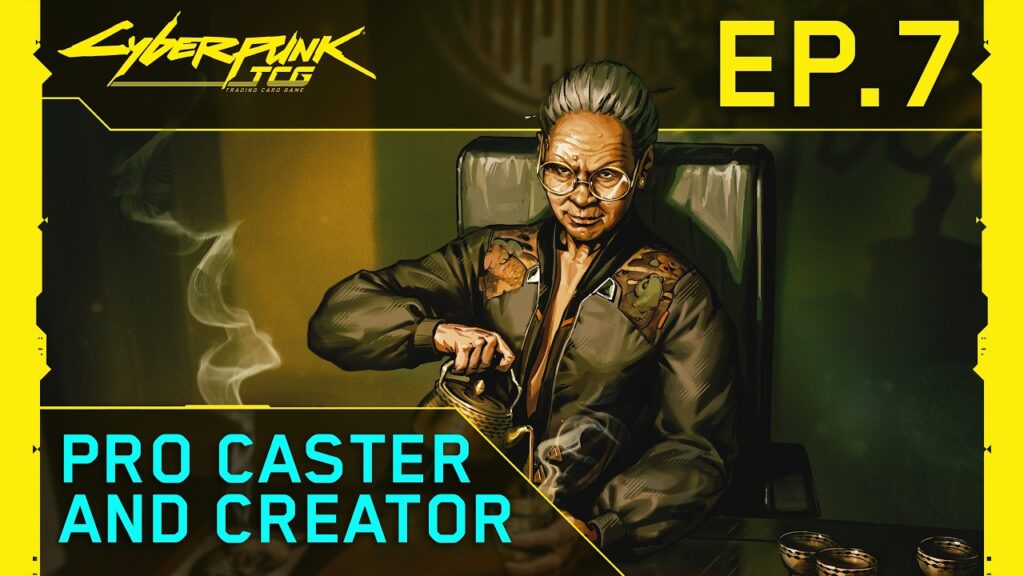
If you ever sat through a Gwent open in the late 2010s, you know Spessie’s voice. Maybe you didn’t know the face. Maybe you didn’t know the handle. But you heard the post-match recap, the slow drag back to the round-two pivot, the „and here’s where it all changed“ walkthrough that turned a card game into a story you actually wanted to follow. Episode 7 of the Cyberdeck Podcast puts him on a couch at WeirdCo with an alpha kit in front of him, a Goro Takamura figure beside him, and one of those opening lines you can’t unhear.
„My first ever card game was Gwent. That’s what really started my obsession with card games.“Spessie, Cyberdeck Episode 7
Read that twice and you can already feel the shape of the episode. There’s no marketing arc. There’s no „this is the Gwent successor“ pitch. There’s a tester who came up through Gwent’s first wave — closed beta from October 2016, open beta from May 2017 — saying out loud that the entire reason he ever picked up a card game was the one CD Projekt Red is now sunsetting in community-patch mode. And he’s saying it on a podcast hosted by the man who used to host the Gwent opens he watched.
That’s the configuration. Spessie at the alpha kit. Pawel „Burza“ Burza behind the mic, still Senior Communication Manager at CD Projekt Red, hosting a podcast for a Cyberpunk Trading Card Game made by WeirdCo. Cree „Kawa“ Gunning between them, a longtime casting partner from various other TCGs, now working at WeirdCo. Three TCG lifers around one table, and the only thing connecting all three of them isn’t a studio, it isn’t a contract, it’s a memory of how Gwent felt in 2017 and how it felt in 2024 when the official esports line ran out of fuel.
Treat that memory as decoration and you’ll miss the episode entirely. What Episode 7 actually does — slowly, almost reluctantly — is show you how a dead game makes a new game possible. Not through a designer migration. Not through a „we took the cards and renamed them“ lift. Through the slower, weirder route where the same person carries the institutional memory of Gwent’s worst meta crisis, its mid-life rebuild, and its sunset communication failure, and uses that memory as a co-production axis on someone else’s TCG.
Listen to it once and it sounds like a friendly tester chat. Listen to it twice with a notepad and you’re hearing a curated genealogy of design decisions, told by people who don’t have to explain their qualifications because the qualifications are in their voice. Let me walk you through it.
Who’s actually at the table
The first thing to clear up, because half the internet keeps getting it wrong: Pawel Burza is not „the ex-CDPR guy doing his own thing now.“ He never left. He’s still Senior Communication Manager at CD Projekt Red. The Cyberpunk Trading Card Game is being made by WeirdCo, a separate studio operating under a Cyberpunk IP license, with Burza hosting the Cyberdeck Podcast in what amounts to a co-production role. Same job, same studio, two parallel game universes — one being phased out, one being built. That distinction matters because every mechanical claim he makes in this episode lands differently if you understand he’s not selling a successor, he’s communicating a co-production.
Spessie comes from the audience side. He was in the closed beta wave. He picked up a Twitch channel that grew tied to the game. He cast Gwent Masters seasons through to the final season in December 2023, then kept casting other TCGs after that. When you ask which path led him onto the Cyberdeck couch, the line he draws himself is simple and a little wistful:
„Watching BJA here on Twitch being like the host of many Gwent opens when I was uh before I started even streaming many many years ago.“Spessie on Burza, Cyberdeck Episode 7
BJA is an old Twitch handle. The episode doesn’t expand on it. The point isn’t trivia, it’s the time axis. Spessie watched Burza host Gwent before Spessie ever sat behind a mic. Years later, the same Spessie who learned how casting works partly by watching Burza now ends up on a podcast hosted by Burza, testing a card game that pulls explicitly from Gwent’s design vocabulary. The distance between caster’s chair and host’s chair isn’t ten years here, it’s effectively zero.
Kawa, sitting in the third seat, sketches their own timeline in one line:
„Before I joined Weirdco I actually was uh I did a lot of professional casting with you on various different TCGs.“Cree „Kawa“ Gunning, Cyberdeck Episode 7
That’s the entire confirmed backstory. No LinkedIn archaeology, no speculative studio paths. Kawa cast TCGs alongside Spessie, joined WeirdCo, now co-hosts Cyberdeck. The personnel point is what matters: when a single episode brings together three voices whose careers all run through the Gwent broadcast scene, that isn’t random guest selection. That’s editorial choice. The conversation we’re hearing isn’t a marketing accident, it’s a curated room.
And the room carries the rest of the episode in ways you wouldn’t catch on a first listen. When Burza explains the RAM system, his explanation lands precisely because he was the one communicating provision in 2018 when CDPR rolled it out as Homecoming. When Spessie reacts to the Eddi asymmetry, his reaction carries weight because he sat through the coin-flip frustration era in Gwent as a caster — meaning he watched pro players visibly unhappy in front of his own camera. When Kawa moderates, the rhythm sounds practiced because Kawa and Spessie have done this together before, in other broadcasts, on other games. None of that is the marketing value of the episode. It’s the structural foundation that makes the mechanical claims land.
One last clarification before the mechanics, because it gets garbled online: in the same window CDPR was scaling down Gwent — December 2022 sunset announcement, roughly 30 Gwent developers laid off in 2023 per Hitmarker’s reporting — the studio also publicly redirected another card-game-adjacent project. That was Project Sirius, the Witcher multiplayer spinoff at The Molasses Flood, rescoped in May 2023. Sirius was a Witcher project, not a Cyberpunk one. Anyone framing it as a CTCG predecessor is constructing a strawman. The relevant context is broader: CDPR was reorganizing several card-game and multiplayer tracks in parallel during this period, and the personnel lessons from that phase condense today into one voice on the Cyberdeck mic. Burza’s.
RAM is provision wearing a new badge
If you only listen to Episode 7 once, you’ll probably miss the central mechanical statement of the entire conversation. It comes between two tester reactions, almost in passing, in that calm Burza tone that gave the old Gwent streams their recognizable rhythm:
„When we were working on Gwent initially I remember we had slots kind of in terms of deck building for like gold, silvers, and then bronzes. But then as the game evolved uh our game designers they also needed another lever lever to kind of pull on. So that’s when we introduced the provision system.“Pawel Burza, Cyberdeck Episode 7
That paragraph is the key. He isn’t explaining a new game to Spessie. He’s telling the prehistory of the lever Cyberpunk TCG now uses under the name RAM, and he’s telling it from the memory of the man who had to communicate the original switch in 2018.
For anyone who dropped out of Gwent before the rebuild, here’s the historical bit. Until the Homecoming update on October 23, 2018, Gwent decks were assembled out of three rarity buckets: Bronze (multiple copies allowed at standard counts), Silver (six slots per deck), and Gold (four slots per deck). That’s the right number — six silvers, four golds, not the inverse you’ll occasionally see misquoted in old forum threads. It was a hard slot model. Designers controlled power level mainly through rarity assignment: a strong card got bumped into Gold, a weaker one stayed in Bronze. That works as long as the power range stays narrow. Once the design team needed finer balancing pressure, the model started to feel coarse — four Gold bombs and six Silver heroes can’t really fine-tune a 25-card Bronze cushion at any meaningful resolution.
Homecoming brought provision. TechRaptor’s October 2018 preview caught the change cleanly: decks now had a maximum provision budget of 165 points across 30 cards, each card assigned a provision value reflecting its potential strength. Stronger cards cost more from the budget. Weaker ones cost less. The Gwent wiki’s patch breakdown for October 23, 2018 documents the structural changes in detail. The design effect: a continuous spectrum instead of three discrete buckets. A lever the designers could pull at much finer resolution.
Read that history and Burza’s „another lever to pull on“ reads as exactly what it is — a man describing his own communication memory from seven years ago, then stitching it forward into how WeirdCo’s RAM system works in 2026. He never says „we copied Gwent’s provision.“ He says something far more precise: the same problem Gwent had, the lever that solved it back then still works.
The community deck guides you can still find on LerioHub describe Gwent’s provision logic as more than a mana stand-in. It’s a design language. If you want a strong card, you accept something weaker elsewhere. If you want to stuff a deck with bombs, you have to find creative cuts because the budget runs out. That’s the same language CTCG inherits, and Spessie — testing it for the first time — reacts to it with a prediction that reads like a direct answer to Burza’s memory across a decade-long gap:
„There’s like one card game where you can play any uh color card in any deck, but you have to pay like an additional cost … in this game, because of the RAM system, your sort of like generically best cards on average are going to be very heavy on RAM cost. So I think it’s just going to result in a lot of diversity.“Spessie, Cyberdeck Episode 7
Spessie is taking an indirect swing at Magic: The Gathering’s hybrid mana and triome systems, where the „permission“ to play a color gets paid out in tempo costs. His point: RAM does the same thing in CTCG, but along the power-level axis instead of the color axis. The cards your deck most wants are RAM-heavy by definition. Anyone trying to build „all bombs“ runs into the legend-RAM coupling (more on that in a second) and into the simple resource math of the early Eddi turns.
His diversity prediction is, on closer inspection, a testable thesis rather than a euphoric claim. You can only assess it after six to twelve months of live meta. That’s exactly where the value sits. It’s datable, falsifiable, and it comes from a tester who knows like few others how a deckbuilding lever in a live meta either generates variety or smothers it. Spessie’s bet is that RAM generates variety. His evidence: provision pulled it off in Gwent once the scaling was found. Burza remembers that scaling. They agree without having to spell it out — the lever works.
Why does the comparison to other 2026 TCG markets matter? Because the Western TCG market right now doesn’t have a lot of games stretching a provision-style lever across the entire deck size. Magic runs on a mana curve and land math but not a global deck budget. Lorcana has a 60-card deck size and an ink system that gets negotiated fresh each turn, not at deckbuilding time. Pokémon TCG paces through energy attachment per turn rather than budget allocation across the whole list. Other 2026 TCG launches are still in early stages with too few finalized mechanics to compare against meaningfully. CTCG’s RAM system, in 2026, sits relatively alone in the physical TCG market — and its direct ancestor is Gwent provision. Genealogy, not imagination.
Legends are leaders, minus the fireworks
Spessie does something in this episode that rarely happens cleanly in tester conversations. He translates a CTCG mechanic directly into the Gwent vocabulary he grew up with:
„Leader type cards starting in your Eddie area as mana essentially.“Spessie on CTCG legends, Cyberdeck Episode 7
The article only has to let that sentence stand. What Spessie sees: CTCG legends are functionally leader cards — the central deck identity, the archetype anchor, the strategic spine — but they’re embedded in an architecture that no version of Gwent ever had.
To appreciate the difference you need a quick recap of Gwent’s leader history, because that history itself has two clean phases. In the pre-Homecoming era (closed beta 2016 through October 2018), leaders were cards on the playfield edge with a powerful once-per-match ability. You clicked the leader once. It fired. That was it. A single dramatic action that could tip the match in a decisive round. The design weakness was binary: either you found the right round to fire it, or it fizzled.
Homecoming brought the second leader generation. Charges-based abilities replaced once-per-match buttons, sometimes playable across multiple rounds. That fixed the binary problem but layered in new complexity — leader charges had to be factored into tempo planning across the whole match. Both models are in Gwent’s documented history. Both have their fans.
CTCG takes a third path, and Spessie’s „leader type cards starting in your Eddie area as mana essentially“ describes it precisely. Legends aren’t playfield-edge buttons. They’re cards in your Eddi zone you pay for like any other card to activate. Once-per-match pyrotechnics disappear. A legend isn’t a trigger sitting outside the play area — it’s a strategic element belonging to the same Eddi resource that flows along with match tempo.
The design effect is substantial. In Gwent you constantly asked yourself: when do I fire my leader? Which round? In CTCG you ask: which legend do I build into the deck, and what does that mean for my RAM math? Because — and this is where the conversation gets dense — legends and RAM are coupled. Richard Zapp, Head of Game Design at WeirdCo, explained in Cyberdeck Episode 5 that picking, say, two red legends constrains the RAM ceiling of your remaining 40-card deck to a specific value. Legend choice isn’t „which special ability lights up per match.“ Legend choice is „which deckbuilding scaffolding becomes available to you at all.“
Stack that on top of provision-style budgeting and you get a second design layer Gwent didn’t have. Gwent’s provision and Gwent’s leader choice were related but largely independent budgets — leader was faction-bound but didn’t compress the provision math. CTCG fuses the two. Your legend choice determines how much RAM-heavy power you can fit into your 40 cards. Mathematically more interesting deckbuilding, mechanically less per-match pyrotechnic pressure. You’re no longer building „a deck plus a bomb.“ You’re building a deck where the bomb is the scaffolding.
Compare against other leader architectures and you can see how unusual the fusion is. Hearthstone had heroes with hero powers — a once-per-turn special ability that simultaneously locked in deck identity (Mage, Warlock, Druid, etc.). But hero power and deckbuilding caps were decoupled. Pokémon TCG uses Trainer cards and Pokémon Powers but has no central leader card affecting deckbuilding volume. Magic’s closest analogue is the Commander format, where a Legendary Creature defines color identity — conceptually nearer to CTCG legends than anything else, but Commander still doesn’t couple mana curve volume to commander choice, only color permission.
CTCG’s interlocking of legend choice and RAM budget is its own design idea, expanding Gwent’s provision logic along an axis Gwent never used. Want to build a 40-card list with a high share of RAM-expensive cards? You need the right legend configuration as a precondition. Want to spread your curve wide? Different legend pick. That shifts deckbuilding from „which cards thematically fit together“ toward „which curve distribution can be built under this legend at all.“ Tournament players know that constraint from MtG Standard banlists or Commander color identity, but a mainstream TCG making it a core mechanic is rare in 2026.
What Spessie likes about this architecture — what the conversation suggests without spelling it out — is the abandonment of once-per-match drama. If the match doesn’t depend on a single button-press decision but on continuous Eddi resource management with the legend playing along, the format has a different strategic distribution. Casts will look different. Less „the one big moment,“ more „a sequence of medium-sized decisions whose sum shapes the match.“ Whether that’s better or worse is a matter of taste. That it’s different is a design fact.
A small historical footnote, because it sharpens the comparison. Pre-Homecoming Gwent had famous leader trade-offs: King Henselt with the Kaedwen faction buff, Eredin with Wild Hunt synergy, Foltest with the Temerian boost. The leader signaled faction identity, but the deckbuilding volume — six Silver, four Gold — was faction-independent. Post-Homecoming, the faction bindings softened under provision; you could pick a leader whose charges opened different play styles, but the provision math stayed the same across factions. CTCG pulls both logics together. The legend is faction identity (subtype, archetype) and at the same time it changes the curve budget. Packing that dual function into one card is design-tight. And design-tight is the kind of thing that either makes a game tournament-ready or breaks its neck. Which outcome waits here, only the live meta will say.
Coin-flip trauma and the Eddi answer
At one point in the episode Burza gets unusually direct. He tells a story every older Gwent player knows but rarely hears so cleanly from an insider:
„We had a coin flip mechanic. Um and it kind of uh there was there was this one point where the game people felt like the game was kind of solved already because of the coin flip.“Pawel Burza, Cyberdeck Episode 7
For anyone who wasn’t in the Gwent beta, here’s the quick context. Gwent matches were best-of-three rounds: whoever won two of three rounds won the match. The coin flip at the start decided who drew first. In certain meta phases — especially the Midwinter update window from late 2017 into mid-2018 — a perception developed that the coin flip had outsized impact on match outcomes. Some decks reliably won going first. Others reliably won going second. The community started calling the game „solved,“ and what they meant was that the most important decision of any match landed before the first card draw.
Spessie remembers what came next:
„You guys like almost like totally redesigned the game um where like the meta in Gwent almost broke the game.“Spessie, Cyberdeck Episode 7
That’s the Homecoming rebuild of October 2018, which restructured Gwent from the ground up. Polygon’s later sunset coverage mentions it in retrospect; the October 23, 2018 patch notes document the structural changes. Among them was the „Tactical Advantage“ system: the player who drew first got a points bonus on their final score in the first round. That was Gwent’s answer to the coin-flip trauma.
Spessie’s verdict is unusually open:
„CD Project did such a brilliant job of balancing it where there’s so many decks that want to go first now.“Spessie, Cyberdeck Episode 7
If you hear that on a tester episode for a Cyberpunk TCG, you know Spessie isn’t sweet-talking the host. He’s describing a design experience from years on stream. Tactical Advantage fixed the coin-flip problem so well that decks started getting built that wanted to go first. The asymmetry went from a bug to a feature — one of the cleaner design recoveries in modern card-game history.
Burza places the CTCG solution against that backdrop:
„First player starts with two of their Eddies spent … the second player starts with four eddies. So like playing a four cost card versus playing a two cost card. That’s a big difference.“Pawel Burza on the CTCG Eddi asymmetry, Cyberdeck Episode 7
Cyberpunk TCG carries the lesson from Gwent’s coin-flip trauma forward instead of repeating it. Rather than building a downstream points correction the way Tactical Advantage did, the designers bake the asymmetry directly into the opening. Whoever draws first opens with two Eddies. Whoever draws second opens with four. That’s a drastic numerical asymmetry. The going-first player gets the initiative advantage — earlier board pressure, first chance to attack a gig — while the going-second player gets a substantial tempo gift in the opening, able to deploy a 4-cost card against a 2-cost one.
Compare across the rest of the TCG market and the architecture starts to look harder. Magic compensates the going-first advantage by skipping the going-first player’s first card draw — a weak compensation, since it only addresses card advantage, not tempo. Yu-Gi-Oh lets the going-first player build freely but bans first-turn attacks — a tougher solution that’s been controversial through the modern combo era. Hearthstone gives the going-second player an extra card plus „The Coin,“ a 1-mana resource that softens the early-tempo gap. CTCG’s Eddi asymmetry is conceptually a much harder version of Hearthstone’s Coin idea — the same logic, but turned up.
Reconstruct the reasoning carefully and the picture sharpens. Burza wasn’t the man who designed the Gwent coin-flip crisis (he was communication, not game design), but he was the man who communicated it. He hosted open streams where pro players sat in front of his camera visibly unhappy about supposedly unfair coin-flip outcomes. He sold the Tactical Advantage solution to the community alongside the design team. When that man explains the Eddi asymmetry today as a deliberate design choice, sitting at the table with him is the institutional memory of every going-first frustration tweet of the Gwent beta. That isn’t anecdote. That’s the kind of memory you only build by living through a meta crisis as the public-facing voice of the studio.
Spessie validates the architecture indirectly by calling Tactical Advantage „brilliant“ and then moving on to play with the CTCG Eddi asymmetry without complaint. Which solution is more elegant — Gwent’s downstream points correction or CTCG’s pre-baked asymmetry — only the live meta can answer. Spessie’s reading is clear: both work. Which works better depends on whether the community feels the going-first tempo gap as an exciting puzzle or a frustration loop.
One more axis worth pulling out. CTCG didn’t even keep Gwent’s best-of-three round format. The Eddi asymmetry applies to a single match, not three nested rounds where the going-first player can pass round one to bank cards for round two. The best-of-three architecture was itself a coin-flip amplifier in Gwent, because the going-first player could choose tactically when to cash in the advantage. CTCG sidesteps the amplifier by simply running one match: one game, one asymmetry, one winner. The cleaner format isolates the design problem instead of stacking it.
Curve, sellable cards, and what 40 does to your hand
There’s a moment in the episode where Spessie talks about the practical side of his testing, and the line lands with the texture of a TCG insider who knows his tools:
„I will yeah be trying to actually keep as I will try and keep my cable count as low as possible so that I can safely mulligan again.“Spessie on cable management during mulligan, Cyberdeck Episode 7
Cables are the resource cards in CTCG — functionally close to mana sources, but inside an architecture where you can manipulate them actively. Spessie’s discipline sounds counterintuitive at first. Who’d voluntarily hold few resource cards? But the argument is subtle: if you want to mulligan again during the mulligan phase, the cards you keep have to be „safe“ — meaning cables you can afford to lose or trade on the next swap. Hold too many cables in hand and you’ve gambled away your mulligan capacity, because every additional swap raises curve risk.
That math is a direct function of the 40-card deck size. In a 60-card list (Magic, Lorcana), the mulligan math softens because the statistical spread is wider. In a 30-card list (Gwent, Hearthstone), it tightens, but the format compensates with other levers — Hearthstone’s per-turn mana ramp, Gwent’s provision budget. 40 is the middle ground, and Spessie’s point is that this middle ground in CTCG demands a mulligan discipline he brought over from Gwent experience, with the additional variable of cable-quantity control layered on top.
He’s just as direct about what CTCG deliberately doesn’t have:
„Not having too many draw options, I think is is also healthy and good. And also not having too many tutors cuz I feel like there are a lot of card games in the in the space where are just about like like let me tutor for this, let me t for that.“Spessie, Cyberdeck Episode 7
Tutoring in TCG-speak means cards that fetch other specific cards from the deck. „Tutor for this, tutor for that“ describes a design trend in some modern TCGs where deckbuilding degrades into a search template — you build a 60-card list where ten cards find the other fifty. Spessie reads that as a design weakness: the gameplay enjoyment shifts from „I draw and react to what I get“ to „I plan a deterministic search path.“ CTCG’s restraint on tutor effects (per Spessie’s tester impression) keeps the stochastic layer high — and with it the necessity to actually master curve and mulligan.
Sellable cards are the other practical element here, and Gwent didn’t have an exact equivalent. A sellable card you can — instead of playing it — trade for an Eddi resource or an effect. That’s a tempo valve. If you’ve got a card in hand that no longer fits your current curve plan, you sell it and gain a resource or another action. The classic „dead card“ problem shrinks: every card has at least a secondary value.
What this looks like in practice, Spessie demonstrates indirectly by building his game around cable discipline. He doesn’t think in single turns. He thinks in curve sequences where mulligan, cable selection, sellable timing, and RAM distribution flow together. That’s tournament thinking at tester level. And it’s exactly what makes an episode like 7 valuable — when an experienced caster reveals his own play pattern live, listeners learn what actually goes through someone’s head behind the scenes of a match decision.
Anyone who wants to replay this in 2026, when the cards finally ship, won’t get far without tournament equipment. A play mat with clear zone layout (Eddi area, RAM cards, sellable stack, hand reserve) turns table chaos into a readable architecture, and on a decent TCG playmat you can actually pull off Spessie’s cable discipline cleanly without hunting after every mulligan for where which card belongs. Anyone who played against unstructured tables back in Gwent times knows the gap between „I see my curve“ and „I hope I see my curve.“ With 40 cards plus an Eddi zone plus a legend slot, that gap matters operationally.
What makes the combination of 40-card decks, sellable mechanics, and legend-RAM coupling a unicum in the Western TCG market in 2026 isn’t any single ingredient. Lorcana has ink. Magic has mulligan rules. Pokémon has energy pacing. But the coupling of all three — medium-sized curve, tempo valve through sellable, deckbuilding gated by legend RAM — doesn’t exist in this combination anywhere else. Spessie’s diversity prediction hangs on exactly that coupling. If it works, we’ll see a broad meta in six months. If it doesn’t, you’ll see Spessie come back on a future episode and dissect it with the sharpness his casts have always had.
Daily Discord, or what Gwent’s silence taught one person
If you followed the Gwent sunset arc from 2022 to 2024, you know exactly where the wound sits. In December 2022, CD Projekt Red announced the end of active Gwent development. Polygon reported the transition into community-led patch mode from mid-2023, the famous shift to „Gwentfinity.“ PCGamer covered the timeline in detail, and CDPR walked through the phase-out in an official 2023 roadmap. In the same window, Hitmarker reported roughly 30 Gwent developers were laid off. In May 2023 the Witcher multiplayer spinoff Sirius was publicly redirected.
What lay between those dates, for the players who were still around, was a phase where Gwent fans felt cut off. Patch updates grew rarer. The official Discord channel dropped frequency. The once highly professional esports season ended with Gwent Masters Season 5 in December 2023. Casters like Spessie stood in front of one of their final casts knowing that the game format would live on afterward in a thinning supporting communication. That experience — a living game whose communication apparatus is gradually shut down around it — is formative. You don’t unlearn it.
Hold that in your head and the CTCG communication line in Episode 7 reads differently:
„We’re trying to do things a little bit differently. We’re trying to be, you know, extremely communicative with the with the audience, with our fans. Uh, you know, we’re we’re in Discord every single day answering people’s questions.“Pawel Burza and Cree Gunning, Cyberdeck Episode 7
On a first listen that’s the kind of PR-speak you hear at every Kickstarter game. On a second listen it’s more specific. „We’re in Discord every single day“ is a hard operational claim that can be falsified — there is a Discord channel where the statements are countable, where designer response times are traceable, where testers like Spessie himself read along actively and know whether the claim holds.
Burza in the episode also surfaces something Richard Zapp had said publicly in that channel:
„Games in our play testing have rarely gone to overtime, which is a great sign in my opinion.“Richard Zapp, quoted by Burza, Cyberdeck Episode 7
Notice the operational density. The Head of Game Design publicly discusses on Discord his observations about match length from internal playtests. The communication manager picks up those Discord statements on the podcast. The external tester sits in the same channel and can react. There’s no communication barrier between designer discussion, host mediation, and tester feedback — the three axes lie on top of each other like sheets on a light table.
Risk a thesis here, and acknowledge that it stays speculation: „daily Discord“ reads as a deliberate counter to the Gwent sunset experience. Whoever held the communication chair in 2022 and 2023 when a game transitioned from active to phase-out knows exactly what radio silence sounds like. The Gwent lesson, condensed in one person on the Cyberdeck mic, would be: a new game requires from day one the communication discipline whose absence you can’t make up later. That reading isn’t readable from press releases — Burza never spells it out — but it’s coherent with the personnel continuity, and it’s coherent with the operational footprint.
What still makes the claim fragile: „daily Discord“ as a USP has thin external anchoring in the 2026 CTCG press coverage. It lives operationally, it lives in the podcast, but it doesn’t live in a WeirdCo press release pinning it down as a marketing promise. Burza’s own tweet around Episode 6 (Clark, the community manager) made the commitment more visible, but that’s still self-PR. Anyone wanting to verify the operational reality has to go to the Discord directly — and anyone who does, finds, currently, daily designer statements and community responses. The burden of proof still sits on the operative side, not the press release.
Compare against Lorcana, against the upcoming Riftbound launch, against other late-2020s Western TCGs and the standard shifts. Lorcana’s communication in 2025 and 2026 runs largely through official blog posts and tournament coverage; designer Discord presence is sparse. Riftbound is structured similarly — Riot-typical, with heavy press materials and lighter designer presence in the community channel. CTCG runs a different shape: narrower resources, but operationally present every day. Whether that’s the better strategy depends on how scalable it stays as the community grows. As a counter-bet to the sunset experience where exactly that daily presence was missing, though, it’s coherent.
Worth pulling another historical arc to Gwent here, because it makes the comparison concrete. In the early open beta months of 2017, CDPR ran a similarly dense communication culture. Burza was active in Twitch chat. Designers like Jason Slama (Gwent’s then game director) did regular interviews and answered Reddit threads. Patch notes were extensive and commented. That’s the phase that built the Gwent goodwill cushion the community drew on through the 2024 sunset year, even after official statements had long since collapsed in frequency. Communication culture is a reserve currency. What you invest today, you can draw on tomorrow during frustration phases. What you skip today, you’ll miss tomorrow when the cards run thin.
CTCG’s bet on running maximum communication density during pre-launch and launch fits this logic exactly. The episodes featuring designers like Zapp and testers like Spessie sitting on the couch right now aren’t marketing soundtrack. They’re the cushion the community will draw on in two or three years when the first expansion waves land, when the first balancing crises break out, when the first tournament dispute generates escalation pressure. Anyone able to call up grown trust in that later phase weathers crises differently from a game that only starts talking to its community when the crisis is already there.
The weak point of the thesis is scalability. A daily Discord rhythm is doable while Burza and the WeirdCo design team can still be personally present. Once CTCG has six expansions and 50,000 active Discord members, the „single point of contact“ character gets brittle. Lorcana went through exactly that scaling phase and largely stepped back from designer Discord presence. Riftbound dodges the question by Riot working from day one with a large communications apparatus. CTCG sits between the two approaches, and the first tournament season will show whether daily presence holds under growth pressure.
What CTCG quietly chose not to take
This article has built a lot of bridges between Gwent and Cyberpunk TCG, and I want to step back and sort what CTCG explicitly didn’t take. The omissions are as telling as the adoptions — they show a design team that didn’t transfer the Gwent legacy uncritically but curated it.
First omission: the best-of-three round format. Gwent grew up with it — three separate rounds, cards and tempo carrying between rounds, whoever won two rounds taking the match. That architecture allowed strategies a single-match format can’t reach: deliberately losing round one to bank cards for round three (the „dry pass“); shifting complexity weight across rounds; building bluffs that span multiple resets. It also allowed coin-flip trauma in its harshest form, because the going-first player could deploy the advantage tactically across three rounds.
CTCG is single-match. One game, one Eddi asymmetry, one winner. That’s the mainstream TCG architecture (Pokémon TCG, Magic, Hearthstone, Lorcana). Gwent was the exception. CTCG returns to the norm and gains a coin-flip trauma resolved as an isolated design problem within one match, instead of as a multi-round amplifier.
Second omission: 30-card decks. Gwent had 30, CTCG has 40. The difference sounds small but is mathematically substantial. With 40 cards and a 7-card hand, more curve room opens up, more mulligan variability, more space for the kind of tutoring abstinence Spessie praises. The 30-card size in Gwent compensated through provision; the 40-card size in CTCG compensates through RAM plus sellable plus legend coupling. Both architectures are coherent in themselves, but they produce different play feels.
Third omission: once-per-match leader pyrotechnics (pre-Homecoming) and charges-multi-use leaders (post-Homecoming). CTCG picks a third path — legends in the Eddi area, activated by paying. The „one big button“ drama of the pre-Homecoming era disappears, and so does the charges complexity of the post-Homecoming era. The legend is a card, a RAM factor, a strategic anchor — not a playfield-edge special key.
Fourth omission: no official digital counterpart at launch. Gwent was digital-first (free-to-play on Steam, GOG, mobile). CTCG is physical-first. There’s no announced digital companion product in 2026. That has operational consequences — no online tournament mode, no automatic matchmaking, no digital collection — and a design consequence: the mechanics have to work cleanly at the physical table without digital aids. Sellable cards, RAM tracking, Eddi asymmetry — all of it has to be readable on the cardboard. That disciplines designers in a way digital TCGs can sidestep.
Fifth and maybe most important omission: no free-to-play collecting mechanic with continuous in-game purchases. Gwent’s business model demanded a permanent content pipeline (new expansions, special cards, season decks), and exactly that pipeline broke in 2022 when CDPR scaled down development. CTCG runs a classic TCG business model — boosters, starter decks, limited editions, tournament promos — built on a Kickstarter foundation. That’s a different economic architecture creating different obligations. If you sell boosters, you don’t have to run live ops. If you don’t have to run live ops, your community strategy isn’t driven by a daily season-calendar question.
Sixth omission, quieter but important for game identity: Gwent’s asymmetric faction mechanics. Northern Realms had buffs. Monsters had weather. Skellige had self-damage synergies. Scoia’tael had move effects. Nilfgaard had spy tricks. Each faction was its own world with its own core mechanic. CTCG, as far as Episode 7 and Episode 5 reveal, works with mechanics shared across the entire play surface, profiled through legend choice and card synergies. That’s a more cautious architecture — less immediate per-faction recognition, but it also prevents the classic Gwent problem of one faction being structurally superior in a meta phase because its core mechanic happened to fit the current tempo frame. Anyone who lived through Gwent’s Skellige self-damage era or the Monster weather stacks of the early closed beta knows what happens when a faction core mechanic dominates the meta. CTCG dodges that concentration vulnerability through flatter faction identity and deeper card synergy.
Seventh omission, more subtle: Gwent’s mulligan ran fresh each round, not just at match start. You could swap cards at the start of each of the three best-of-three rounds, with mulligan tokens available per round. That gave the format a per-round-reset feel rare in modern TCGs. CTCG (per Spessie’s tester discipline in Episode 7) runs a classic opening mulligan with fixed rules, no per-round reset, because there’s no per-round architecture. That makes mulligan a one-time setup event around which Spessie’s cable discipline hangs. It’s a cleaner, more conventional mulligan architecture and it fits better with single-match tournaments running on clear time slots.
Read all those omissions together and you see a pattern. CTCG takes from Gwent what worked as mechanical design language — provision logic, coin-flip correction, communication discipline — and drops what made the architecture an outsider in the mainstream TCG market: best-of-three rounds, 30-card decks, per-round mulligan, once-per-match pyrotechnics, asymmetric faction cores, digital-first business model. The result is a game trying to inherit Gwent’s mechanical elegance without continuing its architectural special routes. Whether the elegance still works without the special routes — that’s the open question. Spessie’s tester impression suggests it does. But tester impressions in pre-release phases skew optimistic by design. The real test arrives with the first tournament season.
Frame it the other way: CTCG isn’t Gwent in cardboard form. It’s a game that selectively takes Gwent’s design levers and drops Gwent’s architectural quirks. Anyone calling it a „Gwent reissue“ overlooks the second half of that list. Anyone calling it a „designer lineage“ overlooks the personnel continuity, which weighs heavier than any designer migration. CTCG instead stands on a curated co-production relationship between a CDPR communication manager with long Gwent memory and a WeirdCo design team turning the lessons of Gwent’s near-death and sunset into its own mechanics.
Tournament outlook, and what Spessie actually wants
When Spessie talks about CTCG’s tournament potential, that’s not a hype speech. It’s a technical assessment from a caster who knows what casts need to function and what tournament formats need to keep sponsors and viewers. The central line:
„It’s like the the last ever Gwent Masters we had. Um, and yeah, I I look back on those memories like really fondly, like breaking down all the action. And I think Cyberpunk TCG will lend itself really well to that recap at the end of a game.“Spessie on CTCG’s casting fitness, Cyberdeck Episode 7
Read carefully. „Recap at the end of a game“ is caster-speak for: the match had enough tactical depth to summarize meaningfully after it ended. Not every TCG match supports that. Some games run so resource-chaotic that a recap creates more confusion than clarity. Others run so deterministically that the recap is redundant. Spessie’s read on CTCG’s match architecture — Eddi asymmetry, RAM discipline, legend coupling, sellable tempo — is that it produces enough decision moments that a good caster can make the two or three critical tipping points readable after the match ends.
He has a concrete wish on top of that:
„I’m always a big fan of the concept … but I’ve always been in love as a digital card game player with the idea of chess clocks in trading card games.“Spessie, Cyberdeck Episode 7
Chess clock in TCG means each player has a fixed time budget for the entire match. Whoever overruns loses. The format exists in some online TCGs in approximation (Hearthstone has a per-turn rope), but in physical TCG tournaments it’s rare. Spessie’s wish has a practical casting backdrop: a chess clock makes the match plannable, caster-friendly, broadcast-ready. You know when the game ends. You can plan ad breaks. You stop a single match from running into a third-hour overtime nightmare.
His best-of-three argument on game length backs the same point:
„It’s like the perfect game length where you can comfortably fit in a best of three probably in an hour.“Spessie, Cyberdeck Episode 7
Doing the math from there lands you at roughly twenty minutes per match — and that’s my own extrapolation, not Spessie’s stated number. Three matches in an hour, so roughly a third of that per match. That yields a tournament slot leaning on esports standards. Lorcana tournaments run with longer slots; Magic tournaments often with fuzzy time windows that make casts difficult. Spessie’s point: CTCG has a match length that fits a casting rhythm, and that’s a designed tournament property, not a marketing bullet.
Burza supports it on the broadcast side:
„CDPR when it comes to broadcasts really care about the experience of the viewer … I remember watching over some of the old Gwent uh VODs as well, and it was the same the level of of of quality and detail.“Pawel Burza, Cyberdeck Episode 7
If you go back and watch the old Gwent VODs — Gwent Masters Season 1 through Season 5, with Spessie casting and Burza hosting — you’ll see broadcast quality that isn’t standard in Western TCG esports. Multiple cameras. Clear card overlays. Replay functions. A casting studio with a real set. When Burza says today that this quality level should transfer to CTCG, that’s a verifiable claim. There’s no official CTCG tournament roadmap in 2026 yet, but the communication team has set the level it wants to be measured against. That’s worth something.
What an honest prediction here requires: Spessie’s „lend itself really well to that recap“ works as a casting assessment, not as an esports promise. Whether CTCG becomes an esports format depends on factors that have little to do with design quality — sponsorship, tournament infrastructure, community size after launch, card availability. Design quality is the precondition; the promise sits separate from it. Spessie delivers the precondition assessment, and it’s positive. The rest will be decided by the tournament pipeline of the next 18 months.
If you want to prepare for that pipeline without sliding into hype, you start small. A solid TCG deckbox for 100 cards covers a 40-card tournament deck plus sideboard plus a trade pool, and it’s standard equipment in tournament settings. If you take the game seriously, your cards live in a box where they don’t wander, don’t bend, and don’t disappear into the bottom of your bag. A trivial detail rule that, in any tournament hall on earth, separates the sorted players from the chaotic ones.
CTCG’s esports horizon stays speculative for now. What isn’t speculative: a tester who carried the Gwent open casts for years sees the architecture for comparable casts in the new game. A communication manager who co-shaped those broadcast standards himself wants to transfer them. A match length that fits an esports slot. A mechanic that’s recap-ready. Those aren’t small building blocks. But they’re blocks, not a building. The building gets framed once the cards are in players‘ hands and the first organized circuit starts running matches with stakes.
When the cards finally hit tables in 2026
Near the end of the episode something happens you rarely hear so cleanly on a tester cast. Spessie talks about his Gwent casting memories with a wistfulness that’s a rare register in TCG-speak:
„I look back on those memories like really fondly.“Spessie on his Gwent casting legacy, Cyberdeck Episode 7
Listen to that and you hear someone who knows he cast the last Gwent Masters season — Gwent Masters Season 5, December 2023 — and that there were no official casts after it. The game lives on in community-patch mode, on the line Polygon in 2022 described as „Gwentfinity.“ But the official esports line Spessie helped shape over years has been told.
And in that wistfulness sits maybe the most honest moment of the episode. When Spessie says CTCG will fit comparable casts, he’s not hyping a new game. He’s recognizing, in what’s on the table in front of him, the structural features that made the old game grow on him in the first place. A match length that fits a casting hour. Tactical depth that carries a recap. Design discipline that doesn’t flatten in mid-match. A communication culture where designers, hosts, and testers sit in the same Discord channel.
None of that is guaranteed. CTCG is a Kickstarter game whose cards ship in 2026. Live meta exists so far only internally. There’s no published tournament roadmap. Spessie’s diversity prediction can only be assessed after months of live play. The daily Discord discipline has to scale once the community grows. The Eddi asymmetry has to prove in the real meta whether it’s more elegant than Gwent’s Tactical Advantage or whether it leaves going-first players in a frustration hole. All of that is open.
What isn’t open is the personal bridge. Pawel Burza isn’t the former CDPR guy doing his own thing. He’s the active CDPR Senior Communication Manager who in parallel hosts the Cyberdeck Podcast where a game is discussed that’s developed by a studio interlocked with CDPR. This co-production is a unicum in the Western TCG market in 2026. There’s no direct comparable case where the same person carries the memory of Gwent’s provision rollout, the coin-flip crisis, the sunset communication, and the Tactical Advantage solution — and at the same time co-shapes the communication axis of a new TCG launch.
That’s the structural bet CTCG runs on. Listen to Episode 7 twice and you can hear that trust in the pauses between sentences. Spessie tests a game and finds in it structural features he knows from his own caster career. Burza explains mechanics by telling their prehistory from the Gwent studio. Kawa moderates with the ease of two voices who’ve done this together before. When those three heads sit around a table talking about RAM, Eddi asymmetry, and daily Discord, they’re not really talking about a new game. They’re talking about the Gwent legacy reorganizing itself in front of them.
What you take from this episode depends on what you came in expecting. Anyone wanting a clone-charge won’t find it; the omissions are too consistent. Anyone wanting a euphoric hype speech also won’t find it; Spessie’s tester register is too dry. What you get instead is an episode where a new game gets lifted onto the shoulders of a dead one by people who carried the dead game themselves.
Maybe that’s the most honest form a TCG legacy can propagate itself in. Not through a designer migration where one person carries tricks from one studio to the next. Through a personnel continuity where the same person provides the lessons from the predecessor as a communication axis for the successor — without changing studio, without claiming an owned designer identity, without publicly devaluing the old game. Burza in Episode 7 talks about Gwent with the same warmth as Spessie. Both loved Gwent. Both now work, on different axes, to keep what they took from that game from being lost.
When the cards hit tables in 2026, we’ll see how much of that legacy holds. Until then, the best picture of the Cyberpunk Trading Card Game lives in an episode where three people with Gwent past walk each other through their own memory toward the mechanics of a game that isn’t even officially for sale yet. Spessie’s „my first ever card game was Gwent“ at the beginning and his „I look back on those memories like really fondly“ near the end aren’t two different statements. They’re the same statement read from two sides — and CTCG is the game forming in the middle between those two sentences.
Sources
- Cyberdeck Podcast Episode 7 with Spessie (YouTube, WeirdCo Cyberdeck channel)
- Cyberdeck Podcast Episode 5 with Richard Zapp (YouTube)
- Cyberdeck Podcast Episode 6 with Clark, community manager (YouTube)
- Polygon: Gwent shutting down, Project Gwentfinity (2022)
- PCGamer: Gwent development ending 2024, community takeover
- TechRaptor: Gwent Homecoming preview (October 2018)
- Gwent Wiki: Update from October 23, 2018 (Homecoming patch notes)
- LerioHub: Provision and Leader Ability guide for Gwent
- CDPR Press Center: Cyberpunk Trading Card Game Kickstarter launch
- Hitmarker: CDPR layoffs of roughly 30 Gwent developers

// KOMMENTARE (0)