WeirdCrew: Backer Voice or Just a Focus Group?
🇩🇪 Deutsche Version · 🇬🇧 English (you are here)
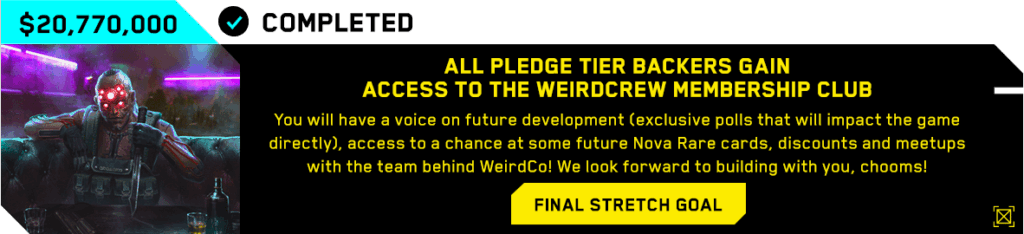
On April 13, 2026, somewhere between campaign fever and the final countdown, WeirdCo posted Update #31 and unlocked a new stretch goal: the WeirdCrew Membership Club. Exactly at $20,770,000 in funding. That number is no coincidence, and it’s precisely where my mixed feelings about this update start.
⚠ AI Translation Note
This article was originally written in German and translated with AI assistance, then reviewed by a human. Minor stylistic quirks may remain. The German original is the canonical version, and you can read it here.
Read it generously and you see a studio handing its community genuine input: polls intended to influence game design, chances at Nova Rare cards, discounts, meetups, „and more surprises wired into the grid as we go.“ Read it skeptically and you see a well-intentioned Kickstarter playbook. A membership program hung on a dramatically chosen milestone, whose language leans on hedges at every turn, and which leaves the important infrastructure questions wide open.
Full disclosure: I’m a Night City Legend backer myself, so I sit squarely among the people who theoretically benefit most from a functioning WeirdCrew program. That doesn’t make me neutral, which is why I’m trying to look twice as hard. What follows is a dissection of the update, its language, the community reactions, and where all of it sits in the broader TCG landscape. Based on a snapshot from April 14, 2026, around 09:00 CEST, roughly 14 hours after the update dropped. Things can and will still change. Swing too hard too early and you end up judging an unfinished draft as if it were the final product. I have to carry that caveat with me, even when the analysis shows what it shows.
The Moment: What Was Actually Announced
The $20.77M Trigger and the 2077 Easter Egg
WeirdCo didn’t simply announce the Membership Club. They tied it to a very specific number: $20,770,000. If you know Cyberpunk 2077 (and at a CDPR-licensed TCG campaign, that’s just about everyone), this is no mathematical accident. The year from Night City hangs in the funding ticker as if it always belonged there.
As storytelling? Clever. The congratulations moment („we’ve hit $20.77M, that’s our Cyberpunk moment“) generates exactly the collective buzz that campaign finales need. Three days before the end (April 17, 2026, 7:00 PM EDT), that’s the right energy. The community caught the wink immediately; „omg the 2077 reference“ was the most shared comment phrase in the first few hours.
Take one step back, though. WeirdCo could have announced a membership club at any time without the 2077 number. Coupling it to $20.77M is dramaturgical craft. It makes the program feel „earned,“ a collective result of backer energy rather than a community tool that was always going to happen anyway. Classic Kickstarter playbook. Whether genuine commitment lies behind it depends not on the symbolic trigger but on what actually happens over the next 18 months.
„I feel like this should of been a reward just for pledging, not a stretch-goal reward; especially the significance of the 2077.“ — Izik, Kickstarter comment on Update #31
Izik nails it. The symbolic value of the number is high; the structural benefit of using it as a funding incentive is questionable. If WeirdCo was going to build the club anyway (and any serious TCG publisher banking on community retention should), why not offer it as a baseline reward for every backer from day one? The answer is probably: because a stretch goal generates more emotional energy than a bundled feature. Correct from a marketing standpoint. Whether the program actually fills that emotional energy with real content is a question the update leaves hanging.
If you love the IP and want to dig into the lore behind references like this one, the Cyberpunk 2077 World Compendium from Dark Horse explains why the year 2077 in Night City is no randomly chosen marker but the gravitational center of the entire chronology.
The Update Body: What’s There and What Isn’t
Update #31 itself is barely a page of text. Measured against what it announces (a structural community program meant to accompany WeirdCo for years), that’s strikingly brief. WeirdCo describes four perk pillars: polls that should directly influence the game, access to chances at Nova Rare cards, discounts and exclusive drops, and meetups with the team. Plus a closing line about „more surprises we’ll wire into the grid as we go.“
The tone is warm and enthusiastic, embedded in CDPR community language with „chooms“ and „WeirdCrew.“ That works. What remains open is how the membership is actually supposed to function. Is there a card, an app, an account integration on cyberpunktcg.gg? How does a backer get verified as a WeirdCrew member when they want to redeem a discount at their local game store? How binding are the poll results? Will they be implemented, or do they just inform internal decisions? How will Nova Rare cards be shipped to international backers?
None of these questions have answers in the update. Eighteen hours after launch, that’s defensible; nobody expects a 40-page infrastructure manual in a stretch goal announcement. But these are exactly the questions that separate a pretty vision from a functioning program, and that’s the core of what we’re talking about here.
The Embedded Poll and Its Four Options
Simultaneously with the announcement, WeirdCo launched a poll, and it’s structurally interesting. The community is asked to vote on which of four membership categories gets tackled first: Accessories Design, Organized Play, Convention Attendance, or Future Design Choice.
- Accessories Design: Sleeves, deck boxes, playmats. Low risk, high visibility. A cosmetic decision with no gameplay implications, but highly relevant to everyday players.
- Organized Play: Tournament structure, LGS integration, format rules. Medium risk, high long-term relevance. OP structure is the deciding factor in whether a TCG survives in the local game store scene over the long run.
- Convention Attendance: Where and when does WeirdCo appear at events? Low risk, but heavily geography-sensitive: US events help US backers, EU events help EU backers. Internationally, this is a fragmented question.
- Future Design Choice: Direct influence over card design or game mechanics. Highest risk, highest substance, and the only option that truly lives up to the term „co-creation.“
The structure of this meta-poll is unusual. WeirdCo isn’t asking „what should the next accessory design be?“ They’re asking „which topic should we vote on first?“ That’s a prioritization decision that implicitly shapes the membership club’s roadmap. And as Akito aptly noted: „Accessories Design is very broad.“ Without sub-options, the community is voting half-blind. Choosing a category isn’t yet choosing within it. Voting for Accessories Design doesn’t mean picking between Sleeve A and Sleeve B; it means choosing that sleeves get discussed next.
For a launch poll, that’s pragmatic. The community has to start somewhere, and a prioritization question isn’t a bad opening. For a co-creation model that bills itself as a direct backer voice, it’s a compromise rather than a template for the substantively meaningful polls that need to follow.
The Four Membership Club Pillars in Detail
Voice-in-Polls: the Central Promise
The most prominent promise is the polling right. „Exclusive polls that will impact the game directly“ is the phrase from the update banner that all discussion centers on, and rightly so. Notably, in the actual perk list WeirdCo phrases it even softer: there it reads „A direct voice in development through exclusive polls that will shape the game.“ Shape. Not impact, not determine. Wait, scratch that: shape is actually the softer word. WeirdCo has used two formulations for the same perk, and both land below the threshold of a binding commitment. On paper the promise describes real community participation: players talk with the studio, not just at it. That’s a different model from what WotC or The Pokémon Company offer, where surveys exist but no polls with direct game implications.
That said, „impact“ is not „decide,“ not „determine,“ not „bind.“ The language is carefully chosen, and I’ll lay out why that matters in the next chapter. Here, just the observation: in the TCG industry, polls come in very different quality tiers. The spectrum runs from „we asked you and archived your answer“ all the way to „your vote sets the ban list.“ WeirdCo hasn’t positioned itself on that spectrum yet. Maybe that’s not to be expected after 18 hours, but it’s the question that should interest anyone considering bumping their pledge because of WeirdCrew.
Nova Rare Card Chances: Raffle or Redemption?
The second perk: „Access to chances at future Nova Rare cards.“ Nova Rares are the apex rarity in Cyberpunk TCG, the chase cards that emotionally represent the highest tier of the game for the collector audience. That sounds enticing and genuinely is. But this is also where the densest hedge-stack in the entire update lives.
„Access to chances at.“ Three words that together mean: you get access to the possibility of having the chance to receive a Nova Rare. That’s not a promise of a card. What it probably promises is a raffle slot. How the raffle actually works (digital or physical, how often, which cards, whether it ships internationally or US-only) is nowhere stated. That can go well: structured draws with fair distribution, internationally accessible, with clear odds. Or it can end in disappointment, say one mini-raffle per year for 30,000 nominal WeirdCrew members, where most people win nothing anyway. The difference lies in implementation, not in the announcement.
Raffle systems for rare cards are normal and legitimate in the TCG world; they distribute coveted cards more fairly than pure first-come-first-served. The problem isn’t the model. The problem is expectation management, and expectation management is exactly where many Kickstarter campaigns later run into trouble: the update presents this perk as a premium advantage for WeirdCrew members. The reality could be a rare raffle with slim odds. Neither would be a lie, but the perceived gap can grow large.
Discounts and Special Drops: For Whom, Really?
Third perk: discounts on products and exclusive drops. Attractive on paper. Who doesn’t want a member discount on TCG products? In practice, this is the most geographically asymmetric perk of all, and we’ll work through the numbers in their own chapter. Even for US backers, though, one question arises: how does a discount on cards sold through the retail channel (LGS) work? Publisher-direct discounts to end consumers require either a direct-to-consumer shipping channel or an LGS integration, and neither exists yet for a game that hasn’t launched.
Special drops, meaning exclusive products only for WeirdCrew members, are more interesting. WotC uses the drop model with Secret Lair: small, limited runs for an engaged base. If WeirdCo is thinking along those lines, the collector audience will bite. But again, everything hinges on verification: how does WeirdCo know who’s a WeirdCrew member when a drop is offered?
Meetups: the Convention Question
Fourth perk: meetups with the WeirdCo team. Attractive for engaged backers. Direct contact with the studio, early hands-on time, insider conversations with designers. Exactly what backers who are passionate about a game want: the feeling of being part of it rather than just a customer.
For European backers, this is primarily a convention question. WeirdCo mentioned Essen Spiel (October 2026) in a comment, along with plans for Poland and the UK. More than nothing, but not a structured meetup program. It reads more like a commitment to convention booths that were probably coming anyway. Whether convention attendance counts as a „meetup in the sense of the membership club,“ whether these events will have special WeirdCrew slots (early access, dev Q&A for members, exclusive preview games), or whether they’ll just be ordinary public convention booths: not communicated.
The Language of the Update: How to Read Hedges
„Impact“ Instead of „Determine“: a Three-Letter Difference That Matters
Language in official game publisher documents is almost always intentional. Legal teams read drafts, PR teams read drafts, and nobody writes „the community will determine card design“ in a Kickstarter update unless they’re willing to be held to exactly that. WeirdCo chose „impact.“ Not „determine,“ not „decide,“ not „vote to approve.“ That is a deliberate choice, and it’s the most important linguistic fork in the entire update.
The difference isn’t merely semantic. It’s constitutive. „Impact“ means: your opinion feeds into our decision. That’s what focus groups do; they have impact. „Determine“ would mean: your opinion is the decision, not the basis for ours. One instrument informs, the other binds. WeirdCo has linguistically chosen the informing variant, which is the smarter legal position and simultaneously the weaker co-creation promise.
This doesn’t have to mean bad faith. Hard commitments („we will implement whatever the poll picks, no matter the cost“) would be dangerous for a studio in the pre-launch phase. Unforeseen production constraints, IP licensing restrictions from CDPR, or designs that simply don’t work mechanically in practice can turn any publicly given blank check into a problem fast. A studio promising „we’ll implement whatever the community votes“ is in a trap the moment the community votes for something that can’t be done for any reason. Legal caution is legitimate. It just doesn’t change the fact that the model is rhetorically packaged as stronger than it is structurally.
„Access to a Chance at“: the Double Conditional
With the Nova Rare cards, the hedges stack up in almost textbook fashion. „Access to chances at future Nova Rare cards.“ Three layers between member and card: access (no automatic entitlement, since you have access to something, not the thing itself), chance (no promise, because a chance is explicitly not an outcome), future (not yet defined which cards, when, how many). Triple-insulated non-commitment. No single word is dishonest. But the sum of the three communicates something stronger than the individual parts support.
That sounds more cynical than I mean it. There’s nothing wrong with a raffle mechanic; it’s standard infrastructure for rare cards in the TCG world. The problem is the framing: presented as a membership advantage, „access to chances at“ creates the expectation of privilege. In practice it probably means „you’re in a pool of potentially 30,000 people who all have the same chance.“ That’s a different expectation than „as a WeirdCrew member you get preferred access.“ Both could be true, but the difference lies in implementation, and that implementation hasn’t been communicated.
„More Surprises Wired into the Grid“: Promises on Layaway
The last sentence of the membership section is the vaguest, and that’s probably not accidental. „And more surprises wired into the grid as we go.“ No list, no timeline, no definable commitment. That can be honest openness: WeirdCo is a small studio days away from campaign end, and they don’t yet know exactly what’s possible. Or it’s strategic ambiguity, a back door kept open in case the initial four perks prove insufficient. Both readings are possible.
For a backer deciding whether WeirdCrew justifies a pledge upgrade, it’s not useful information. It’s atmosphere. The Cyberpunk 2077 language („wired into the grid“) turns it into flavor text, and flavor text is nice but not load-bearing.
I’m not saying that to be petty. It’s simply what the language analysis yields: the update has four sentences with real content and one sentence with vibes. Four sentences with systematic hedges and a promise on layaway. That’s the text WeirdCrew members will reach for when they ask: „What did you actually promise us?“ The answer is: impact, chances, discounts, meetups, and surprises. No decisions, no cards, no defined prices, no scheduled events.
The 63 Comments: What the Community Actually Says
A methodological note first: the Firecrawl scrape only captured 25 of 63 comments due to a load-more limit, leaving roughly 60% of the discussion invisible. On top of that, the Reddit perspective is missing: the 18-hour snapshot catches the Reddit discussion too early; Google indexing for freshly posted threads on r/tcg, r/cyberpunk, or r/kickstarter typically lags 24–48 hours. What we have is representative of the early voices in the Kickstarter comment thread, but not a complete picture of community sentiment. Keep that in mind while reading the next few sections.
The Underlying Enthusiasm (and How It’s Shifted)
The majority of visible comments are positive. „This is so amazing!“, „Love everything about this“, „Cannot wait!“ The hype baseline from earlier updates is still present. That context matters when analyzing the more critical voices: they don’t come from an overwhelmingly skeptical or hostile community. They come from a community that is fundamentally engaged and enthusiastic but is starting to ask concrete questions.
Anyone who’s followed Updates 1–30 will notice a gradual shift. Early updates received almost unfiltered hype feedback; every new announcement was cause for celebration. Update #31 still gets a lot of approval, but the comments are more differentiated. Fewer pure exclamation points, more questions. „Sounds great but how exactly does X work?“ is a healthier sign than „OMG YES TAKE MY MONEY.“ It means the community is starting to transition from enthusiasm mode to stakeholder mode. Long term, that’s exactly what WeirdCo needs: a community that’s engaged and critical rather than blindly thrilled.
The Non-US Exclusion Cluster: Schug, Luke, and the Shipping Reality
The most substantive critique in the visible comment thread comes from Maximilian Schug (Germany) and a user named Luke (Australia). Both articulate the same structural problem with different levels of sharpness: the membership program is structurally US-centric in its material perks, namely discounts and meetups. For backers outside the US, a substantial portion of the membership benefits gets eaten up by overseas shipping costs or becomes de facto irrelevant due to geographic distance.
„weirdco doesnt actually want to listen to their community, but backers get that as a treat“ — Maximilian Schug, Kickstarter comment on Update #31 (framed as a European self-summary)
Schug puts it very pointedly. Perhaps too pointedly for what the evidence actually supports: on the basis of 18 hours and 25 comments, „WeirdCo doesn’t want to listen at all“ is too harsh a verdict. But beneath the sharp formulation lies a real structural finding. Of the four membership pillars, only two are available regardless of geography. The poll vote is digital and has no borders. Digital content is digital and has no borders (assuming Nova Rare draws have a digital option, which isn’t specified). Discounts require shipping, and shipping across the Atlantic or Pacific for a TCG product can cost more than the product itself. Meetups are inherently tied to physical locations. Luke from Australia makes it concrete: „Access to the cards may be an option for those like me across the world (Australia) but I suspect we will have to pay too much for shipping to be worth it.“ And that’s not a specifically European complaint; it’s the reality for everyone who doesn’t live in the US.
WeirdCo responded to this cluster with the Essen mention and plans for Poland and the UK. More than silence, and I mean that without irony. A direct response to geography criticism with concrete convention commitments is a positive signal. It’s not a structural counter-argument to the discount problem, though. „We’re coming to Essen“ solves the meetup perk for a subset of European backers on one date. The question of how a backer in Austria, Australia, or Japan redeems a product discount without ending up paying more than without the discount remains open.
The Mechanics Questioners: Squirrel Mob, Akito, Cameron Jones, and the Open Fundamentals
A second group of commenters goes not political but technical. Squirrel Mob, identifiable as a Superbacker (someone with substantial personal investment in the campaign, not an outside critic), asked perhaps the most precise question:
„It might be too early but what does this mean? […] I feel like this brings up a ton of questions…“ — Squirrel Mob, Kickstarter Superbacker, Update #31
That’s more telling than it sounds. A Superbacker, someone obviously deeply invested in this game, is asking „what exactly does this mean?“ Not with hostility, not with frustration, but directly. And he’s not alone: Cameron Jones, Grant, and Akito all ask variations of the same question. How is membership verified? Is there a digital card, an account status, a link to the Kickstarter profile? How does a discount work in the LGS model, where the retailer buys from a distributor and a direct-to-consumer discount mechanism is non-trivial? What exactly are the sub-options within „Accessories Design“?
None of these questions has an official WeirdCo response in the scrape. As noted: 18 hours is not a fair benchmark for response time. It’s still a data point worth recording.
Jeremy Alberts raised the vote-change question specifically, and that’s a genuine design gap. If someone votes early, before they’ve thought through all the implications of their choice and then changes their mind: can they re-vote? Kickstarter’s standard polls don’t always allow this, and for a co-creation model that claims real participation, it’s not an irrelevant implementation detail. Poll results that systematically over-weight early impulsive votes reflect community opinion less accurately than those with open amendment windows.
The Forward Thinkers: Rickdom75, ordalic, and What the Community Builds for Itself
What interests me most about the comment thread isn’t the criticism; that’s justified and expected. More interesting is the group of people who don’t just name the problem but sketch their own solutions.
„Something awesome to ’network‘ Company > LGSs > Players could be actually building a wiring connecting these three entities. […] Hard to make it real? Yes! Impossible? No!“ — Rickdom75, Kickstarter comment on Update #31
Rickdom75 thinks about the problem from infrastructure up, not from rhetoric down. A hub that structurally connects backers, local game stores, and the studio, with a discount redemption mechanic, event coordination, and membership verification as an integrated system, would address exactly the open questions others are raising. Ordalic brings an app-based approach into the conversation. Jan-Noel David has a different issue in mind: „I hope we get a better forum. Discord kinda sucks and makes things hard to find.“ A platform problem that directly affects polling infrastructure. Sal D’Amico thinks about accessibility: digital play, online events, options for people who can’t physically make it to a local game store or convention.
A community that actively thinks ahead and provides structural solutions before the studio has solved them is the kind of community that sustains a membership program. The question is whether WeirdCo channels this energy into infrastructure decisions, or lets it sink into a comment thread.
Sal D’Amico also wrote a comment that opens a dimension no one else in the visible thread touches: he mentions wanting a digital version of the game because an autoimmune condition makes it difficult for him to regularly visit game stores in person. Not a niche issue. In a community of 33,000 backers, statistically several hundred people are in similar situations. A membership program that relies exclusively on physical perks structurally excludes these people.
The Four Archetypes: Where WeirdCrew Sits in the TCG Landscape
WotC, Pokémon, Lorcana: the Classic Extractive Pole
Wizards of the Coast is the ultimate reference point for community distance in the TCG space, and that’s not a critique. It’s corporate logic. As a Hasbro subsidiary with billions in revenue, WotC sits in an architecture where design NDAs, leak prevention, and brand control take priority over community transparency. A poll openly asking „which mechanic should go in the next set?“ would be a leak risk. A binding community vote on ban list decisions would drive brand strategists to despair. WotC has no structural interest in co-creation, and that pays off for them because their IP is large enough to operate without community input.
The Pokémon Company is similarly positioned, with one interesting edge case: the Professor Program has existed for years and actually built a global structure with regional organizers. The associated integrated platform, Prof Com, with a directory, seminar library, and event registration, is a new development from 2025/2026, freshly launched rather than a decades-old portal. That’s not a voice in design decisions, but it is structural community integration into the tournament system. Lorcana (Ravensburger) is too young for a definitive verdict, but visibly trends toward the WotC model. With these three publishers, the asymmetry is deliberate architecture.
LSS / Flesh and Blood: Community Integration Through Tournament Structure
Legend Story Studios is running the most ambitious community integration experiment in the non-Hasbro TCG space with Flesh and Blood, but not through voting in the conventional sense. The Living Legend system is a performance-based points model: heroes accumulate points through tournament wins at all levels, from Skirmish events to the World Championship. At 1,000 points a hero automatically reaches Living Legend status and exits competitive formats. No vote, no community resolution, yet still collectively driven: tournament performance is aggregated player behavior. The community decides through its deck choices which heroes collect the points. Indirect influence with structurally binding consequences.
That’s a fundamentally different mechanism from a poll, and honestly a more interesting one. WeirdCo doesn’t need to orient itself on this model, since it provides no direct template for purely vote-based membership programs. But what LSS demonstrates: it is possible to build community integration into mechanisms that have real format consequences without constantly wading into open-ended discussions.
There’s also a second verified experiment: the Silver Age development program „Project Blue“ actively embedded local veteran players into internal development findings. Real co-creation in the testing phase rather than just post-hoc polling. LSS has found ways to feed community expertise into the development process that go beyond surveys. Infrastructure worth more than any single poll, and one that WeirdCo doesn’t yet have.
The surrounding infrastructure supports this: Talishar as a community-driven digital platform for FAB, a structured Pro Tour system with international stops, open dev communication within the Rathe Times ecosystem. Flesh and Blood has been live since 2019, over six years post-launch. The early years had their own problems. But the time span shows: structured community integration can be built if the will is there. It’s not a natural state; it’s a chosen path.
The industry has no model that could serve as a universal reference point for community voting. LSS does it through tournament performance, others through surveys, others through Discord polls without binding consequences. WeirdCo doesn’t need to measure itself against a single precedent. But it does need to honestly ask whether its own model sits closer to the informing end of the spectrum or the binding end. And if it knows, what is it doing to communicate that transparently?
Sorcery, Grand Archive: the Indie-Direct Track
At the other end of the spectrum there are studios so small that the Discord leads directly to the lead designer. Erik Olofsson at Sorcery: Contested Realm is known as a Game Creator for being personally present in the community. Alan Phan, Project Manager of Grand Archive TCG, communicates openly with the player base, while Lead Game Designer Sylidar publicly discusses and develops mechanics. No formalized voting, but maximum access granularity: anyone in the community can be heard directly.
That works beautifully with communities under 10,000 active players. At 33,000 Kickstarter backers it doesn’t scale. Too many voices, too little structure, too little capacity in a small team to read every thread. WeirdCo sits in a middle space: too large for direct indie communication, too small and too early for the institutionalized WotC distance. Exactly the point where a structured membership program makes sense. If it works.
Altered, Cyberpunk TCG: the Kickstarter-Native Archetype
And then there’s the fourth archetype: campaigns with massive Kickstarter hype, strong community rhetoric during the funding phase, and the unresolved question of whether post-launch energy holds. Altered TCG raised €6.2 million, was considered the second-largest TCG Kickstarter before Cyberpunk TCG took the record, ran active community engagement during the campaign, and shut down in March 2026. The next chapter tells that story in more detail.
Cyberpunk TCG is starting in this archetype. Not an indictment, just a status assessment. WeirdCrew positions itself rhetorically like LSS: „direct voice in development,“ co-creation, backers as partners. Structurally it’s closer to the Kickstarter-native pattern. The CDPR IP is a substantial advantage that Altered didn’t have. But the anchor alone isn’t enough. The road from Archetype 4 to Archetype 2 has to be walked, and it begins with the first poll after campaign end, not the announcement before it.
Altered TCG as a Warning Shot: What Can Go Wrong
The €6.2M Campaign and the Community Hype
Altered TCG was briefly the story everyone wanted to tell. An original French studio, Equinox, with an innovative design concept: cards with variable values, a well-considered draft system, a visually distinctive aesthetic. €6.2 million on Kickstarter in the January/February 2024 campaign. At the time the largest TCG Kickstarter campaign ever, until Cyberpunk TCG took the record. The community was hot, the dev team’s communication open and frequent, the feedback system during the campaign aggressively participatory. Equinox knew how to run a campaign.
What followed: a product that survived launch but couldn’t meet the retention challenge. Winning new players, building LGS presence, developing a tournament scene, reaching a second wave of buyers beyond the Kickstarter base. All of that takes time, money, and structured work that a Kickstarter campaign doesn’t automatically supply. Momentum from the funding phase doesn’t transfer linearly into post-launch activity.
The Second Crowdfund: When the Base No Longer Carries
The second crowdfund, „Roots of Corruption,“ was meant to finance the first major expansion set. It missed its target by a significant margin. In March 2026, Equinox announced the discontinuation of the game. The community that had been so vital and engaged during the first campaign had not, in sufficient numbers, made the critical transition from backer to lasting active player.
The pattern isn’t unique; it’s structural. Kickstarter-native TCGs struggle with a specific dissonance problem: the hype mechanism of the campaign is wired differently from the retention mechanic of the product. During the campaign there’s an emotional countdown, collective milestones, public stretch-goal moments, the feeling of being part of something bigger. Post-launch there’s only the game itself, and that game has to be good enough to retain players, stock LGS shelves, and maintain enough active community for the next crowdfund to make sense.
WeirdCo has the CDPR advantage here: the IP attracts people who aren’t TCG players but are Cyberpunk 2077 fans. A wider acquisition funnel than Altered ever had. But fans alone don’t play a TCG; they might buy it and put it on a shelf. Real player retention requires organized play, accessible tournaments, LGS support, and a mechanic that keeps the game interesting and competitive over time. WeirdCrew polling on Accessories Design doesn’t directly solve any of these problems. What it can create, if well implemented, is the sense of ownership that makes players show up again for the second set.
What Altered Teaches WeirdCo (and What It Doesn’t)
„Community first“ as rhetoric is no longer innocent after Altered. Not because WeirdCo is being dishonest, but because Altered showed that good intentions and genuine community engagement during the campaign don’t automatically buffer the post-launch drop. The trust credit that Kickstarter-native TCGs receive from their community is real, but not unlimited. It has to be extended through concrete product decisions: through tournament structures that retain players, through card sets that evolve mechanics, through membership clubs that deliver more than they announce.
What Altered doesn’t teach WeirdCo: the direct comparison breaks down at one crucial point. Equinox had no established IP as an anchor; Altered had to build from zero brand awareness. Cyberpunk 2077 is a multi-million dollar IP with a global fanbase. A substantial structural difference. WeirdCo won’t fail at the same point Altered did. But at the next hurdle (second crowdfund, first expansion set, first retail wave), the underlying logic still applies: community hype from the Kickstarter phase is a resource with an expiration date. WeirdCrew is the opportunity to push that expiration date back. Whether it’s used lies with WeirdCo.
The 19.5% Question: How to Read Poll Participation
6,450 Votes: a Lot or a Little?
Here’s the only hard number in the entire announcement that can actually be measured: 6,450 votes out of 33,153 backers, measured on April 14, 2026 at around 09:00 CEST, roughly 14 hours after the update dropped. That’s 19.5% of the backer base. This snapshot is a moving target: on the same day the backer count was already at 33,159 and still climbing. The specific numbers are a moment-in-time reading, not a final tally. The poll runs three days, through campaign end on April 17. Kickstarter poll experience suggests most votes come in the first few hours, when the update is fresh and the notification email is still in the inbox. After that the curve flattens. Realistically the final number could sit at 25–35% if the campaign gets its final push to the finish line.
How to read it? In absolute terms, 6,450 active voters in 18 hours is a substantial number. Most TCG publishers, even larger ones, would be happy to have that many players directly engaged in a decision. More than the attendance of many mid-size tournaments. In percentage terms, 19.5% means four out of five backers didn’t vote in the first 18 hours. At a final 30%, that means 70% of nominal WeirdCrew members didn’t weigh in on which direction the program takes first.
Not a crisis. Normal, actually. Comparable figures for LSS hero rotation participation or Pokémon Professor Program activity aren’t publicly available, making a harder quantitative benchmark difficult. What can be said: Kickstarter poll participation below 50% is the normal case, not the exception. WeirdCo is in the expected range. The question isn’t whether 19.5% is good or bad. The question is whether WeirdCo finds ways to drive higher community participation in future, more substantively important polls. Newsletters, Discord reminders, app notifications: all of that is possible and contributes to the quality of poll results.
The Vote-Change Gap
Jeremy Alberts raised a small but technically relevant question: can you change your vote after submitting? Kickstarter polls don’t allow this by default, and WeirdCo left the question unanswered in the scrape. For this first meta-poll („which category first?“) that’s probably not an existential problem. For later substantive polls („which sleeve design wins?“, „which hero enters the next rotation?“) it’s a question of fair design.
Poll systems without vote-change capability have a systematic early-voter bias problem: anyone who votes before the community has fully discussed all relevant information can’t correct their mistake. For a community vote that presents itself as genuine participation, vote amendments should be possible until the poll closes. Not a technical hurdle, a design decision. And it counts among the small but measurable quality criteria that reveal whether a voting system is taken seriously.
Why 100% is Never Possible (and Why That’s Fine)
To be fair: complete community participation in polls doesn’t exist anywhere, under any model. Apathy is a constant in every community, and ignoring that would be naive. Many backers understood backing as financial support, not as an obligation to permanent participation. Entirely their right. A membership program that’s really only relevant for the 20–30% of active voters can still function, provided those 20–30% adequately represent what the community as a whole wants.
The standard by which WeirdCrew should be measured isn’t „all 33,153 backers vote.“ It’s: are the polls structurally fair? Are results communicated transparently? Is it made clear and traceable what each poll winner actually changed? Those are the relevant criteria, not the absolute participation rate.
The Infrastructure Gap: How Do You Verify Membership?
No Card, No App, No Account Integration
Update #31 describes a Membership Club without describing where that club actually exists. Where does the WeirdCrew membership live technically? Is there a digital badge, a dedicated page on cyberpunktcg.gg, an account status linked to a Kickstarter profile? How does an LGS employee know someone is a WeirdCrew member when they want to redeem a discount? How does WeirdCo ensure that polls are only voted on by backers and not by anyone who happens to find the link?
None of these questions have answers in the update or in WeirdCo’s comment responses. That may legitimately be because the infrastructure is still being built. The announcement comes three days before campaign end, many months before the planned game launch. Building infrastructure for a membership program takes time, and it would be absurd to expect a complete technical dossier from a studio in the final phase of a Kickstarter campaign. It’s still an open question that has to be answered before WeirdCrew is anything more than a well-intentioned concept.
What Others Do Differently Here
The Pokémon Professor Program has been working since 2025/2026 with an integrated platform: Prof Com, with a directory, seminar library, and event registration. The program itself has years of infrastructure behind it; the new platform now bundles it digitally. LSS uses Talishar, a community-driven platform, for digital play and tournament tracking. WotC has only ever explored a Secret Lair subscription through surveys (2022) and WPN store tests (2025), never launching it as a permanent product. But even in the existing drop model, every Secret Lair purchase needs an account assignment for delivery and communication. Even smaller publishers like Grand Archive use Discord roles with verified pledge levels as a provisional membership solution. Not perfect, but functional.
What all of these solutions have in common: they have an answer to the question „how does the system know who is a member?“ WeirdCrew doesn’t have that answer yet. Not a catastrophe for an 18-hour-old announcement, but the first and most important infrastructure question that has to be answered before the program can actually deliver on any of its promised perks.
Rickdom75’s Company > LGS > Player Draft as a Reference
Rickdom75 offered the conceptually strongest response to the infrastructure problem in the comment thread: a connected hub that structurally links WeirdCo, local game stores, and players. Discount redemption mechanics through the LGS channel, event coordination with studio support, membership verification as an integrated system. „Hard to make it real? Yes! Impossible? No!“
That’s the right way to think about it. LGS discounts don’t work in a direct-to-consumer model; a publisher can’t reasonably process every individual backer purchase worldwide with a member discount. They work when the publisher gives the retailer a membership program that the retailer can pass on to their customers. Loyalty points on LGS purchases, event rewards at WeirdCo-sanctioned tournaments, a digital membership card with a QR code the LGS can scan. Solvable. It needs will, development resources, and a retail channel partnership that doesn’t yet exist as of the announcement. But Rickdom75 is right: it’s not impossible.
The Geographic Asymmetry: Perks That Die in Shipping Costs
Discounts for European Backers: a Losing Calculation
Run the numbers concretely, because they show why this is not a fringe issue. A WeirdCrew member in Vienna gets a member discount on a product shipped from WeirdCo in Seattle or a US distributor. Transatlantic shipping for a small card package: depending on size and shipping class, €10–25 or more. The price of a booster pack for a new TCG: typically €5–9. The price of a starter deck: €20–40.
How large would the member discount have to be to offset the international shipping surcharge on a starter deck? At least 30–40%, in a product category where the usual membership discount range is more like 10–20%. For a single booster pack, shipping costs more than the product itself. The discount would need to be 100%+ to be meaningful. Obviously not a realistic model.
The only way discounts make economic sense for international backers is through a local distribution channel: a game store in Germany buys at wholesale pricing (with a membership discount for WeirdCrew members?) and passes the savings on at the register. But that requires a retail infrastructure that doesn’t yet exist for an unlaunched game. And even then: how many local game stores in Austria, Poland, or Australia will carry WeirdCo products when the game is available? A genuine unknown.
The card sleeves and TCG accessories that sit as one of the four poll categories illustrate the ambivalence well: having a say in designing these products is appealing. Ordering them at member prices, as an international backer without a local distribution channel, is economically questionable.
Meetups and Conventions: the Essen Concession and Its Limits
WeirdCo responded to the Europe criticism with a concrete concession: Essen Spiel in October 2026, plus plans for Poland and the UK. Real progress, and I mean that without irony. Essen is the largest board game fair in Europe with strong TCG participation, central enough for Central Europe backers from Germany, Austria, Switzerland, and the Netherlands. A WeirdCo presence there would be many European backers‘ first physical encounter with the team.
What the concession doesn’t solve: whether convention attendance counts as a „meetup in the sense of the membership club“ is not clarified. Whether there will be special WeirdCrew slots at these events (early access, member Q&A, exclusive preview games) or whether they’ll be ordinary public convention booths: not communicated. And for backers in Australia, Japan, Brazil, western Canada, or the US South, the convention route remains distant or fragmented.
Essen is a good first step. It doesn’t solve the structural meetup problem, but it makes things manageable for a subset of European backers. A difference worth naming.
Digital as a Bridge Solution (and Why Accessibility Belongs Here)
The cleanest solution to the geographic asymmetry would be a digital alternative for every perk that’s physically distributed unequally. A digital membership card instead of a physical one. Online polls with verified backer accounts instead of Discord channel votes. Digital Nova Rare drops (online tournaments, digital card collections, if a digital game is ever built) instead of physical shipping. Online dev Q&A for WeirdCrew members instead of convention meetups.
That would also address the accessibility angle Sal D’Amico raised: people with health conditions who can’t regularly visit game stores in person wouldn’t be structurally excluded from the membership program. Not a niche issue. A design decision about who the program actually wants to include. WeirdCo hasn’t made any statement on this. The community has asked the question. It would be good if an answer came.
The Central Question: Voice or Focus Group?
The Binding Axis
I want to answer the core question directly, as far as that’s possible on the basis of an 18-hour snapshot: WeirdCrew, as announced, sits closer to a structured focus group than to genuine participation rights. That’s not an indictment. Focus groups are valuable, and many successful products have been made better through well-run community feedback loops. But a focus group is structurally different from „a direct voice in development.“
The difference lies in binding. A focus group informs designers. A voting mechanism binds them, or at least makes the break transparent when designers decide against the vote result. WeirdCo chose the soft language („impact“), which sets no standard of obligation. Understandable and legally smart. At the same time, it’s the formulation that serves as an escape hatch at every future conflict between poll result and design decision: „We listened to you, but that was the impact. The decision is ours.“
That can work well if WeirdCo actually follows poll results and communicates that. It can become a source of disappointment if a popular vote lands against internal preferences and the community notices that the impact was a soft one. We’ll know in 6–12 months.
What WeirdCo Must Prove in the First Polls
The first six polls, whatever the current meta-poll selects as the first topic, are the hardest track record test. Has WeirdCo already run polls in previous updates? If so, were the results implemented and communicated? The analysis couldn’t fully review the poll history from Updates 1–30. That would be the hardest argument for or against WeirdCo’s commitment, but it lies outside the available data.
What is clear: if six months pass after the first poll winner is announced and no product, no design update, no traceable „here’s what your vote actually changed“ comes from WeirdCo, then WeirdCrew has failed, no matter how good the April announcement was. Conversely: if the first poll result is cleanly implemented and publicly communicated („you chose Accessories Design, here are three sleeve designs to vote on, and the winner will be produced“), that’s real trust-building. The model exists at LSS and it works. WeirdCo just has to apply it consistently.
The „Weirdos“ Naming Signal
Jaxon Herman asked something in the comment thread that’s really a request: „As members, can we be called Weirdos? I pray that becomes official lingo.“ Sounds like a small thing. Diagnostically, it’s anything but.
When a community develops its own name for itself, bottom-up rather than handed down by brand management, that’s a sign of genuine ownership. „I’m not just a backer, I’m a Weirdo“ is the self-identification that turns a membership program into an identity. And how WeirdCo handles it is a micro-litmus test for the entire „we’re building this with you“ rhetoric.
LSS picked up „Hero Pilot“ slang when it emerged bottom-up in the community and integrated it into official communications. WotC established top-down naming and never budged. WeirdCo didn’t respond to the suggestion in the 18-hour scrape; too early for a verdict. The suggestion is out there, it hasn’t been forgotten, and at some point the response will come. It’ll be worth watching which one it is.
Assessment: Why I’m Still Cautiously Optimistic
Over the last thousand words or so I’ve dissected hedges, named infrastructure gaps, told the Altered story, and measured the distance between LSS’s binding commitments and WeirdCo’s rhetoric. That’s my job as someone who takes Kickstarter announcements seriously rather than just waving them through.
But I’d be dishonest if I didn’t also say this: I find the whole thing cautiously positive. As a Night City Legend backer, with considerable personal stake (read: a lot of eddies) in this campaign, I obviously have an interest in WeirdCo delivering. That doesn’t make me a neutral observer, which is why I’m saying it directly rather than pretending my assessment comes from nowhere.
What makes me optimistic, beyond my own investment: the CDPR IP is a genuine structural advantage. It attracts not only TCG players but Cyberpunk fans who are willing to give a game a chance they might never have tried otherwise. An acquisition funnel that Altered never had and that Sorcery or Grand Archive will never have either.
The team communicates actively. Not perfectly, not completely in every update, but frequently and directly. Anyone reading the complete update history of this campaign sees not a studio ignoring community feedback. More one that sometimes promises more than it can substantiate, but is earnest at its core. A good starting point.
And the community itself, as the comment analysis shows, isn’t just enthusiastic. It’s thinking things through. Rickdom75 sketches infrastructure solutions. Akito pinpoints design gaps precisely. Sal D’Amico opens accessibility questions that are raised too rarely. The kind of community that sustains a long-lived TCG, not one that loses interest three weeks after launch because no new content update arrives.
My cautious optimism has a price: three expectations I’m keeping in the back of my mind. Infrastructure first. WeirdCrew needs a working digital membership verification system before game launch; without it the perks can’t be redeemed. Poll communication second. After the first completed poll cycle, there needs to be an update that makes transparent what the result actually changed. Not atmosphere or a „thanks for your input,“ but a traceable „you voted for X, so Y is happening.“ An international discount solution third. Essen is good, but it’s not a structural answer.
If WeirdCo delivers on those three things by early 2027, WeirdCrew is what it should be. If not, the announcement was a pretty trigger moment for the last 72 hours of the campaign, and nothing more.
What to Watch Now: The Next 18 Months
The First Post-Poll Production Cycle
The current meta-poll runs until April 17, 2026, campaign end. Then we’ll know the community’s priority: Accessories Design, Organized Play, Convention Attendance, or Future Design Choice. What happens next is the first real data point for WeirdCrew’s substance.
Concrete things to watch: how long does it take WeirdCo to turn the winning topic into a substantive poll? Are poll results communicated with a timeline? Are community members informed about progress, not just called to the next poll, but given a retrospective „here’s what the last poll changed“? That’s the real test. Not the announcement, not this article, but the implementation over the next three to six months.
If Accessories Design wins (likely in a community with fresh collector enthusiasm) and WeirdCo presents sleeve designs to vote on six months later with a note that „you kicked this off in April 2026,“ then the model works. If the poll winner sinks in a priority backlog because other things were more pressing internally, and no follow-up poll comes for six months, that’s a warning signal that should be taken seriously.
The Expansion Set Question
Longer term, the most important question for WeirdCrew isn’t the first poll. It’s what happens when the next product cycle arrives. Will the WeirdCrew base still be active enough by then to function as trust capital? Will retail buyers of the base game, people who never backed on Kickstarter, have any form of membership access? Under what conditions? Will WeirdCrew grow or shrink as the Kickstarter energy fades?
The Altered pattern warns: anyone without a functioning community at the second crowdfund loses. WeirdCrew is the structural opportunity to retain that community beyond the first Kickstarter. Whether that opportunity is used lies with WeirdCo, not with the stretch goal trigger, and not with the pretty announcement.
The Infrastructure Question as a Year-One Checkpoint
Concrete checkpoints for April 2027, twelve months after the announcement: Is there a working digital membership verification system? Do international backers have a functioning way to redeem discounts, through an LGS program, a digital alternative, or some solution that doesn’t yet exist but needs to? Has the first complete poll cycle (meta-poll to content poll to result to product) taken place and been documented traceably? Are there international meetup formats beyond three convention slots?
Not a high bar. It’s the minimum for a program that calls itself „direct voice in development.“ If two or more of these points can be answered clearly with Yes in April 2027, WeirdCrew has proven its substance. If all four end in No, the announcement was atmosphere for the last 72 hours of the campaign, nothing more and nothing less.
I want WeirdCrew to be the former. As a backer, as a Cyberpunk fan, and as someone who’s seen enough TCG campaigns to know how rarely this model actually works. The opening move has been made. Night City is waiting. And we’re watching what comes next.
Sources
- Kickstarter: Cyberpunk TCG Update #31 (WeirdCrew Announcement, April 2026)
- Legend Story Studios: Living Legend Program, Flesh and Blood (fabtcg.com)
- BoardGameWire: Altered TCG / Equinox Shutdown Coverage, March 2026
- TechRaptor: Altered TCG: Roots of Corruption Crowdfund Analysis
- GamingTrend: Kickstarter-Native TCG Market Analysis 2024/2025

// KOMMENTARE (0)