Cyberpunk TCG: 9 Fan Tools a Year Before Retail
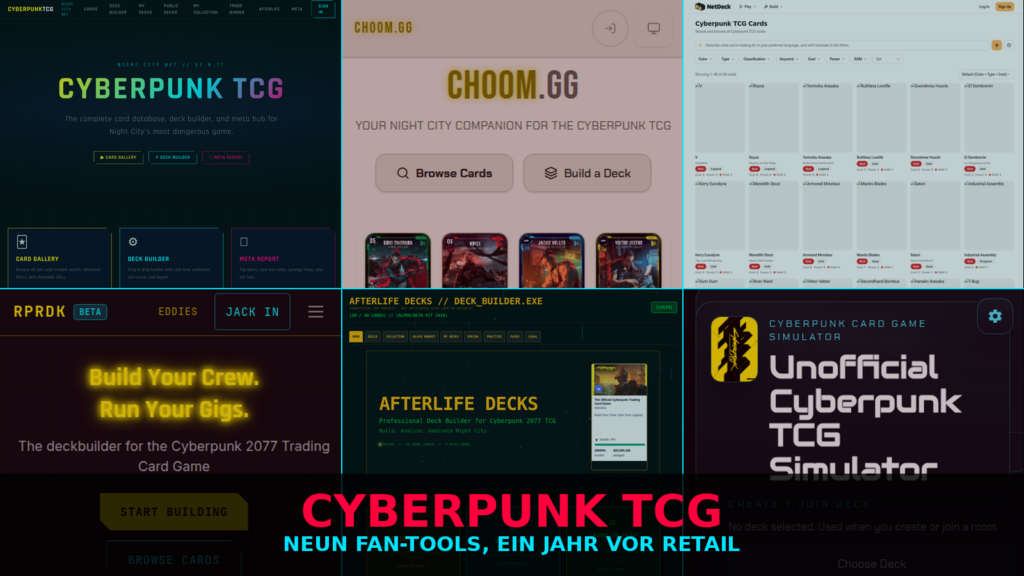
This is the English edition of a deep-dive originally written in German. The analysis, math, and editorial voice are ours. The translation was produced with AI assistance and reviewed by a human editor. If you spot an inaccuracy or an awkward phrasing, let us know via the site contact page. The original German version is linked at the top of every article.
Tobias dropped a tool in the WeirdCo Discord on April 15. „Vibed together a deckbuilder where you can export a PDF with cutting guidance to print proxies,“ he wrote. One fan. One afternoon. One link. Maxmegapix replied, „Wow! This this looks cool!“ and the channel went quiet for the night.
It didn’t stay quiet.
A day later Lovecore flipped the switch on Choom.gg’s direct integration with cyberpunk-tcg-sim.online. Short, matter-of-fact announcement: „Recently updated the looking for game function on Choom.gg to support direct play support with cyberpunk-TCG-sim.online. This should make it easier for players to sync up and find games. I’m also in touch with the Pixelborn team about a direct integration.“ Max responded immediately: „Thank you so much for your commitment and precious time, that you spend on this project!“ Two hours after that, seikiro dropped the link to tcgcyberpunk.com, a full-stack community tool with marketplace, Trade Binder, and explicit permission from CD PROJEKT RED and WeirdCo in the footer. „I’m new here, say Hi!“ Three developers. One Discord channel. One Wednesday evening. And you sit there and realize the scene has already started. The game isn’t even on shelves yet, the first retail booster lands sometime later in 2026, and fans have already built half the infrastructure you normally see years after release.
Maxmegapix had a telling line when the third tool dropped that day: „And yet another one useful tool for the community!“ The „yet another one“ is what this article is about. The question isn’t whether this ecosystem works. It’s what it’s already pulled off while you were looking somewhere else.
I tested nine active tools, declared one dead, sent two to honorable mentions, noted three fact-check open points, and took forty-plus screenshots. Every tested tool is free, every one was built by fans, and every one can be used tonight. If you want to jump straight to which tool does what best, scroll down to the reviews. If you want to understand how this ecosystem came together this fast, stick around.
The „Official Vacuum“ Isn’t a Vacuum
The first reflex in any fan-ecosystem article is to write: the manufacturer doesn’t deliver, the community fills the gap. Magic was like that (Wizards ignored the web until 2015, Scryfall cleaned up). Netrunner was like that (Fantasy Flight dropped the game, jinteki.net lived on). Pokémon was like that (The Pokémon Company to this day has no acceptable first-party card DB, Limitless TCG stepped in). For Cyberpunk TCG, that story doesn’t hold up. It’s a bit more complicated.
The official site cyberpunktcg.com has a working card database. With smart filters for color, type, classification, keyword, cost, power, RAM, and set. With card detail pages and high-res renders. As of April 17, 48 cards are listed. Rules are there, the FAQ is there, the retailer locator is there, the Discord is linked. As an official launch hub, that’s absolutely solid.
Except, and this is the twist I enjoyed most during testing, in the footer of the card DB there’s a line: „Card database powered by Netdeck.gg.“ Netdeck isn’t WeirdCo. Netdeck is a multi-TCG community platform that, alongside Cyberpunk TCG, also supports Magic, Pokémon, Yu-Gi-Oh!, One Piece, Lorcana, Flesh and Blood, Grand Archive, Cataclysm Arcade, Vibes, and „+many more.“ Netdeck itself carries its own disclaimer: „NetDeck.gg is not an official WeirdCo product and is not affiliated with or endorsed by CD PROJEKT.“ So: the official card DB runs on fan infrastructure, and that fan infrastructure is legally, explicitly unaffiliated.
WeirdCo apparently made the call not to build the card-DB backbone in-house, but to hand it off to a specialist. A team that’s been building card databases for years builds the next one for a new TCG, and does it better than WeirdCo could in-house. The model is elegant. Scryfall was unofficial for Magic for thirteen years. Netdeck gets integrated with manufacturer blessing for Cyberpunk TCG from day one. That’s a leap that tells the fan scene: if you want to contribute to the official DB, you can plug straight into an open, documented API. No years in the gray zone before the manufacturer plays along.
Running in parallel are the fan tools that operate completely outside this partnership. Every single tool I tested carries a „not affiliated“ disclaimer. One, tcgcyberpunk.com, has explicit permission in the footer anyway: „Used with permission from CD PROJEKT RED & WeirdCo“. That’s, as far as I could see across the scene, unique. No other fan tool for any modern TCG I can think of has open permission from the IP holder stamped in the footer like that. Another community project, Gniih’s Tabletop Simulator mod, was pulled from Steam on April 9 for violating Steam Community Guidelines. 278 subscribers, 516 unique visitors, actively maintained since late March, and gone. WeirdCo reviews case by case. Web-based deckbuilders without protected assets get tolerated, sometimes even authorized. Tabletop Simulator bundles with full card images get the takedown. Disney’s Lorcana killed Pavel Kolev’s Pixelborn client completely in 2024. WeirdCo, by contrast, invited seikiro in.
Not officially delivered by WeirdCo (as of mid-April): a deckbuilder, an online sim, an LFG service, a trade/market platform, a meta tracker, a pack simulator, a mobile app, and detailed archetype guides. All of it exists in the fan scene. Most of it multiple times over. The following reviews explain who does what and how well.
The Tools
tcgcyberpunk.com: NIGHT CITY NET
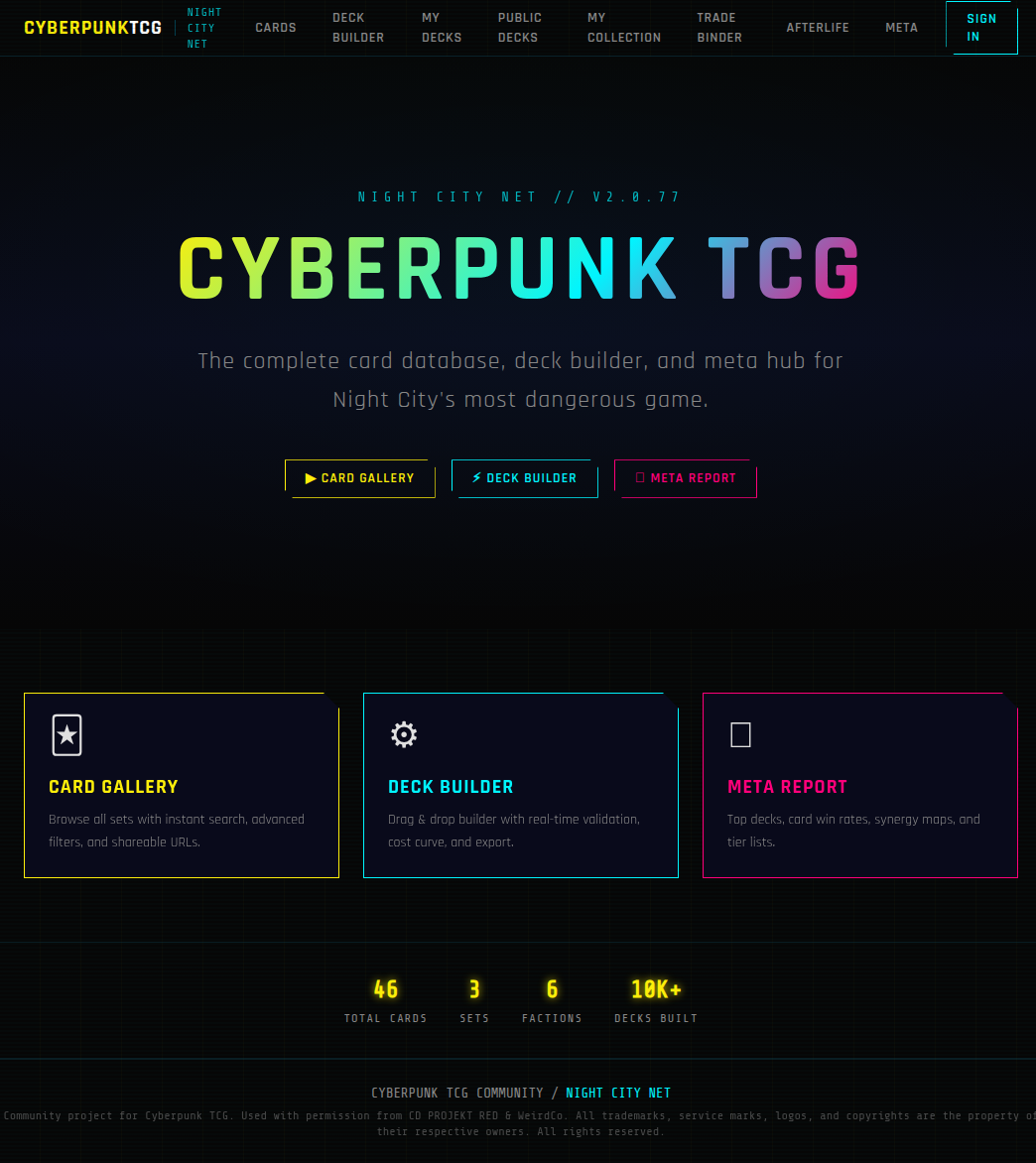
This is the flagship of the scene, and I say that without hesitation. seikiro [RIFT], the developer who introduced himself in Discord on April 16 with „I’m new here, say Hi!“, didn’t just build a deckbuilder. The site carries the sub-branding „NIGHT CITY NET // V2.0.77“ and covers Card Gallery, Deck Builder, My Decks, Public Decks, Collection, Trade Binder, AFTERLIFE (a marketplace feature), and Meta. A full ecosystem platform, built in Next.js with Turbopack. The footer note „Used with permission from CD PROJEKT RED & WeirdCo“ is, as far as I could tell across all my testing, the only one in the entire scene.
The homepage stats already make a statement: 46 Total Cards, 3 Sets, 6 Factions, 10K+ Decks Built. That „10K+ Decks Built“ is social proof no other fan site delivers. Land here and you see immediately: this thing gets used, not just offered.
For the test, I started a deck: pulled V, Alt Cunningham, and Jackie Welles in. Rule validation reported right away, matter-of-factly: „Needs exactly 3 Legends (Has: 2)“. V and Alt are Legends (red and blue), Jackie in this version is a Unit (yellow). Trying to add a second copy of V failed elegantly: the „Add copy“ button got disabled, and so did the card in the gallery grid. No error message, no popup, just: nope. That’s how UX should work. No tool in the test handles this as elegantly: most either throw error dialogs or allow the action and then report „deck is illegal“ after the fact. seikiro picked the stricter path: what’s not allowed isn’t clickable.
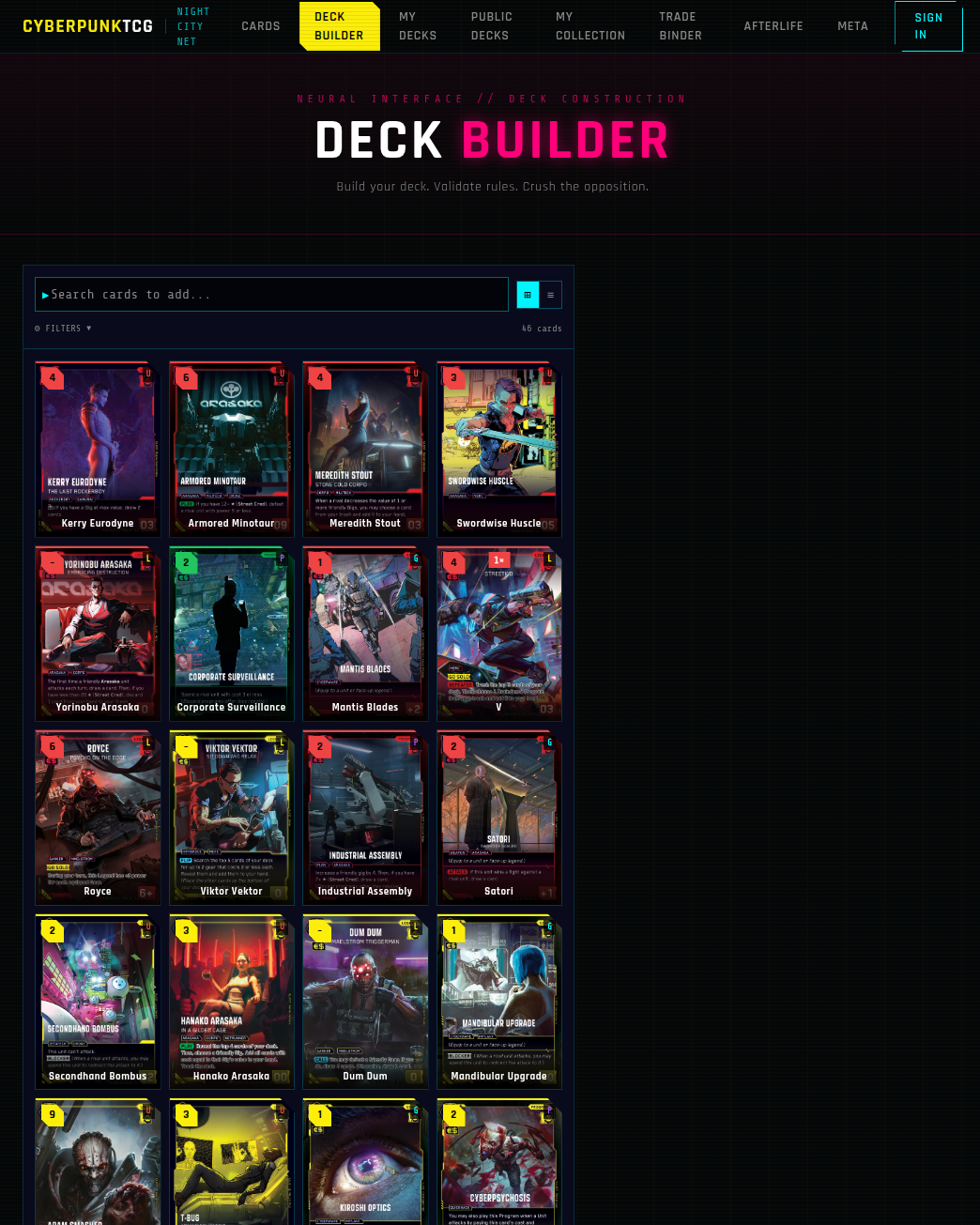
The deck panel shows Cost Curve (0 through 7+, with a bar per cost tier), Types breakdown (Legend: 2, Unit: 1), Colors breakdown (Red 1, Yellow 1, Blue 1) in real time. If you want to keep an eye on the balance between low-cost curve and big finishers, you get the feedback while you build. Plus a „DRAW 7“ button, right next to Import and Export, that simulates the starting hand. A feature you usually only find in simulators. The Export supports three formats: Copy to Clipboard, Download .TXT, Download .CSV. That gets you into any other builder, any tracker app, and even Excel.
Lighthouse delivers 96 Accessibility, 96 Best Practices, 100 SEO on Desktop, and 96/100/100 on Mobile. The card buttons have separate Preview and Add labels: screen-reader users get the information that a card is a Legend directly in the a11y tree. That’s professional-grade. The network check shows no third-party requests beyond res.cloudinary.com for the card images. No Google Analytics, no ads, no Facebook Pixel. The auth endpoint polls regularly (NextAuth default), but nothing that follows the user in a tracking sense. For a community tool with this feature breadth, that’s the clean setup.
The Trade Binder and AFTERLIFE features are what make tcgcyberpunk.com unique. Other tools have collection trackers; here you can explicitly flag cards as „for trade,“ and the AFTERLIFE menu is the marketplace front end. With Set 1 still pre-retail, there’s not much action over there yet, but the infrastructure for the secondary market is already standing. When boxes start cracking in the fall, seikiro’s tool is the place where the first singles prices get stuck. And the AFTERLIFE naming is a nice lore callback: in the Cyberpunk universe, Afterlife is the merc bar where gigs go down. Trading cards for eddies, cutting deals, building cred. It fits.
What’s missing: the site itself has no developer attribution and no GitHub link. If you want to contribute, there’s no visible entry point outside the Discord. In the screenshot grid, three different Goro Takemura cards show up side by side without subtitles, which confuses at first glance: those are Iconic Rare variants, but a tooltip would be nice. This is nitpicking. If there’s one thing to knock about this tool, it’s the reluctance to show the human behind it.
When Max asked on Discord, „Do you think of going mobile in the stores? App wise…“ seikiro replied briefly, „can be done yeah“. An app-store port isn’t ruled out, but it’s not on the roadmap either. The current state is enough, at least for the browser. If you’re going to remember one community tool, this is the one.
Update before publication: Zoilo [CTCG] from the tcgcyberpunk.com team reached out directly to flag something we missed: the platform already has a match simulator in beta testing at /playtest, wired directly to the decks built in the tool. Currently Discord-login-gated, not fully optimized for all devices yet, and still missing some mechanics and automations, but matches are already playable. That puts the tcgcyberpunk.com team squarely into the sim category alongside cyberpunk-tcg-sim.online and V4MP’s upcoming phase9_simulator. The sim race now officially has three contenders. Thanks for the direct feedback, Zoilo, and for catching that our review celebrated the Trade Binder and AFTERLIFE market pages but overlooked the playtest feature.
choom.gg: Your Night City Companion
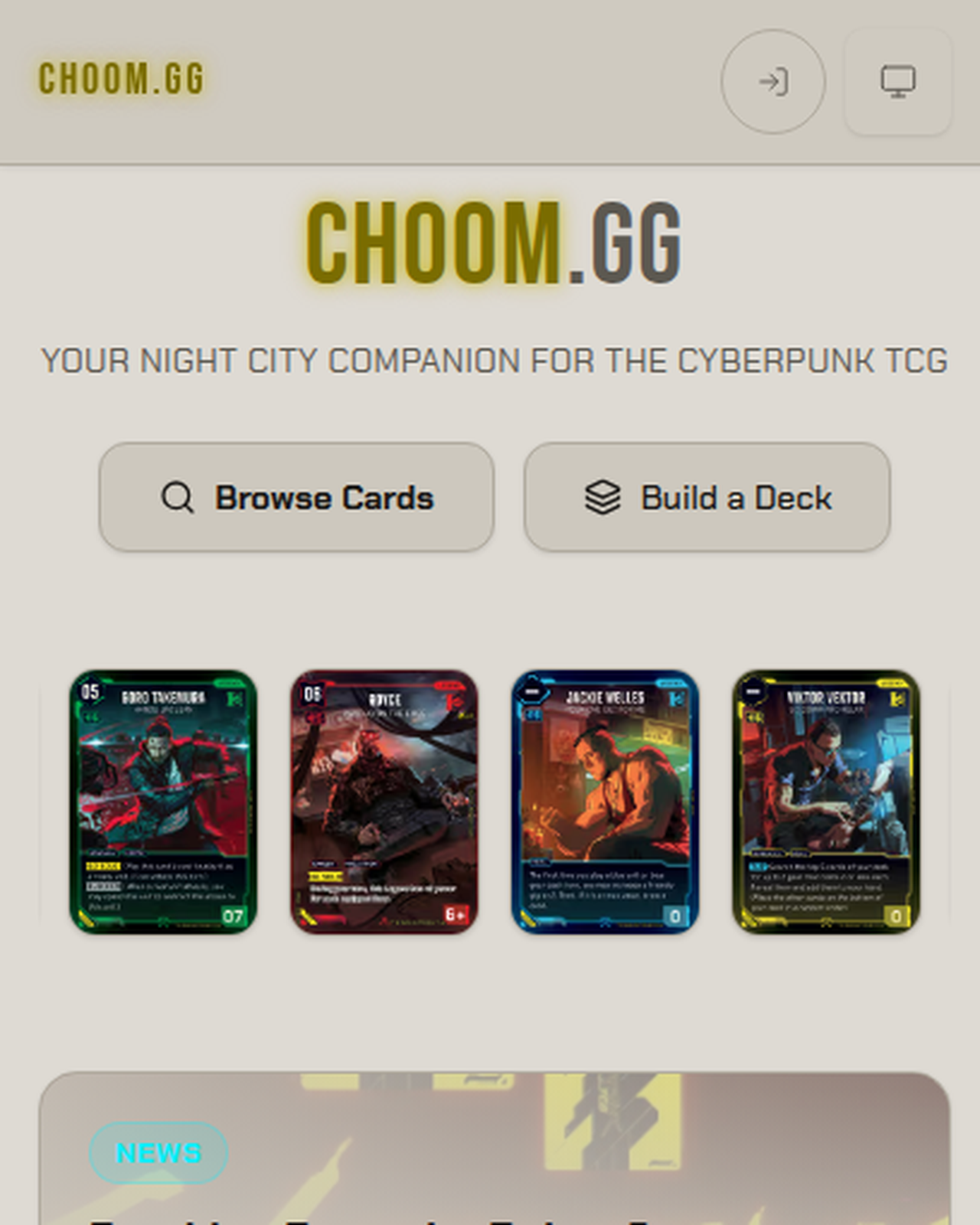
Lovecore [RIFT] isn’t new at this. The Tip Top Jar link in the Choom footer leads to a page titled „Support Lovecore on Tip Top Jar“ (URL: tiptopjar.com/comboforge). Lovecore also built comboforge.gg (fighting-games combo DB for Street Fighter 6, Tekken 8, 2XKO, Guilty Gear Strive) and riftboundrules.lol (project name: „Riftbound Oracle“, for Riot’s Riftbound TCG). This is a multi-TCG veteran who knows exactly what a fan ecosystem needs. Choom.gg is his Cyberpunk contribution, and he’s brought most of his tool experience to it.
The feature portfolio is broad: Card Database (42 cards visible, with filters by color/type/attribute), Deck Builder with QR code share (!), Collection Binder with variant tracking for standard/foil/kickstarter, Wishlist, Gig Board (LFG), Analytics under /meta, Draft mode under /draft. Plus its own blog with content like „Breaking Down the Debut Set: Welcome to Night City“ (April 10, with rarity breakdown and pull-rate analysis), „Official How To Play Trailer!“ (March 17), „A summary of the pre-kickoff stream“ (March 16), and „Quick Hacks are here!“ (March 16, guide category: „New to the game? Here is everything you need to know about card types, colors, Gigs, and Street Cred before your first match“). Posting cadence goes back to the Kickstarter kickoff and hasn’t slowed down since. That’s not tool-obligation content. That’s editorial commitment.
The site is a PWA. Service worker (/sw.js) registered, manifest.json present, icons/icon-192.png defined. Hit it on a phone and you can install it with a single tap: no app-store detour, no tracking through Apple or Google Play Services. That’s the answer to seikiro’s Discord question „going mobile in the stores? App wise…“ from a different direction: Choom is already installable as an app, and has been from the start.
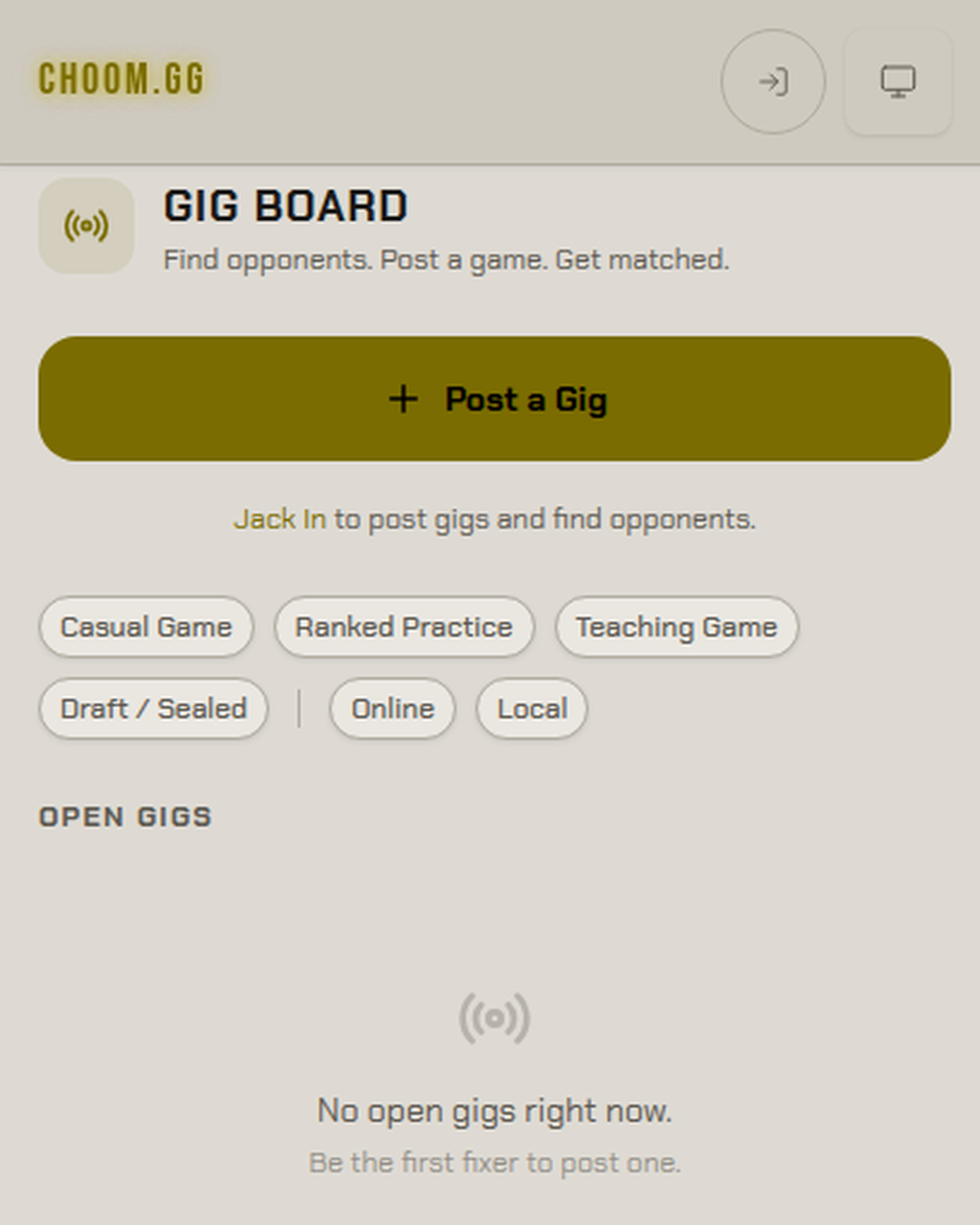
The Gig Board, the LFG feature, is the category where Choom stands completely alone. „Find opponents. Post a game. Get matched.“ Filter chips for Casual Game / Ranked Practice / Teaching Game / Draft / Sealed, plus an Online/Local toggle. When I tested it at 5 PM CEST, the board was empty („No open gigs right now. Be the first fixer to post one.“), but the infrastructure is fully in place. In the network tab, you can see posts loading live from a Supabase table, with exact query structure (status=eq.open&expires_at=gt.<now>&order=created_at.desc) and pagination. Postgres backend for live data, classic Supabase setup. When fall hits and the first players start looking for matches post-retail, this is the spot. And thanks to the direct integration with cyberpunk-tcg-sim.online (live since April 16), LFG matches drop straight into a sim room, no platform switch. Lovecore’s Discord statement was deadpan: „This should make it easier for players to sync up and find games.“ That’s English understatement for „I just welded two tools into one.“
The blog is the bonus other tools don’t have. Lovecore writes editorially about pull rates, card reveals, stream summaries. That binds the Choom community beyond the tool itself. And it makes Choom.gg a place you come back to even when you’re not in the mood to build a deck.
Lighthouse Desktop: 95 A11y, 100 Best Practices, 100 SEO. Mobile same. The tracker stack is worth mentioning: Google AdSense (ca-pub-1575110123156971) plus Google Funding Choices (the GDPR consent module) run alongside, plus Vercel Analytics and Vercel Speed Insights as first-party-proxied telemetry. Choom finances itself through ads, which is legitimate. The GDPR consent dialog is in place. Running a community platform at this level means financing it somehow, and ads are the clean path, cleaner than crypto grift or a premium paywall. If you want it interruption-free, install the site as a PWA and use it with an ad-blocking browser.
The Choom-Sim integration from April 16 is more than a feature update: it’s the first documented example of deliberate cross-tool cooperation in this scene. And the Pixelborn mention („I’m also in touch with the Pixelborn team about a direct integration“) has implications that go well beyond Choom. If Pixelborn actually builds a full digital client with animated battles and Choom sits in front as the matchmaking layer, a digital TCG ecosystem materializes overnight, the kind Magic Arena took ten years to build. That’s maybe the most ambitious plan in the entire scene.
cyberpunk-tcg-sim.online: The Quiet Hero
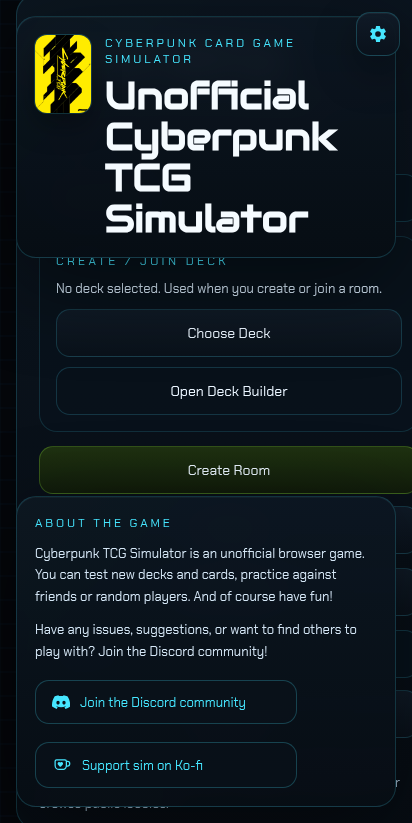
Sometimes you test a tool and Lighthouse spits out numbers you have to read twice. Accessibility 100. Best Practices 100. SEO 100. Desktop and Mobile. No errors, no warnings, all 51 audits passed. And that on a site that’s also for a long time the only real online simulator of the scene, until tcgcyberpunk.com entered the category in mid-April with its own playtest mode at /playtest (see update box in the tcgcyberpunk chapter) in this scene. Zero trackers, zero ads, zero external requests apart from its own hosting. A tool that’s a textbook example of how fan infrastructure can be built minimally and still work.
The match setup shows the core philosophy: three buttons, „Hot Seat“ for local two-player (one laptop, two friends, one physical deck each just typed in), „Create Room“ for a private lobby with a 6-character join code (which you send via WhatsApp), „Public Lobbies“ for matchmaking. The callsign is auto-generated („Runner13325“), the deckbuilder is linked directly, and the footer says: „Have any issues, suggestions, or want to find others to play with? Join the Discord community!“ Plus a Ko-fi link for support. That’s it. No ads, no trackers, no login required to play a Hot Seat game. The developer, whose name I couldn’t find publicly anywhere, chose a path of maximum restraint: no attribution, no advertising, just functional.
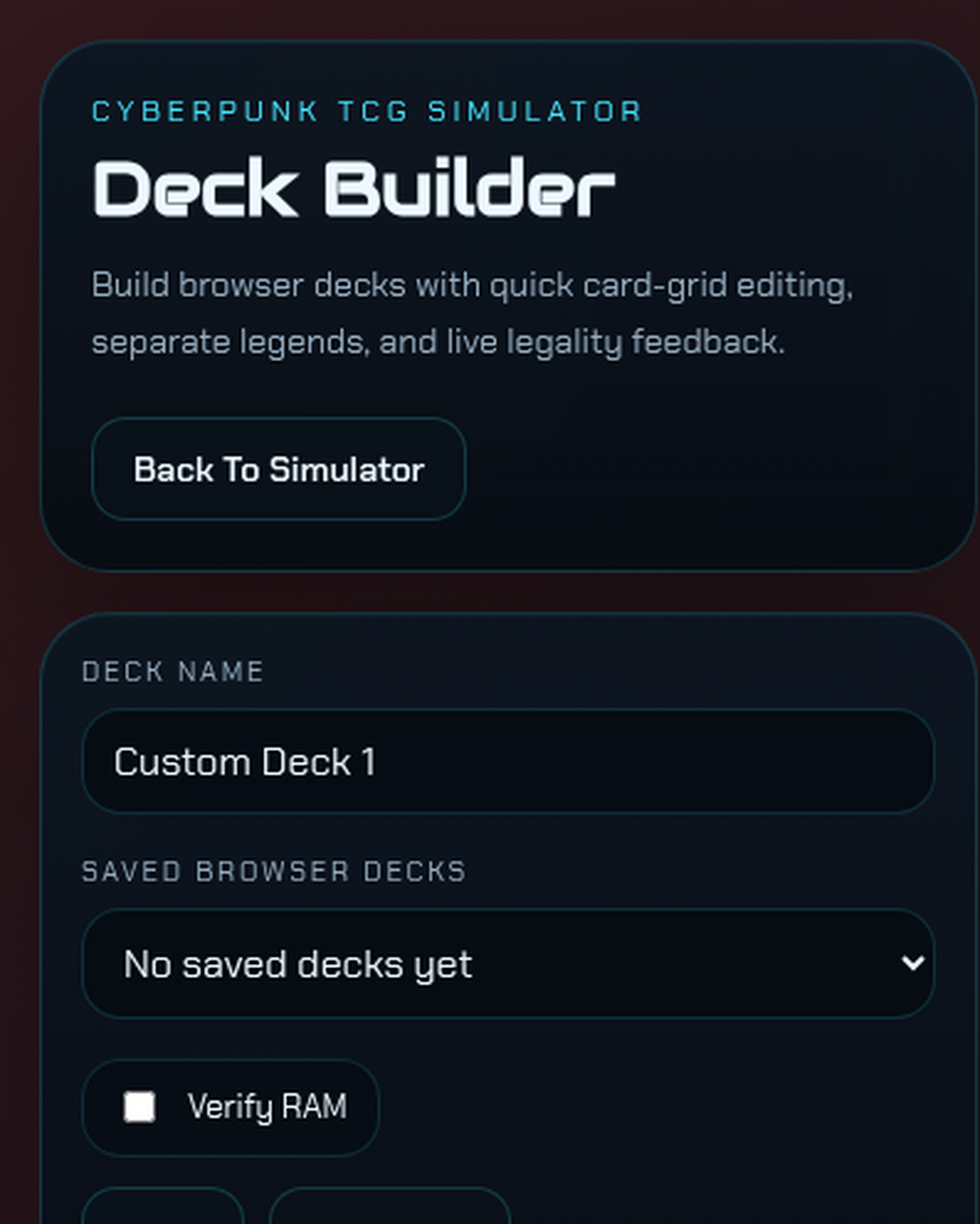
The integrated deckbuilder with 48 cards (consistent with the Netdeck count) uses an interesting data architecture: every card is its own JSON file under /cards/all_cards/adam_smasher_metal_over_meat.json and so on. Plus a master JSON with the index. That’s CDN-friendly, offline-cacheable, and delivers surprisingly good performance, even though the site theoretically makes 48+ individual fetch calls on load. You could call this „inefficient“ or „deliberately simple.“ No backend needed. No database. No auth infrastructure. All card data sits statically on the webserver, the user helps themselves. If the developer loses interest tomorrow, the site stays functional until the hosting subscription runs out. Most other tools in this scene depend on live Supabase projects and auth tokens. This sim doesn’t.
The deckbuilder has a „Verify RAM“ checkbox that can be toggled, for casual brews without a RAM budget, or for tournament prep with strict validation. Saved decks live in localStorage, no backend account needed. Import Deck accepts the collector-number format per the Google snippet („3x A027 / 1x MS01-131“). And the accessibility is pro-grade: every card in the library grid has an a11y label like „Adam Smasher – Metal Over Meat. Main-deck card.“ or „Alt Cunningham – Soulkilller Architect. Legend card.“ The card-type suffix in the screen-reader text spares blind users the guesswork.
One observation: the deck counter says „LEGENDS 0/3“ and „MAIN DECK 0/30-50“, so 3 Legends plus 30-50 main deck cards. The official rule on cyberpunktcg.com/gameplay-guide reads unambiguously: „Use exactly 3 Legend cards with unique names. Include no less than 40 and no more than 50 cards (not including your Legends). Use no more than 3 copies of the same card.“ The minimum is 40 main-deck cards plus 3 Legends, not 30. sim-online undershoots the official minimum by 10 cards: clear tool bug in the validation, not a rules-interpretation question. The sim allows decks that would be illegal by official rule. If you’re building for tournament prep, rely on tcgcyberpunk.com’s rule validation, which correctly enforces 40-50 main-deck cards plus 3 Legends.
For the use case, that doesn’t matter right now. Anyone who wants to test their new deck against a friend tonight clicks „Create Room,“ gets a 6-character code, sends it via WhatsApp, and plays. That’s the shortest path to the first match. And Choom.gg’s LFG link has been dropping users straight here since April 16. If that’s not an argument for tool cooperation in this scene, nothing is.
netdeck.gg: The Invisible Infrastructure
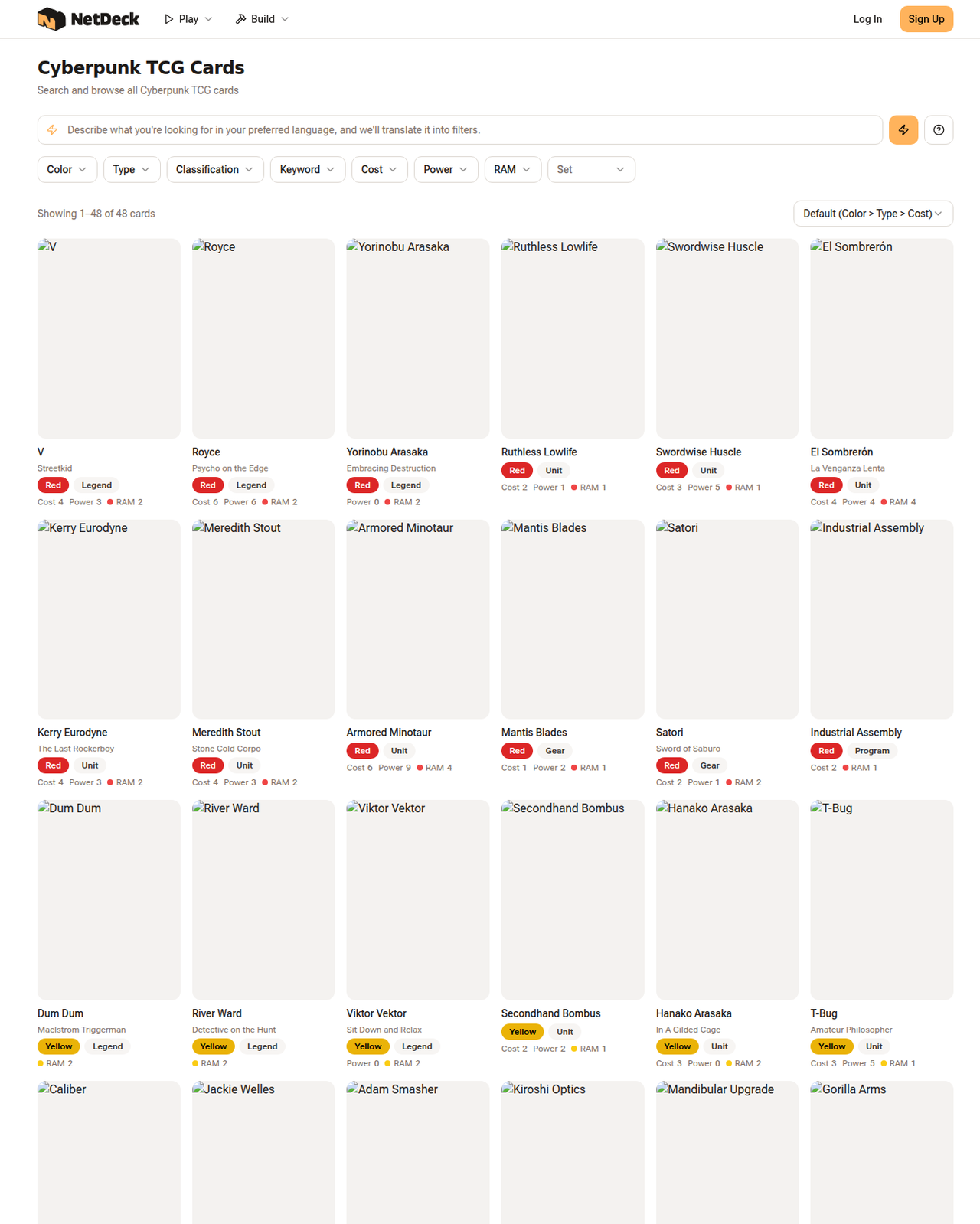
The paradox about Netdeck: it’s the tool that does the most work and gets named the least. Because when someone says „I’m checking the official card database,“ they end up on cyberpunktcg.com/cards, and that DB runs on Netdeck. The team stays in the background, whether by choice or design. No team page, no about page, no developer signature. Just the legal line in the footer: „Cyberpunk TCG, Cyberpunk, Cyberpunk 2077, Cyberpunk: Edgerunners, and related names, images, and marks are the property of their respective owners, including CD PROJEKT and its licensors. NetDeck.gg is not an official WeirdCo product and is not affiliated with or endorsed by CD PROJEKT.“
What happens on netdeck.gg/cards/cyberpunk is everything a professional card-DB frontend needs: 48 cards, filters by Color / Type / Classification / Keyword / Cost / Power / RAM / Set, sort by „Default (Color > Type > Cost)“ or a range of other criteria, card detail pages with SEO-friendly slugs (/cards/cyberpunk/alt-cunningham-soulkilller-architect, for example, „Soulkilller“ with three Ls is how it’s printed on the card, not a typo in the tool). And then the function Netdeck has all to itself: natural-language search. The text box asks: „Describe what you’re looking for in your preferred language, and we’ll translate it into filters.“ Behind the scenes, a smart-search endpoint (/api/smart-search/status) translates natural language into structured filters. None of the other Cyberpunk tools can do that. Type „show me all red Units under 3 cost with at least 2 power“ and you get the filters set automatically. For users who don’t want to click through all eight filter dropdowns, that’s a significant difference.
The platform is deliberately multi-TCG. „One account, every game.“ Supported alongside Cyberpunk are Magic, Pokémon, Yu-Gi-Oh!, One Piece, Lorcana, Flesh and Blood, Grand Archive, Cataclysm Arcade, Vibes, „+many more.“ For a single Cyberpunk user, that’s maybe overkill. For WeirdCo as a DB partner, it’s gold: Netdeck has the infrastructure, the experience, the API. WeirdCo provides the data, Netdeck hosts the facade, cyberpunktcg.com embeds it in the footer. Symbiosis. And from a user’s perspective: if you already have a Netdeck account to build your Lorcana deck, you build your Cyberpunk deck in the same interface, with the same keyboard shortcuts, the same sort logic. That’s fan infrastructure that works industry-wide.
The „Play“ and „Build“ dropdowns in the top nav suggest Netdeck has play-online features as well: Discord bots for card lookups, event matching, player finding. For Cyberpunk TCG, those features aren’t specifically activated yet (the Cards URL leads into the DB, not into a sim), but the space for them is reserved. If Netdeck decides to build a Cyberpunk sim too, it’ll probably be the first cross-TCG sim interface in the Cyberpunk ecosystem.
Lighthouse: 90 A11y, 100 BP, 100 SEO on Desktop and Mobile. Slightly below tcgcyberpunk.com, but that’s the multi-game UI using generic control elements for all games. The tracker stack is the most aggressive of the tools described so far: PostHog runs with session recording, dead-clicks autocapture, web vitals, exception autocapture, feature flags, and surveys. All in one bundle. That’s professional product analytics, which makes sense for a multi-game platform: they need the data to understand which games are doing well and which UI elements put users off. A consent dialog wasn’t visible during testing; GDPR transparency would be welcome here. Privacy-conscious users visit Netdeck only for targeted card lookups and take a peek with the browser inspector.
Netdeck isn’t for people looking for Cyberpunk flair. The UI is generic, the branding belongs to the parent platform. But as a card DB that, from the official fall launch onward, needs to stay current every single day, there’s no better candidate. Scryfall for MTG wasn’t the „prettiest“ tool at first glance in 2017 either. Scryfall won because it works. Netdeck can become the same here, and not after twelve years, but from the first retail booster onward.
ripperdeck.gg: Terminal Aesthetic and Rules Editorial
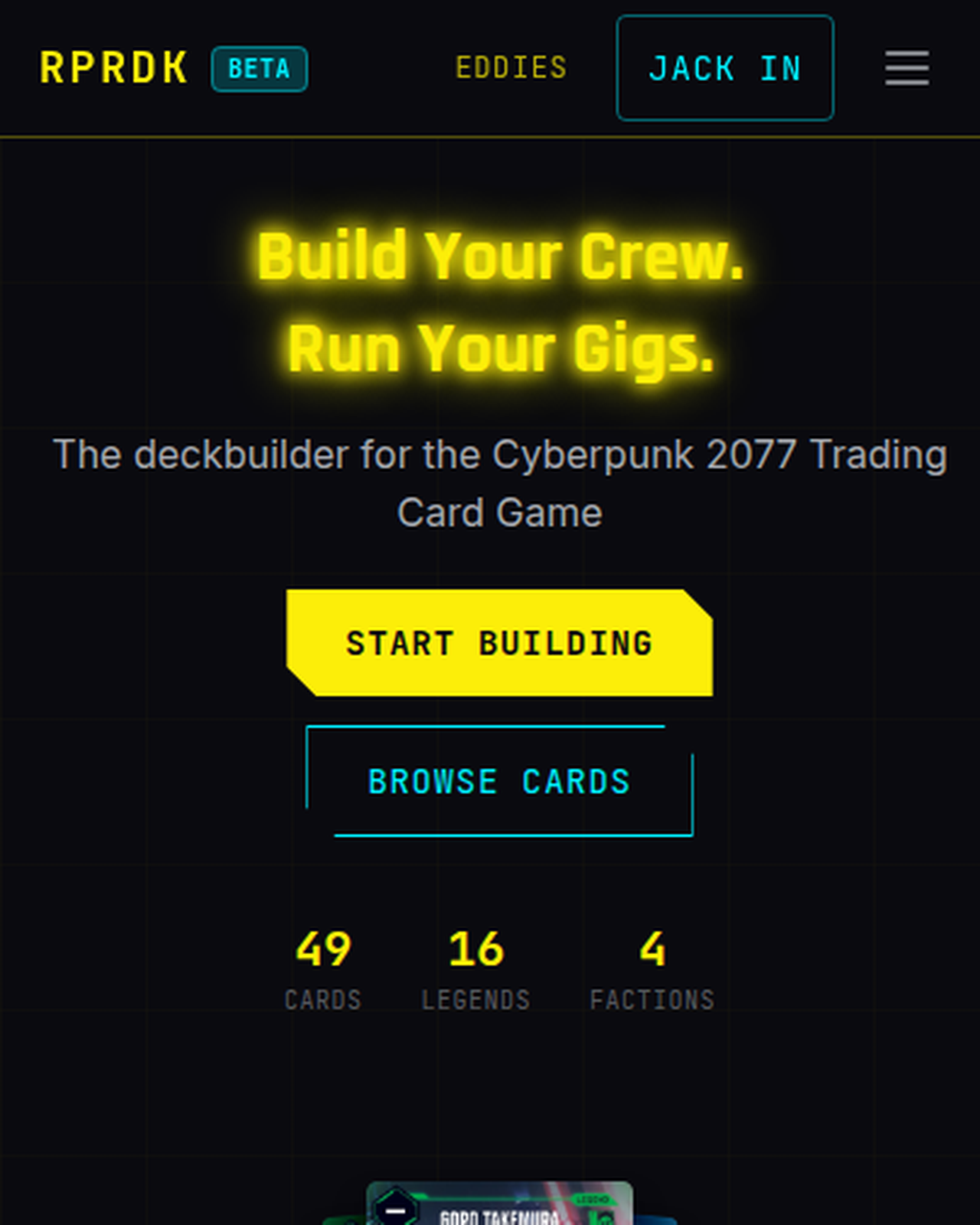
„RPRDK“ in the logo. A „BETA“ badge next to it. The navigation reads „EDDIES“ and „JACK IN“. The feature tiles on the landing page are called „// DECK_BUILDER.EXE“, „// DB_QUERY“, „// ANALYTICS.SYS“. Below the hero, the stats line reads „49 CARDS / 16 LEGENDS / 4 FACTIONS“. The terminal-cyberpunk theme is the most consistent in the entire scene here, more consistent even than the official site. If you want the genre vibe strongest in the UI, this is your spot. And if the name Ripperdeck rings a bell: ripperdocs are the Cyberpunk black-market doctors who put the chrome in. The naming says: here you build your deck the way Victor Vektor builds his patients, with care, with a plan, and a little street-cred attitude.
The 49 cards are a clue. Other tools show 42 (Choom), 46 (tcgcyberpunk), 48 (sim-online, Netdeck, Afterlife Decks), or 45 (cyberpunktcgmeta). 49 is more than the official count. The URL slugs give it away: alongside alpha-a* and promo-n*, there are spoiler-* variants. So Ripperdeck maintains its own spoiler set in parallel to the official DB, cards that surface in community leaks before WeirdCo officially lists them. That’s relevant for early brewers who want to prep for new archetypes without combing Discord channels for the latest reveals. The tool does the research for you. And when WeirdCo officially unlocks the cards, they’re already there.
The second distinctive feature: Ripperdeck maintains its own Rules/FAQ/Glossary pages. No other tested tool (apart from cyberpunktcg.com itself) has its own rules editorial. Linked in the footer: Cards, Build a Deck, Rules, FAQ, Glossary, Privacy, Terms. If you want to look up a rule and the official site isn’t helping right now (or you’d rather not deal with the official FAQ), you get a second perspective here. The fact that Ripperdeck has Privacy and Terms pages is also a sign of professional ambition. Most fan tools skip the legal bits.
The deckbuilder itself is Next.js with Turbopack, Supabase backend (gwupeldmdknkipmnuiwt.supabase.co for card images), real-time validation (3 Legends + up to 50 cards, Eddie Curve + RAM budget live), its own analytics under /decks/new. The feature tiles describe it precisely: „Build with 3 Legends and up to 50 cards. Eddie curve, RAM budget, and card limits update live.“ „Eddie curve“ is the Cyberpunk-flavored term for cost curve: eddies are the currency in Night City, so the tool counts how many eddies you have per cost tier.
Lighthouse: 96 A11y, 100 BP, 100 SEO on Desktop and Mobile. Tracker list: Google Analytics (G-780J4GB0CQ) and Vercel Insights. No AdSense, no NitroPay. The „Eddies“ nav component suggests planned monetization, maybe an in-app currency or cosmetics for logged-in users. The feature isn’t active yet, but the BETA badge hints that more is coming.
What Ripperdeck actually does better than some tools with more features is the feel: land here and within two seconds you know what kind of site you’re on. The design commitment is total. Every UI element, every typography choice, every icon label sits in the genre. That’s something even the official cyberpunktcg.com doesn’t quite pull off as consistently: the official site always keeps one eye on the parents (mainstream TCG players). Ripperdeck keeps an eye on nobody. This is a site that says: I’m for chooms who already know their way around Scryfall and jinteki.net and now want a home for their Cyberpunk mode.
If you want a standalone deckbuilder without needing the trade-market breadth of tcgcyberpunk.com or the companion functions of Choom, you get the most straightforward offering here, and you can take the rules page as a learning reference while you’re at it.
afterlife-decks.vercel.app: V4MP and the Secret Roadmap
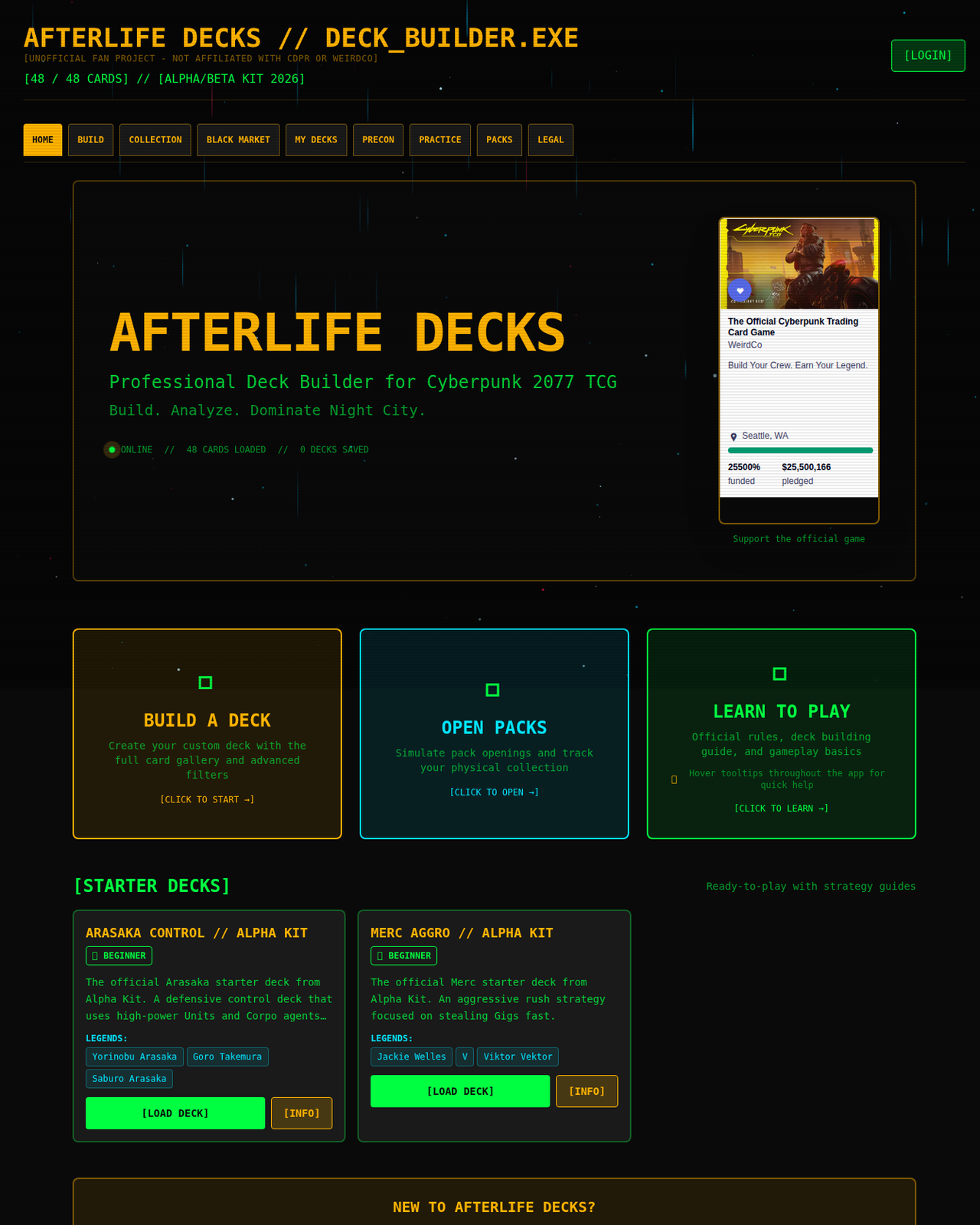
Afterlife Decks is the tool hero nobody has on their radar because it lives on a vercel.app hobby domain. The URL suggests „someone uploaded this on a weekend.“ The reality during testing: a seriously developed tool with visible developer signature, documented keyboard shortcuts, and a secret roadmap you only find if you watch network requests.
The footer says something that doesn’t appear anywhere else in this scene: „Built by // V4MP.“ That’s the only direct developer attribution on a tool site I found. All the other tools hide their developers in Discord or keep them completely anonymous. V4MP stands by his work, with a Cyberpunk-stylized handle, but publicly signed. If you want to ask around on the WeirdCo Discord who that is, „V4MP“ gives you a direct anchor. That’s a level of transparency rare in this scene.
The feature list has nine main tabs: HOME, BUILD, COLLECTION, BLACK MARKET, MY DECKS, PRECON, PRACTICE, PACKS, LEGAL. Two of these features are unique in the scene:
PACKS is a pack-opening simulator that, together with the collection tracker, simulates the pull-rate experience. For people who want to understand, before the retail purchase, what 6 Commons / 3 Uncommons / 2 Rares / 3 Iconic variants feel like when they rattle out of a booster, it’s pure gold. After the pull-rate debate that ran for weeks on the Kickstarter forum and various TCG YouTubers, a simulator like this is the most practical answer to the question „Is this really fair?“ You crack ten virtual boosters and see what comes out.
PRECON contains two pre-built Alpha Kit decks: „ARASAKA CONTROL // ALPHA KIT“ (Yorinobu, Goro, Saburo: „A defensive control deck that uses high-power Units and Corpo agents to dominate the late game“), and „MERC AGGRO // ALPHA KIT“ (Jackie, V, Viktor: „An aggressive rush strategy focused on stealing Gigs fast“). Both with strategy descriptions at beginner level. That’s not a small amount of work: someone sat down, analyzed both Alpha Kit decks, categorized them, and condensed them into two sentences so newcomers can start with a gameplan. No other tool delivers onboarding this concrete.
Then the detail that amused me most: the footer lists keyboard shortcuts. Ctrl+S Save Deck, Ctrl+F Search, Ctrl+E Export, Ctrl+B Feedback, ESC Close. That’s power-user level, the kind only professional dev tools document. Next to it a „Send Feedback“ button for bug reports. And at the top, a note about hover tooltips: „ⓘ Hover tooltips throughout the app for quick help“. That’s not hobby, that’s product thinking. V4MP made design decisions that favor power users, and documented them so nobody has to guess.
And during the network check, a Supabase request fired on /rest/v1/feature_flags?feature_name=eq.phase9_simulator. Afterlife Decks has a feature-flag system, and one of the flags is called „phase9_simulator.“ V4MP is building his own simulator in „Phase 9.“ That’s a documented roadmap that isn’t even communicated on the tool’s surface. Look closer and you see the next step. When Phase 9 goes live and Afterlife presents its own sim alongside pack simulator, precons, keyboard shortcuts, and black-market trading, it’s suddenly no longer a „hidden gem“ but a serious all-in-one competitor to tcgcyberpunk.com.
PWA installability is there too (registerSW.js + sw.js), the tool is offline-capable. Tracker stack: zero. No GA, no AdSense, no PostHog. Just its own Supabase for data and service worker for offline. One of the cleanest privacy records in the test. V4MP apparently has no plan to monetize the tool with ads: either Ko-fi donations or it stays a passion project.
The one actual weak spot in testing was that Lighthouse timed out twice on network emulation. I couldn’t measure objective performance numbers. Manually, the site felt responsive, and the audit failure is probably a Chrome protocol issue, not a tool issue.
Afterlife Decks is the most underrated tool in this scene. If you value feature depth with an invisible roadmap and, as a bonus, want the only fan tool signed with a name, you land here right.
chromevibe.vercel.app: Printing Proxies Like a Choom
The Discord drop was what kicked off this article. April 15, 2:49 PM, Tobias aka „To Jo“: „Vibed together a deckbuilder where you can export a PDF with cutting guidance to print proxies.“ One sentence, one link, done. In a scene where a game isn’t even on shelves yet, a PDF export with cutting guidance is what a lot of fans need most: anyone who wants to run playtests with printed proxies at home now has a tool for it. Toploader on, laminate, cut, play. That’s the kind of workflow optimization no official tool delivers, because the manufacturer of course prefers to sell real boosters, but the community runs on it.
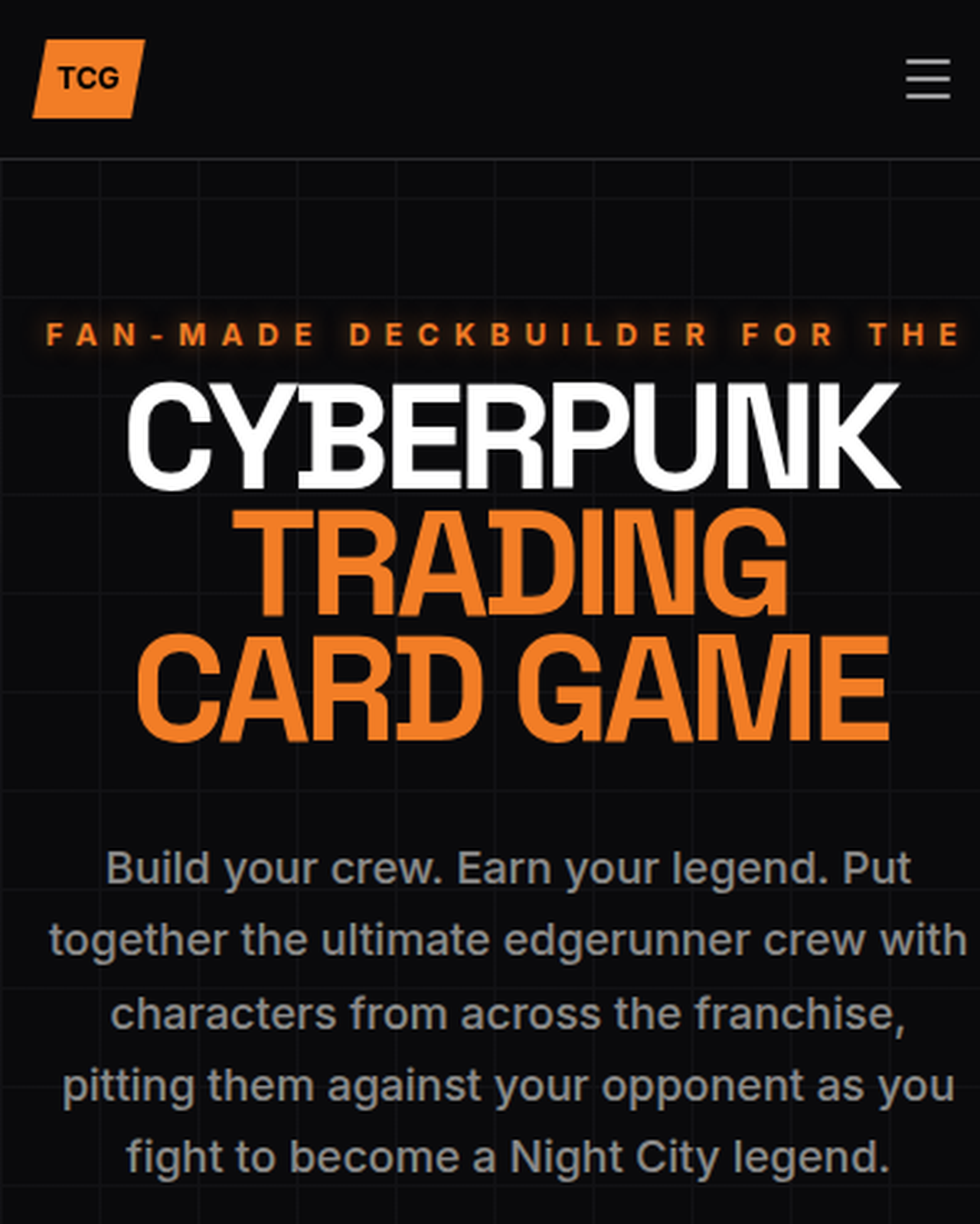
Chromevibe isn’t just a proxy export tool, though. The landing page is noticeably more developed than Tobias‘ Discord announcement suggests. „FAN-MADE DECKBUILDER FOR THE / CYBERPUNK TRADING CARD GAME“ sits in the hero. Below it, a detailed description: „Build your crew. Earn your legend. Put together the ultimate edgerunner crew with characters from across the franchise, pitting them against your opponent as you fight to become a Night City legend.“ That’s no longer a laconic developer one-liner, that’s marketing copy, and it hits the Cyberpunk vibe.
Trending Decks prominent on the landing page:
– „GEAR AND CARDS“ (Viktor Vektor / Dum Dum / V, 30 Cards, 6 RAM)
– „RANDOM DECK 1“ (Jackie / V / Viktor, 30 Cards, 6 RAM)
– „RED YELLOW BLUE DECK1“ (Royce / Lucyna / Viktor, 30 Cards, 6 RAM)
Those are apparently demo/sample decks in the public feed. „30 CARDS / 6 RAM“ per deck, showcase numbers that sit below the official 40-card minimum. Probably placeholder decks for UI demonstration, not tournament-legal example builds. Build a real deck on Chromevibe and you land in the regular 40-50 range; the trending tiles are more front-page filler for a young feed still waiting on real user submissions.
Features section with three tiles that pay respect to Cyberpunk lore: FAST-PACED COMBAT („Engage in high-stakes battles using a unique combat system designed for strategic depth and quick decision-making“), LEGENDARY CREWS („Recruit iconic characters like V, Johnny Silverhand, and Adam Smasher to build the ultimate edgerunner team“), and NETRUNNING DEPTH („Hack the system with powerful programs and quickhacks to gain the upper hand in the digital battlefield“). Reads like the Kickstarter campaign description, but on the fan-tool page: Tobias is selling the game along with it.
Account section „READY TO EDGE?“, auth via Discord login (OAuth). The only tool in the test that uses Discord login as primary auth („ONE-CLICK JOIN WITH DISCORD“). That’s clever, because the target audience hangs out on the WeirdCo Discord anyway. No new account system, no password resets, just the Discord account. Logged in, you get: „SAVE PRIVATE DRAFTS TO YOUR LIBRARY“, „PUBLISH DECKS TO THE GLOBAL FEED“, „TRACK YOUR CARD COLLECTION (COMING SOON)“, „UPVOTE & FORK COMMUNITY BUILDS“. The fork feature is the GitHub-style community mechanic nobody else has: want to tweak someone else’s deck, fork it, and build your own. Version control for decks.
The Official Resources section at the bottom of the landing page actively links to cyberpunktcg.com („Rules, cards, and news about the game“), the Kickstarter campaign („Back the project and get exclusive rewards“), and the official Discord („Chat with other players and the game’s creators“). That’s community-friendly behavior no other deckbuilder tool does in this form. Tobias isn’t positioning himself as „competition to the official site“ but as „supplement.“ That’s good form.
The PDF proxy export feature, the title reason this article gets written at all, I couldn’t isolate on the surface in the quick test. Evaluate scripts for „PDF“, „PRINT“, and „PROXY“ in the DOM text came up empty on the public pages. The feature exists: Tobias announced it, and it’d be an unusually creative fake claim for him to make it up. But it’s probably hidden behind the deck-build flow, for users who’ve built a complete deck and (maybe after login) are ready to export. To see it live, build yourself a deck and try the export. I trust Tobias‘ Discord announcement and will fact-check this on the next pass with a test account.
Lighthouse Desktop: 95 A11y, 96 BP, 92 SEO. Mobile same. The lowest SEO score in the group, but still well above the acceptance threshold. Tracker stack: Vercel Analytics plus Vercel Speed Insights, nothing else. No third parties. That’s the second-cleanest privacy record after cyberpunk-tcg-sim.online. The backend is its own Supabase project (evlxbewvsgrlncvtagmf.supabase.co), not shared with Choom or Ripperdeck: every tool has its own Supabase, nobody shares backend infrastructure.
Chromevibe is the tool that feels most „vibed together“, and I mean that as a compliment. It’s not polished like tcgcyberpunk.com or dense like Afterlife Decks, but it puts the proxy PDF export right at the front of the landing page (ExBurst offers a „Print Proxies“ export function too, but buries it in a menu: on Chromevibe it’s the naming theme). Plus a Discord OAuth mechanic that’s a perfect fit for the audience, a Trending Decks feed with upvote and fork, and a stance toward the official channels that’s distinctly cooperative. For Kickstarter backers who want to proxy-print their Set 1 Alpha Kit deck and play in May, Chromevibe is the direct route.
exburst.dev/cyberpunk: The Pro with 11 Languages
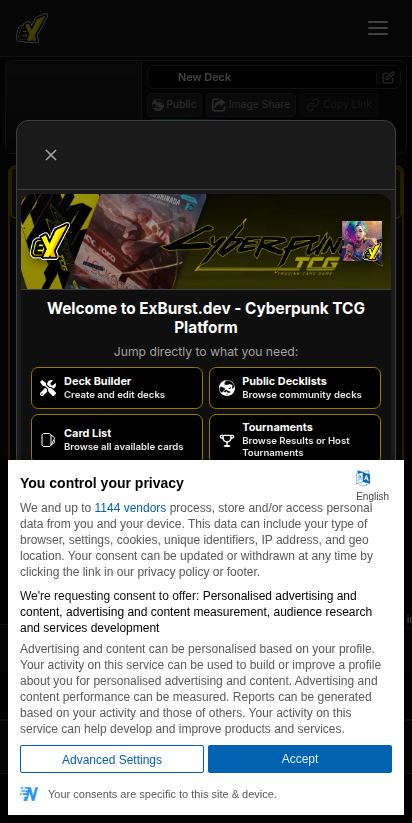
First visit to exburst.dev/cyberpunk/deckbuilder runs you through a Cloudflare Turnstile challenge. That’s fine, Meta does it too. Afterward, a deckbuilder interface opens that plays in a different league in this scene. Filter panel with twelve dimensions (Color, Type, Rarity, Sets, Cost, RAM, Power, Attribute, Source, Generate Resources, five Collection filters). Filter presets (Save / Open). Lock-filter function that protects specific filters from „Clear all.“ Quick-filter marking via lightning symbol. Main Deck (0/50) plus Side Deck (0): no other tested tool has side-deck support. Whether Cyberpunk TCG supports side decks in the official rules is an open fact-check question, but ExBurst has the infrastructure ready.
On top of that, the internationalization: eleven languages on offer, including Deutsch, English, Español, Français, Italiano, Nederlands, Polski, Português, Limba română. It’s the only Cyberpunk TCG tool with real language support. For the global community expecting the first retail push around the German, French, and Spanish markets, that’s valuable. A German native speaker can build a deck here in a German interface and understand the card texts.
ExBurst is a multi-game platform. Cyberpunk is under /cyberpunk/, one of several sub-paths, much like Netdeck hosts multiple games. That has pros and cons. Pro: the infrastructure is established, the features are production-grade (user-level system with Level 1/5/9 icons, avatar customization, tournament integration, community hub). Con: the Cyberpunk branding is understated, the UI generic. If you want Night City flair, you end up at Ripperdeck or tcgcyberpunk.com.
Feature depth is impressive. Collection management has five independent filter dimensions: Collected (Yes/No), Owned Count (0/1/2/3/4+), For Trade (Yes/No), Wanted (Yes/No), Ignored (Yes/No). Granular beyond what any other tool offers. Got ten cards in your binder and want to filter the „available for trade“ list? One click. The +ALT badges on some cards show the tool understands and separately lists alternate-art variants. The user-level system with level icons and avatars is gamification at a level unusual for a TCG deckbuilder site: someone thought about how to turn a deck tool into a community platform.
The tracker stack is this tool’s most distinctive feature. On arrival, a NitroPay consent dialog appears: „We and up to 1144 vendors process, store and/or access personal data from you and your device.“ That’s the most aggressive ad-tech integration in the entire test, and honestly documented. Click „Advanced Settings“ and you can go through partners individually. A „Remove ads“ link leads to linktr.ee/exburst, so a premium upgrade path. ExBurst finances itself through ads, and the funding explains the feature depth. This is a commercially run tool, not a hobby project, and that’s fine, as long as users know it. On top, Cloudflare Insights (static.cloudflareinsights.com/beacon.min.js) loads: first-party perspective, but tracker stack on top of NitroPay.
Lighthouse failed twice on ExBurst with network-emulation timeouts, probably because of the combination of Cloudflare challenge and ad-script initialization. Manually, the site runs responsively after the challenge passes.
For whom? For competitive players who need side-deck support, tournament integration, and multiple languages. For users who don’t worry about ad tech. If you want a pro tool and tolerate the advertising, you find the deepest feature environment here by far. And if you don’t want your German Cyberpunk TCG experience to be in English the whole time, ExBurst finally offers a localized alternative.
cyberpunktcgmeta.com: The Tier-List Promise
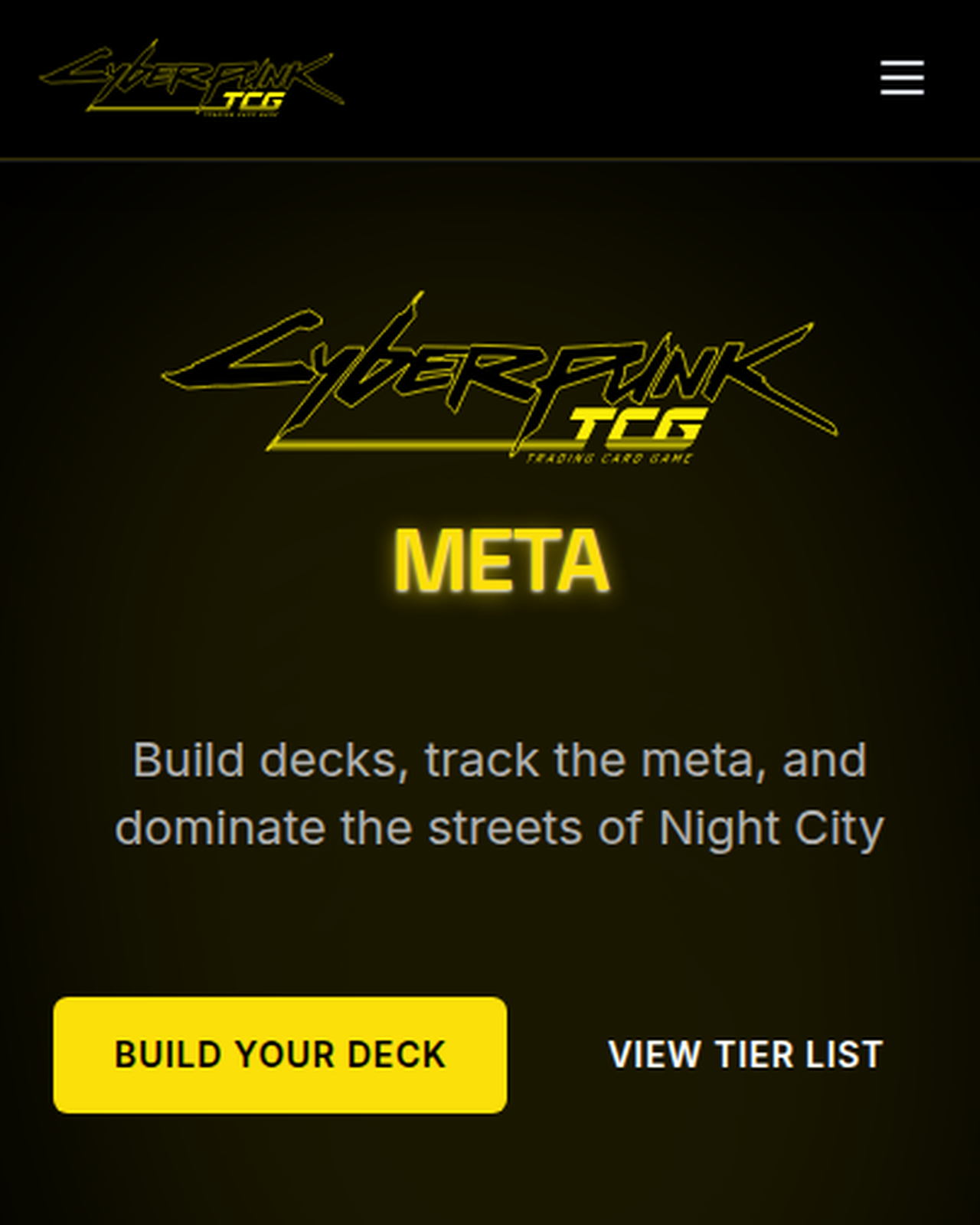
Cyberpunktcgmeta.com positions itself clearly as a tier-list and meta tracker. The landing page has „BUILD YOUR DECK“ and „VIEW TIER LIST“ as two equal CTAs, and in the feature grid, Tier List comes first: „Stay updated with the latest meta rankings. See which decks and strategies dominate Night City.“ Next to it: tournament tracking, strategy guides, deckbuilder, card database with 45 cards.
In testing, it became clear that some of these features are still placeholders. The stats line says „- Decks Tracked“ and „- Tournaments“. The „-“ isn’t a typo, that’s the current state. The tool has the ambition, but tracking isn’t live yet. The guides section has three entries, „New Card Spoilers“ from March 6, „A Beginner’s Guide“ from February 6, „Deckbuilding and Competitive Depth“ from February 6, with editorial work, but since early March no new articles have been added. That’s normal fan-project pace (we all have lives), but in the meta-tracker space, you need regular updates or the format loses relevance.
Among the distinctive features: cyberpunktcgmeta.com is the only tested tool with an explicit contact email in the footer (contact@cyberpunktcgmeta.com) and its own Discord server (discord.gg/cyberpunk-tcg-meta), separate from the official WeirdCo Discord. That shows a certain ambition to build a separate community rather than integrate into the existing one. Whether that approach pays off depends heavily on whether the operators can keep activity up. Your own Discord with three users isn’t a community asset; your own Discord with 500 users is.
The landing page has an embedded Kickstarter video („Cyberpunk TCG Official Kickstarter“): no other tool does that. It’s almost marketing-like. And the site links the official channels in the „Follow Cyberpunk TCG“ section: Kickstarter, cyberpunktcg.com, X, Instagram, Discord, YouTube. Same cooperative stance as chromevibe.vercel.app, no competitive positioning, but explicit links to the official sources.
On the performance side, an interesting measurement artifact happened: Lighthouse reported Desktop SEO 42. Reason: the Cloudflare Turnstile challenge blocks the audit bot, and Lighthouse measures the challenge-wait page instead of the actual content. For real visitors it’s less dramatic, but automated crawlers (like Google itself is one) hit the same problem. If you want to build an SEO-heavy meta hub, you have to soften the challenge wall or replace it with different bot protection, otherwise Google doesn’t see the site. Accessibility 91 and Best Practices 96 are solid.
In the footer, there’s an old-school detail nobody else in this scene does anymore: a „Keywords: cyberpunk tcg, cyberpunk tcg deck builder, cyberpunk cards, cyberpunk tcg cards, card database, tier list, competitive decks“ list. That’s SEO tactics from the early 2010s. Google stopped weighting keyword-stuffing footers a long time ago, but the intent is clear: the tool wants to be found. The classic SEO baseline is there (meta descriptions, structured data), the keyword listing is just extra overhead.
The tool has big potential and a clear USP: competitive meta tracking exists nowhere else. If the placeholders get replaced with real data, the guides series gets moving again, and the Discord community grows, cyberpunktcgmeta.com will become an important part of the ecosystem. Right now it’s the candidate with the biggest growth potential, and the highest expectation bar. The operators want to build tier lists, but tier lists require matches, require tournaments, require meta data that nobody in the Cyberpunk TCG scene is systematically collecting right now. That’s a chicken-and-egg problem: only when the official organized-play program runs in the fall will the data appear that tier lists can build on. Until then, the tool is in standby mode.
The Honorable Mentions
Three stories belong in this article, even if they don’t merit their own tool reviews, because they’re not live, not finished, or no longer playable. All three say something about the ecosystem.
Gniih’s Tabletop Simulator mod was a Workshop entry under Steam Workshop ID 3651358337, title „Cyberpunk TCG (Fan made)“. 278 subscribers, 516 unique visitors, last update April 9, 2026. A 1v1 playtest mod for Tabletop Simulator, with its own deck-building function and the Alpha Kit as the card pool. As of the April 17 test, the page carries a content-removal notice: „This item has been removed from the community because it violates Steam Community & Content Guidelines.“ That’s the flip side of the WeirdCo permission policy that so obviously benefits tcgcyberpunk.com: where card images and game assets are shipped directly in the mod, takedown hits. Web tools that only reference public-domain card names and slugs stay up. For Gniih it’s bitter, but system-consistent. Honorable mention anyway: 278 subscribers on a fan mod for a game that doesn’t officially exist yet is a signal that the appetite for physical simulation is there. And who knows, maybe a TTS path emerges that’s WeirdCo-compliant (say, no card image, only user imports). Then Gniih comes back.
Pixelborn is the other side of the fan-sim story. Pavel Kolev, the developer behind Pixelborn, originally became known with a Disney Lorcana client that Disney stopped with cease-and-desist in 2024. The client was then adapted to Riftbound TCG and currently runs in three variants: Pixelborn Connect (webcam-ranked games), Pixelborn Pulse (semi-automated simulator), Pixelborn Live (TCG tracker, also available as an iOS app). In the December 2025 Patreon report (published January 5, 2026), Kolev announced extending the client to CookieRun and Cyberpunk as the next integration. His words: „The new Pixelborn Pulse performed quite well but did not meet Riot’s criteria for Riftbound. At this point I plan to focus on bringing it to CookieRun and Cyberpunk.“ Lovecore confirmed on April 16 in the Choom Discord statement: „I’m also in touch with the Pixelborn team about a direct integration.“ The Cyberpunk TCG rollout is no longer just rumor but sits in the public Pixelborn roadmap and is in active talks with the Choom dev. No hard dates, but the result will be, if it comes, a full digital client with full-animation gameplay, like Magic Arena or Hearthstone. That’d be the first of its kind for Cyberpunk TCG. And Kolev brings experience: he already built a client that Disney stopped because it was too good. This time on a manufacturer-friendly course.
The GitHub repos are the third wave still running in the engine room. A search for „cyberpunk-tcg“ returns between one and two dozen repositories. Russeus/CyberpunkTCG-TCGA (JavaScript, active, 44 commits). Valithor/Cyberpunk-TCG-Deckbuilder (Next.js + TypeScript + shadcn/ui, 17 commits, cleanly structured, no live URL yet). daboozed/cyberpunk-tcg aka „Neon City Duel“ (Vue.js + Vite + Tailwind, 985 commits, Base44 platform app, very active). Sam-Brad/Cyberpunk_TCG_Runner (Java terminal app with Alpha Kit cards and rules, for people who want to play a TCG in the command line, which requires a very specific personality). YCOD3V/CyberpunkTCGChile (HTML, Chilean community, a Latin American scene building its own platform home). None of them is a deploy-ready tool at the level of the reviews above, but together they say: the next wave is already building. When a new community tool launches in six months, it probably comes out of one of these repos. And the GitHub topic „cyberpunk-tcg“ has no topic tags yet: nobody has activated the topic hub. That’ll be the next step in ecosystem maturation: a central GitHub identity where developers can organize.
What’s Still Missing, What Would Be Nice?
Even in an ecosystem this complete this early, there are gaps. Here’s a wishlist for the summer and fall, the months before retail.
A real meta tracker with live data is missing. cyberpunktcgmeta.com has the ambition, but the stats are still placeholders. The problem is structural: there’s no official competitive tournament calendar yet, so no data stream from which top decks can be extracted. Once WeirdCo launches the organized-play programs in the fall and the first sanctioned events run, the scene needs someone to aggregate tournament decklists, track win rates, and justify tier lists. That’s the niche cyberpunktcgmeta.com could fill, or a new player. Limitless TCG took this role for Pokémon so successfully that tournaments now push their results directly there. If Cyberpunk TCG gets even half that good, it needs exactly such an aggregator.
An odds calculator or pack simulator with real-time inputs would be good after the pull-rate debate. Afterlife Decks has a pack simulator in the collection integration, but no tool shows the question „If I buy X boxes, what’s the probability I get all Iconic Rares?“ with slider input. The pull rates are officially documented in Kickstarter Update 25, the math behind it is solvable: a toolmaker who likes probability visualization could genuinely contribute something new here. That’s the classic case of a Python script that becomes a Streamlit app that becomes a permanent web app.
A price tracker post-retail will become acute in the fall. Once singles hit TCGPlayer, Cardmarket, or eBay, the community needs a central price aggregator. tcgcyberpunk.com has prepared infrastructure for a marketplace with AFTERLIFE, but a neutral price index across multiple platforms is still missing. The use case is clear: who knows whether the $60 Iconic Rare will drop further before buying? For MTG, mtggoldfish.com and cardkingdom.com do that. The Cyberpunk equivalent is still to be built.
Synchronization of the tools with the official rule is still pending. The official spec on cyberpunktcg.com/gameplay-guide is unambiguous: 3 Legends plus 40-50 main-deck cards (without Legends), so 43-53 cards total. The test field was mixed. tcgcyberpunk.com implements the rule correctly (minimum 40 main-deck cards). cyberpunk-tcg-sim.online, on the other hand, shows „3 Legends + 30-50 Main Deck“ and allows decks under the official minimum. Chromevibe’s trending demo decks sit at „30 CARDS / 6 RAM“, presumably placeholders or simplified showcase decks, not tournament-legal. These are tool bugs, not rules ambiguities. If WeirdCo publishes an official rules PDF with a sanctioned-format spec this summer, the tools should align their validation. That’s not a fault of the fan scene, that’s a sign of the times. MTG had comparable conditions from 1993-1995, until the Comprehensive Rules came out in 1997. Convergence will happen; it just takes a bit.
The Pixelborn integration would be the biggest leap. Right now cyberpunk-tcg-sim.online runs as the quiet, perfect Hot Seat sim. Pixelborn would lift this scene to a new level with fully animated battle sequences, ranked ladder, persistent profiles, and app-store availability. Kolev has it on the roadmap, Lovecore is talking with the team. If it comes this winter, the entire sim experience changes. And Afterlife Decks is planning its own sim in parallel: „phase9_simulator“ is what the feature flag is called. That’s two competing sim projects that could go live in the coming months. Competition is good for users.
Better cross-tool deck codes would be the quiet quality-of-life improvement. Right now every tool exports in its own format: tcgcyberpunk to .txt/.csv, Chromevibe in its internal structure, Choom with QR code, ExBurst with publish/private toggle. Importing a deck from Ripperdeck into sim-online usually means manual transfer. A community standard, similar to MTG’s „MTGO“ format or Pokémon TCG’s „PTCGO“ format, would simplify the workflow considerably. But that’s a coordination problem, and nobody currently has the hat for it. Maybe it’d be a topic for a shared Discord channel where the tool authors agree on a minimum format.
An official or fan-made rules wiki alongside cyberpunktcg.com/rules is missing. Ripperdeck has its own Rules/FAQ/Glossary pages, tcgcyberpunk.com shows only the validation rules in the deckbuilder, the rest of the tools link to the official site or leave it out. A searchable, complete rules wiki with card-text rulings (analogous to MTG’s „Gatherer“ or Pokémon’s „Judge Rulings“) would help tournament refs and community disputes. That’s a task for the year after Set 1, when the first edge-case rulings emerge.
Finally: a mobile app in the store. Three tools are already installable as PWAs (Choom.gg, Afterlife Decks, probably also chromevibe.vercel.app). But a native app in the App Store / Play Store that retail backers can carry into the store on their tablet doesn’t exist yet. seikiro’s „can be done yeah“ to Max’s Discord question leaves hope, but until then the PWA route is the workaround. Meaning: every Cyberpunk TCG player should know how to install a PWA on their phone: that’s the bridge between browser and app this scene currently uses.
Why All of This Is Here
For this article I tested nine active tools, declared one dead, sent two to honorable mentions, noted three fact-check open points, took forty-plus screenshots, and ran eight Lighthouse audits. Three of those failed, one delivered 100/100/100 (respect, sim-online). Along the way I found out that the official card database runs on fan infrastructure, that WeirdCo grants permission selectively, that Lovecore built not only Choom but also Comboforge and Riftboundrules, that V4MP is the only developer who signs his own tool site, and that Pixelborn really is working on Cyberpunk TCG and not just on rumor.
If I have to name one number that tells the story of this scene, it’s this: nine active tools, three-hundred-plus fan-mod subscribers (before the takedown hit), at least ten GitHub repos in development, plus a digital-client project (Pixelborn) incoming. All within three months of the Kickstarter launch, a full year before retail. Magic took twelve years for that. Altered took six months, and Altered was considered very fast in the industry. Cyberpunk TCG does it in three. The scene is hungry, the tools are built, and the cross-integration has already started.
Names belong here. seikiro [RIFT], keep building on tcgcyberpunk.com, the permission thing was a coup, and the DRAW 7 feature is pure UX love. Lovecore [RIFT], the sim integration in less than a day after the announcement was impressive, and keeping comboforge.gg and riftboundrules.lol alive in parallel makes you the quiet commodity champion of the multi-TCG scene. V4MP, I’m most looking forward to your Phase 9 simulator, and signing your own site is fair play at a level nobody else in this scene shows. Tobias „To Jo“, the PDF proxy export is exactly the feature the scene needs right now, and using „vibed together“ as a project description fits the Cyberpunk DIY spirit: bluster costs street cred, keeping it small like you do earns respect.
The Netdeck team, anonymously running the official DB in the background: thanks for not seeking the spotlight. The sim developer whose name I couldn’t find publicly anywhere: thanks for the most perfect Lighthouse result in the test and the „just make it functional“ design. The Ripperdeck crew: thanks for the most uncompromising terminal theme in the scene. The cyberpunktcgmeta folks: start posting again, you have potential sitting in placeholder. ExBurst: thanks for the German localization, even if the ad stack takes getting used to.
If you’ve built a tool that isn’t in this article, reach out. If you’re building one that goes live in three months, even more so. The directory box below is the starting point for people who want to click through directly. The reviews above are for everyone who wants to understand first what they’re getting. And the rest of this summer is for everyone playing the first season on the kitchen table with proxies.
The ecosystem stands. Time to draw cards.
Tool Directory
- afterlife-decks.vercel.app: V4MP’s deckbuilder with pack sim, precons, and keyboard shortcuts
- choom.gg: Lovecore’s Night City companion with LFG, PWA, and blog
- chromevibe.vercel.app: Tobias‘ deckbuilder with PDF proxy export and Discord OAuth
- cyberpunktcgmeta.com: tier-list and meta-tracker ambition with its own community
- cyberpunk-tcg-sim.online: perfect-score online sim with rooms and public lobbies
- exburst.dev/cyberpunk: pro deckbuilder with 11 languages and side-deck support
- netdeck.gg/cards/cyberpunk: multi-TCG backbone with AI natural-language search
- ripperdeck.gg: terminal aesthetic with its own rules/FAQ/glossary editorial
- tcgcyberpunk.com: seikiro’s full-ecosystem flagship with permission, Trade Binder, and AFTERLIFE market

// KOMMENTAR (1)
[…] April 17, 2026 > LANG.status() → current: 🇩🇪 DE $ This article is also available in 🇬🇧 EN → read English version […]