Cyberpunk TCG Starters Ship One Copy Short
AI TRANSLATION NOTE
This is the English edition of a deep-dive originally written in German. The translation was AI-assisted and human-reviewed for terminology, lore accuracy, and Rogue-persona tone. All direct quotes from Cyberdeck Podcast Episodes 21 and 22 come verbatim from the original English broadcast, not back-translated from German. The original German article is available at cyberpunk-tcg-news.de.
„Wow so to have a 3 full playable copies of each exclusive card you need to buy each starter deck twice??😢 Worst tactic ever 😮“ That comment sits under WeirdCo’s gameplay video, written by @nikosnikosnikosss, and anybody who only reads the decklists has to concede the point. Embracing Power ships two copies of Minotaur and two copies of Goro Takemura – Losing His Way. The Heist ships two copies of Dexter DeShawn – One Last Chance and two copies of MT0D12 Flathead. You’re allowed three. So one is missing from each box. Straight up: that looks bad.
The complaint that beat the answer
That comment didn’t stay alone. Under the podcast episode, @1nval1dnam3 wrote that starter-exclusive cards are „a crappy thing though. It’s already annoying in OnePiece“, and then asked the question a lot of people were chewing on: „Or at least please tell me, that ‚exclusive‘ only means exclusive art…“.
There’s a second side to this, and it comes out of the same comment section. @UnboxtheUniverseLive pushed back: „The point about starters having 2 copies of certain cards and demo decks often supplying the third really struck a chord with me. Being able to hit that 3-copy limit right out of the gate is such a smart way to help new players customize early.“ Translated into product design: the missing third copy is a plug and socket. It’s supposed to come from the free demo deck at your local store. The exact same explanation sits directly under @nikosnikosnikosss’s complaint, and it didn’t come from the manufacturer either. It came from @thaliadavar: „You can also get the last copy from demo decks which LGSs will be getting…“. The audience had the answer before WeirdCo had said a word.
Which is precisely how Cree „Kawa“ Gunning explains it in Episode 22 of the Cyberdeck Podcast. An explanation that shows up after the accusation has to accept being poked at, though. So let’s poke.
There’s one spot where it doesn’t hold, and it isn’t a small one: nowhere on cyberpunktcg.com does it say that stores give demo decks away. Cree himself phrases it as a maybe.
What actually happens in Episode 22
The Cyberdeck Podcast has run with the same two people at the mic for months. Cree „Kawa“ Gunning comes from WeirdCo, the studio behind the game. Paweł Burza comes from CD PROJEKT RED and is therefore the voice of the licensor, and in this episode he repeatedly lets slip that people in Warsaw are actually playing the thing. Those two host it together. From the gameplay video of the same week you also know Steve „LD“ George, Cree’s opponent at the table. Beyond that name from the video description, the sourcing gives us nothing about him. He doesn’t host the podcast and only appears in Episode 22 as a topic of conversation.
Episode 22 splits neatly in half. The first half is an unboxing of both retail starters, Embracing Power and The Heist, with everything that’s in the box: cards, dice, playmat, tip cards. The second half brings six card reveals from the regular booster set Welcome to Night City, cards that have nothing to do with the starters at all.
What this article is not is a decklist dump or a match report. Both of those landed earlier in the week. If you want the numbers behind the previous episode and the running theme of promises that aren’t written down anywhere, that’s in Cyberdeck Ep20: 107 Cards and a Promise Nobody Made. Here I’m taking the numbers out of the lists and working out what kind of product they add up to.
Two copies, on purpose
None of this argument makes any sense without the deckbuilding rule, so the rule first. The official gameplay guide says: „Use no more than 3 copies of the same card.“ Three copies, that’s the ceiling. And in a 40-card deck, a key card you run three times shows up in your hand noticeably more often than one you run twice. Cree brings this up on his own in the podcast, before anybody asks. The entire product design hangs off his explanation.
„you should be able to take that demo deck home with you“
Cree „Kawa“ Gunning, Cyberdeck Podcast Episode 22
Hold on to that „should be able to“, I’m coming back to it. First the part that can be proven without the podcast at all. The official card database on cyberpunktcg.com assigns every card to its sets, and that assignment tells the whole story by itself. Minotaur and Goro Takemura – Losing His Way sit in the Arasaka Demo Deck. Dexter DeShawn – One Last Chance and MT0D12 Flathead sit in the Merc Demo Deck. Among the ten cards flagged as starter exclusives, those are the four that appear twice instead of three times in the starter.
The overlap runs a lot further than those four. The demo decks are built largely out of starter cards. The Arasaka deck runs Field Operator, Industrial Assembly, Mantis Blades, Satori, Corpo Security and Corporate Surveillance at three copies each, plus all three of the starter’s Legends. The Merc deck runs Delamain Cab and Kiroshi Optics at three, and Dying Night, Secondhand Bombus, Mandibular Upgrade and Afterparty at Lizzie’s at two. So a demo deck doesn’t quietly top your starter up by four cards. It duplicates half its contents.
Now the arithmetic everything rests on. Both demo decks are up as free print-and-play PDFs on cyberpunktcg.com, every card pictured and countable. Minotaur appears in there once. Goro Takemura – Losing His Way once. Dexter DeShawn – One Last Chance once. Two copies from the starter plus the one out of the demo deck makes three, which is the legal playset to the card. Build a plug and a socket and you put a single copy in the counterpart. A single copy is what’s in there. It’s hard to prove intent more cleanly than that, and the proof sits in a PDF you can download in two clicks.
Burza supplies the player’s side of it: „you’re always like, ‚Oh, I wish I had three copies of this'“. If that feeling never comes up when you open a starter, because the third copy is already sitting somewhere, that’s genuinely worth something to a newcomer. And it beats the alternative of stuffing three copies of a card nobody plays into the box.
Where the explanation gets thin
The whole idea only works if the store plays along. And on that, WeirdCo has committed to precisely nothing. No policy page, no blog post, no FAQ entry saying the demo decks go out to customers. The only sourced sentence on the subject is on the retailer page: „In addition, you’ll receive a demo kit before the full retail release.“ The store receives a kit. Whether it hands it out, lends it, leaves it on a shelf or keeps it for the in-store play table is the store’s call. Cree holds out the prospect of you taking one home. He doesn’t promise it happens.
There’s a second condition on top, one nobody says out loud in the podcast and which you have to assemble from the database yourself: you need both demo decks. The Arasaka deck supplies the third copy for Embracing Power, the Merc deck the third copy for The Heist. Get only one and you’re short of a playset in one of the two starters. For both, you need two stores with the same generosity, or one store with two kits.
What the detour costs when the demo deck doesn’t show
Fine, so let’s put the complaint into eddies. Sorry, into euros. A second Embracing Power starter costs, at the German retailers listing it for 24.99 euro on 25 August, those same 24.99 euro. And what does it get you? Two newly playable cards, the third Minotaur and the third Losing His Way. Everything else in that box is a fourth, fifth and sixth copy that the deckbuilding rule forbids. That’s 12.50 euro per additional playable card, or 15.00 at the retailer asking 29.99.
For both decks together it gets no better. Two extra starters cost 49.98 euro and deliver four newly playable cards, again 12.50 euro apiece. One German shop listed a bundle of both decks at 49.99 euro on the research day, essentially the same money. Playset discount? Not a chance.
Hovering over those 49.98 euro is a sentence in the conditional. If Cree turns out to be right and both demo decks really do cross the counter, those same four cards cost zero. The entire difference between fifty euro and nothing hangs on a promise nobody has made. That’s how a clever product design turns into a bet on the retail trade.
The bet isn’t quite that stark, mind you. Those print-and-play PDFs from earlier need no account, no store, no release date. Printed out and shoved behind sleeved proxies, the missing third copies cost you paper and toner. At the kitchen table the problem is solved. At a tournament it isn’t: nobody has said printed cards would be legal there. And for collectors it’s solved even less. It still belongs in the calculation, though. Those 49.98 euro are the price of getting the same four cards printed, playable and collectible, not the price of access to the solution.
How exclusive is exclusive?
The official FAQ words the promise like this: „each starter deck will include 5 mechanically unique cards exclusive to their respective product“. Five cards per deck, ten in total, available only there. The dev blog dutifully marks the corresponding entries in both lists. Anybody concluding from that that ten cards of the set are chained to a 25-euro product is still wrong. How wrong shows up in the printing data in the official database, and the result came out sharper than I expected.
Every card in the database lists its printings individually, set by set. The six Legends across both starters have five apiece: the retail starter, the beta starter, the matching demo deck, plus „Box Toppers Beta“ and „Box Toppers Retail“, those last two as Nova Rare with a different illustrator. That holds for Goro Takemura – Hands Unclean, Yorinobu Arasaka and Saburo Arasaka out of Embracing Power just as much as for V – Corporate Exile, Viktor Vektor: Sit Down and Relax and Jackie Welles: Pour One Out For Me out of The Heist. Six of six, no exceptions.
And the four non-Legends? Minotaur, Goro Takemura – Losing His Way, Dexter DeShawn – One Last Chance and MT0D12 Flathead show up in no box topper, but they carry three printings: retail starter, beta starter and their demo deck. Those four are the ones the playset argument is about, and their third copy sits in the free demo deck.
Add both halves together and there is precisely nothing left of the exclusivity. Not one of these ten cards exists only in the starter. The percentage figure I was planning to calculate here can stay unwritten: there isn’t one.
So the word „exclusive“ on the product page does not survive a check against the company’s own database, and it fails for all ten cards. Two points of fairness are still owed. „Mechanically unique“ is true: these ten cards do not fall out of main-set boosters, their mechanics exist only here. And a box topper is a display freebie, not a shelf product; how easy or hard it is to get one isn’t documented anywhere. Even so, „exclusive to their respective product“ describes a state of affairs that the manufacturer’s own printing list contradicts. For these ten cards there are three routes, and the starter is one of them.
For the playset argument there’s a second restriction, independent of the box toppers. Three of the five exclusive cards per deck are Legends, and the deckbuilding rule says: „Use exactly 3 Legend cards with unique names.“ Of any Legend you permanently need exactly one copy, for every conceivable deck. So the playset problem applies to the two non-Legends per deck, four cards across the whole set, and those are exactly the ones sitting in the demo decks.
The collector numbers give it away themselves
For a piece of evidence you don’t have to argue at all, it’s printed on the cards. Starter cards that aren’t among the ten flagged exclusives carry two numbers: a main-set number and a starter number. Heywood Ripperdoc is 047 and 003. Tetratronic Rippler is 130 and 018. Chrome Fang 008 and 002, Arasaka Emergency Radioport 023 and 006, Shattered Memories 035 and 011, MaxTac AV 080 and 018, Ruthless Lowlife 017 and 004. So those cards come out of boosters too.
Minotaur, by contrast, has no main-set number. Just 002 in the demo deck and 003 in the starter. The numbering tells you itself what can drop from a booster and what can’t, and it does it more precisely than any marketing copy.
These are observations, not an indictment. The FAQ may well have meant „mechanically unique … exclusive to their respective product“ at the level of product categories rather than individual cards. Only then the phrasing carries no information at all. @1nval1dnam3 asked whether „exclusive“ might only refer to the artwork. The answer is more awkward than a yes or a no: the cards themselves are what’s meant. The word just doesn’t fit a single one of them.
Two decks, one template
The full lists went up earlier in the week. Where it gets interesting is when you lay both of them side by side and start counting.
Both main decks consist of exactly 17 different card names. In both, six of those names appear three times, so 18 cards, and eleven appear twice, so 22 cards. Six times three plus eleven times two lands on 40 in both cases. Both decks contain exactly 20 Units. All six Legends across both products have RAM 2. Both decks bring two Legends of the primary color and one of the secondary color.
This symmetry is my count. Nobody at WeirdCo has ever said the decks were built to the same grid. But anyone who counts finds the same construction spec in two supposedly opposed products, right down to the card. I’d call that pretty conclusive: these two weren’t designed independently and reconciled afterwards. They came off a template.
The colors are cleanly divided too. Embracing Power runs one red and two green Legends, The Heist two blue and one yellow. Taken together, the six Legends cover all four colors the game uses, without the two decks overlapping in a single one. Both together show the complete color system, either one alone shows half of it.
40 cards is the legal minimum
This is where a structural observation turns into a commercial one. The gameplay guide sets out four rules: „Use exactly 3 Legend cards with unique names. / Include no fewer than 40 and no more than 50 cards (not including your Legends). / Use no more than 3 copies of the same card. / Cards must stay within the RAM limit set by your Legends.“ Plus the explanation of that limit: „The cumulative RAM of your three Legends cards sets the maximum RAM value for color cards permitted in your deck. … Each Legend’s RAM limit only counts towards their own color.“
Both starters satisfy all four. Forty cards, no card above three copies, three Legends with different names, no color RAM violation. Two primary-color Legends at RAM 2 each produce a limit of 4, the single secondary-color Legend a limit of 2. In Embracing Power that means green up to 4 and red up to 2, in The Heist blue up to 4 and yellow up to 2. So „tournament legal“ here means one thing and no more: they satisfy the published deckbuilding rules. It says nothing about a named format or a ban list, because nothing has been published on either.
Over in r/cyberpunktcg there’s a thread titled „TCG Starter Decks Illegal?“, and underneath it the sentence „The decks aren’t legal for a standard format and the developers are aware.“ For the retail starters that have now been published, plain arithmetic settles that, and it was meant differently anyway. The full wording resolves it: „It’s just a tutorial deck with a curated experience. Meant to teach…“. It’s about the alpha kit decks. Two caveats belong with that: the sentence comes from a comment whose parent post the author deleted, and because Reddit blocks this server’s IP, the thread was only reachable through the search index, so no date could be confirmed.
More interesting are the numbers that stop just short of the limits. In both decks the highest primary-color RAM value actually played is 3, against a limit of 4. In Embracing Power that’s Losing His Way and Sandevistan, in The Heist Evelyn Parker and MT0D12 Flathead. The secondary color, on the other hand, is maxed right up against the lid: nothing but RAM 1 and RAM 2 cards there.
Which produces a finding that hurts later on. Adrenaline Converter, one of the strongest cards of this reveal week, is yellow and has RAM 4. The Heist is a yellow deck, except its yellow lid sits at 2. In the very starter this card matches on color, you can never play it.
Another thing worth checking is which color holds the majority. In both decks it’s the more tightly capped one. Embracing Power has 23 red against 17 green cards, The Heist 21 yellow against 19 blue.
And the second number: 50 minus 40 leaves ten free slots in the main deck. Room for ten extra cards without having to cut anything first. A starter with 45 cards would make you pay for every purchase with a deletion. At 40 cards plus a deliberately unused RAM slot in the main color, everything you buy goes straight into the deck.
You don’t have to read that cynically. A starter you never have to cut from is simply nicer for a newcomer. Even so, the construction says out loud what the product is for: a foundation, not a finished deck.
What the count reveals
If the shell is identical, the difference has to live in the composition. And the composition says more about design intent than any card list does. The card-by-card breakdown ran in our decklist coverage; here it’s about the aggregate numbers.
On card types it stays at 20 Units per deck, plus 11 Gear and 9 Programs in Embracing Power against 13 Gear and 7 Programs in The Heist. Average cost separates them more clearly, 2.90 against 2.53 eddies. The most expensive card in Embracing Power is Minotaur at seven, in The Heist it’s Heywood Ripperdoc at six.
The split between sellable and unsellable cards is where it gets genuinely revealing, because WeirdCo has published a target figure for exactly that. The studio’s sealed primer says: „a 50/50 split between sellable and unsellable cards is a great place to start. The most successful players tend to settle somewhere close to a 55/45 split, in favor of sellable cards.“ Embracing Power sits at 20 to 20, right on the entry value. The Heist sits at 22 to 18, right on the value the same text describes as where experienced players end up. Two products, two numbers out of their own blog, hit dead on. That’s a design department casting its own rule of thumb in cardboard.
A detail from the same count explains, in passing, why the dev blog makes such a fuss of one particular card. Of the 40 Units across both decks combined, exactly one is sellable: MT0D12 Flathead. The blog writes: „A sellable Unit?! You bet! … (arguably) the most flexible Unit card in Welcome to Night City“. With the count in your head, the exclamation marks make sense.
Two curves running in opposite directions
The real difference sits in the cost curves. Embracing Power spreads across five cards for one eddie, 14 for two, eleven for three, four for four, four for five and two for seven. The Heist opens with 13 cards for a single eddie, has twelve for two, drops to two for three, climbs back to nine at four, and finishes with two for five and two for six. A weight in the middle against a broad foot with a second hump.
The dev blog describes the two decks as opposites accordingly. Embracing Power „wants to go big“, The Heist prefers „subtlety … multiple payoffs for maintaining a low Street Cred total … a slightly slower, more methodical path to victory.“ The curves back the prose up.
Among the Units it looks almost identical, and isn’t. Average cost lands at 3.60 against 3.70 eddies, average power at 4.50 against 4.00. The reason is on the table in The Heist: two Units there have power 0, Secondhand Bombus and Evelyn Parker, five copies between them, and per the rules text Units with power 0 don’t steal Gigs. Embracing Power has not a single card like that. Those five zeroes drag the average down without the cards being worse. They just do something else.
One thing to keep in mind while reading all of this: averages are arithmetic, not power level. 4.50 against 4.00 does not mean Embracing Power is the better deck. Cost, curve and card text hang together, and the only sourced assessment of strength comes from the alpha period anyway.
The same pattern repeats in how copies are distributed. In Embracing Power the six three-of cards cost 2.00 eddies on average, the eleven two-ofs 3.64. In The Heist it’s 1.83 against 3.09. So the card played three times costs roughly half of the card played twice. Cheap things you want to draw reliably, expensive spikes stay singletons. Anybody building outward from these starters has picked that lesson up without a deckbuilding guide being waved in their face.
Burza says the balance between the two decks was deliberate: „the team working on the gameplay side on the balancing was really trying to have these decks be kind of ones that counter one another“. He also remembers Embracing Power being the stronger list back in alpha, while The Heist „with age has become better and better“. Whether that still holds today, nobody knows, since there’s no tournament data. Burza would rather push the question away, with the best piece of self-deprecation in the whole episode: „it might not be the deck, it might be the pilot“.
Unboxing: hang tab, dice, playmat, foil
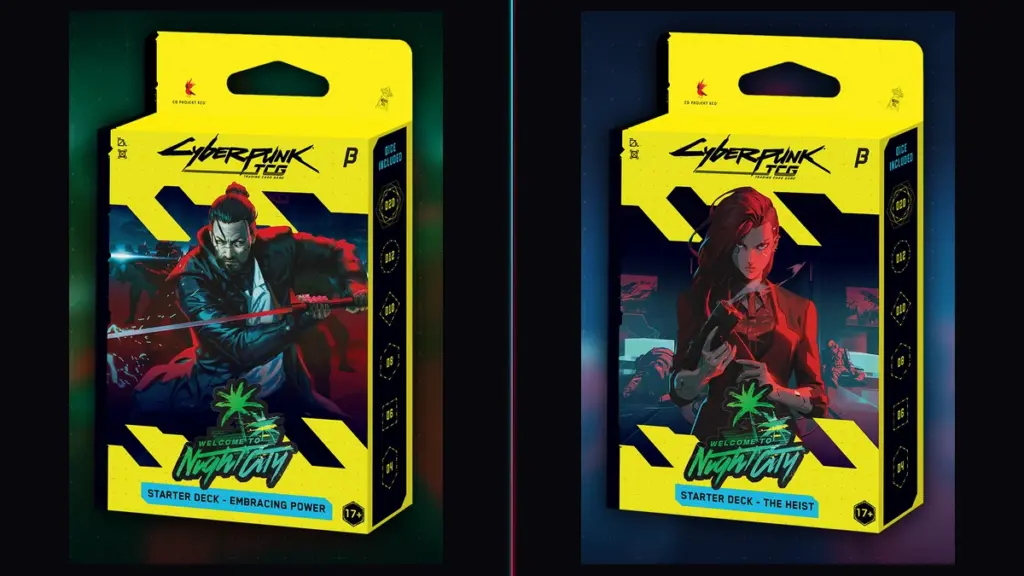
The strongest side of these starters is the physical one, which you can read straight off Burza’s first reaction to the product shots: „they are big, they’re yellow, they’re bold … in your face“. That’s a reaction to a shelf. And the box is built for that: a yellow hang tab with a euro hole up top, a 17+ badge bottom right, the CD PROJEKT RED and Weird Co logos alongside. Packaging that can stand on a shelf and hang on a pegboard.
One caveat about those images matters to collectors: they’re 3D visualizations, not photos of a finished product. The second question does have an answer. The boxes shown carry the β symbol, so they’re the beta boxes from the Kickstarter campaign. WeirdCo puts both series side by side on its marketing materials page, and the comparison shows exactly one differing element, the β symbol at the top right of the front. Otherwise the boxes are printed identically.
Opening it, Cree describes the plastic sleeve with its pull lip at the bottom. No knife, no fingernail wrestling. Underneath, the dice sit visible at the top, then the cards, then the playmat.
Six dice, according to the box
There’s a misunderstanding doing the rounds here, and it comes out of the podcast itself. Cree only names the colors, „the red and black dice“ for Embracing Power and „the yellow and black dice“ for The Heist. Hearing that, you think two dice. The number is printed on the black side flap of both boxes: „DICE INCLUDED“, and below it D20, D12, D10, D8, D6 and D4 as symbols. A full polyhedral set, in other words. Cree’s color note describes how that set is colored, not how big it is.
And that lines up exactly with what the rules demand. The gameplay guide says: „To play, you need a set of six dice (d4, d6, d8, d10, d12, d20).“ Each starter delivers one such set. How high Gig values can climb is visible in the card texts: Over the Edge explicitly asks for the „value of a friendly d20“.
Whether the starter dice hold up against the alpha kit dice Burza still keeps, nobody says in the podcast.
The playmat the two of them disagree about
Content-wise the playmat is the strongest argument in the whole package. Front side: every zone of the play area, Legends, friendly gig zone, deck and trash. Back side: card anatomy, all card types, the complete turn structure and a QR code to the online rules. In the demo decks the turn structure only lived on the tip cards. Coming from those, you’re no longer flipping between little cards.
Then something happens in the podcast that you basically never hear in product communication. Cree defends the material and walks it back in the same breath: „It doesn’t like it’s really hard to rip from when I was testing it in the factory, at least“, followed by „you primarily want to be using a cloth playmat“. There will be creases too, because the mat has to be folded into the box: „there will be like some of the creases cuz we have to fold it in place“. Seconds later, Burza doubles down.
„It is a paper playmat, but it’s not a typical paper playmat … So it might get a couple uses in before something bad happens“
Paweł Burza, Cyberdeck Podcast Episode 22
Two people from the same product saying „it holds up“ and „it might survive a couple of games“ within seconds of each other. Refreshingly honest for a manufacturer podcast, and it’s why the playmat doesn’t count as a feature here. If your deck hits a table regularly, you’re not getting around a cloth playmat. That recommendation is a direct quote from the manufacturer.
Foil: the rule sounds bigger than it is in the deck
The episode’s central foiling statement comes from Cree: „you’ll notice that basically even in the starter decks any of our rare plus cards will still be foiled.“ Everything from Rare upwards gets treated, in the beginner product too. The comment section reacted accordingly, @ericeilersen with „These foils are CRAZY good!!“ among others.
Except, how many cards is that in practice? In the Embracing Power main deck, Shattered Memories is the only card at Rare or above, with two copies. In The Heist it’s Dying Night – V’s Pistol, also Rare, also two copies. Add three Legends per deck, all of them Epic. That’s five foiled cards per product out of 43 cards total, so 11.6 percent. Counting the main deck only, it’s two out of 40, so 5.0 percent. Identical in both decks.
That isn’t an accusation. A starter is almost entirely Commons and Uncommons, so a rule that starts at Rare can’t catch many cards there. It just corrects the expectation: what’s shining is five cards, not half the deck. Cree demonstrated the treatment on Shattered Memories and called it „absolutely nuts“.
The process pulls best on bright areas, incidentally: „any of the kind of really bright white parts come through on foiling super super super well“, Cree says, and in Episode 21 he’d explained the same thing on Panam: „Where it’s white, it’s actually going to be gold cold foil.“ Then there’s the frame break, the tell for Epic rarity, where the illustration breaks out of the border; Cree shows it off on Hands Unclean. Because all six starter Legends are Epic, they all look the same: broken frame plus foil.
In the gameplay video from the same week you see none of this, which irritated a few people. The reason is posted officially right underneath. @CyberpunkTCG wrote: „They will be foil, the lads played with the demo deck cards but the lists they used are the ones you would find when you crack open the starter decks!“ Cree himself, as @kawatek, added: „They will be yes, I just took the Legends from the Demo Deck for this video.“
The most-liked comment under that video comes from Burza himself: „At least the have sleeves! 😅“, 40 likes. Sleeve awareness is apparently a running gag in this community with a serious core, and at five foiled cards per starter that core has substance. If you still want to show your Legends off in six months, put them in standard-size sleeves before they touch a paper playmat for the first time.
Six cards that aren’t in the starter
The second half of the episode belongs to six reveals from the booster set. Read as a package they form a surprisingly clear picture: two Gear, two Units, two Legends. By color, three yellow, two green and one blue. Red? Doesn’t appear at all, even though red is the single strongest color in Embracing Power at 23 of 40 cards. On rarity it’s two Commons, one Uncommon, two Rares and one Epic.
Unlike the starters, these six cards have no findable community discussion attached. What follows is designer commentary and the values from the official database.
Adrenaline Converter
Adrenaline Converter
Gear · Yellow · Cyberware/Medtech · sellable · Cost 2 / Power 3 / RAM 4 · Common 059 · ADIA
„(Equip to a friendly Unit or face-up Legend.) / If a Rival controls at least 2 more Gigs than you, this Unit has {Adrenaline}. (This Unit can attack the turn it’s played.)“
Two eddies for three power, plus conditional immediate attack ability. Preem. Cree is visibly taken with the efficiency: „Two cost plus three power is kind of insane. … I think that might be the best starter gear that we’ve seen in set one for two cost.“ The combo he names in the podcast runs through River Ward – Detective on the Hunt, a yellow Legend with the text „{Quick} {Spend} Play a Gear with cost 2 or less from your hand for free“. What that means in numbers comes further down.
The catch sits on the RAM. At RAM 4, Adrenaline Converter fits into no deck that runs a single yellow Legend, because one Legend caps its color at 2. That’s what Cree’s phrasing „If I’m playing any sort of double yellow deck“ is aimed at. Burza confirms in passing that Warsaw isn’t just watching: he talks about a yellow-yellow-green build as „the deck that we were testing here at CDPR“.
Delamain, and not the one in the deck
Delamain – Rideshare AI
Unit · Blue · AI · not sellable · Cost 3 / Power 0 / RAM 3 · Uncommon 111 · Łukasz Wiktorzak
„{Play} Draw 2. / (Units with power 0 don’t steal Gigs.)“
Careful, there’s a trap waiting here. The Heist contains three copies of a card called Delamain Cab, a blue Unit with cost 4, power 4, RAM 2 and the text „At the end of your turn, if this Unit stole a Gig this turn, ready 1 Eddie“. Different card. The reveal from Episode 22 is called Delamain – Rideshare AI, costs more in RAM, less in eddies, and has zero power.
Burza just does the math on it in the podcast: „You pay three, you get two cards … And it has zero“. Cree considers the RAM cost appropriate. A Unit with power 0 steals no Gigs, so it sits on the table as a pure card engine. Which suits The Heist beautifully, where Secondhand Bombus and Evelyn Parker already put five power-0 copies into the list.
Zetatech Berserk
Zetatech Berserk
Gear · Green · Cyberware/Zetatech · sellable · Cost 6 / Power 3 / RAM 2 · Common 096 · Mooncolony
„Play this Gear for -1 €$ for each friendly face-up Legend, to a minimum of 1 €$.“
Six eddies is a statement for a piece of Gear, and it makes this the most expensive Gear shown from the set so far. The printed price is only the starting value, though. With three Legends face up the card drops to three eddies for three power, and that’s the realistic best case Cree names. In the podcast it gets explained via the Panam strategy, meaning putting Gear onto the Legend first and moving it later. None of that is on the card text of Panam Palmer – Strength Through Family. She helps Zetatech Berserk a different way, by flipping Legends faster („During your turn, you may Call a Legend for free“), and every face-up Legend knocks an eddie off the price. That card came out of Episode 21.
It gets cheaper still. Combine Zetatech Berserk with the Unit Viktor Vektor – Drop Your Illusions from further down: she takes another three eddies off the first Cyberware Gear each turn. Six minus three from the Legends, minus three from Viktor, floor of one eddie. One eddie for three power. For comparison, the dev blog calls Mantis Blades, one eddie for two power, „the most efficient weapon you’ll find in Welcome to Night City“.
Padre and the shift with no upper bound
Padre – Man of the Cross
Legend · Green · Fixer/Ganger/Valentino · sellable · RAM 2 · Rare 074 / β074 / β153 · Mooncolony (β153: PANDART STUDIO)
„{Call} Choose one effect. / Spend a rival Unit. // Draw 1. / {Spend} Set a player’s Gig to the same value as another player’s Gig.“
The second ability is the exciting one: it sets a Gig value to another one’s value instead of shifting it by a fixed amount. Cree describes the range with audible pleasure.
„The delta that you can change gigs is like so high with this card, so you could like, you know, in theory you can change a 20 to a one.“
Cree „Kawa“ Gunning, Cyberdeck Podcast Episode 22
The second Viktor Vektor
Viktor Vektor – Drop Your Illusions
Unit · Yellow · Ripperdoc · not sellable · Cost 5 / Power 5 / RAM 2 · Epic 057 · TOPDOG Entertainment
„Play your first CYBERWARE Gear each turn for -3 €$, to a minimum of 1 €$.“
And there’s the episode’s second confusion trap: The Heist contains Viktor Vektor: Sit Down and Relax, a yellow Legend at Epic rarity with a completely different text. The reveal is a Unit. Put the wrong one in your deck and you break two rules at once.
The card itself is a discount machine for Cyberware. In the podcast Cree names Gorilla Arms dropping from four eddies to one, The Relic – Experimental Biochip from five to two, and Zetatech Berserk all the way down to the floor of one.
The nicest story in the whole episode hangs on a face. Sebastian Kalemba is documented as game director of The Witcher IV, and the reporting consistently lists him as the face model for Viktor Vektor in Cyberpunk 2077; a primary source from CD PROJEKT RED on that wasn’t reachable. That he of all people revealed this card, his own card, exists only in the podcast. Burza describes moments like that with „you see like their their face lights up instantly“. For a licensed product where the conversation is otherwise rarity distributions and distribution windows, that’s a surprisingly personal item on the schedule.
El Capitán and the step of exactly one
Muamar Reyes – El Capitán
Legend · Yellow · Fixer · sellable · RAM 2 · Rare 038 / β038 / β147 · Mooncolony (β147: PANDART STUDIO)
„{Call} Choose one effect. / A friendly Unit can’t be defeated in a fight this turn. // Draw 1. / {Spend} Adjust a Gig by 1.“
The card was revealed by WeirdCo community manager Clark according to the podcast; externally, neither the name nor the attribution can be confirmed. At first glance „Adjust a Gig by 1“ is the weakest Gig ability the set has shown so far, and Cree goes on the defensive unprompted. His argument turns on parity, and why parity matters in this set’s design is the next section.
What of this fits straight into a starter
Both starters have ten free slots, so the obvious question: which of these six cards drops straight in on 6 November? Pure rules arithmetic. Does the card’s RAM value stay under the limit of its color in the target deck?
Rideshare AI, at blue RAM 3, sits under the limit of 4 in The Heist. Zetatech Berserk, at green RAM 2, sits under the limit of 4 in Embracing Power. Drop Your Illusions hits the yellow lid exactly at RAM 2 in The Heist. Adrenaline Converter fails at RAM 4 in yellow, in both decks. Padre and El Capitán are Legends, so a swap rather than an addition: Padre for one of the green Legends in Embracing Power, El Capitán for Viktor Vektor: Sit Down and Relax in The Heist. The two-primary, one-secondary split survives that, so the lids don’t move.
What this calculation says nothing about is whether a card actually does anything once it’s in the deck. Which makes counting worthwhile for Drop Your Illusions in particular. The card discounts the first CYBERWARE Gear each turn by three eddies, floor of one. In The Heist, per the database classifications, four card names carry that tag, eleven copies in total: Kiroshi Optics and Mandibular Upgrade at three copies each, Zetatech Faceplate also at three, and Tetratronic Rippler at two. Only Dying Night – V’s Pistol stands apart as Merc/Weapon.
So the discount reaches more than a quarter of the deck and still delivers almost nothing. Kiroshi Optics, Mandibular Upgrade and Tetratronic Rippler already cost one eddie, so the floor is reached before Viktor ever hits the table. Only Zetatech Faceplate costs two, and it does so three times. Across a whole game, the discount in an unmodified The Heist saves exactly one eddie, and only in turns where that specific Gear happens to come first. Five eddies for a Unit that saves you one? Doesn’t add up in this deck. It gets interesting the moment expensive Cyberware joins the list, and the most expensive Gear in the set has been on the table since Episode 22. Between „may go in“ and „does something“ sits the entire deck here.
One number, six tools, one threshold
Scan the cards shown so far for a common denominator and you inevitably land on the Gigs, specifically on the number on the Gig die. Six cards touch that number, three from Episodes 21 and 22, three from the dev blog’s starter decklists, and they spread across five distinguishable effects.
El Capitán says „Adjust a Gig by 1“. No „up to“, so exactly one, with the direction your choice. Wakako Okada – Peace and Harmony says „Decrease a Gig by up to 2“, so up to two, downward only. Dexter DeShawn says „Adjust a Gig by up to 1“. Zetatech Faceplate says „adjust a Gig by up to 1. Then, if you control 3 or more Gigs with different values, draw 1.“ Padre sets one Gig to the value of another. And MaxTac AV swaps: „{Play} You may swap a friendly Gig with a rival Gig.“
By the numbers alone you get a ranking where one is worse than two and two is worse than arbitrary. By the wording it’s five different tools: Dexter DeShawn and Zetatech Faceplate carry the identical effect sentence and differ only in trigger, the other four each do something of their own. None of these effects is unique, mind. Set-wide, 16 cards change a Gig value, Peace Offering repeats Padre’s mode word for word, and Hanako Arasaka repeats MaxTac AV’s swap. It’s the fineness of those gradations that Cree’s defense of El Capitán is aimed at: a shift of exactly one is the only one that turns an even value odd and vice versa. A shift of two leaves parity where it was.
In that passage Cree names a „Jackie unit that cares about even and odd gigs“, and the card exists. It’s called Jackie Welles – Ride or Die Choom, a yellow Unit at Epic rarity, publicly listed in the database: „{Attack} Give this Unit +2 power this turn for each friendly Gig with an even value. / {Defeated} Draw 1 for each friendly Gig with an odd value.“ Just don’t confuse her with Jackie Welles: Pour One Out For Me, the Legend from The Heist, which carries no parity text. After Delamain and Viktor, that’s the third name collision this week.
Parity is no footnote in this set either. Rogue Amendiares – Preem Solo hangs off it („if its value is even, draw 1. If its value is odd, a Rival discards 1.“), and so do Bootleg Black Sapphire Show, Pacifica Netrunner and Field Operator, the last of which sits three times over in Embracing Power. Cree’s defense of the step of exactly one therefore rests on at least five cards, one of them inside the starter itself.
One distinction slips past easily here, and it matters: the game knows two different Gig quantities. One is the value, the number on the die, which is what Padre, Wakako, El Capitán, Chrome Fang, Heywood Ripperdoc, Shattered Memories and Industrial Assembly are about. The other is the count, meaning how many Gigs somebody controls, which is what Adrenaline Converter („at least 2 more Gigs than you“), Bonnie and Clyde, Zetatech Faceplate („3 or more Gigs with different values“) and Saburo’s reminder text are about. Mix the two up and you misread half the card pool.
That this axis isn’t an invention of the podcast, the starters prove themselves. In The Heist, nine of the 40 main-deck cards change a Gig value: two Dexter, three Zetatech Faceplate, two Afterparty at Lizzie’s and two Dying Night, plus the Legend Jackie Welles. In Embracing Power it’s four, two Industrial Assembly and two MaxTac AV. 22.5 percent against 10.0 percent. So the blog’s „subtlety“ and „methodical“ have a number behind them.
Why seven isn’t safe
There’s a threshold that appears on none of the cards involved and still decides games. It surfaces as reminder text on Saburo Arasaka – Stubborn Patriarch: „(Units steal an extra Gig for every 10 power.)“ That’s a general rule, not a property of this card. The dev blog works it through on an example of its own: „When your Saburo Arasaka Legend is flipped, Minotaur attacks with 10 power“, it says, and then, „exactly enough to steal 2 Gigs!“ Nine power plus one from Saburo makes ten.
Burza describes what that threshold does at the table, from the perspective of the person who misses it.
„the combo that you mentioned River into Adrenaline Converter is the thing that hurts the most because you kind of always get to a board state where you see a couple units which are at this beautiful like threshold of being sevens and you think like oh seven oh I’m I’m I’m safe“
Paweł Burza, Cyberdeck Podcast Episode 22
Mathematically, what Burza is describing there is simple. Adrenaline Converter gives three power. Seven plus three is ten, and ten is the threshold. River Ward puts that same Gear down for free and at {Quick} speed, because Adrenaline Converter costs two. Your opponent sees a seven, files it under harmless, and a card that costs no money and doesn’t wait for your turn turns it into an extra stolen Gig. That chain is my derivation from two card texts and Burza’s quote; nobody works it through in the podcast.
Whether the combination is too strong, nobody can say. Burza only says it hurts. It is, though, the best tangible evidence that the most-liked comment under the episode means something real. @BryceOffBryceOn wrote there about the starters: „Some of the best designed starter decks I’ve ever seen in a game. Simple enough for enough for everyone to play but with intricate lines that will keep experienced players engaged.“ Three cards that look banal individually, plus a number printed on none of them. That’s exactly what those lines look like.
What 24.99 euro means against the field
Is 24.99 euro a lot for a beginner deck or not? First the caveat the whole section hangs on. WeirdCo has never named a price for the Cyberpunk starters. Every number in this text is a retailer price as of 25 August 2026; where a competitor has a manufacturer’s recommendation, I say so.
The field of single beginner decks looked like this on the research day:
- Cyberpunk TCG starter: 24.99 euro (CCN Cards, GeeksHeaven, Cardcosmos), 29.99 euro at Mayener Fantasyland. 3 Legends, 40 cards, six dice, paper playmat, tip cards. No booster, English only.
- Riftbound Unleashed Champion Deck: 24.79 euro (najada.games), 26.36 euro (heartforcards). 56 cards, one booster, full-size playmat, deck box.
- Riftbound Origins Champion Deck: 20.99 euro at the Riot Merch Store. 56 cards including three rares, one booster, playmat, deck box.
- Pokémon Mega Battle Deck: 19.99 euro German MSRP, above that in the trade. Price comparison sites sat between 20 and 35 euro on the research day. 60 cards, double-sided playmat with a printed strategy guide, one large coin, deck box, markers.
- One Piece starters ST-31 through ST-36: 11.99 US dollars MSRP, 18.99 euro in German retail (tcgviert); the Spanish shop ninpostore asks 15.95 euro. 51 cards, 10 DON!!, playsheet, one bonus booster.
- Disney Lorcana single deck, discontinued: 18.00 euro (bb-spiele), MSRP was 19.99 euro. 60 cards including two foils, eleven markers, one booster. Available in German, too.
- Altered Beyond the Gates starter: 13.99 euro (FantasyWelt). 40 cards, tokens, player aids, paper playmat, rulebook.
- Flesh and Blood Blitz Deck: 11.99 US dollars or 11.99 euro MSRP. 40 cards plus hero, weapon, equipment, tokens.
Break that down to price per card and Cyberpunk stands at 24.99 euro for 43 cards, so 0.581 euro apiece. Behind it comes the Riftbound Unleashed Champion Deck at 0.443 euro, then Riftbound Origins at 0.375, One Piece at 0.372, Altered at 0.350, Pokémon at 0.333, and finally Lorcana and Flesh and Blood at 0.300 each. That puts Cyberpunk roughly 31 percent above the next most expensive deck in the field and roughly 94 percent above the cheapest. Two reservations: for Pokémon and Flesh and Blood the manufacturer’s recommendation goes into the calculation, because no reliable street prices were available, while for everything else it’s a retailer price from 25 August. And a price comparison is no substitute for a value comparison, because the systems differ and the deck sizes differ more. The number is on the table regardless.
On package price, the money you actually hand over at the till, the ranking looks different, and the two measures shouldn’t be blended: 19.1 percent above the Riftbound Origins Champion Deck, 25.0 percent above the German Pokémon MSRP, 31.6 percent above One Piece at tcgviert, 78.6 percent above Altered. Per card it would be 74.4 percent against Pokémon instead of 25.0, because that box holds 60 cards. The only product sitting at the same package level is the Riftbound Unleashed Champion Deck at 24.79 to 26.36 euro, and that one brings a booster, a full-size playmat and a deck box.
What stands out most, though, is something else: Cyberpunk is the only deck in the lineup without a booster in the box. One Piece, Riftbound and the old Lorcana single deck each include one. A single Cyberpunk booster costs 5.90 euro at Mayener Fantasyland, which is 23.6 percent of the starter’s price. On card count, Cyberpunk sits at the bottom end with 40 main-deck cards plus three Legends, though level with Altered and Flesh and Blood, which also sit at 40 and also throw extras in, tokens and adventure cards in one case, hero, weapon and equipment in the other. Above them come One Piece at 51, Riftbound at 56, Pokémon and Lorcana at 60 each. The claim that Cyberpunk has the fewest cards only works if you count the same components across all three 40-card decks.
What speaks for Cyberpunk is the accessory load, and it’s genuinely good. A six-die polyhedral set, playmat and tip cards in this price bracket is otherwise only matched in breadth by Riftbound, with Altered at least managing the playmat. On the dice you have to stay honest, though: without six dice this game is unplayable by its own rules. An included booster is a bonus, an included dice set is a prerequisite. That shrinks the accessory advantage considerably. What’s genuinely missing is a deck box, which Riftbound and Pokémon both include; anybody who doesn’t want to carry their deck around in a torn-open carton after the first evening needs a 100-card deck box on top, and at 43 cards plus sleeves that size fits exactly.
More interesting than the single-deck comparison is the class above it. Buying both starters twice for the complete playset comes to 49.98 euro for 86 cards. The Lorcana two-player starter deck costs 29.99 US dollars MSRP and brings two lots of 60 cards; an official euro recommendation for it wasn’t findable, and Lorcana otherwise mirrors dollars and euros one to one. The Star Wars Unlimited two-player starter is documented at 29.99 euro and delivers two lots of 50 cards plus two playmats and two deck boxes. So two Cyberpunk starters cost 66.7 percent more than that two-deck package. Whether those decks are tournament legal isn’t documented; this is about price and quantity, not play value.
And then there’s a trend standing in the way. Lorcana has dropped the single starter deck. The Winterspell wave of 20 February 2026 contained none, and only with Wilds Unknown on 8 May 2026 did the two-player starter deck take over the on-ramp, alongside a „Collection Starter Set“ with no playable deck in it. For two and a half months, Lorcana had no beginner deck for sale at all. Over at Magic, the run of Starter Kits at 19.99 US dollars with two lots of 60 cards ends with the FINAL FANTASY kit of 13 June 2025, with nothing after it; there’s no discontinuation announcement from Wizards, and the current entry product is the pricier Beginner Box. That box didn’t replace the Starter Kit, though, since at November 2024 it’s seven months too old. So Cyberpunk TCG enters the market with the exact format two market leaders are phasing out, and prices itself at the top edge of that class.
Gap or false start? The data simply doesn’t settle it. There is no reliable industry figure for what a starter usually costs. The best number I could find comes from Athlon Sports and gives a range of 10 to 50 US dollars, which is useless. What’s provable is the position in the field and the missing booster, nothing more.
Where, when and in which language
The 24.99 euro from earlier is the bottom of a range. Mayener Fantasyland asked 29.99 euro on 25 August, 20.0 percent more for the identical product. The reason is simple: there’s no public price recommendation for anyone to orient on. In France, Agorajeux listed 31.50 euro. In the US, Miniature Market asked 27.99 and CoolStuffInc 29.99 US dollars, deliberately not converted here. Several German listings were sold out on the research day, as was a bundle of both decks at TCG Tavern for 49.99 euro.
Boosters look no different. A display of 24 packs cost between 99.99 euro (GeeksHeaven) and 119.99 euro (Mayener), a 20.0 percent spread; single boosters sat at 5.90 and 6.00 euro. Out of the cheapest display a pack costs 4.17 euro, which is 29.4 percent less than buying singly, and even the most expensive display stays below that at 5.00 euro per pack. A display equals 4.0 starters, a starter 4.2 single boosters, though in the starter you get 43 targeted cards instead of roughly 50 random ones.
Retail supply runs through Luminous Cards GmbH of Gera, officially listed for Germany, Austria, Switzerland, the Netherlands, Luxembourg, Belgium, Hungary, Czechia and Slovakia. For three of those countries the remit is only half: the French-speaking parts of Belgium, Luxembourg and Switzerland are served, according to the same page, by Neoludis. WeirdCo works with one exclusive distributor per main market. The Luminous Cards website is pure B2B, prices behind a login, no public price list. So the claim that Luminous sets the end-customer prices isn’t documented.
On language it gets genuinely unpleasant for the German-speaking market: no German localization has been announced. The first localization language is French, and French stock is already physically in the trade, with Agorajeux listing a display FR at 139.90 euro and French boosters. Every German, Austrian and Swiss listing, by contrast, carries the „EN“ tag. Competitively that’s the hardest disadvantage of the lot, because Lorcana and Pokémon are available in German.
On the release date, manufacturer and trade contradict each other cheerfully. Officially it’s 6 November 2026, documented through three independent official sources. Practically every German shop says 15 October, right across their Cyberpunk range: CCN Cards, GeeksHeaven, TCG Tavern and Feenturm. The Swiss shop Pokefaust says 31 October, US retailers a blanket „November 2026“. The shops flag their own dates as provisional, Feenturm for instance with „changes by manufacturer or distributor possible“. The 15th of October is 22 days before the official date and 15 days before the pre-release, and the official chain of pre-release plus seven days lands cleanly on 6 November. My reading, explicitly labelled as such: 15 October is delivery to the trade, not a sales start.
Singles are considerably earlier. Cardmarket announced on 12 August that it would carry „boosters, boxes, starter decks, and all of its singles“, starting „right around the time of the game’s full launch in the first weeks of September“. As of 25 August there was still no Cyberpunk product section there. Between the first weeks of September and 6 November lie roughly two months in which singles are tradeable in Europe before the product hits shelves. What that means for collectors and deckbuilders is in Cyberpunk TCG on Cardmarket: Two Months Without Retail. Burza places the platform in an explicitly European frame: being listed there „gives you the street cred“.
The route hardly anybody has on their radar
There’s a third date almost nobody talks about, and for Europe it’s the fastest way to the product. The organized play FAQ says: „OP Stores may sell Beta Starter Decks and Beta Displays starting September 1, 2026.“ Plus: „OP Stores may sell Beta Event Kits starting September 10, 2026.“ And a rider: „(for use within said stores‘ Beta Event). These should not be sold separately from a Beta Event until after September 20, 2026.“ So buying an event kit over the counter works from 20 September at the earliest. If you’ve got a registered OP store nearby, and there are more than 3,000 of them worldwide as of 17 July, you don’t have to wait until November.
The conditions belong with that, or it turns into a disappointment. „May“ is a permission, not a delivery guarantee. Whether a store gets beta stock and whether it sells it is entirely its own call. For guaranteed allocation and for the right to run beta events there was also a cutoff, 1 May 2026. After successful OP events, 20 percent guaranteed resupply is promised. A phone call to the store around the corner will settle faster than any product page whether November is even the relevant month for you.
From „too simple“ to „too complicated“
Back in March, shortly after the campaign launched, BoardGameGeek user Balleflass, first name Erik according to his profile, wrote: „I’m wondering if this seems like a cheap cash grab or an actual game with some depth. I read through most of the cards shown on the cardlist on their website, and I can’t get rid of the feeling of most cards being built around the same two mechanics. Either give your dudes some strength OR do something with Gigs.“ A day later he followed up: „I just hate the gambling aspect around random booster packs and that the game seem a tad too simple. BUT, I am currently backing it in hope of watching a playthrough that convinces me to keep the pledge.“ That second half belongs with the first, because it flips the tone: Erik had backed and wanted to be convinced.
Five months later, the comments under the same brand read: „This game feels overly complicated. I’m on the fence.“ (@0NCE_000). Alongside that, „I guess I’m not quick enough to wrap my head around all the mechanics at once. I’m afraid to enter a tournament“ (@wulkan2032, four replies down) and, from the perspective of a long-time Magic player, „I am still a bit confused by the Gig dice stuff, but I will need to look up and read in to this more. The rest was pretty easy to understand.“ (@LongTimeAgoNL). Same channel, same audience, opposite complaint.
In between sit spoiler season and the first complete decklist. Only once 80 cards were public could Erik’s two-mechanics thesis be checked at all. And it doesn’t hold. The 17 names in Embracing Power alone hang off at least eight distinguishable triggers: Street Cred comparison, Gig value matching, the state of your own Legends, ready-and-spend economy, attack and block restrictions, combat outcome, power threshold and the plain stat buff. Every one of those categories can be evidenced with at least one card from the deck, from Minotaur through Sandevistan and Satori: Sword of Saburo to Mantis Blades. The categorization is mine, not official.
Fairness is still owed. The „overly complicated“ complaint aims almost entirely at the Gig dice, with @LongTimeAgoNL naming those as the single hurdle and explicitly calling the rest easy to follow. Which puts us back at Erik, only flipped around on the same mechanic: he found the Gigs too thin, the August comments find them too much.
A second friction point came out of the same source: „My brutal honset opinion, is the OverTime. I feel like its a buzz kill tho i understand why its there. The person who goes 2nd has a huge advantage.“ (@shadows1235). @toastmasterTCG independently confirms the match in the video really did go to overtime, and likes it that way: „Going all the way to overtime made it a perfect showcase game“.
That rule is in the official gameplay guide under the heading „WIN CONDITION“: „OVERTIME: 7 GIGS WINS INSTANTLY“, and at more length: „OVERTIME begins after the last player’s 7th turn. Overtime is sudden death; as soon as a player has a majority of Gig dice in their Gig area, they win.“ The rules card in the print-and-play demo deck repeats it: „OVERTIME starts after the last player’s 7th TURN. It’s sudden death: you win as soon as you control 7 Gigs.“ Except the two versions don’t say the same thing. The guide talks about a majority of Gig dice, the tip card about seven Gigs. Seven is the majority precisely when thirteen Gig dice are in play, and how many there actually are is stated in neither place. That flavor of vagueness costs somebody a game in a tournament room sooner or later.
The core of @shadows1235’s criticism can at least be traced through the rules text. Whoever goes second acts last in the sudden death phase, so they see their opponent’s position before they commit. Whether that information edge carries the „huge advantage“ he describes comes down to numbers that don’t exist yet. Cree himself called the match „a true starter deck battle … we had a pretty intense match for using starter decks“.
On how solid any of this is: the BGG thread dates from the campaign launch in March, there’s no newer one about the starters, and apart from Erik’s two posts none of the contributions could be attributed to an author. The gameplay video has roughly twice the views of the podcast episode. So the sharper comments sit exactly where more people are looking.
The schedule up to November
Two statements from two episodes add up to the end of spoiler season. On 14 August, Cree said there were „2 weeks left of of card reveal season“, which points at 28 August. A week later, in Episode 22, he said that „in about a week and a half … we probably have every single card of Welcome to Night City spoiled“, which points at 31 August or 1 September.
Those are exactly the days Kickstarter fulfilment lands in. The target is „around September 1, 2026“, the shipping window is two weeks, in two waves: wave 1 with starter decks, beta booster displays and add-ons, wave 2 with accessories, the beta box, the Lucy cards and the starters and displays from the „Common Cyberdecks“ and „Quickhacks“ tiers. So the last card gets spoiled roughly in the week the first parcels arrive. Open your parcel and you’ll find nothing inside you haven’t seen online for weeks. Whether that’s by design, nobody says. First reports are already in, with @ripstott posting: „I already received mine, they are awesome!“ Others are still waiting, @CYB3RN4UT among them with „Man I want my two starter decks so bad… i hope they ship out by december“.
After that the calendar gets tight. The 1st of September with beta sales in the OP stores is above. On 4 September the Digital Beta Celebration runs at 12:00 EDT, so 18:00 in central Europe; the Rebecca promo goes only to Kickstarter backers and only during the stream, the signup page closes when the broadcast ends, and the card ships with wave 2. After that the event moves into the official Discord. Without backer status, per WeirdCo, exactly one route leads to the same promo: „you’ll need to come and see us at one of our upcoming convention appearances.“
From 10 to 20 September the beta events run; older sources say 10 to 17, the newer and more specific ones say 10 to 20, and those are the ones that count here. An event kit contains six beta boosters, three random Legend promos, one guaranteed Mantis Blades full-art promo and six polyhedral dice. On 30 October comes the retail pre-release weekend, on 6 November the retail launch. Between the fulfilment target and that date lie 66 days, and 44 days up to the 15 October that German shops keep naming. So in Europe, if you neither backed nor have an OP store nearby, you’re waiting roughly six to nine weeks longer than a backer. Pure gonk move to only work that out in November.
Content-wise, Cree announces a swing towards sealed and limited for the coming episodes, including the question of how you play with your old kits, plus community decklists, the art process, gameplay designers as guests and tournaments. The sealed specs are already fixed: a minimum of 30 cards in the main deck plus three Legends, recommended split 14 Units and 16 sellable cards.
And then Cree drops a sentence he very deliberately leaves open.
„we’ve got lots of other really cool exciting news for you guys coming out as well that we can’t talk about quite yet, but there are bigger plans in the works as well.“
Cree „Kawa“ Gunning, Cyberdeck Podcast Episode 22
What that means, nobody knows, and I’m not going to start guessing here. For collectors a different point matters anyway: WeirdCo has committed in writing that there will be no second Kickstarter campaign for this game and no reprint of the same set in the same configuration. Which is why beta stock versus retail stock is a collector question at all. Beta cards carry a beta symbol at the top right, retail stock doesn’t; the same goes for the box, as the packshot comparison further up shows. For scale: 50,773 backers, 28,353,088 US dollars, an average of 558.43 US dollars per backer.
What stays open
After a week with two decklists, one match, one unboxing and six reveals, questions are still open. Some of them weigh a lot.
Top of the list is the demo deck question. The entire playset design hangs on a sentence in the conditional. Until WeirdCo clarifies in writing whether stores hand these decks out, the answer to the complaint from the comment section stays a statement of intent, nothing more.
Just as open: there is no manufacturer price. Every number in this text is a snapshot from the trade on 25 August, several listings were already sold out by then, and the 20 percent spread between two German shops comes straight out of that vacuum. What a beginner deck costs across the industry can’t be stated reliably either, since one very broad range doesn’t cut it.
How big the set is, nobody outside WeirdCo knows. The card database serves 142 pages, which is a lower bound; the highest collector number assigned in the retail set is 140, namely Unlikely Bond, and Padre carries β153 in one of its numberings. That the number sequence isn’t dense shows in the gaps: 127, 134, 137 and 138 are unassigned. All you can say from that is that both starters together cover at most a good quarter of the set, not an exact figure.
Whether the beta and retail starters are identical in content isn’t documented. The database lists them as separate sets with identical numbers apart from the β prefix, which suggests they match; the FAQ also speaks of „art variants of cards that are exclusive to the Kickstarter Beta product“. Nobody has confirmed it.
Then the smaller holes in the picture. The alpha history of Ruthless Lowlife rests on Cree’s phrasing that the card had „a very different shape“ back then, with no numbers attached. On overtime, it’s open which of the two official formulations applies in a dispute, the majority from the gameplay guide or the hard seven from the tip card. And the community base under this article is thin: essentially two YouTube comment sections with 37 and 44 top-level comments, 49 and 61 posts including replies, plus a forum thread half a year old and a Reddit comment that was only reachable through the search index. For the six revealed cards there’s no findable discussion at all. Anybody reading „what the community thinks“ out of that is reading more than is there.
Sources
- Cyberdeck Podcast, Episode 22 (WeirdCo, 21 August 2026) and Episode 21 (14 August 2026)
- Gameplay video „Starter Deck Battle“ on the Cyberpunk TCG YouTube channel, including the comment section
- Dev blog: „Welcome to Night City Starter Decks: Full Decklists Revealed“ (21 August 2026)
- Dev blog: sealed primer (recommendation on the sellable split)
- Dev blog: retail plans and localization
- Dev blog: Production Update 1 (fulfilment, waves)
- Dev blog: „Availability versus Collectibility“ (no second campaign, no reprint)
- Official gameplay guide (deckbuilding rules, RAM limits, dice requirement)
- Official FAQ (exclusive cards, beta art variants, localization)
- Organized play FAQ (beta sales from 1 and 10 September, cutoffs, resupply)
- Retailer and distributor page (Luminous Cards, Neoludis, demo kit)
- Official print-and-play demo decks as PDF: Arasaka and Mercs (card images, copy counts, rules card with the overtime rule)
- Official marketing materials (retail and beta packshots of both starters)
- Official card database: Adrenaline Converter, Delamain (Rideshare AI), Zetatech Berserk, Padre (Man of the Cross), Viktor Vektor (Drop Your Illusions), Muamar Reyes (El Capitán), Minotaur, Goro Takemura (Losing His Way), Dexter DeShawn (One Last Chance), MT0D12 Flathead, Jackie Welles (Ride or Die Choom), Field Operator, Zetatech Faceplate, Kiroshi Optics, Mandibular Upgrade, Tetratronic Rippler, plus the printing overviews of all ten starter-exclusive cards (Box Toppers Beta and Retail)
- Retailer listings as of 25 August 2026: CCN Cards, GeeksHeaven, Cardcosmos, Mayener Fantasyland, TCG Tavern, Feenturm, Pokefaust (CH), Agorajeux (FR), Miniature Market and CoolStuffInc (USA); comparison prices from najada.games, heartforcards, Riot Merch Store, tcgviert, bb-spiele, FantasyWelt, ninpostore (ES), Geizhals and idealo
- BoardGameGeek, thread „Cyberpunk TCG on Kickstarter“ (18 March 2026, user Balleflass); Kickstarter campaign statistics; Reddit r/cyberpunktcg, thread „TCG Starter Decks Illegal?“ (original post deleted by its author, comment reachable only via the search index)

// KOMMENTARE (0)