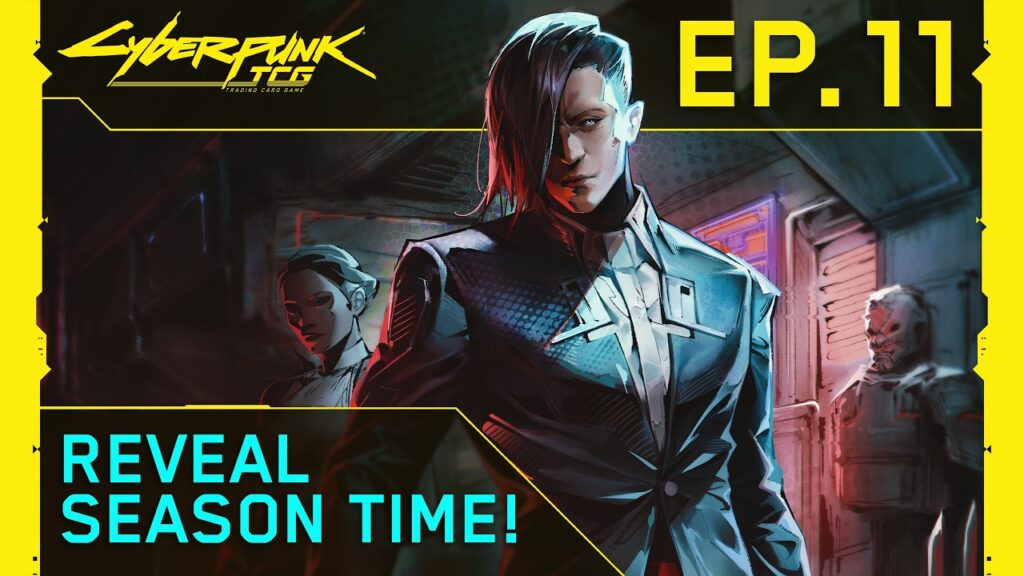
Episode 11 Card Reveals: Quick, Adrenaline & a Live DB
AI TRANSLATION NOTE
This is the English edition of a deep-dive originally written in German. The translation was AI-assisted and human-reviewed for terminology, lore accuracy, and Rogue-persona tone. All direct quotes from Cyberdeck Podcast Episode 11 come verbatim from the original English broadcast, not back-translated from German. The original German article is available at cyberpunk-tcg-news.de.
Why Episode 11 hits different
Reveal season is the best time in any TCG. New cards, new combos, the speculation machine running at full speed. Every drop feels huge. But Episode 11 of the Cyber Deck Podcast isn’t just a card dump. It’s the moment WeirdCo does two things at once: show off 22 cards, and tell you how they actually think about their own game.
Two new keywords, Quick and Adrenaline, sit at the center. Both are keyword compression: one word replaces a chunk of timing text, the card reads better across the table, and there’s a whole layer of strategic depth hiding underneath that doesn’t show up at first glance. Quick especially has more going on than the reminder text tells you. We’ll get to that.
There’s also a new face. Steve, freshly hired as a marketing copywriter at WeirdCo, shows up on the podcast for the first time. He calls himself a „rogue deck builder“ (his words), the kind of player who’d rather crack open the meta than copy the strongest list in the format. From here on out he writes every blog post on cyberpunktcg.com, which gives the game’s official voice a dose of authenticity. Not an anonymous PR department anymore, but someone who actually plays the cards.
The Discord crossed 34,000 members in under a month, a number that seems to have caught even WeirdCo off guard. Reveal season plus a dedicated content creator plus a swelling community: the game is shifting out of Kickstarter mode and into something that feels like ongoing operation.
This piece covers all 22 reveals, but not in the order the podcast went through them. We’re grouping by function: mechanics first, then cards by color, then the meta analysis (the gaps between the spoiler DB and the beta, the design philosophy, Alpha Kit legality). If you’re hunting one specific card, the contents menu up top will get you there.
„The so-called spoiler season is always the most exciting part of any card game.“ — Bersera, Cyber Deck Podcast Ep. 11
He’s right. And this episode gives you plenty of material to back that up.
Quick explained, and why you’re probably reading it wrong
Quick is pink. That’s the first and most important thing about it. In the Cyberpunk TCG, pink flags a reaction window, the same color the Blocker keyword uses. See Quick on a card and you instantly know: something can happen when your opponent attacks.
The game keeps it terse: the gameplay guide lists Quick as a react-window option („QUICK: Activate card effects or play cards with the keyword“), and the beta-rules blog post frames the window as the moment a defender can „declare blockers, Call a Legend, and play cards or use abilities with the new QUICK keyword.“ Inside the defender’s react window you’ve got three open options: activate a Quick effect, intervene with a Blocker, or Call a Legend. And if you’ve got enough eddies, you can stack two of those: Call a Legend and activate its Quick effect, when the timing lines up.
Up to here, Quick sounds like an MtG instant. React to your opponent, defensive tool, tempo swing on their turn. That’s the read your instincts hand you.
The line that matters comes right after, and it’s honestly the more important half. The podcast spells it out: „With the quick keyword, it doesn’t mean that you can only use it within the reaction phase. You can also use this ability during your own main phase. So using it offensively or using it defensively.“ Quick is a flexible effect that brings along a reaction option. It isn’t nailed down to it.
What that means hits harder through Steve’s Goro Takemura example than through any abstract explanation. As one of the hosts puts it: „Someone will activate a Goro, pay before one of their own attacks. The blocker keyword in this situation completely irrelevant. They purely do it to give something plus one power. Push it from nine to 10. Take two gigs and it’s the difference between winning or losing a game.“ Goro is a defensive Legend with Quick-Blocker synergy, and he still gets played offensively, because +1 power in your own main phase shifts the gig breakpoint.
That’s the strategic depth WeirdCo baked into Quick. The beginner reads the card as a „reaction tool.“ The experienced player sees a mana sink that lives in bluff space: how many eddies do I leave open? What do I want my opponent to believe? That’s Dum Dum in its purest form. More on him in a moment.
The comparison to MtG flash only carries half the weight. Flash cards in Magic are almost exclusively strong when played on the opponent’s turn, for surprise attacks, counter-magic, blockers. Quick has that reactive aspect too, but the offensive use in your own main phase makes it a different category. Slot Quick into your head as a plain „instant“ and you’ll undervalue the cards.
One thing the rules video will need to be clear about: Quick effects always cost something. Either eddies, or spending the Unit, or both. That’s the price of the flexibility. Your opponent sees open eddies, but they don’t know whether you’re planning defense or offense. That information asymmetry is the whole core of Quick as a bluffing tool.
Four Quick cards showed up in Episode 11: Dum Dum, River Ward, Goro Takemura, and Cyberpsychosis. Each one shows a different facet.
Quick in action: the demonstrator cards
Dum Dum: Maelstrom Triggerman
Type: Legend | Faction: Ganger/Maelstrom | Color: Red | RAM: 2
Set: Spoiler Set | No. 133 | Illustrated by: Pandart Studio
Shown in the podcast (authoritative): CALL: sacrifice a Gear for „draw two cards, or at worst, it’s just draw one.“
Live DB (as of June 5, 2026) instead:
[CALL] You may defeat a friendly Gear. If you do, draw 4 cards. Otherwise, draw 1 card.
Whether „draw 4“ is a last-minute buff after recording or the podcast showed an older build is unclear. When in doubt we follow the podcast version until the print run settles it.
Dum Dum is the episode’s first Quick demonstration, and a good one, because the podcast makes the bluff dimension tangible. In the broadcast, Bersera describes the Call effect as „draw two cards, or at worst, it’s just draw one“ while the Live DB now reads „draw 4 cards. Otherwise, draw 1 card.“ Whether that’s a post-recording buff or the podcast captured an older build stays open. Draw 4 off a single Gear would be outstanding card advantage either way, especially in Maelstrom builds around Royce, where Gear rotates anyway. And the old TCG truism still holds, of course: „Drawing cards is always good in card games.“ „In card games. Yeah.“ „Who would have thought?“ Good fun for a quick exchange between two hosts who clearly enjoy their own product.
River Ward: Detective on the Hunt
Type: Legend | Faction: NCPD | Color: Yellow | RAM: 2
Set: Spoiler Set | No. 135 | Illustrated by: Pandart Studio
RULES TEXT (Live DB, as of June 5, 2026):
[CALL] Draw a card. When a Unit attacks, [Spend]: Choose a Gear from your hand with cost 2 or less. Equip it for free to a friendly Yellow Unit with no equipped Gears.
In the podcast River Ward was discussed as a Quick card (a free Gear play as a reaction). The Live DB shows a CALL effect with different wording. Treat as a documented discrepancy until the print version exists.
River Ward is the counter-model to Dum Dum: a pure utility Legend, no power push, no Go Solo. His Quick effect plays a Gear costing 2 or less for free, effectively a 1-eddie discount since spending the react window costs you the chance to use River Ward elsewhere. But the swing is big when your opponent is mid-attack and you can drop a Blocker-Gear into the react window, or equip a Gear that makes an existing blocker hit harder.
The second ability is a trash enabler: when an equipped Unit dies, search the top two cards of your deck and trash one. Sounds like self-harm, but in blue synergy builds (Braindance recycling, Jackie Welles) it’s controlled graveyard setup. River Ward sees himself as a deck manipulator, not a threat. He’s the Legend who makes other cards‘ battle plans possible.
Goro Takemura: Vengeful Bodyguard
Type: Legend | Faction: Arasaka/Corpo | Color: Green | RAM: 2
Set: Spoiler Set | No. 125 | Illustrated by: Pandart Studio
RULES TEXT (Live DB, as of June 5, 2026):
[CALL] Ready this Legend. When a rival Unit attacks, [Spend]: If you have a sided-pair of Gigs, give a friendly Unit with cost 4 or less +1 power and BLOCKER this turn.
Presented in the podcast as a Quick card (Blocker + power boost as a reaction). The Live DB shows a CALL effect with a BLOCKER conditional. Treat as a documented discrepancy until the print version exists.
Goro Takemura is Episode 11’s mechanical darling. He shows better than any other card what Quick can actually do. At first glance Goro is a defensive Legend: he hands a friendly Unit costing 4 or less Blocker status for a turn. With Green’s value-pair bonus, that same Unit also picks up +1 power. Classic reaction tool.
But Steve demonstrates the offensive use: you fire Goro’s Quick effect in your own main phase, before your own Unit attacks. You ignore the Blocker status entirely. You want the +1 power. Nine power becomes ten, one gig steal becomes two. The gig-value breakpoint decides games. As the podcast puts it, the opponent „will just have to think, I did not think Goro did anything meaningful in your own turn. It absolutely can.“
Then there’s Goro’s second ability: whenever a friendly Unit activates Blocker, you can discard a card and draw a new one. That’s targeted deck cycling mid-combat, swapping bad cards for potentially better ones while your opponent is attacking. Goro folds defense, an offensive boost, and card filtering into one card. For one eddie.
Cyberpsychosis doesn’t get a full stat block here, but it belongs in the Quick round: the Quickhack Program (Spoiler Set #102, Michal Ivan, Cost 2, RAM 3) hands an equipped Unit a power boost on the attack, and with multiple Gear equips it gets absurd fast. With Caliber and a bit of Gear setup, you clear 20 power plus Caliber’s defeated trigger. The readability win from Quick is especially clear here: this card used to need its own block of timing text. Now it just says „QUICK“ and that’s it.
Adrenaline: an honest keyword debut
Riding Nomad
Type: Unit | Faction: Nomad | Color: Green | Cost: 5 | PWR: 4 | RAM: 4 (podcast)
Set: Spoiler Set | No. 042 | Illustrated by: Michal Ivan
Shown in the podcast (authoritative): „a five cost green card. It’s four green ram, four power.“ The new keyword Adrenaline comes with it („This Unit can attack the turn it’s played“).
Live DB (as of June 5, 2026) instead: Cost 6 / PWR 6 / RAM 3, no Adrenaline keyword, and narrower:
This Unit can attack spent rival Units the turn it's played.
Stats and wording differ. Documented discrepancy; we follow the podcast version.
Adrenaline is simple. Almost too simple to fill a whole section, but that’s exactly the point. The reminder text says everything: this Unit can attack the turn it’s played. Keyword compression, same as Quick. The spelled-out line would be „This Unit can attack the turn it’s played.“ Adrenaline is shorter.
Other TCGs know this as Haste (MtG), Rush (Hearthstone), or Charge. The mechanic isn’t new. The strategic context in the Cyberpunk TCG is. Adrenaline here isn’t an early-game aggro tool. In the podcast, Riding Nomad costs 5 eddies at 4 power (the Live DB lists it at 6/6 as of June 5), either way not an early drop, but a piece for the later game. The value shows up when your opponent has no Go Solo Legend open to react with, a surprise gig steal on the final turn they never saw coming.
That’s what separates Adrenaline from MtG Haste: in Magic you want Haste creatures down early, to deal damage fast. In the Cyberpunk TCG, Riding Nomad only makes sense once the gig situation is right and your opponent is unprepared. Tempo theft in the late game, not early aggression.
Here’s the honest take: Episode 11 shows exactly one Adrenaline card. Six mentions in the podcast against roughly 35 for Quick, three-plus dozen. So there’s no talking about an equal-weight double reveal. Adrenaline is a keyword debut, and WeirdCo doesn’t yet have the cards that give it its own archetype story. That’ll change. Riding Nomad is the first proof that the game imagines immediate-attack as a tool, how many Adrenaline cards there’ll be and how they interlock stays open.
A look at Go Solo is worth it too: both enable an immediate attack. Go Solo costs more (the full Legend cost) but hands you more flexibility and runs on Legends, not Units. Adrenaline is the Unit version, cheaper in the single case, more limited in use, but without the Go Solo overhead. A Go Solo attacker also sticks around in the sense that the Legend stays on the field unless it dies. An Adrenaline Unit stays standing after its attack as well, but a Unit costs less to deploy than a Legend, has less flexibility, and no doubled effects. The niches are cleanly separated.
What makes Riding Nomad concretely interesting: the raw stat block (5/4 in the podcast, 6/6 in the current DB) is unspectacular on its own. The Adrenaline ability effectively adds an immediate attack worth at least one extra gig when the timing lines up. Late game, when maybe 3-4 gigs are already in the pot and the opponent has no Go Solo Legend ready, Riding Nomad can steal a decisive gig before there’s even a chance to respond. Especially in a color built on value-pairs (Green), a targeted instant steal can tune the gig value you need to complete your next value-pair. That’s the real combo angle: the immediate attack matters less as damage here than as resource manipulation.
Red: power, gear, and the dream combo
Red is the most direct slice of the color pie in this game. Power on board, gear scaling, max-gig payoffs, it’s all about reaching the highest possible power numbers and stealing as many gigs at once as you can. Episode 11 brings four red cards, and El Sombrerón is the most dramatic showcase of the bunch.
El Sombrerón: La Venganza Lenta
Type: Unit | Faction: Ganger/Valentino | Color: Red | Cost: 4 | PWR: 4 | RAM: 4
Set: Spoiler Set | No. 019 | Illustrated by: Rafael de Latorre & Clonerh
Shown in the podcast (authoritative):
[ATTACK] You may pay 2 €$. If you do, this Unit gains power equal to a friendly max Gig this turn.
Live DB (as of June 5, 2026) instead: „[ATTACK] While fighting a rival Unit, double this Unit’s power.“ That’s a clearly different mechanic (power doubling in combat instead of a gig-value bonus). Documented discrepancy; we follow the podcast version.
El Sombrerón wears his hat for a reason, as Bersera explains: „the guy[s] is called the big hat for a reason. That hat can get really big.“ What the podcast describes is an ATTACK effect where El Sombrerón pays 2 eddies to gain power equal to a friendly max gig, 4 base power plus a max gig of 20 becomes 24 power. The Live DB (as of June 5, 2026) shows a different variant: „[ATTACK] While fighting a rival Unit, double this Unit’s power.“ so 8 power in combat off a 4-power base. Whether that’s a redesign after the podcast or an earlier build captured on the broadcast stays open. Both versions make El Sombrerón an ATTACK trigger, just with different scaling.
The dream combo the podcast describes runs like this: you play El Sombrerón and Panam Palmer, attack with El Sombrerón, use the max-gig bonus, then activate Panam’s ability, transfer the Gear, ready El Sombrerón, and he attacks a second time. In the podcast’s words: „you play two red legends in order to play El Sombron… then Panam… you hit for 24… do the panam ability, put the gear onto Elsomberon, ready him up… increase it by 20. It’s going to be a 44 power card. And then you’ll swing into your opponent and steal what’s that five gigs.“ 44 power, 5 gigs, per the podcast version. And El Sombrerón is still balanced, after the combo turn he’s a 4-power body. The investment is total, the turn after belongs to your opponent.
Royce: Psycho on the Edge
Type: Legend | Faction: Ganger/Maelstrom | Color: Red | Cost: 6 | PWR: 6 | RAM: 2
Set: Spoiler Set | No. 131 | Illustrated by: Pandart Studio
RULES TEXT (Live DB, as of June 5, 2026):
[GO SOLO] During your turn, this Legend has +2 power for each of its equipped Gear.
Royce is unchanged from earlier versions, a stability signal in an episode where plenty else moved. Go Solo for 6, base 6 power, and +2 power per equipped Gear. Pre-equip Mantis Blades and Royce immediately hits 10 power (6 base + 4 for 2 Gear), the 2-gig breakpoint on the same turn he’s played. Seven eddies invested for an instant double steal.
Royce is the build-around for red/yellow gear decks. Steve runs „three caliber, three Royce“ and has a clear focus: strip low-cost Units with Caliber, accumulate Gear, finish with Royce. Maelstrom as a faction has the thematic coherence (high-chrome gangs), and mechanically the gear stacking plays well with Dum Dum as support.
V: StreetKid
Type: Legend | Faction: Merc | Color: Red | Cost: 5 | PWR: 6 | RAM: 2 (podcast)
Set: Spoiler Set | No. 132a | Illustrated by: Pandart Studio
Shown in the podcast (authoritative): „a 5-6, two red ram.“ CALL: trash 3, then add a Braindance from your trash to your hand, plus GO SOLO. Playable as male or female V, just like the video game.
Live DB (as of the afternoon of June 5, 2026) instead: Cost 4 / PWR 3 / RAM 2 with
[GO SOLO] [DEFEATED] Discard the top 3 cards of your deck. Then, choose 1 Braindance Program from your trash and add it to your hand.
Stats and trigger (CALL → DEFEATED) changed between the podcast and the current DB state. Our morning research still saw the podcast wording in the DB. Documented discrepancy; we follow the podcast version.
V: StreetKid is the protagonist’s first dual version: Vincent (male) or Valerie (female), your choice, just like in Cyberpunk 2077. Mechanically V is a Braindance recycler, discussed in the podcast as a CALL effect (trash 3, then pull any Braindance Program from the entire trash). The Live DB (as of June 5, 2026) shows GO SOLO + DEFEATED instead: „Discard the top 3 cards of your deck. Then, choose 1 Braindance Program from your trash and add it to your hand.“ The core function, Braindance from the trash, is the same, only the trigger differs. Build Braindance Programs in early and V keeps pulling them back, as long as there are enough cards in the deck to discard.
With Peace Offering and other Braindance cards you build a recycling line where V makes the same high-value effect accessible again and again. The podcast frames the floor cleanly: even when you only hit the Braindance, in the host’s words, „you’ve just gained yourself an extra sellable resource.“ Even if the Braindance synergy doesn’t fully fire, V as a Go Solo body for 5 eddies (podcast; the afternoon DB lists 4/3) is a solid piece.
Kerry Eurodyne rides along without his own stat block (Spoiler Set #067, Bogna Gawrońska, Cost 4, PWR 3, RAM 2). The Spend effect draws 2 cards when you control a gig at max value. „Must have in red,“ as the podcast says, and that tracks: a max gig is realistically reachable in the late game, and 2 cards for one Spend is outstanding card advantage in Red, which otherwise pushes power more than it draws. Kerry fills the gap aggressive red decks usually have, they like to run themselves empty, and a cheap refill keeps them in the game.
Illustrator Bogna Gawrońska, by the way, also worked on Gwent, and the artwork for Kerry actually hangs in Kerry’s apartment in the Cyberpunk 2077 video game. It’s a franchise crossover moment that shows how tightly WeirdCo and CDPR coordinate the card aesthetic. If you know Kerry’s apartment from the game, you’ll recognize the piece on sight. Deliberate lore embedding that hooks video game players the first time they pick the card up. We dug into this art-and-Gwent lineage before, in Spessie, Burza, and CTCG’s Gwent Legacy.
Yellow: toolbox, cost removal, and Adam Smasher
If Red stands for maximum power, Yellow is the toolbox. Cost-based removal, gear scaling, gig-value tuning, and at the top end, Adam Smasher as a 9-cost bomb. The interesting thing about Yellow’s identity: it removes cards by their cost, not their power. That’s a deliberate design choice that mirrors the gig-value system.
Caliber: Totentanz’s Top Dog
Type: Unit | Faction: Ganger/Maelstrom | Color: Yellow | Cost: 5 | PWR: 6 | RAM: 4
Set: Spoiler Set | No. 036 | Illustrated by: André Lima Araújo with Chris O’Halloran
RULES TEXT (Live DB, as of June 5, 2026):
[DEFEATED] A rival discards 1. If the card's cost is equal to the value of a friendly Gig, that rival discards 1 more.
Caliber is the clearest expression of Yellow’s removal identity. In the podcast he’s described as a card that, on play, removes a rival Unit costing 2 or less, targeted removal against low-cost enablers. The Live DB (as of June 5, 2026) shows no PLAY effect, only the DEFEATED trigger: Cost 5, PWR 6, RAM 4. Whether the play effect is still in or got cut stays open until print. What’s locked is the DEFEATED package.
The defeated effect makes the opponent discard a card when Caliber dies, two on a gig-value match. So Caliber does damage even on a combo death, a „cleanup crew“ mindset, as Steve describes it. Three Caliber, three Royce: build gear, exploit the defeated trigger, finish with Royce.
Then there’s the Cyberpsychosis-Caliber synergy: Cyberpsychosis hands Caliber +3 power per equipped Gear, and Quick lets you fire it in your own main phase or as a reaction. With 2-3 Gear equips, Caliber clears 20 power plus its defeated trigger. In a gear deck that’s not theorycrafting. It’s a setup that actually hits the table.
Adam Smasher: Metal Over Meat
Type: Unit | Faction: Arasaka/Merc | Color: Yellow | Cost: 9 | PWR: 15 | RAM: 5
Set: Spoiler Set | No. 137 | Illustrated by: Łukasz Poller
RULES TEXT (Live DB, as of June 5, 2026):
[PLAY] Defeat all other Units.
Cost 9. Power 15. On play, everything else on the field dies. Adam Smasher is what TCG players call a finisher, a bomb that clears the board by itself and leaves behind a body that’s almost impossible to answer. Steve nails it: „When you play Adam Smasher, you feel like Adam Smasher.“
That’s flavor-first design. WeirdCo didn’t design a mechanically interesting card first and then slap the Smasher name on it. They asked: how should it feel when you play Smasher? Then they designed backward. The answer is a board clear plus a 15-power threat plus enough RAM demand that getting him out is its own strategy problem.
Cost 9 is the „perfect place“ per the podcast. Cheaper would be too easy to reach, more expensive too rare. There were actually games where a player sold a card every turn and worked their way up to Adam Smasher, proof that 9 eddies is reachable but costs effort. The podcast teases it: „There is more than one way to play this Adam Smasher, as Steve knows… I want people to discover the method.“ A nudge toward at least one more method that doesn’t get spelled out. David, lead game designer, is set to write soon about a card that brings Smasher into play more easily. That’ll be worth watching.
Another look at Gorilla Arms (Spoiler Set #111, TOPDOG, Cost 4, PWR 4, RAM 4): the Cyberware Gear steals, on the first gig steal each turn, a rival gig with a value you don’t already have. The key qualifier matters, „not shared by a friendly Gig“ means Gorilla Arms deliberately generates gig diversity. You grab values you’re still missing instead of doubling up on the same one. For Yellow, which works with divergent gig values (Hanako wants different cost values, Afterparty triggers on different gig values), that’s a very clean synergy.
The Cyberware type line is a deliberate tease. Episode 11 hinted that a future card will interact specifically with Cyberware Gear. Gorilla Arms on low-power Units still works right now, because the steal ability is independent of your own power. A 2-power Unit with Gorilla Arms steals the same gig a 10-power Unit would, the first gig steal each turn triggers the effect. That makes Gorilla Arms a gig-diversity tool that doesn’t lean on a strong body.
Hanako Arasaka earns a mention in the Yellow section too (Spoiler Set #126, Akram, Cost 3, PWR 0). Her PLAY effect searches the top 4 of your deck for cards whose cost matches the value of a chosen friendly gig, which in a Yellow context means: if you control a gig worth 9, Hanako digs specifically for Adam Smasher. A gig-bound tutor that covers the whole top 4 at once and trashes the rest. In an Adam-Smasher-backed strategy, Hanako is the search engine, and that she only costs 3 eddies for it makes her a remarkably efficient tool.
Green: the value-pair engine
Green in the Cyberpunk TCG revolves around gig-value matches, value-pairs and matching gig values. When two of your gigs share a value, bonuses fire. It’s a mechanical identity that demands deck-building: you have to actively work to make your gig values line up. Episode 11 brings Panam Palmer and Wraith Marauders as a re-ready engine, and Wraith Marauders carries the most important balance anecdote of the episode.
Panam Palmer: Nomad Cavalry
Type: Legend | Faction: Aldecaldo/Merc/Nomad | Color: Green | RAM: 2
Set: Spoiler Set | No. 032 | Illustrated by: Łukasz Poller
RULES TEXT (Live DB, as of June 5, 2026):
[CALL] Ready this Legend. When a friendly Unit attacks, [Spend]: Choose a Gear from this Legend and equip it to that Unit. If you do, ready that Unit.
The podcast also describes the end-of-turn board-wide ready (at 5+ equipped Units). The Live DB shows only the CALL effect. Either the second ability was reworked or the podcast shows an older version.
Panam is a combo engine wrapped in two sentences. The first ability transfers Gear from her to another Unit and readies that Unit immediately, a double attack in one turn if the Unit has already attacked once. The flavor context is lovely: the rifle „Overwatch“ from the game, which V receives from Panam after the „Ghost Riders of the Storm“ quest, is mechanically the starting point of this ability.
The second ability is the bigger one: at the end of your turn, when 5 or more friendly Units and/or Legends are equipped, ready them all. That’s a board-wide re-ready, five blockers turn into potential attackers, a defensive turn turns into an alpha strike. Combined with Quick cards that also use ready triggers, you get a synergy layer that becomes genuinely dangerous on a five-Unit board.
Panam is also the second half of the El Sombrerón dream combo, she transfers the Gear and readies him for the second attack. Per the podcast, an Epic rarity. In the DB, rarity isn’t currently set.
Wraith Marauders
Type: Unit | Faction: Ganger/Nomad/Raffen Shiv | Color: Green
Not yet in the official DB (as of June 5, 2026). Sole source: Podcast Episode 11 (brand-new reveal).
RULES TEXT (per podcast):
When this Unit steals a Gig, ready another friendly Unit with power equal to the Gig's value.
Wraith Marauders are the episode’s brand-new reveal, shown nowhere else yet. And they carry the best story of the whole episode. One of the hosts had initially misread the card: the ability supposedly readied any friendly Unit matching a gig value from your gig collection, not a Unit with power „equal to the Gig’s value,“ meaning the value of the gig you just stole. The verdict on that misread comes out dry in the podcast: „that would have been absolutely nuts.“
That’s the proof of active playtesting. WeirdCo saw this loop, an infinite chain where you ready any Units as long as gigs keep getting stolen, and shut it down with a single word. „Power equal to the Gig’s value“ instead of „any friendly gig value“ is the only difference, but it turns a potentially broken loop into a fair re-ready effect. The verdict on that in the podcast: „Well done, Weird Co Game Design Team. You guys have smashed it.“
In practice, Wraith Marauders readies a Unit whose power value matches the stolen gig value. That demands board-state awareness, which Unit has the right power right now, and makes the card a skill-testing piece, not an automatic advantage generator. For an Uncommon (per the podcast; not yet present in the DB) that’s a surprisingly deep effect.
Blue: „a different game“
Blue, per the podcast, deliberately plays „a different game“ than the other colors. Min-gigs, programs, control mechanics, card advantage. The podcast calls it „big brains“ gameplay. Anyone coming from MtG knows the concept: Blue is the control and card-advantage color there too. In the Cyberpunk TCG the parallel is strikingly clear. As one of the hosts puts it, when you’re across from a Blue deck, „they feel like they’re playing a different type of game than you are.“
Jackie Welles: Pour One Out For Me
Type: Legend | Faction: Merc | Color: Blue-Support | PWR: 0 | RAM: 2
Set: Alpha Kit Set | No. α002 | Illustrated by: Envar
Shown in the podcast as the beta version (authoritative):
The first time you play a blue unit or blue gear each turn, you may decrease a friendly Gig by up to 2. If it becomes a min Gig, draw 1.
Live DB (as of June 5, 2026) still lists the Alpha Kit wording: „increase a friendly gig by 2. Then, if it’s at max value, draw a card.“ That’s the opposite direction (increase + max instead of decrease + min). The podcast explicitly calls this „a couple of changes here from the alpha kit“; we follow the podcast version.
Three stories hang on Jackie Welles. The first is his origin: he was originally part of the Alpha Kit, an exclusive demo set that went only to reviewers and content creators before the Kickstarter. Now he moves into the Starter Deck, which puts him in every player’s hands from launch. Four printings are planned: box topper, the Heist set, and the Starter Deck.
Then the templating story. The Alpha version of Jackie had a different effect than the podcast build, and the Live DB shows yet a third version. The podcast describes a beta version: „decrease a friendly Gig by up to 2. If it becomes a min Gig, draw 1.“ The Live DB (as of June 5, 2026, Alpha Kit Set #α002) instead shows: „The first time you play a blue unit or blue gear each turn, you may increase a friendly gig by 2. Then, if it’s at max value, draw a card.“ That runs in the opposite direction, increase instead of decrease, max-gig instead of min-gig. Whether the podcast shows an interim version or the DB just isn’t current stays open. The only certainty is that Jackie is still being worked on.
That leaves the ability itself, read here per the podcast build. Jackie triggers on the first blue Unit or blue Gear you play each turn. You can lower a friendly gig by up to 2, and if it becomes a min gig, you draw. Blue wants min-gigs, and Jackie in this version is the engine part that helps get there.
Alt Cunningham: Soulkiller Architect
Type: Legend | Faction: Merc/Netrunner | Color: Blue | Cost: 6 | PWR: 4 | RAM: 2
Set: Spoiler Set | No. 121 | Illustrated by: Pandart Studio
RULES TEXT (Live DB, as of June 5, 2026):
[GO SOLO] When this Legend steals a Gig, you may remove this Legend from the game. If you do, choose a Program from your trash. Play it for free.
Presented in the podcast as a Program-cost reducer (min-gig discount + trash recycling). The Live DB shows the earlier spoiler version: GO SOLO with self-sacrifice for a free Program from the trash. Treat as a documented discrepancy. The podcast may describe a reworked version not yet in the DB.
Alt Cunningham is, per the podcast, a Program-cost reducer that turns Blue’s min-gig strategy into capital: min-gigs lower the cost of the next Program, with at least 1 eddie of discount. The Live DB instead shows the GO SOLO version, steal a gig, sacrifice yourself, play a Program free from the trash. Which version lands on the table sorts itself out by print. More on the development history in the discrepancy section.
Evelyn Parker: Beautiful Enigma
Type: Legend | Faction: Doll | Color: Blue | RAM: 2
Set: Spoiler Set | No. 122 | Illustrated by: Pandart Studio
RULES TEXT (Live DB, as of June 5, 2026):
[CALL] Decrease a rival Gig's value by 3. [Spend]: Search the top 3 cards of your deck for up to 1 Braindance Program. Add it to your hand. Bottom-deck the rest.
Described in the podcast with different abilities (eddie regen on Corpo/Ganger gig steal; force-attack on a rival Unit). The Live DB shows a CALL effect with gig disruption and a Braindance search. Treat as a documented discrepancy until the print version exists.
Evelyn Parker showed up in Episode 11 with her first artwork, a shattered mirror as the motif, fitting the character from the game. Mechanically she’s a disruption Legend: her second ability forces a rival Unit to attack next turn (if it can). That „pries open“ blockers, anyone who wants to block has to attack first. And anyone who attacks can’t block anymore.
The first ability readies an eddie when a friendly Corpo or Ganger Unit steals at least one gig. That’s resource regeneration mid-combat, every successful gig steal hands you an eddie back, which you can immediately spend on Quick effects or other reactions. Evelyn scales with future Corpo/Ganger cards and gets stronger the more of them release. Right now Corpo and Ganger Units are spread across all colors, Caliber, Meredith Stout, Royce, Hanako. So Evelyn creates an incentive for Blue to deliberately splash cards from other colors, or to commit to a Corpo/Ganger faction that generates more gig steals.
The second ability, rival Unit must attack next turn, is tactically interesting because it destroys the opponent’s information advantage. In the Cyberpunk TCG, players plan which Units act as attackers and which as blockers. Play Evelyn and you force a decision in advance: this Unit attacks, whether the opponent likes it or not. That removes the Blocker option for this Unit next turn. Against defensive setups with several blockers, that’s a disruption tool, you decide which blocker can no longer block. Combined with your own offensive, you can take the opponent’s most defensive Unit out of the equation by forcing it to attack. Rules-compliant „cannot attack“ restrictions are respected, though. Evelyn only forces Units that can actually attack.
Spoiler vs. beta: a database under construction, live and in color
Something happened during the research for this episode that reframes the entire section. On the morning of June 5, 2026, the official card DB at cyberpunktcg.com counted 34 cards, spread across one Spoiler Set. By the afternoon (press time) it was 56 cards across three sets: Spoiler Set (27), Alpha Kit Set (28) with an α-number prefix, and one Promo card. A complete new set had appeared in a span of hours. Card numbers were partly reassigned. And for Dum Dum, the rules text had shifted between podcast recording and DB state: Bersera says verbatim in the podcast „draw two cards, or at worst, it’s just draw one“ while the DB says „draw 4 cards. Otherwise, draw 1 card.“
Whether that’s a last-minute buff after recording, or whether the podcast shows an older build, nobody but WeirdCo knows. And that’s exactly the point: the DB is not a finished document, it’s a moving target, still being changed while reveal season runs. None of it is final until the cards are printed. That’s not meant as a complaint, just the reality of a game in its pre-release phase: dig deep into the cards now and you’re diving into a picture that’s still developing.
Rarity is uniformly unset in the DB, which is why every stat block in this article skips rarity. Wraith Marauders is still entirely absent from the DB (as of June 5, 2026); only the podcast is a source there.
Against that backdrop, the card developments Episode 11 documents get even more interesting. WeirdCo shows the work openly, and the design stories the podcast tells play out in a DB that’s changing in real time.
Meredith Stout saw the most drastic power shift. Early spoilers: Cost 4, Power 3, 2 RAM, no Blocker, narrower trigger („decreases“). DB today (as of June 5, 2026): Cost 4, Power 3, 2 RAM, trigger „When a rival decreases the value of your friendly Gig, you may choose a card from your trash and add it to your hand“ (Spoiler Set #069, Daniel Valaisis). What the podcast describes as a beta version (Power 5+, Blocker, broader trigger „adjusts or swaps“) hasn’t landed in the DB yet, or got rolled back in the meantime. For deck-builders: use the podcast values for the game plan, the DB for currently verified stats.
Alt Cunningham is the most extreme redesign. The very first spoiler preview and today’s DB (Spoiler Set #121, Pandart Studio, Cost 6/PWR 4/RAM 2) both show GO SOLO with self-sacrifice for a free Program from the trash, expensive, one-shot, dramatic. What the podcast presents as the current state is a completely different concept: a Program-cost reducer that uses min-gigs as a discount resource, plus a 1-eddie trash recycle with a bottom-deck clause. Whether the DB lags or the podcast shows a not-yet-deployed rework stays open. The design-philosophy gap is substantial regardless: the aggressor who throws out one Program is a different game piece than the enabler who permanently cheapens Blue’s min-gig chess.
Hanako Arasaka: early spoilers had Cost 3, Power 0, with empty rules text. DB today: Cost 3, Power 0, PLAY „Reveal the top 4 cards of your deck. Then choose a friendly Gig. Add all cards with cost equal to that Gig’s value to your hand. Trash the rest.“ (Spoiler Set #126, Akram). What that means: control a gig worth 9 and Hanako digs straight for Adam Smasher. A gig-bound multi-value tutor that works through the whole current gig situation. A placeholder became one of the most interesting search effects in the set.
Afterparty at Lizzie’s shows, in the DB (Spoiler Set #116, Alicja Użarowska, Cost 2), the effect „Adjust a rival Gig by up to ±2. Then, if a friendly Gig has the same value, draw a card.“ What the podcast describes as a beta version, Cost 1, ±1 adjust on any gigs, draw when your own gigs hold different values, is a fundamental direction change: disruption against the opponent becomes self-setup for Blue’s min-gig strategy. Plan with the podcast version and you’re currently building on a state not yet in the DB.
What all these developments share: WeirdCo communicates the changes openly, the design reasons get explained, and the DB behaves like a living document that’s continuously updated instead of standing as a closed archive. Wraith Marauders loses a potential infinite loop to a single qualifier. Jackie gets a loop fix between Alpha and Beta. Dum Dum maybe draws 4 instead of 2. Rather than quietly patching these in the background, WeirdCo talks about them, a communication culture that builds trust in the pre-release phase. Whether next week’s DB crawl shows different numbers again is open. All DB figures in this article are as of June 5, 2026.
Design and readability as a philosophy
One of the underrated aspects of Episode 11 is the discussion of card design beyond the individual effects. WeirdCo actively worked on the readability of the cards in this set, and that matters more than it looks at first.
Placide gets shown as a templating demo (not in the DB, no full stat block here): a card with two effects, rendered in the new version as colored „pills“ (On-Play and On-Attack as separate boxes with a background color, instead of one connected wall of text). The podcast frames the advantage: „having dynamic text box text boxes in our game is just awesome… you get to see way more of the art… not many other games do it. They they only usually do it for like their high rarity cards.“ That’s not an overstatement, plenty of TCGs only run dynamic layouts on mythic-rarity cards. WeirdCo builds it into the entire set.
Bersera brings the practical reasoning: „whenever you go to an LGS people… don’t read the full card if it’s too long, they forget about something or they misinterpret it. And here… it just makes the readability of the card so much simpler… a refreshing thing within the TCG space.“ Anyone who plays regularly across the table knows the problem, cards with five lines of rules text get misread, misplayed, and spark rules arguments. Shorter cards with visual structure cut that down.
Quick and Adrenaline are direct applications of this philosophy. Cyberpsychosis used to need its own block of timing text to make clear when the effect applied. With Quick, the keyword stands there, and anyone who knows the color knows the deal. Riding Nomad would have had to spell out „This Unit can attack the turn it’s played.“ With Adrenaline it’s ten letters. That’s keyword compression as a service to the player.
There’s an indirect benefit that’s easy to miss: shorter card text means more visible artwork. WeirdCo cards show their illustrations larger than many competitors, because the rules text is compressed. On cards like Dum Dum or El Sombrerón, with their character-heavy artwork, that pays off, you play a card, not a wall of text with a tiny image thumbnail. It’s an aspect that often slips past in single-card reviews, but it’s present every turn at the table.
Steve’s role as the new marketing copywriter fits this picture. Someone who builds and plays cards himself writes the blog posts. Instead of an anonymous PR department, there’s now a recognizable voice behind it, with its own deck philosophy („rogue deck builder,“ direct format disruption). The choice to communicate that transparently, Steve introduces himself in the episode, explains his play-style profile, is a community signal. The official communication now has a face.
One more detail belongs with the „dynamic text boxes“: in the Cyberpunk TCG, keyword pills (Quick, Adrenaline, Blocker, Go Solo) sit on a colored background. Pink for reaction-window effects, other colors for other trigger types. There’s more than aesthetics behind that coloring, colored backgrounds enable fast visual scanning. At the table you want to recognize in seconds whether a card is relevant in the react window, not read the label. The pink system makes Quick and Blocker identifiable at a glance, without anyone having to read the text. In a game built on reaction timing, that’s a real usability win.
WeirdCo, per the podcast, aims to have a dedicated production podcast in the works. The infrastructure for ongoing content operation is forming: reveal-season episodes, blog posts with a player’s voice, a growing Discord. For our own side that’s relevant, the official blog voice now has a face, and community content can respond to concrete people and opinions instead of anonymous corporate communication.
The Alpha Kit becomes an artifact
If you have an Alpha Kit, you own an artifact. That only sounds like overstatement until you know the legality rule confirmed in Episode 11: it turns most Alpha cards into collector’s items with no tournament legality.
The rule: only cards from the Arasaka Triptych stay legal. That’s three Legends, Goro Takemura, Yorinobu Arasaka, and Saburo, „the stubborn patriarch.“ Every other Alpha card becomes illegal because it changed. That’s the direct consequence of the discrepancies: if the card in the podcast differs from the Alpha Kit card, there are two versions that aren’t identical. WeirdCo decided to keep only the cards that stayed unchanged legal. The Arasaka Triptych stayed untouched, which is why it stays legal.
The Alpha Kits were never sold publicly. They went to reviewers and content creators before the Kickstarter, as demo material. That’s important for EU players to know: outside the content-creator channel, nobody in Europe had access to these cards. If you have an Alpha Kit you already know it. The rest of the community doesn’t have one and won’t be getting one.
But the collector status is real. The podcast paints the picture: in a couple of years someone walks into the local game store with their Alpha Kits, and everyone knows the look, „that’s an OG.“ The alpha symbols are the identifier. Pre-release promos as collector’s items are a TCG standard, MtG prerelease foils, Pokémon staff promos, and the Alpha Kit works on the same logic. The difference: only three of its cards are also tournament-playable.
Jackie Welles bridges Alpha Kit and Starter Deck, he was Alpha material and now moves into the Starter Deck. Four printings total. That means the Alpha version of Jackie could be tournament-legal (if it falls into the „unchanged“ category, which isn’t explicitly clarified), but the beta rules apply. Play Jackie and you play the beta version of the card.
A quick note on Viktor Vektor (with a k, not Vector): he was shown in the Alpha Kit context as a setup card for Adam Smasher. The DB today lists him as Alpha Kit Set #α006, „Sit Down and Relax“ (illustrated by Envar), a Legend with a FLIP effect that searches the top 5 of the deck for up to 2 Gear costing 2 or less and adds them to your hand. Anyone who wants to position Royce or Adam Smasher through gear accumulation finds the right search engine in Viktor Vektor.
The Alpha Kit Set now exists officially in the DB, 28 cards with the α prefix in their numbers (as of June 5, 2026). The series starts at Yorinobu Arasaka „Embracing Destruction“ (#α001) and includes, among others, Jackie Welles „Pour One Out For Me“ (#α002), V „Corporate Exile“ (#α003), Goro Takemura „Hands Unclean“ (#α004), Saburo Arasaka (#α005) and Viktor Vektor (#α006). The α prefix is the visual identifier, anyone with an Alpha Kit sees it instantly on the card. By now it’s more than a collector’s symbol, since the set has an official DB home that confirms which cards were inside it.
For collectors who want to protect their Alpha cards, good sleeves are mandatory. Dragon Shield sleeves in standard size are among the most established TCG protectors on the market.
For EU players: what all of this means
Alpha Kit legality and US spoiler lists are abstract for most EU players, the relevant touchpoint is a different one. Luminous Cards GmbH out of Gera is the official DACH distributor and organizes Organized Play under the name „Night City Gauntlet.“ That’s the platform where the beta cards, the authoritative version, actually hit the table.
For competitive players prepping for Night City Gauntlet: the versions shown in the podcast are the planning state, but the DB is a moving target. Between podcast recording and press time, the DB grew from 34 to 56 cards, a complete Alpha Kit Set appeared, and Dum Dum’s rules text changed. All DB figures in this article are as of June 5, 2026. Afterparty at Lizzie’s, Meredith Stout (the podcast version with Power 5+ and Blocker), and several other cards currently show gaps between podcast and DB. For concrete deck-building, a look at cyberpunktcg.com/cards yourself is worth it. Contact for Organized Play: op@luminous.cards.
The game is in its beta phase, meaning not all cards and mechanics are finalized. What podcast episodes like #11 show is a window into the ongoing development process. That’s an opportunity: dig deep now and you understand the game from the ground up, instead of inheriting a finished meta landscape later. And if you want to get familiar with the Cyberpunk 2077 universe early, the card flavor texts and factions pull straight from the game, the franchise entry point is worth a look: Cyberpunk 2077 on Amazon.
If you want more on how WeirdCo thinks about its mechanics, our earlier piece Zapp’s Design Theory Under the Lens covers the design-philosophy foundations this episode keeps circling back to.
Verdict and outlook
What Episode 11 reveals about the direction of the game comes back to one point: the four colors genuinely play differently. Red wants high power and gear scaling. Yellow builds tools, cost removal, finishers, gig-value tuning. Green works with value-pairs and re-ready engines. Blue plays min-gig-focused Program chess. Those are four recognizably separate identities, and Episode 11’s 22 reveals sharpen each of them further.
Quick is the most powerful design statement of the episode. A pink keyword that works both defensively as a reaction and offensively in your own main phase creates a bluff space that pulls tactical depth out of a simple resource decision. How many eddies do I leave open? What do I want my opponent to read? That’s the heart of Quick, and it’ll be interesting to see how this design principle develops across further card sets. Four Quick cards in Episode 11, each with a different cost structure and a different payoff. That suggests WeirdCo sees Quick as a horizontal keyword that fits into any color when the function is right.
Adrenaline is the appetizer. A keyword debut with one card isn’t an archetype, it’s an announcement. Riding Nomad is the first building block, and more Adrenaline cards will follow. If the design team has Haste-like immediate attacks in its repertoire, they’ll use them. The interesting question for the rest of reveal season: does Adrenaline get its own faction identity, or does it stay a generic keyword spread across colors? Riding Nomad sits in Green/Nomad, but that says nothing yet about where Adrenaline finds its future home.
The color-pie picture Episode 11 paints is the most convincing argument that this game is finding its own character. Four colors, four clearly distinct ways to play, and none of them feels like a generic TCG archetype with a Cyberpunk costume thrown over it. Red fights its way up, Yellow cleans up and searches with intent, Green coordinates and doubles up, Blue waits and plays a game of lower gigs and expensive Programs. Which color you prefer says something about how you want to play cards. That’s TCG design that works.
A few rumors for the outlook, flagged explicitly as speculation: the podcast hinted that Adam Smasher has „more than one way“ to be played. David (lead designer) is set to write soon about a card that brings Smasher into play more easily. That could be a cost reducer, a tutor, or a combo card, open. Gorilla Arms and the Cyberware type line suggest a dedicated Cyberware-synergy card is in the pipeline. And Bersera’s closing statement stays the right one:
„Reveal season is the best part of any card game.“ — Bersera, Cyber Deck Podcast Ep. 11
True. And WeirdCo is delivering a reveal season that shows they know what they’re doing.
Sources

// KOMMENTAR (1)
[…] Juni 5, 2026 > LANG.status() → current: 🇩🇪 DE $ This article is also available in 🇬🇧 EN → read English version […]